Blog

Why Early-Stage Collections Deliver the Highest ROI in 2026

Feb 26, 2026

Image of growing ROI

Blog Summary: In this blog, we dive into why early-stage collections (the first 30-90 days of delinquency) offer the highest ROI in the debt collections industry. With insights from the 2025 TransUnion Debt Collection Industry Report, we’ll explore the evolving landscape of consumer delinquencies, the mounting pressures from inflation, rising account volumes, and how Agentic AI is transforming early-stage collections through automation. We will also show how FinanceOps, an Agentic AI platform, is the key to unlocking better collection outcomes, reducing operational costs, and improving recovery efficiency from day one.

Table of Contents:

  1. Why the Collections Landscape Is Changing in 2025–2026

  2. Why Early-Stage Collections Deliver the Highest ROI

  3. What is the Impact of Rising Delinquencies on Debt Recovery

  4. How Automation & AI Are Revolutionizing Early-Stage Collections

  5. What is the Role of Agentic AI in Maximizing Early-Stage Collections ROI

  6. What is the Impact of Early-Stage Automation on Debt Recovery Outcomes

  7. Key Takeaway

  8. FAQs

Why the Collections Landscape Is Changing in 2025–2026

The debt collection industry is undergoing a seismic shift in 2025, driven by rising delinquencies, increasing account volumes, and shrinking consumer capacity. The 2025 TransUnion Debt Collection Industry Report reveals that the delinquency rate has been climbing across all major credit products, putting even greater pressure on collections teams. At the same time, inflation and rising consumer financial stress are pushing more households into financial fragility, further challenging the industry’s recovery strategies.

Amid these challenges, the solution lies in early-stage collections. The window of opportunity to recover debts is at its peak during the first 30-90 days of delinquency, and acting quickly can lead to substantial returns on investment (ROI). However, with manual processes failing to scale, automation and AI-powered solutions have become the necessary enablers of high-performance collections.

Why Early-Stage Collections Deliver the Highest ROI

The financial outcomes of debt portfolios are largely determined in the early stages of delinquency (30-90 days). As accounts age, the likelihood of successful recovery declines sharply. The TransUnion 2025 report shows that:

  • Engagement drops by 70% after 90 days.

  • Payment capacity weakens with every missed cycle.

  • Regulatory friction increases as accounts progress.

By engaging with accounts early, collections teams can capitalize on higher recovery rates, prevent accounts from aging into charge-offs, and reduce the overall cost of recovery. Early-stage collections are where the highest ROI is achieved. Organizations that employ AI-driven automation for early engagement consistently see better recovery outcomes and reduced operational expenses.

What is the Impact of Rising Delinquencies on Debt Recovery

The TransUnion report highlights a critical issue: consumer delinquencies have been rising steadily across major credit products. In Q2 2025, serious delinquency rates climbed to:

  • 3.37% for unsecured personal loans

  • 2.17% for bankcards

  • 1.49% for auto loans

  • 0.80% for mortgages

The report notes that charge-off balances grew from $18.6 billion in Q3 2019 to $33.5 billion in Q2 2025. Additionally, the number of accounts entering charge-off rose from 5.4 million to 8.3 million over the same period.

1. Lower Recovery Rates

As delinquent accounts age, both contactability and willingness to pay drop sharply. Engagement can fall by 50–70% after 90 days, meaning the recoverable value of a portfolio collapses early and makes timely early-stage intervention essential.

2. Higher Operational Costs

Teams must make significantly more outreach attempts just to maintain baseline results. As volumes rise, manual segmentation and repeated follow-ups increase cost per dollar recovered, even while performance continues to decline.

3. Increased Charge-Off Volume

More accounts are entering charge-off, with placements rising from 5.4M to 8.3M. Once accounts reach late-stage, recovery odds fall dramatically, and agencies recoup far less at much higher cost, turning a larger portion of the portfolio into permanent loss.

4. Weaker Consumer Payment Capacity

Inflation, wage pressure, and reduced Aggregated Excess Payment (AEP) mean fewer consumers have discretionary funds to put toward delinquent balances. Even early in delinquency, households are stretched thin and need flexible, affordability-based payment options.

5. Higher Compliance Risk

With more delinquent accounts, outreach volume climbs, and so does regulatory exposure. Complaint rates rise, and FDCPA/TCPA violations become more likely when manual processes struggle to maintain consistency across increasing contact attempts.

6. Harder Portfolio Prioritization

Rising delinquency bloats the number of accounts requiring attention. Traditional models can’t accurately identify which customers are likely to pay, leaving teams wasting time on low-probability accounts and missing high-yield opportunities without AI-driven prioritization.

7. Declining Late-Stage Effectiveness

Once accounts exceed 120+ days, settlement likelihood plummets. Contact rates are low, consumers face deeper financial hardship, and recovery becomes dependent on costlier, lower-yield third-party efforts. Late-stage becomes a cost center rather than a performance lever.

8. Early-Stage Becomes the Only Scalable ROI Lever

Because engagement, payment capacity, and compliance stability all deteriorate with account age, the first 30-90 days now represent the only window where recovery economics still work. Automation and AI have become essential to capturing value before accounts structurally decay.

With delinquencies rising and consumer financial stress growing, businesses must adopt a proactive strategy for early-stage collections to maintain higher recovery rates and reduce the cost of collections.

Early-Stage Collections vs. Late-Stage Collections

Factor

Early-Stage Collections (30-90 Days)

Late-Stage Collections (90+ Days)

Engagement Rate

Higher (up to 70%) due to proactive outreach and early intervention

Drops significantly (50-70%) after 90 days due to missed communication opportunities

Recovery Potential

High - accounts are more likely to pay within 90 days

Low - reduced willingness to pay and high default probability

Operational Cost

Lower - reduced need for manual intervention and repeat follow-ups

Higher - frequent manual intervention, escalating costs and resources

Effectiveness of Collection

Higher - AI-driven segmentation and predictive outreach ensure prioritization of high-value accounts

Lower - Difficulty in prioritizing accounts with reduced contactability and higher risk

Payment Capacity

Higher - customers are more likely to pay in full or in installment

Lower - financial stress and limited payment capacity due to prolonged delinquency

Customer Experience

Better - personalized, context-driven communication increases engagement

Worse - generic reminders, limited personalized engagement leading to frustration

Time to Resolution

Faster - AI-based strategies ensure quicker recovery cycles

Slower - lengthy recovery processes due to aging accounts

Compliance Risk

Lower - compliant communication ensures minimal risk

Higher - increased chances of regulatory violations as manual interventions grow

Cost of Recovery

Low - early intervention prevents long-term financial damage

High - increased reliance on costly third-party solutions and collection agencies

Impact on Cash Flow

Significant - early collections contribute to working capital

Minimal - aging accounts reduce overall cash flow

How Automation & AI Are Revolutionizing Early-Stage Collections

As the debt collection industry faces rising volumes and tighter consumer budgets, automation and artificial intelligence (AI) are providing much-needed solutions. The above report also reveals that 93% of debt collection organizations are adopting or exploring AI/ML technologies to manage increasing complexity and compliance risks. AI is transforming early-stage collections by enabling:

  • Automated outreach based on behavioral signals and payment history.

  • Real-time sentiment analysis to adjust engagement tone, ensuring compliance and improving response rates.

  • Precise segmentation of accounts based on risk, value, and likelihood of recovery.

In short, agentic AI is helping collections teams engage with the customers proactively, even before they fall into delinquency, all while ensuring fully-compliant payment recovery and collections.

What is the Role of Agentic AI in Maximizing Early-Stage Collections ROI

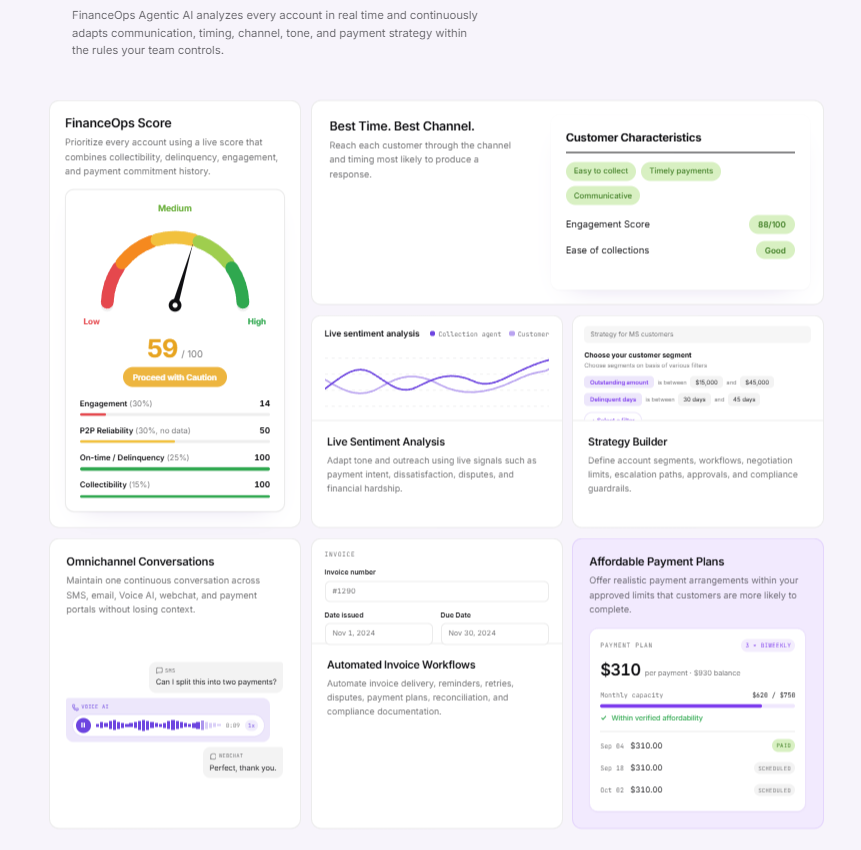
Agentic AI in FinanceOps goes beyond traditional AI and automation by unifying all financial processes, payments, loan servicing, customer service, and debt collections, into one real-time execution layer. This unified approach is key to improving early-stage collections ROI. Here’s how Agentic AI FinanceOps delivers value:

  1. Live Sentiment Analysis: Detects stress, tone, and intent across channels (SMS, email, voice AI) and adjusts engagement in real time to maximize customer response.

  2. Best Time • Best Channel • Best Person Intelligence: AI predicts the optimal time to contact, the best communication channel, and the correct decision-maker, eliminating guesswork.

  3. Two-Way, Multilingual Omnichannel Communication: Engages customers through SMS, email, voice, and chat, maintaining continuity and context across interactions.

  4. User-Controlled Strategy Builder: Empowers collections teams to define tone, cadence, escalation logic, and compliance guardrails while automating execution.

  5. Automated Invoice Management: Automates invoice issuance, reminders, retries, reconciliation, and dispute management.

  6. Affordability-Based Flexible Payment Plans: Uses behavioral signals to offer personalized, sustainable payment plans based on each customer’s financial capacity.

What is the Impact of Early-Stage Automation on Debt Recovery Outcomes

  • 70% higher recovery rates: Early engagement significantly improves recovery chances.

  • 93% reduction in operational costs: Automation reduces manual intervention and operational inefficiencies.

  • 80% faster resolution cycles: AI-driven workflows resolve collections faster, improving customer satisfaction.

  • 30% better customer engagement quality: Personalized, real-time engagement increases customer satisfaction and cooperation.

Key Takeaway

The 2025 TransUnion Debt Collection Industry Report makes it clear that with rising delinquencies, larger account volumes, and shrinking consumer capacity, early-stage collections are now the key to optimizing ROI. The solution lies in adopting AI-driven automation and agentic AI to engage customers early, reduce operational costs, and improve collection outcomes.

FinanceOps, powered by Agentic AI, offers the tools necessary to navigate this new reality. By unifying payments, loan servicing, customer service, and debt collections into one real-time execution layer, FinanceOps enables businesses to optimize recovery from day one.

Book a quick 20-minute demo and discover how our Agentic AI payment processing platform can transform your recovery strategies.

FAQs 

  1. Why are early-stage collections so important in 2026?

Early-stage collections deliver the highest ROI because accounts are still in the process of engagement. When dealt with promptly, they have a much higher chance of recovery. Late-stage accounts face structural decay, making them harder and more expensive to recover.

  1. How does AI improve early-stage collections?

AI optimizes engagement by predicting the best time to contact, the right channel, and the correct person to engage, improving right-party contact (RPC) rates and increasing recovery success.

  1. What makes Agentic AI different from traditional AI?

Traditional AI automates isolated tasks. Agentic AI coordinates and executes multi-step workflows across payments, servicing, customer service, and collections, driving better outcomes across the entire financial lifecycle.

  1. How does FinanceOps help improve early-stage collections?

FinanceOps unifies all financial processes into a single platform powered by Agentic AI, automating outreach, managing payments, offering flexible payment plans, and improving recovery efficiency from day one.

  1. What ROI can I expect from automating early-stage collections?

By automating early-stage collections with Agentic AI FinanceOps, organizations can expect 70% higher recovery rates, 93% lower operational costs, 80% faster resolution cycles, and 30% better customer engagement quality.

Image of FinanceOps CTA

4 minutes

Posted by

Arpita Mahato

Content Writer

Background
light

Stay Updated with Us

Enter your email below and subscribe to our weekly newsletter

Instant Access

Boost Productivity

Easy Setup

Photo of two ladies sitting together with one of them showing them something on their laptop.

Transform Your Financial Processes

Join thousands of businesses already saving time and money with FinanceOps

Photo of two ladies sitting together with one of them showing them something on their laptop.

Transform Your Financial Processes

Join thousands of businesses already saving time and money with FinanceOps

Photo of two ladies sitting together with one of them showing them something on their laptop.

Transform Your Financial Processes

Join thousands of businesses already saving time and money with FinanceOps