
AI collections compliance in 2027 will depend on whether a bank can control and prove what its system does at every outreach step. For U.S. banks and credit unions collecting on consumer loan accounts, that means checking who is contacting the borrower and under what authority, applying channel-specific rules before each message or call, and preserving a usable record of decisions, disclosures, opt-outs, and escalations.
There is no single federal “AI collections” rule that replaces existing law. Applicable obligations depend on the account, communication, bank’s role, vendor’s role, and state law. The practical job for compliance and finance leaders is to govern AI outreach as a regulated servicing and collections workflow, not as a standalone chatbot.
What should banks prepare for in AI collections by 2027?
Prepare to show that every automated outreach action followed rules approved for the relevant account and channel. A defensible program connects account eligibility, consent and contact preferences, approved content, frequency and time restrictions, exception handling, and records. The model can help select or carry out an action only within those controls.
This is a readiness horizon, not a claim that a new federal AI collections law takes effect in 2027. Banks should monitor federal guidance, state statutes and regulations, court decisions, and regulator expectations as they evolve. A platform’s “compliant” label cannot determine legal applicability or replace the bank’s own review.
Which rules apply to a bank’s AI outreach?
Start with the relationship and purpose of the communication. The FDCPA generally applies to covered debt collectors collecting consumer debts and does not generally cover an original creditor collecting its own debt. That distinction is fact-specific: how an account was obtained and the name used in collection can matter. Regulation F implements the FDCPA for covered debt collectors. Do not assume a vendor-led workflow is outside the law simply because a bank owns the account. Have counsel map the actual parties, account types, and collection stage. The CFPB explains the original-creditor distinction.
Other requirements may still apply to a bank’s own outreach. The TCPA and FCC rules can govern calls using artificial or prerecorded voices, including AI-generated voices; consent, purpose, technology, and exemptions matter. Regulation F sets electronic communication opt-out requirements for covered debt collectors and presumptions around telephone-call frequency. State laws may add protections. If outreach accepts or initiates electronic fund transfers, assess Regulation E and payment authorization requirements too. FCC’s AI voice ruling and CFPB Regulation F are starting points, not a substitute for an applicability analysis.
Don’t hard-code one national rule set and assume it fits every account. Build a policy that can apply the stricter relevant control when state, federal, contractual, or bank requirements differ.
What controls should a bank test before AI contacts a borrower?
Test the full outreach path before launch, then monitor it in production. Ask not only “Was the script approved?” but whether the system had accurate account context, respected preferences, stopped when a risk signal appeared, and created evidence a reviewer can follow. Use the matrix below as a bank-side test plan, not a universal statement of legal requirements.
| Outreach control | What the bank should verify | Evidence to retain |
|---|---|---|
| Account and role eligibility | Account, debt type, delinquency stage, and bank/vendor role are correctly identified before selecting applicable rules. | Applicability matrix, account status, policy version, and vendor scope. |
| Consent and channel permission | The system checks relevant consent or other legal basis for the specific channel and call type; it does not treat one permission as universal. | Consent source, timestamp, scope, channel, and revocation history. |
| Contact cadence and local time | Suppression and frequency rules run across the customer and account before each attempt, including activity across channels and vendors where available. | Attempt ledger, time zone/source, suppression result, and rule version. |
| Message content and disclosures | Approved language is used for the context; the system does not invent balances, deadlines, legal consequences, or settlement terms. | Template version, rendered message or transcript, and delivery result. |
| Opt-outs, disputes, and hardship | A stop request, dispute, wrong-party signal, deceased indicator, attorney representation, or hardship cue triggers the configured pause or human review. | Trigger, time detected, suppression/action, owner, and resolution. |
| AI voice and escalation | AI voice outreach is reviewed for TCPA/FCC requirements; uncertainty prompts a handoff or stop rather than improvisation. | Call purpose, consent check, applicable recording/disclosure controls, transcript, handoff. |
| Monitoring and change control | Compliance can test edge cases, review outcomes, approve policy changes, and roll back a failed change. | Test cases, approvals, exception reports, version history, remediation. |
How should banks control AI collection messages and calls?
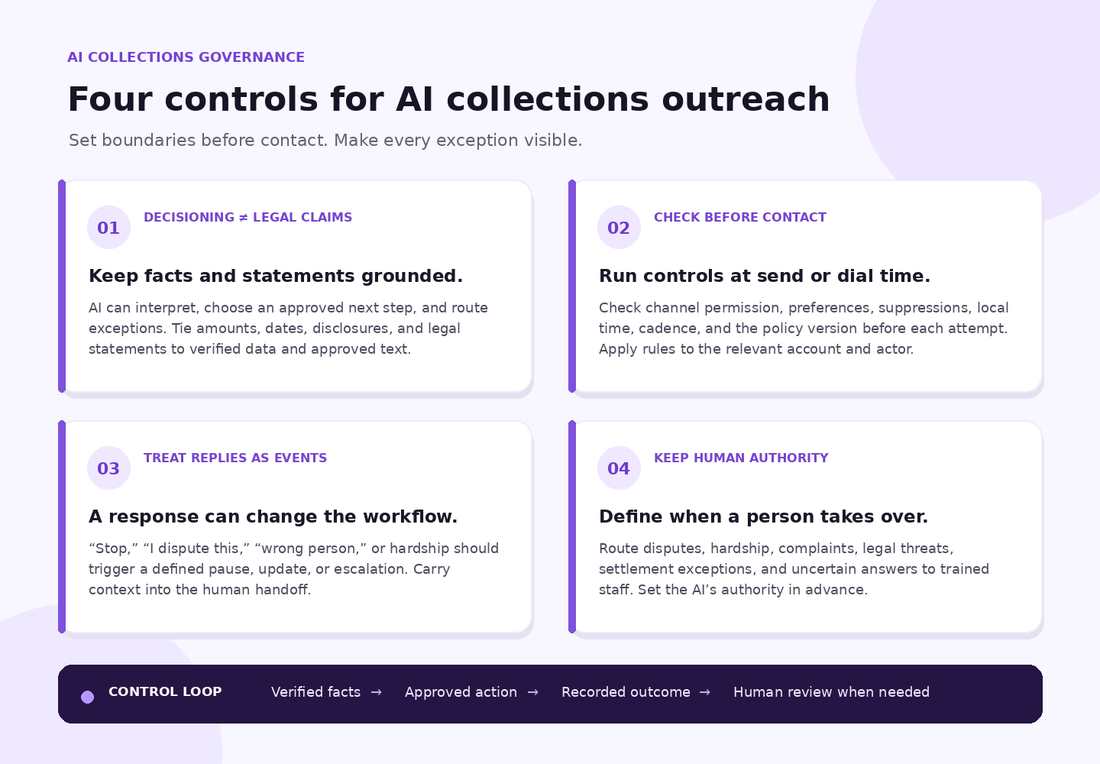
Separate decisioning from legal claims. Use AI to interpret a conversation, select among permitted next steps, summarize context, and route exceptions. Keep amounts, payment dates, account status, required disclosures, and legal statements tied to verified account data and approved language. If a fact cannot be verified, ask for help or stop.
Enforce controls before outreach. At send or dial time, check channel permissions, contact preferences, suppression flags, applicable hours and cadence, and the relevant rule version. Regulation F’s call-frequency presumptions apply to covered debt collectors; they are not a universal safe harbor for every bank contact, and other facts or stricter state rules may still matter. Regulation F also requires a reasonable and simple opt-out method in covered electronic collection communications. Design for actual obligations, not one threshold copied into a dialer.
Treat responses as workflow events. “Stop texting,” “I dispute this,” “wrong person,” or “I can’t pay because…” should not be an ordinary conversational turn. Route each response to a defined action: suppress a channel, pause collection pending review where required, update records, or escalate to a trained employee. A handoff should carry context forward so the borrower does not repeat the problem.
Keep meaningful human authority. Human review should be available for disputes, identity uncertainty, complaints, hardship, settlement exceptions, legal threats, and low-confidence answers. Set authority in advance: what the agent may explain, what arrangements it may offer, and when approval is required.
What should an AI collections audit trail contain?
A useful record lets a reviewer reconstruct an event without reverse-engineering a model. Keep the source account data used, applicable policy and version, why the channel and action were selected, message or call content, delivery or call outcome, consumer response, suppression or escalation decisions, and any human approval. Link interactions across channels and vendors so an SMS, voice call, and follow-up are not reviewed in isolation.
Set retention and access rules with counsel and the bank’s records schedule. Protect recordings and transcripts, restrict access by role, and document sensitive-data handling. Test whether complaint staff can retrieve the complete interaction history quickly. “The model decided” is not an audit explanation; the record should show the facts and policy that governed the decision.
What is a practical 2027 readiness plan for bank leaders?
- Map the workflow. Inventory consumer loan outreach across bank staff, agencies, servicers, and AI vendors. Identify the owner of each message, call, arrangement, and record.
- Approve a control matrix. Map account and channel types to federal, state, contractual, and internal requirements. Assign an owner for updates.
- Test real conversations. Include wrong-party answers, disputes, opt-outs, hardship, requests for a person, uncertain identity, payment questions, and outages. Test voice, SMS, and email.
- Measure exceptions, not just volume. Track blocked attempts, opt-out latency, complaints, disclosure failures, escalations, inaccurate data, and repeat contacts across systems. Review trends with compliance and operations.
- Govern updates. Require approval, testing, versioning, and rollback for changes to prompts, scripts, models, cadence, and escalation logic. Reassess after legal changes, complaint trends, or material system updates.
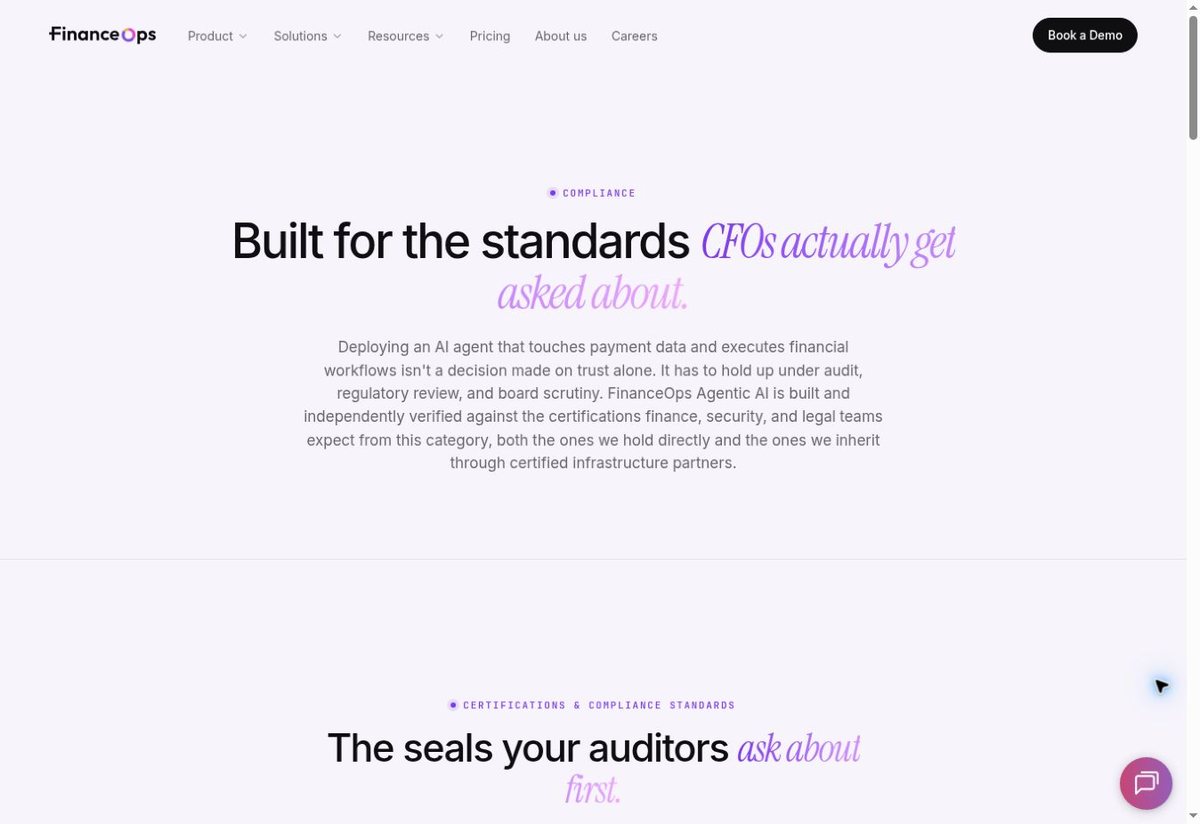
These controls align with the practical approach described on FinanceOps’ compliance page: traceable decisions and operational guardrails need to work in the outreach path itself.
Its Strategy Builder describes configurable tone, cadence, escalation, and negotiation limits.
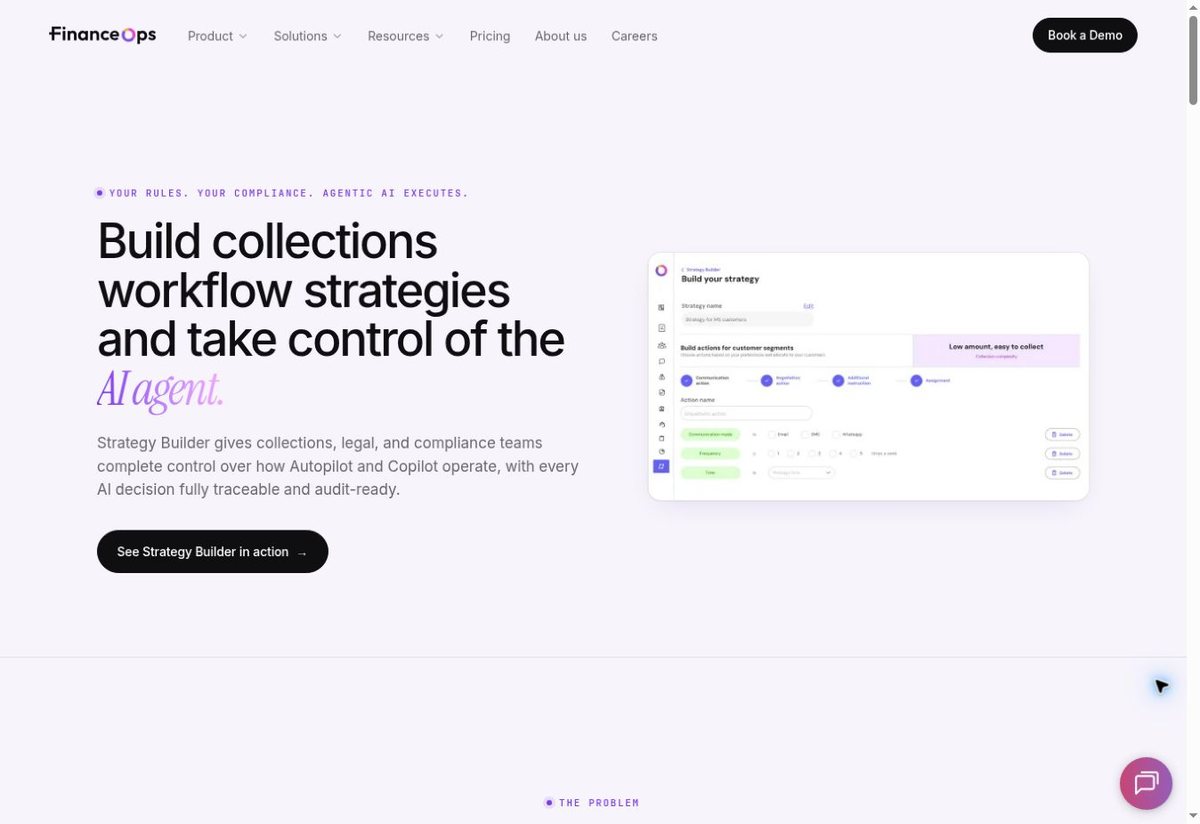
Those are capabilities to evaluate, not proof by themselves that a particular deployment satisfies every applicable law. Confirm the rules, evidence, and oversight in your own program.
The 2027 standard: controlled outreach, provable decisions
Banks do not need to wait for a law named “AI collections” to govern AI outreach seriously. Existing rules already make channel, consent, content, timing, and consumer response consequential. A bank should be able to explain why a borrower was contacted, what the system was permitted to say, how it handled a stop or dispute, and who can intervene when automation reaches its limit.
That is the readiness test for AI collections compliance in 2027: every outreach action stays inside an approved policy, and the bank can show its work.
This article is general information, not legal advice. Requirements vary by product, actor, communication technology, jurisdiction, and account facts. Have qualified counsel review your program and changes in law before deployment.