
Every unpaid claim and every open patient balance is dental accounts receivable, and most practices are managing far more of it than they realize.
This blog walks through what dental accounts receivable actually means, why insurance A/R and patient A/R behave like two different problems even though they show up as one number, and how a dollar of dental A/R moves from treatment to resolution, or to a write off, if nobody catches it in time. It also covers how FinanceOps Agentic AI approaches both sides of the balance on a single platform, including a real practice result from Enamel Dentistry.
Dental accounts receivable (dental A/R) is the total amount of money owed to a dental practice for treatment that has already been provided but not yet paid, whether that money is owed by an insurance payer, a patient, or both.
It sits on the practice's balance sheet as an asset, not cash, until it's collected. Every claim submitted to a payer and every patient balance left on a ledger is dental A/R until the day it's paid, adjusted, or written off.
Dental A/R Is Really Two Different Numbers
Most practice management systems report dental A/R as a single line. In practice, it behaves like two separate pools of money, and treating them as one is where a lot of aging balances start.
Insurance A/R is what payers owe the practice after a claim is submitted. It moves through verification, adjudication, and EOB processing, and it ages when claims are denied, underpaid, or stuck waiting on additional documentation.
Patient A/R is what the patient owes after insurance has paid its share, if any. It ages when statements go unopened, payment plans lapse, or a balance is simply never followed up on with enough consistency to get resolved.
| Aspect | Insurance A/R | Patient A/R |
|---|---|---|
| Who owes the money | The insurance payer | The patient |
| Starts aging when | A claim is denied, underpaid, or stuck in adjudication | A statement goes unopened or a payment plan lapses |
| Primary friction point | Missing documentation, coding errors, payer backlog | Affordability, unclear billing, inconsistent follow up |
| Typical resolution path | Claim correction, appeal, resubmission | Payment plan, statement follow up, collections |
| How FinanceOps Agentic AI recovers it | Automated claim tracking and denial routing | Scored outreach, live sentiment monitoring, omnichannel contact |
A healthy dental A/R strategy tracks these two pools separately, because what fixes one rarely fixes the other. For a full breakdown of how to run separate recovery strategies for each, see Insurance A/R vs. Patient A/R: Why They Need Two Different Recovery Strategies.
How Dental A/R Moves Through a Practice
Every dollar of dental A/R passes through the same basic lifecycle:
- Eligibility verification, confirming coverage and benefits before treatment.
- Treatment and claim submission, the visit happens and a claim goes to the payer.
- Adjudication, the payer processes the claim and returns an Explanation of Benefits (EOB), approving, denying, or partially paying it.
- Payment posting, the payer's portion is applied to the ledger, and any patient responsibility balance is calculated.
- Patient billing, statements, reminders, and payment plan offers go out for the remaining balance.
- Resolution or escalation, the balance is paid, adjusted, disputed, sent to a collection agency, or eventually written off as bad debt.
Dental A/R "aging" simply describes how long a balance has been sitting somewhere in that lifecycle without resolving. For what counts as normal aging versus a red flag, see Dental A/R Aging Benchmarks 2026: What's Normal, What's a Red Flag.
Why Dental A/R Management Matters
Dental care runs on tighter margins than most practice owners realize, and A/R is where that margin quietly leaks. Every day a balance sits unresolved is a day of working capital the practice doesn't have access to, whether it's tied up in a slow moving insurance claim or a patient statement nobody followed up on. A high days sales outstanding figure is usually the clearest sign this is happening.
This pressure isn't hypothetical. Government payer programs, which carry longer reimbursement and appeals cycles than private insurance or self-pay, are becoming a larger share of dental revenue nationally, per CMS's National Health Expenditure Accounts. That shift means a growing share of every practice's A/R is entering the slower half of the collections cycle by default, not by mismanagement.
Where Dental A/R Typically Breaks Down
Most practices don't lose A/R to one dramatic failure. They lose it to the same small gaps, repeated across hundreds of accounts.
Claims get worked by balance or age, not by urgency, meaning a $200 claim three days from its timely filing deadline gets the same priority as a $2,000 claim with sixty days left. Patient outreach often isn't timed, channeled, or toned to the individual, so one script and one channel gets used for every patient, regardless of what actually gets a response. Billing teams frequently have no visibility into how a conversation is going, so there's no way to tell a patient is about to go silent or dispute a balance until they already have. And handoffs between claim follow-up, patient billing, and collections are still largely manual, so context gets lost every time a balance moves from one system, or one person, to the next.
None of these are staffing failures. They're the predictable result of running dental A/R on tools built for a single, static worklist, instead of hundreds of accounts that each need something different.
How FinanceOps Agentic AI Closes This Gap
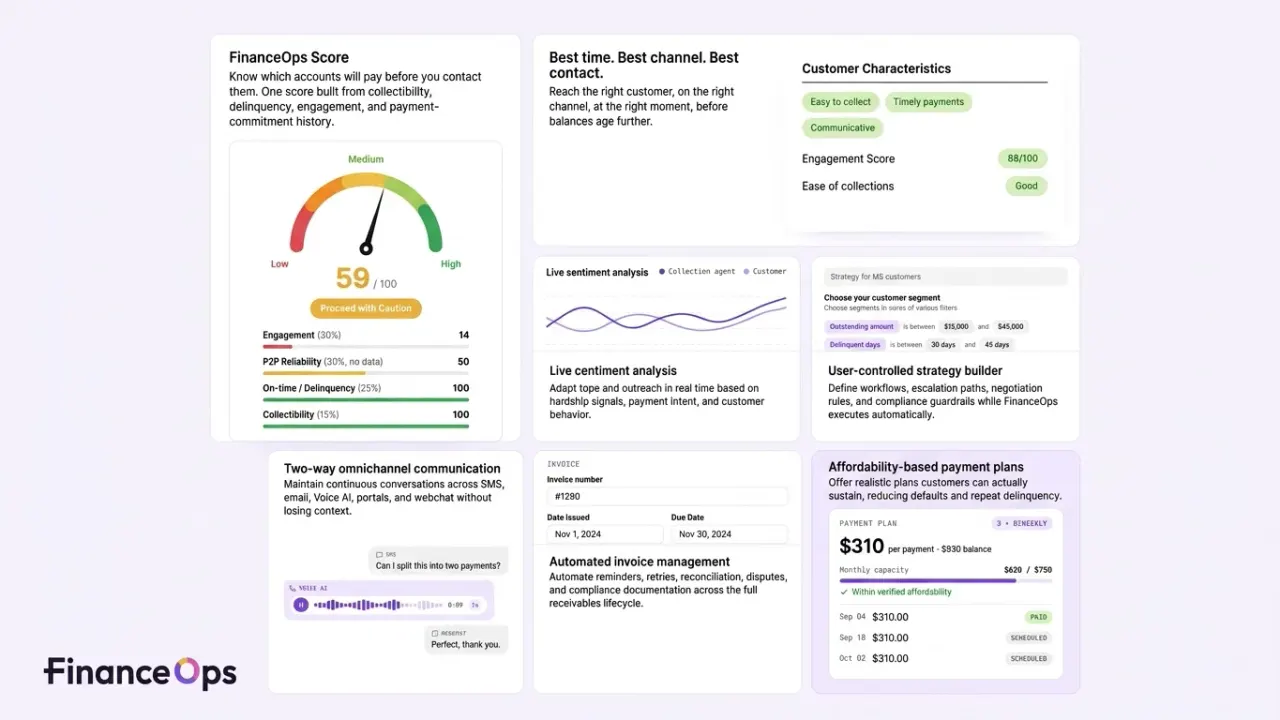
Instead of a single balance sorted worklist, FinanceOps Agentic AI treats every dental A/R account, insurance and patient, as something to be actively scored, timed, and monitored, through seven connected capabilities.
- FinanceOps Score, prioritizes every account by actual collectibility, delinquency risk, engagement, and promise to pay history, not just balance size or age.
- Best Time, Best Channel, Best Contact, identifies the optimal moment, channel, and person for every outreach attempt, whether the contact is a payer or a patient.
- Live Sentiment Analysis, reads tone and urgency across conversations in real time, flagging accounts trending toward frustration, dispute, or silence before a promise to pay breaks.
- Two Way Omnichannel Multilingual Communication, keeps call, text, email, webchat, and portal conversations connected and consistent, in the patient's preferred language, so nothing repeats and nothing falls through a handoff.
- Automated Invoicing Life Cycle, generates, sends, tracks, and reconciles claims and statements automatically, from first invoice through final reconciliation, without manual entry.
- Strategy Builder, lets billing teams design, adjust, and control outreach workflows, negotiation limits, and escalation paths themselves, without waiting on engineering support.
- Flexible Payment Plans, offers patients weekly, biweekly, monthly, or custom payment arrangements based on what they can realistically sustain, improving completion rates and reducing write offs.
FinanceOps Agentic AI is natively integrated with Open Dental, supports connections to QuickBooks, Sage, and other practice management systems on request, and is built around HIPAA-compliant handling with controls designed to applicable CFPB Regulation F, FDCPA, and TCPA requirements. On dental A/R specifically, recovery through the platform runs at roughly $3.65 per recovery, compared to $50 to $150 charged by traditional collection agencies, with no upfront platform cost. Results are based on FinanceOps Agentic AI customer results and comparative cost analysis for eligible accounts, and outcomes may vary by portfolio.
Case Study: Enamel Dentistry
90% fewer overdue accounts Enamel Dentistry, Operations Manager As featured on the FinanceOps Agentic AI homepage results carousel.
Enamel Dentistry used these same seven capabilities to work insurance and patient A/R as one connected system instead of two disconnected worklists, cutting overdue accounts by 90%. The result reflects the same lifecycle described earlier in this guide, resolved sooner, with far less of it ever reaching the aging report at all. See more results on the FinanceOps Agentic AI case studies page.
Key Takeaways
- Dental A/R is two pools, not one. Insurance A/R and patient A/R age for different reasons and need separate recovery strategies, even though most systems report them as a single number.
- A/R doesn't age from one big failure. It ages from small, repeated gaps, undifferentiated outreach, no sentiment visibility, and manual handoffs between claim follow-up and patient billing.
- Resolving both sides on one connected system works. Enamel Dentistry cut overdue accounts by 90% using FinanceOps Agentic AI's seven connected capabilities to manage insurance and patient A/R together instead of as separate, disconnected workflows.