Choosing an agentic AR platform means selecting software that can support your account workflows, integrate with authoritative records, and operate within agreed permissions. The right decision comes from testing the work you need completed.
A collections team wants fewer manual touches. Finance wants correctly applied cash. Technology wants reliable integrations. Risk wants clear authority. Procurement needs a scope and cost it can compare.
Bring those requirements into the same selection process before judging a feature list.
What Are You Actually Buying?
Write a one-page scope covering account types, balances, age ranges, channels, and eligible actions. Identify the systems holding financial records and the team owning exceptions.
Distinguish servicing and collections from adjacent work such as origination, underwriting, or accounting. Broader finance operations can involve additional modules, but those need their own requirements.
For an introductory explanation, read Agentic AI in Finance.
Who Should Define Acceptance?
| Stakeholder | Decision to own |
|---|---|
| Finance | Outcome definitions, costs, and financial reporting |
| Operations | Treatment paths, staff workload, and handoffs |
| Technology | Integration behavior, data ownership, and monitoring |
| Risk and compliance | Relevant controls, approvals, and exceptions |
| Procurement | Commercial scope, responsibilities, and exit terms |
Agree how conflicting priorities will be resolved. A pilot can look efficient to collections while creating more reconciliation work for finance.
What Should Every Provider Demonstrate?
Use the same sample cases during evaluation: an ordinary overdue account, a pending payment, a disputed balance, a request outside approved terms, and a missing system response.
Inspect what the platform reads, what it requests, which checks apply, and what happens afterward. Require a clear result for each case. Use synthetic or approved test accounts in an authorized environment.
For a pending payment, check that the platform distinguishes an initiated transaction from settled, applied cash. For a dispute, inspect the assigned owner and permitted follow-up. For a timeout, confirm that an uncertain result triggers a status check rather than an unverified repeat action.
The enterprise evaluation checklist provides the evidence requirements. This guide focuses on how to use those requirements to make a selection.
How Should Integrations Be Scoped?
Identify the authoritative record for each obligation, transaction, arrangement, and account adjustment. Confirm which integrations read data and which can write changes.
Document update frequency, identifiers, retry behavior, and failure handling. Daily files and real-time APIs create different timing expectations. Ask how duplicate events, out-of-order updates, and conflicting account changes are handled. Require stable transaction identifiers and evidence that retries cannot create duplicate payment requests or postings.
Ask how updates reach the systems used for outreach and reporting. A payment can be correctly processed but still generate an incorrect reminder if the account state is stale.
How Can a Pilot Support a Buying Decision?
Choose a bounded population and record the baseline before launch. Set the observation period, measures, permitted actions, and exception owners.
Test the scenarios before exposing live accounts. During operation, review cash collected, manual touches, unresolved handoffs, payment-application issues, and customer effort.
Write acceptance criteria as observable outcomes. For example: a disputed account reaches its designated owner with the supporting history; an unavailable payment service produces an exception rather than an invented confirmation; a strategy change has a named approver and recorded version.
Predetermine expansion criteria. Avoid changing the success definition after seeing the results.
What Belongs in Total Cost?
Include recurring fees, implementation, integrations, channel usage, payment costs, support, monitoring, and the staff work that remains. Document what volume or service changes would alter the price.
Review FinanceOps pricing against the same scope used for the other options. Keep recovery outcomes separate from the cost comparison until both are measured consistently.
A low fee can still produce a costly process if staff spend time correcting records and handling incomplete cases.
How Should FinanceOps Be Assessed?
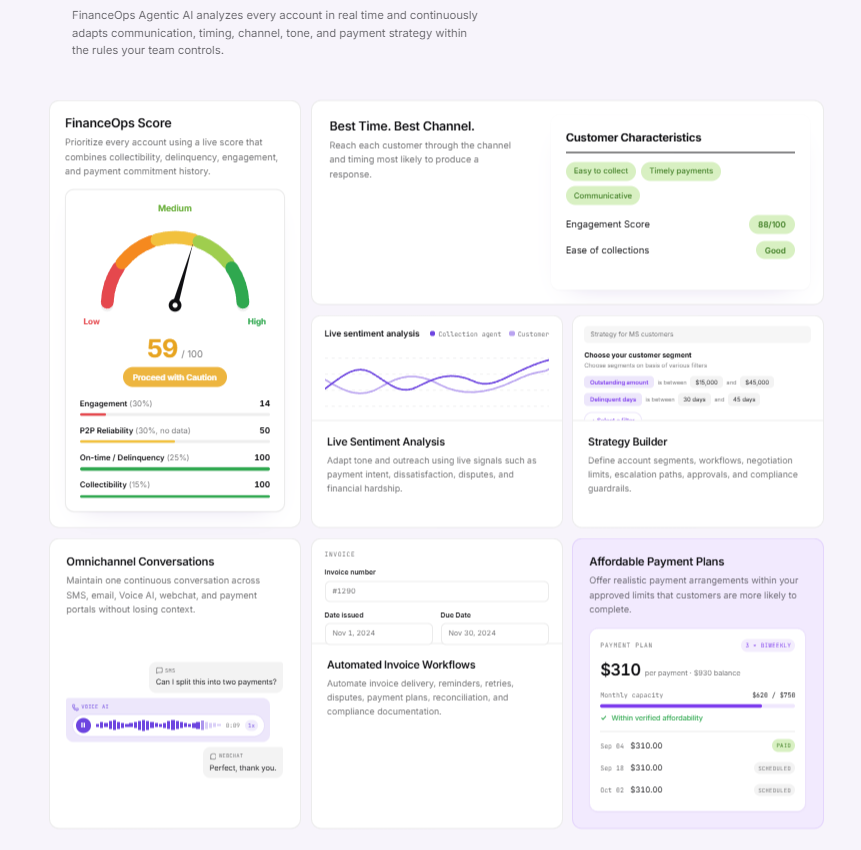
Review FinanceOps account intelligence, omnichannel conversations, Strategy Builder, invoice workflows, Agentic Payments, and Dashboards against your account cases.
For banks and credit unions, fintechs, and utilities, confirm how servicing and collections connect in the proposed scope. Ask which tasks are automated, which require approval, and which remain staff responsibilities.
The implementation should specify available data, supported channels, authorized actions, and outcome reporting.
What Should the Final Decision Record Include?
Document the approved scope, evidence reviewed, unresolved dependencies, owners, acceptance criteria, and expansion process.
Agree how to export relevant records, suspend automation, and complete work in progress if the service changes or ends. A workable exit plan helps clarify operational responsibilities from the start.
Select the platform your team can explain, operate, and measure across both ordinary accounts and exceptions.