
An enterprise AI collections checklist should specify what a buyer needs to see, test, and document before approving a deployment. Feature descriptions help frame the conversation. Evidence establishes whether the platform fits the proposed work.
If a provider says it offers audit trails, ask to see an account history. If it says it integrates with your systems, inspect the fields and failure handling. If it promises staff efficiency, measure the work that remains.
This checklist focuses on evidence. For the wider procurement process, read Choosing an AR Platform.
What Evidence Should Buyers Request?
| Evaluation area | Evidence to request | A practical test |
|---|---|---|
| Data access | Data flow and permission scope | Try to access an account outside the approved scope |
| Action controls | Configured limits and approval paths | Request an arrangement outside the permitted range |
| Payment integration | Status mapping and retry behavior | Simulate a timeout and a repeated notification |
| Account records | Field ownership and reconciliation rules | Apply a partial payment and inspect the balance |
| Staff handoff | Routing rules and case history | Escalate a disputed balance and verify receipt |
| Change control | Release and rollback process | Review a material workflow change |
| Operations | Monitoring and incident ownership | Identify who handles a failed tool or delayed file |
| Economics | Baseline, costs, and outcome definitions | Recalculate a reported benefit from its inputs |
Use an authorized test environment with synthetic or approved account data. Each test should have an expected result and a named reviewer. A demo that merely completes a happy-path conversation leaves the hardest questions unanswered.
How Should Security Claims Be Reviewed?
Ask for the available independent assurance documentation, its scope, and the period it covers. Review the service and environment included rather than treating a certification name as proof of every requirement.
Document data retention, access control, tenant isolation, encryption, subprocessors, and incident responsibilities for the proposed deployment. Security reviewers should assess the evidence against the institution's requirements.
Keep the distinction between a product capability, an implemented configuration, and an assurance finding. They answer different questions.
Can the Agent's Authority Be Demonstrated?
An agent that can read a balance should not automatically gain permission to change it. Require separate controls around each account action.
NIST's agent identity and authorization work is relevant to managing access and actions. In a demo, the useful evidence is what happens when a request exceeds that authority.
Review the policy check, blocked operation, and staff handoff. A generated statement saying the request was denied is insufficient if the underlying tool still executes it.
Will Integrations Handle Uncertain Outcomes?
Ask which system owns each balance, obligation, transaction, and arrangement. Inspect identifiers, timestamps, and update frequency.
A request timeout does not necessarily mean the operation failed. Repeated payment notifications should not create repeated account changes. Test how the integration verifies the result and avoids duplicate execution.
Also review daily-file delays, unavailable tools, and conflicting records. Each needs a documented pause, retry, or escalation path.
What Makes an Audit Record Useful?
Staff need the account reference, relevant policy version, request, approval where required, tool result, timestamp, and final outcome. Keep sufficient evidence to reconstruct the action without treating a model's explanation as the financial record.
During review, choose one ordinary case and one exception. Ask the team to trace each from the first contact through payment posting or completed handoff.
How Should FinanceOps Be Evaluated?
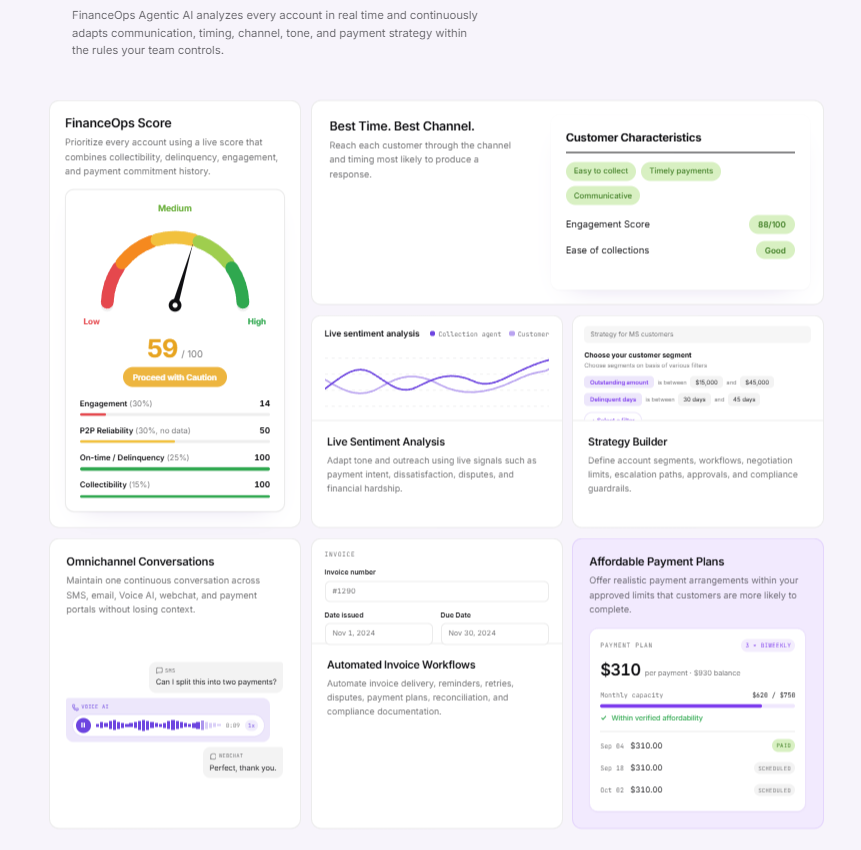
Apply the same checklist to FinanceOps. Review Autopilot, Copilot, configured strategies, communication, payment workflows, and Dashboards against your account cases.
FinanceOps connects servicing and collections for banks, credit unions, fintechs, and utilities. Confirm the available capabilities, data, and actions in the agreed scope.
Review pricing with implementation, channels, payments, and remaining staff effort included.
What Should Be Agreed Before Go-Live?
Record the portfolio, eligible actions, exception owners, outcome definitions, and acceptance criteria. Identify who can approve a change and who can suspend the workflow.
Close material gaps before expanding access or account volume. Keep evidence of the tests and decisions so later reviewers can understand the approved scope.