FinanceOps
Book a Demo
AR Platform

FinanceOps Agentic AI: Choosing an AR Platform

Learn how to evaluate an AI accounts receivable automation platform and how FinanceOps Agentic AI connects servicing, collections, payments, and reconciliation.

Yogesh Jeswani, CTO & Co-founder12 min read

Finance teams do not need another dashboard that tells them which invoices are overdue. They need to know what should happen next.

An account can remain unpaid because the customer has a cash-flow problem, the invoice is disputed, the payment method failed, the balance is incorrect, the customer already promised to pay, or the account simply fell through a gap between systems.

These situations should not all trigger the same reminder.

That is why I believe the next generation of accounts receivable technology will be defined by execution, not notification volume.

FinanceOps Agentic AI evaluates account signals, applies company policy, selects an approved action, communicates with the customer, verifies the result, and escalates the account when human judgment is required.

That is the difference between traditional AR automation and an agentic AR platform.

Key Takeaways

  • AI accounts receivable automation should connect account intelligence to execution, not simply send more reminders.
  • FinanceOps Agentic AI combines seven capabilities with payment recovery, flexible plans, exception handling, escalation, and reconciliation.
  • Buyers should evaluate AR platforms based on cash recovered, cost per resolved account, governance, integration quality, and implementation effort.

Why AR Automation Needs to Change

AR Automation Needs to Change

Most finance teams operate across several systems. The ERP stores invoices and balances. The payment processor records transaction results. The CRM contains customer information. The collections system stores outreach activity. The accounting system manages cash application and reconciliation.

Each system may work correctly on its own. The problem appears between them. A customer may have already explained a hardship through voice, disputed an invoice by email, made a partial payment through a payment portal, or promised to pay on Friday. If the next automated message does not recognize that event, the customer receives an irrelevant request and the finance team creates another exception.

The system has automated the message, but not the outcome. The U.S. Treasury’s Centralized Receivables Service provides a useful example of a connected receivables model. It brings together receivable intake, invoices, digital payment invitations, payment posting, customer support, installment agreements, active collections, and escalation.

The Treasury reports a 98% collection success rate and more than $923 million collected through fiscal year 2025. Read the Treasury’s Centralized Receivables Service fact sheet.

This is not an industry-wide AR automation average. It is an operational benchmark. It shows what becomes possible when the receivables lifecycle is treated as one connected workflow.

What Agentic AR Means

Traditional automation follows a fixed sequence:

  1. An invoice becomes overdue.
  2. The system sends a reminder.
  3. The system waits.
  4. The next reminder is sent.
  5. A person handles whatever remains unresolved.

This model is useful for consistency. It is not sufficient for complexity. Accounts receivable is a state-based process. The state of an account changes after every meaningful event.

A customer replies. A payment fails. A promise is made. A dispute is raised. A payment posts. Consent changes. A hardship signal appears. A balance is corrected.

The next action should change with the state of the account. An agentic AR platform should therefore be able to:

  • Observe the current account state
  • Apply business and compliance policies
  • Select an approved action
  • Execute the action
  • Verify the result
  • Escalate when the account is outside the permitted workflow

This does not mean giving an AI unlimited access to financial systems and asking it to optimize collections.

In enterprise finance, autonomy needs boundaries. The finance team should define eligible accounts, communication rules, payment limits, approval requirements, stop conditions, and escalation paths.

The platform should then execute within those boundaries and make its decisions inspectable.

What Enterprise Buyers Should Evaluate

Evaluation area Buyer question
Account intelligence Does the platform understand payment, engagement, balance, and delinquency signals?
Prioritization Can it identify which accounts require action first?
Customer engagement Can it coordinate voice, SMS, email, and self-service interactions?
Payment recovery Can it respond intelligently when a transaction fails?
Payment plans Can it offer realistic arrangements within approved limits?
Exception handling Can it identify disputes, hardship, complaints, and policy exceptions?
Reconciliation Can it verify that payments are posted and applied correctly?
Governance Can finance teams control, test, monitor, and audit AI actions?
Measurement Can the business measure incremental recovery and cost per resolution?

Feature count is a poor way to evaluate an AR platform. A platform can have invoice delivery, reminders, payment links, and dashboards and still leave the most difficult work to the finance team.

The more important question is whether the platform can move an account from an unresolved state to a verified resolution.

The Seven FinanceOps Capabilities

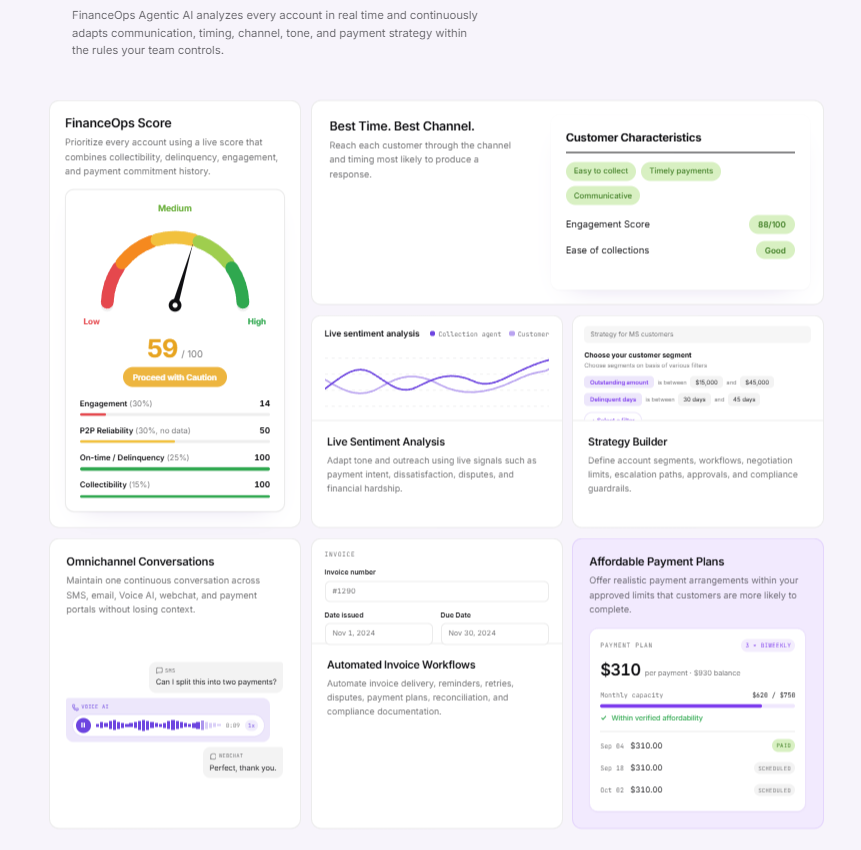
FinanceOps Agentic AI connects seven capabilities inside one governed servicing, collections, and receivables workflow.

FinanceOps interface showing account scoring, contact optimization, customer characteristics, sentiment analysis, Strategy Builder, omnichannel conversations, invoice workflows, and affordable payment plans
Core Capabilities of FinanceOps Agentic AI

1. FinanceOps Score

FinanceOps Score evaluates account-level signals such as delinquency, payment history, engagement, balance, previous commitments, and collectibility.

It helps determine which accounts require immediate attention, which accounts are suitable for self-service resolution, and which cases should be routed to a person.

A static aging bucket tells you how old an account is. FinanceOps Score helps provide a view of what is likely to happen next.

2. Best Time, Best Channel, and Best Person

FinanceOps determines when to contact a customer, which channel to use, and who should receive the communication.

The decision can consider response history, contact permissions, previous engagement, customer preferences, and the probability of a successful interaction.

The objective is not to send more messages. It is to reduce unnecessary contact and improve the quality of each interaction.

3. Live Sentiment Analysis

Live Sentiment Analysis evaluates the tone and meaning of customer interactions in real time.

It can identify confusion, frustration, hardship, vulnerability, disagreement, or willingness to pay. These signals help FinanceOps adjust the workflow or escalate the account when a person should become involved.

Sentiment is not a replacement for policy. It is an input into a controlled decision.

4. Two-Way Omnichannel Communication

FinanceOps supports two-way communication across voice, SMS, email, and other approved channels.

The conversation history remains connected across channels. If a customer explains a payment issue through voice, the next SMS or email can reflect that context instead of sending an unrelated reminder.

When the account is escalated, the customer-side team receives the relevant history, payment status, conversation context, and recommended next step.

5. User-Controlled Strategy Builder

The Strategy Builder allows finance and collections teams to turn approved policies into executable workflows. Teams can define:

  • Eligible account segments
  • Communication rules
  • Contact windows
  • Payment limits
  • Negotiation boundaries
  • Approval requirements
  • Stop-contact conditions
  • Escalation paths
  • Dispute and hardship workflows

This is the control plane for governed autonomy. The organization defines what the AI may do. The AI executes those actions and records what happened.

6. Affordability-Based Flexible Payment Plans

FinanceOps can support flexible payment plans based on customer affordability, account history, policy limits, and expected payment behavior.

The platform can present approved options, record the customer’s commitment, monitor payment dates, and follow up when a payment is missed.

The AI does not invent payment terms. It operates within the ranges and conditions approved by the finance team. A payment plan should be judged by whether it is realistic and sustainable, not merely whether it was accepted.

7. Automated Invoice Management

Automated Invoice Management connects invoices, account balances, payment status, reminders, failed transactions, disputes, payment plans, and reconciliation.

This helps finance teams understand whether an account is unpaid because the customer cannot pay, the invoice is disputed, the payment failed, remittance data is incomplete, or the payment has not been applied correctly. The value is not seven isolated features. The value comes from the shared account state.

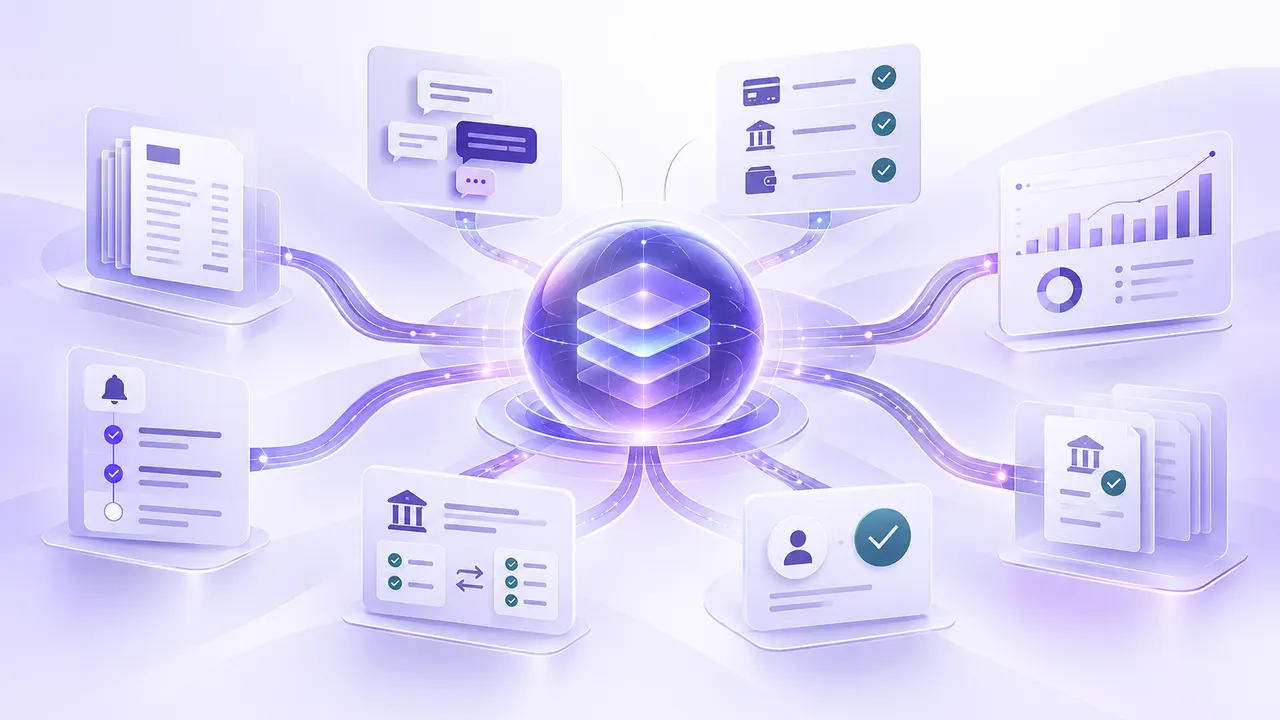
FinanceOps Score prioritizes the account. Contact intelligence selects the next interaction. Sentiment analysis updates the workflow. Strategy Builder enforces policy. Flexible plans support resolution. Invoice management verifies payment and reconciliation. That is how the system moves from activity to outcome.

Agentic Payments and Recovery

Agentic Payments by FinanceOps Agentic AI

Payment processing tells you whether a transaction succeeded or failed. Payment recovery requires a decision about what should happen next.

A payment may fail because of an expired card, insufficient funds, a changed bank account, a processor issue, timing, customer behavior, or the absence of a realistic payment option. FinanceOps Agentic Payments can help determine whether the next action should be:

  • Retrying an eligible payment
  • Creating a new payment link
  • Offering an alternative payment method
  • Initiating a customer conversation
  • Presenting an approved payment plan
  • Routing the account to a human specialist

The workflow connects payment events with customer conversations, collection strategy, account history, and financial systems.

This is why payment recovery should not be evaluated as an isolated payment feature. It is part of the receivables operating model.

For more background, read What Is an AI Payment Collection Agent?.

Traditional Automation vs Agentic AR

Question Traditional automation FinanceOps Agentic AI
What triggers action? Date, balance, or aging bucket Account state and approved policy
How is the next step chosen? Fixed sequence Account-level decisioning
What happens after a reply? Often manual review Workflow state changes
What happens after payment failure? Retry or queue Recovery action, payment option, or escalation
How is success measured? Message delivered Payment resolved and reconciled
What happens with exceptions? Manual reassignment Contextual escalation
Who controls the strategy? Technical configuration Finance and collections teams

Traditional AR software remains useful for invoicing, payment tracking, reporting, and accounting synchronization.

FinanceOps is designed for the execution layer that follows. It helps determine why an account remains unpaid and what action is most likely to produce resolution.

How to Test an AR Platform

Do not evaluate an AR platform through a generic product demonstration.

Give every vendor the same operating scenarios:

  • An overdue account with no response
  • A failed card or ACH payment
  • A customer requesting a payment arrangement
  • A disputed invoice
  • A partial payment
  • A customer changing communication preferences
  • A hardship or vulnerability disclosure
  • A payment that succeeds but does not reconcile correctly

Ask the vendor:

  • Can the platform explain why it selected the next action?
  • Can finance teams change strategies without engineering support?
  • What happens when the customer disputes the balance?
  • Can it suppress contradictory outreach?
  • How does it verify that a payment was posted?
  • Can it show the complete audit history of an AI action?
  • Can it distinguish gross recovery from incremental recovery?
  • What happens when the system has low confidence?
  • How are exceptions routed to the correct team?
  • Can the platform work with APIs and batch files?
  • How does it handle failed integrations and data corrections?

The platform should demonstrate account prioritization, customer response handling, payment recovery, payment-plan support, policy enforcement, human escalation, reconciliation, reporting, and auditability.

The best demo is not a feature tour. It is a controlled test using real operating scenarios and measurable success criteria.

Governance Is an Internal Control

For a CFO, AI governance belongs alongside financial controls, vendor oversight, and operational risk.

The organization should be able to define eligible actions, communication rules, payment-plan limits, approval requirements, and stop conditions.

Teams should also be able to:

  • Test strategies before launch
  • Review why an action occurred
  • Monitor actions and outcomes
  • Reproduce account history
  • Audit customer communications
  • Investigate exceptions
  • Track human interventions
  • Measure workflow performance

NIST’s AI Risk Management Framework provides a useful reference for evaluating trustworthy AI design, development, use, and evaluation. Its 2026 work on trustworthy AI in critical infrastructure reinforces the importance of risk management when AI is used in operational environments. Review the NIST AI Risk Management Framework.

Governed autonomy means the AI can act independently only inside boundaries established by the organization.

Starting an AR Automation Pilot

Organizations evaluating an agentic AR platform should begin with a defined portfolio and a measurable baseline.

Before deployment, establish:

  • Current recovery rate
  • Current DSO
  • Current cost per resolved account
  • Existing payment success rate
  • Manual effort required
  • Exception volume
  • Reconciliation accuracy
  • Customer complaint and opt-out rates

FinanceOps can then run approved workflows against eligible accounts and compare the results with the existing process.

A controlled pilot should measure:

  • Incremental cash recovered
  • Time to resolution
  • Payment success
  • Kept-promise rate
  • Human-intervention rate
  • Exception quality
  • Reconciliation accuracy
  • Cost per resolved account

Start with a bounded portfolio. Establish the baseline. Configure the permitted actions. Test the exceptions. Expand only when the financial and risk evidence supports expansion.

FinanceOps Agentic AI for Enterprise AR

FinanceOps Agentic AI

FinanceOps is built for organizations that need more than invoice reminders. The platform connects:

  • Servicing and collections
  • Customer communication
  • Payment recovery
  • Flexible payment plans
  • Account prioritization
  • Dispute and exception management
  • Payment reconciliation
  • Reporting and auditability

FinanceOps operates under the organization’s brand, policies, and compliance framework. Finance teams retain control over the strategy while AI handles approved execution and routes situations requiring judgment to the appropriate person.

FinanceOps Agentic AI delivers:

  • 90% reduction in operational costs
  • 250+ payments processed per day
  • 100% regulatory compliance

The platform can integrate with existing ERP, CRM, billing, payment, and accounting systems through APIs, batch files, and other approved integration methods.

Testimonial by Yogesh Jeswani, Co-founder and CTO, FinanceOps Agentic AI

Compare FinanceOps Agentic AI

If your team is evaluating an enterprise AR automation platform, bring your own receivables scenarios to the evaluation.

Test overdue accounts, failed payments, disputes, payment-plan requests, customer responses, escalation rules, and reconciliation requirements.

Measure recovery, customer engagement, payment success, manual effort, compliance, and cost per resolved account against your current baseline.

FAQs

Frequently asked questions

What is AI accounts receivable automation?

AI accounts receivable automation uses artificial intelligence to analyze account signals, prioritize receivables, communicate with customers, support payment recovery, manage exceptions, and improve reconciliation.

What is an agentic AR platform?

An agentic AR platform evaluates the current state of a receivable, selects an approved next action, executes the action, verifies the result, and escalates the account when human judgment is required.

How is FinanceOps different from traditional AR software?

Traditional AR software generally focuses on invoices, reminders, payment tracking, and accounting workflows. FinanceOps connects those activities with account-level decisioning, customer engagement, payment recovery, flexible plans, escalation, and reconciliation.

What are the seven FinanceOps Agentic AI capabilities?

The seven capabilities are FinanceOps Score, Best Time, Best Channel and Best Person, Live Sentiment Analysis, Two-Way Omnichannel Communication, User-Controlled Strategy Builder, Affordability-Based Flexible Payment Plans, and Automated Invoice Management.

Does FinanceOps replace collections teams?

No. FinanceOps handles approved repetitive execution while finance and collections teams retain control over policy, exceptions, complex negotiations, disputes, and accountability.

Can FinanceOps recover failed payments?

FinanceOps Agentic Payments can evaluate failed-payment signals and support approved recovery actions, including payment retries, payment links, alternative payment options, customer communication, and escalation.

What should companies test during an AR platform demo?

Companies should test overdue accounts, failed payments, disputes, payment-plan requests, partial payments, customer replies, escalation rules, reconciliation, and audit reporting.

How should CFOs measure AR automation ROI?

CFOs should compare incremental cash recovered, cost per resolved account, DSO, payment success, kept promises, human-intervention rate, reconciliation accuracy, and customer-risk indicators against a pre-deployment baseline.

How does FinanceOps keep AI actions governed?

FinanceOps operates within customer-defined strategies, payment limits, communication rules, approval requirements, stop conditions, and escalation workflows. The organization controls the policy while the AI executes approved actions and records the outcome.

Written by

Yogesh Jeswani

CTO & Co-founder

10+ years building financial infrastructure at Visa, PayPal, and Nirvana Money left Yogesh with one unforgiving standard: money has to move correctly, even at volume, because a small mistake never stays small. He brought that standard into collections. As CTO, he built FinanceOps around agents that handle a growing book without losing accuracy, so payments owed to creditors reach them reliably, inside TCPA, Regulation F, and state collection law. He writes on agent architecture, payment infrastructure, and what it takes to make autonomous AI secure, scalable, and accountable in a regulated industry.

All articles by Yogesh Jeswani
Related
Enterprise AR Automation

Top Alternatives to Bill.com for Enterprise AR

Meta description: Compare Bill.com alternatives for enterprise AR automation, payment recovery, cash application, customer engagem

Yogesh JeswaniSep 21, 20269 min