
An AI payment collection agent is a governed software agent that helps a bank or credit union identify payment risk, contact the right member or customer, conduct a two-way servicing or collections conversation, arrange an approved payment, and confirm that the money is correctly posted.
It is not simply a chatbot that sends reminders. It is also not an agentic commerce tool that shops or checks out on behalf of a consumer. For financial institutions, the purpose is narrower and more operational: resolve failed or overdue payments inside approved policies while maintaining member experience, compliance, and an auditable record.
That distinction matters in 2026. The National Credit Union Administration reported that federally insured credit unions held $1.76 trillion in loans at the end of the second quarter of 2026, up 4.9% over the year. The Federal Reserve's May 2026 Financial Stability Report also described consumer delinquencies as high by historical standards.
More accounts do not automatically create more servicing capacity. Payment failures, missed promises, disputes, hardship signals, and unmatched payments still require action. When those actions live across separate teams and systems, the cost of resolution rises faster than the portfolio.
An AI payment collection agent closes that execution gap.
AI Payment Collection Agent: Quick Definition
An AI payment collection agent evaluates a payment or delinquency event, chooses a permitted next action, communicates through an appropriate channel, supports payment resolution, verifies the result, and escalates exceptions to a person.
An effective agent works across both servicing and collections. A member asking for a balance, statement, due-date option, or payment confirmation may need servicing. A member who missed a payment may need collections outreach. A member reporting hardship, fraud, bankruptcy, a dispute, or a deceased borrower requires a controlled exception workflow.
The agent must understand which situation it is handling before it acts.
This is what separates agentic payment automation from basic dunning. Dunning follows a schedule. An agent responds to the account's current state.
Why Payment Collection Still Breaks in 2026
Most banks and credit unions already have a core system, payment processor, loan servicing platform, communication tools, and collection queues. The problem is rarely the absence of software. It is the distance between those systems.
The NCUA's 2026 Supervisory Priorities identify declining loan performance, elevated losses, asset-quality pressure, and liquidity risk. The agency states that overall delinquency and the rolling 12-month loss rate in federally insured credit union loan portfolios are at their highest point in more than a decade. It also notes that examiners may assess third-party risk when lending, servicing, or collection functions are outsourced.
Inside the operation, those pressures appear as seven practical problems.
| Operational pain point | What the institution experiences | What resolution requires |
|---|---|---|
| Stale prioritization | Teams work aging buckets rather than live risk | Account-level scoring that updates with new signals |
| Low contact efficiency | Calls and messages reach the wrong person, channel, or moment | Contact optimization before outreach |
| One-way communication | Members cannot resolve questions inside the interaction | Two-way conversations with retained context |
| Fixed scripts | Tone and next steps ignore intent, hardship, and dispute signals | Real-time interpretation and controlled adaptation |
| Inconsistent execution | Strategies vary by employee, vendor, and queue | Institution-controlled rules applied to every account |
| Broken payment arrangements | Plans are offered without enough affordability context | Options inside approved capacity and policy limits |
| Payment-to-ledger gaps | A collected payment still needs manual posting and reconciliation | Connected invoice, payment, and ledger workflows |
An AI payment collection agent is useful only if it addresses the full sequence. Automating one message while leaving six manual handoffs is not an operating-model change.
How the Seven FinanceOps Features Work as One Agent
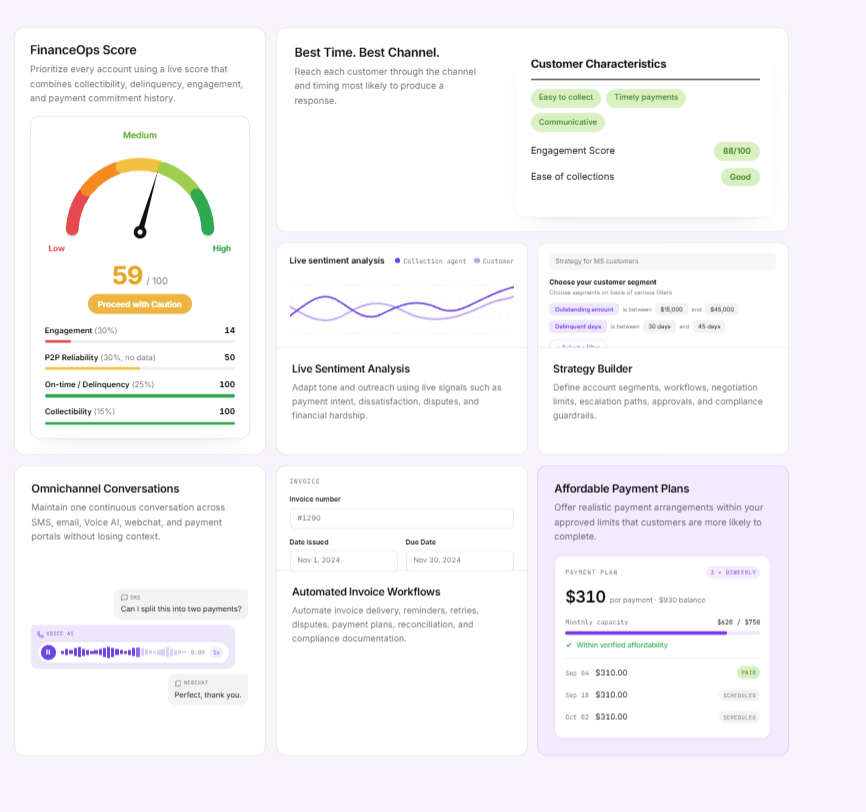
FinanceOps Agentic AI connects seven capabilities. Each solves a different point of failure, but their value comes from working together.
1. FinanceOps Score Decides Which Account Needs Action
Most collection queues begin with balance and days past due. Those fields matter, but they do not show whether the account is likely to self-cure, whether the member has engaged, whether a promise has been kept, or whether a contact attempt is likely to work.
FinanceOps Score combines collectibility, delinquency, engagement, and payment-commitment history into a live account score.
The agent uses that score to prioritize action. A large balance with strong payment behavior may not require the same intervention as a smaller balance showing sudden disengagement and a broken promise.
This helps teams stop treating every account in the same aging bucket as the same problem.
2. Best Time, Best Channel, and Best Contact Improve Reach
The next problem is not what to say. It is reaching the right person through a channel they use at a time they are likely to respond.
FinanceOps Agentic AI evaluates engagement history, channel responsiveness, contact validity, and payment authority before outreach. It can select SMS, email, Voice AI, webchat, or another approved channel based on the account context.
For a credit union, this supports member-first communication. For a bank, it reduces repeated attempts that create cost without producing a meaningful contact.
The objective is not more activity. It is a better probability of resolution per permitted attempt.
3. Live Sentiment Analysis Interprets What Changes During the Conversation
A member may begin by asking for a balance and then disclose a hardship. A customer may sound cooperative but dispute the amount. A frustrated reply may indicate confusion rather than refusal.
Live Sentiment Analysis evaluates language and interaction signals while the conversation develops. The agent can adjust tone, select a lower-friction path, or stop routine collection activity and escalate the case.
Sentiment is not used as a substitute for verified facts or policy. It is a signal that helps the workflow recognize when the situation has changed.
4. Two-Way Omnichannel Communication Keeps Context Intact
Many institutions can send an SMS, email, or automated call. Fewer can continue the same conversation when the customer changes channels.
Two-Way Omnichannel Communication connects conversations across SMS, email, Voice AI, webchat, and payment experiences. The agent retains relevant context, so the member does not need to repeat the same issue to a new system or employee.
This matters because payment resolution is rarely a single-message event. Members ask for documents, confirm amounts, explain circumstances, propose dates, and change payment methods.
A continuous conversation turns outreach into resolution.
5. User-Controlled Strategy Builder Defines What the Agent May Do
Autonomy without operational control is not appropriate for a regulated financial workflow.
The FinanceOps Strategy Builder lets authorized servicing, collections, compliance, and legal teams define account segments, contact cadence, channel rules, tone boundaries, negotiation limits, approval requirements, stop conditions, and escalation paths.
These policies are applied consistently across the portfolio. Every action can be traced to the rule that governed it.
This is especially important when a bank or credit union works with an external technology provider. The institution should be able to show what the agent was allowed to do, what it did, and what happened next.
6. Affordability-Based Payment Plans Turn Intent Into a Sustainable Commitment
A promise to pay is not a resolution if the member cannot keep it.
Affordability-Based Payment Plans help the agent present realistic arrangements inside institution-approved limits. The workflow can consider available payment capacity, timing, balance, prior commitments, and eligible plan structures without allowing the agent to invent terms.
Once a member agrees, the agent records the commitment, schedules reminders, monitors performance, and responds to a missed installment according to policy.
This reduces the gap between a positive conversation and a completed payment.
7. Automated Invoice Management Completes the Financial Workflow
A payment collection workflow is not complete when the member clicks pay. The institution must confirm the payment, match it to the correct account or invoice, update the servicing record, and prevent unnecessary follow-up.
Automated Invoice Management connects invoice delivery, reminders, payment attempts, payment plans, disputes, payment status, cash application, and reconciliation.
This final step is what turns agentic payment automation into financial execution. Without it, a successful conversation still creates back-office work.
For a deeper architectural explanation, read How Autonomous Collections Software Actually Works.
What Happens When the Seven Features Work Together?
Consider a member with an overdue auto-loan payment.
- FinanceOps Score identifies increased risk after a missed payment and declining engagement.
- Best Time, Best Channel, and Best Contact determine that the verified member typically responds to SMS in the early evening.
- The agent sends a permitted message using the credit union's approved strategy.
- The member responds and explains that income timing changed.
- Live Sentiment Analysis detects financial stress and keeps the interaction supportive.
- The conversation continues through the member's preferred channel without losing context.
- Strategy Builder limits what the agent can offer and defines when hardship review is required.
- The agent presents an eligible payment arrangement based on approved affordability parameters.
- The member accepts and completes the first payment.
- Automated Invoice Management confirms, posts, and reconciles the payment.
- The agent monitors the remaining commitment and escalates only if a policy condition is triggered.
No single feature owns the outcome. The connected loop does.
The FinanceOps Accounts Receivable Automation 2026 Guide explains where this model fits within the broader AR stack. The comparison of agentic AI collections software and traditional platforms covers how the execution model differs from fixed workflows.
A Florida Deployment Lens
A Florida bank or credit union should not buy a generic national workflow and assume the operating details will take care of themselves.
The agent should be configured around the institution's actual portfolio and policies, including:
- Direct and indirect auto loans.
- Credit cards and personal loans.
- Mortgage and home-equity servicing.
- Member balance and payment support.
- English, Spanish, and other language needs in the service area.
- Local contact windows and channel consent.
- Hurricane or disaster-assistance procedures.
- Due-date extensions, skip-a-pay, hardship, and loan-workout policies.
- Branch, digital, and contact-center escalation routes.
- Florida-specific legal and compliance review.
- Payment posting, cash application, and reconciliation across existing systems.
The Florida lens is operational, not cosmetic. A strategy should change when a member is in a declared-disaster area, when branch availability is affected, when a hardship policy becomes active, or when the institution changes a permitted payment option.
Strategy Builder should encode those conditions before the agent acts. The agent should never infer a disaster accommodation or legal requirement on its own.
Banks and credit unions can explore the dedicated FinanceOps servicing and collections solution for these workflows.
SkyOne: What Agentic Payment Collection Looks Like in Practice
SkyOne Federal Credit Union needed to manage rising delinquency without expanding its collection team or continuing to rely on a fragmented vendor stack.
FinanceOps connected engagement, payment arrangements, follow-up, and reconciliation through one governed workflow. The approved case-study results include:
- 8 times more payments processed.
- 90% lower operational costs.
- Cost per collection reduced to $3.65.
- 80% promise-to-pay completion.
- $1.5 million in monthly recovery volume.
SkyOne did not add more queues. It reduced the number of systems and manual steps between an account signal and a resolved payment.
Read the complete case study: How SkyOne Cut Costs 90% and Boosted Payments 8x.
How to Evaluate an AI Payment Collection Agent
A feature demonstration can make every platform look autonomous. A changing account reveals the real operating model.
Ask the vendor to show what happens when:
- The first payment attempt fails.
- The member replies on a different channel.
- The member requests a statement.
- Part of the balance is disputed.
- The member proposes a partial payment.
- The payment arrives through another rail.
- The remittance does not match.
- A hardship, fraud, bankruptcy, legal, or complaint signal appears.
Then evaluate seven questions:
- Which systems and account signals can the agent observe?
- How does it verify the right contact and permitted channel?
- Which decisions can it make without human approval?
- Which rules prevent an unapproved offer or communication?
- How does it maintain context across channels?
- How does it verify posting and reconciliation?
- What evidence does the institution receive for audit and review?
If the answer is another employee task, the platform is assisting the workflow. If it can continue the approved path and escalate the genuine exception with full context, it is acting as an agent.
The Right Outcome Is Resolved and Reconciled Cash
An AI payment collection agent should not be measured by messages sent, calls placed, or promises recorded.
Banks and credit unions should measure:
- Cash resolved.
- Cost per resolved payment.
- Right-party contact.
- Promise-to-pay completion.
- Manual touches per resolution.
- Time from payment failure to useful action.
- Exception resolution time.
- Payment-posting accuracy.
- Reconciliation latency.
- Complaints and policy deviations.
The goal is not to automate collections activity. It is to complete more servicing and collections workflows correctly, with fewer handoffs and better control.
That is the practical value of agentic payment automation.