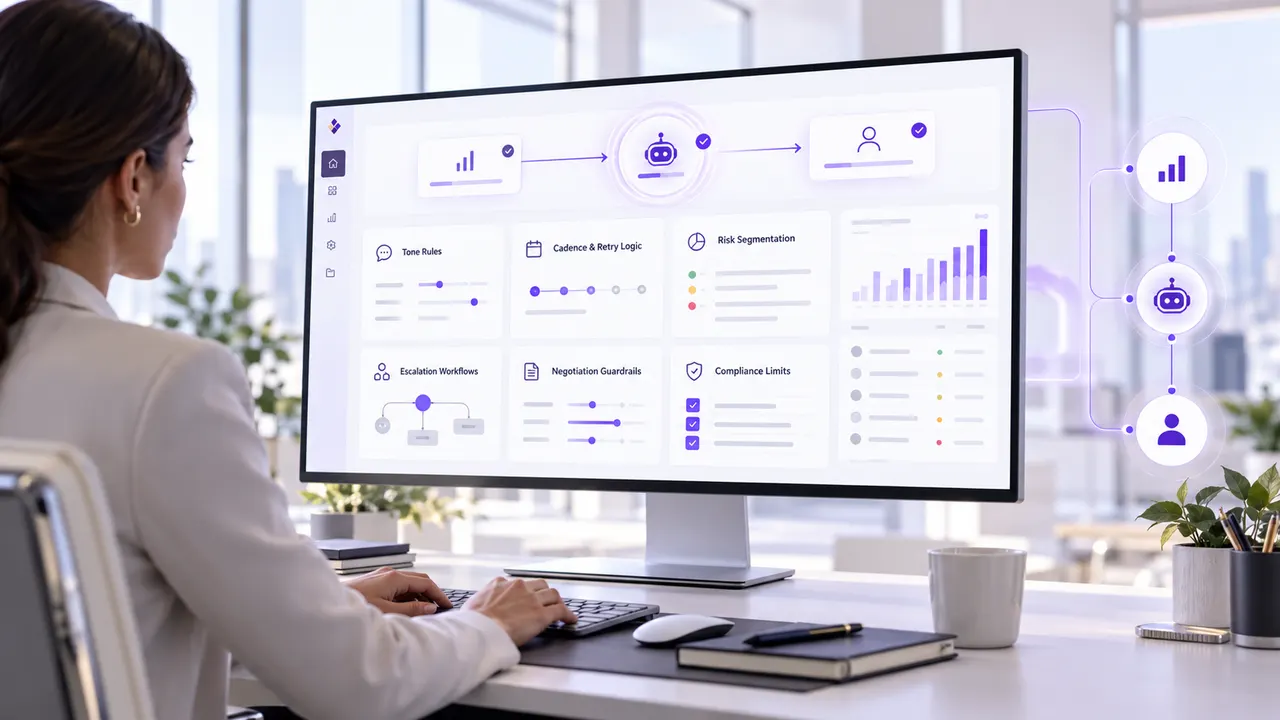
Agentic AI collections software is the better choice when a business wants software to decide and execute the next best action across servicing and collections, while a traditional collections platform is better suited to teams that want humans to remain the primary decision-makers inside fixed workflows. The difference is not “AI versus no AI.” It is whether the platform merely organizes work or can safely complete it within business and compliance guardrails.
For a collections leader, the practical question is simple: do you need a better work queue, or do you need fewer accounts to reach a work queue at all?
This comparison focuses on that operating-model decision. It does not repeat a feature checklist. For a capability-by-capability evaluation, read AI Collections Software: Features Every Enterprise Should Evaluate.
What Is Agentic AI Collections Software?
Agentic AI collections software is an AI-driven system that can evaluate account context, choose a permitted action, use connected tools to execute it, monitor the result, and adapt the next step without waiting for a person to approve every routine decision.
That does not mean uncontrolled AI. In a production collections environment, autonomy should sit inside explicit limits for contact frequency, communication windows, disclosures, approved channels, settlement authority, dispute handling, hardship treatment, and escalation.
The system should be able to:
- Observe account, payment, engagement, consent, and conversation signals.
- Reason over the available actions and policy constraints.
- Act through approved channels and connected systems.
- Record the decision, action, and outcome.
- Re-plan when a payment fails, a customer responds, or an exception appears.
- Escalate cases requiring human judgment to a controlled resolution queue.
FinanceOps Agentic AI Autopilot applies this model across servicing and collections. Its agents can prioritize accounts, orchestrate communications, respond to customer intent, generate payment options, track promises to pay, route disputes, and update connected systems while keeping customer-side teams in control of policies and exceptions.
What Are Traditional Collections Platforms?
Traditional collections platforms are systems of record and workflow tools that help human collectors manage accounts, queues, scripts, tasks, notes, dialer activity, and reporting. They may automate reminders or route cases using deterministic rules, but the human agent usually remains the decision engine.
A traditional workflow often looks like this:
- A supervisor segments accounts by balance, age, risk band, or product.
- A rule assigns each segment to a queue or campaign.
- The platform schedules a call, email, letter, or SMS.
- A collector reviews the account and decides what to do.
- Notes, promises to pay, disputes, and payment outcomes are entered manually or through separate integrations.
- Exceptions return to another queue for follow-up.
This model can work for low-complexity portfolios and teams with mature staffing. Its weakness is that scale usually adds more queues, rules, handoffs, and monitoring work.
Agentic AI Collections Software vs Traditional Platforms
| Decision area | Agentic AI collections software | Traditional collections platform | Buyer implication |
|---|---|---|---|
| Primary role | Executes approved outcomes | Organizes human work | Choose autonomy to reduce routine handling, not just clicks |
| Decisioning | Dynamic, signal-based, account-level | Rules, segments, and queues | Static segmentation can miss changes between batch runs |
| Customer conversations | Adaptive and context-aware across channels | Scripts, templates, or channel-specific threads | Context continuity matters when customers switch channels |
| Action execution | Can use tools to send, negotiate, schedule, update, and reconcile | Often creates tasks for people or separate systems | Automation value falls when every action creates a handoff |
| Exceptions | Routes disputes, hardship, fraud, and policy edge cases to humans | Humans review most accounts by default | Human attention becomes selective instead of universal |
| Learning loop | Uses outcomes and fresh signals to adjust the next action | Requires analysts to change rules or campaigns | Faster adaptation reduces stale strategy risk |
| Compliance control | Policy guardrails, consent checks, decision logs, escalation | Scripts, permissions, QA sampling, manual oversight | Governance must be designed into either model |
| Integration model | Reads and writes across CRM, payment, servicing, and communication tools | Frequently centered on the collections system of record | Verify write-back and reconciliation, not just data ingestion |
| Operating cost | Shifts spend toward automation, exceptions, and governance | Scales with seats, agent time, and campaign administration | Compare cost per resolved account, not license price alone |
| Best fit | High-volume, multi-channel, complex portfolios | Stable processes with high-touch human servicing | Many enterprises will use a governed hybrid during migration |
How Agentic AI Collections Software Makes Decisions
The cleanest way to separate agentic AI collections software from traditional automation is to follow one account.
Imagine a customer misses a scheduled payment.
A traditional platform may apply a “failed payment” rule, create a task, place the account into a queue, and send a standard reminder. A collector later reviews the record, chooses a channel, confirms the customer’s history, decides whether to offer a plan, and updates the system.
Agentic AI collections software can treat the failed payment as a new event. It can check consent, recent contact history, prior promises, preferred channel, sentiment, balance, policy limits, and payment status. It then selects an allowed next step, executes it, watches for a response, and changes course if the customer disputes the balance or needs a different arrangement.
The distinction is a closed decision loop:
- Observe: What changed?
- Decide: Which permitted action is most likely to resolve the account?
- Act: Which connected tool should perform it?
- Verify: Did the action work and reach the correct person?
- Adapt: What should happen next?
- Escalate: Does a person need to review an exception?
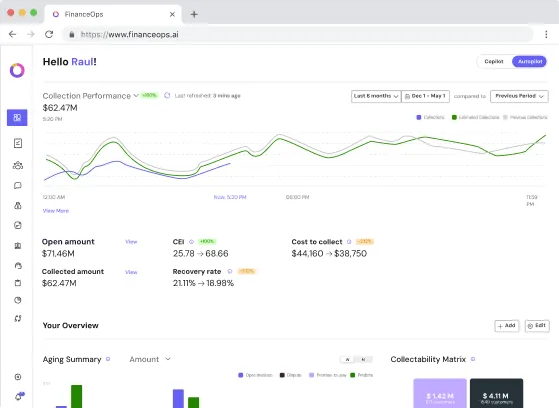
FinanceOps Agentic AI brings this loop into one operating layer. FinanceOps Score helps prioritize recoverability and delinquency risk; best-time, best-channel, and best-contact models guide outreach; live sentiment analysis changes the approach during conversations; and the Resolution Center sends unclear or high-risk cases to the customer’s own team for human review.
Why Agentic AI Collections Software Is Different
The phrase “AI-powered” is now attached to almost every collections product. That label alone proves very little. Three categories are commonly collapsed into one:
- Rules-based automation: “If an invoice is 30 days late, send template B.”
- AI assistance: “Draft a message or recommend the next action to a collector.”
- Agentic execution: “Choose and complete an approved action, observe the outcome, and continue until resolution or escalation.”
Traditional platforms can include excellent analytics, workflow automation, and generative writing tools. They become autonomous only when the system can carry responsibility across multiple steps, use tools, and manage changing state without a human authorizing every routine move.
That boundary matters during procurement. A chatbot embedded in a collections portal may answer questions, yet still leave segmentation, channel choice, payment-plan setup, dispute creation, and reconciliation to people. That is useful assistance, but it is not agentic AI collections software.
For a deeper explanation of the underlying model, see What Does Agentic AI Mean for Accounts Receivable?.
When Agentic AI Collections Software Wins
Agentic AI collections software creates the strongest advantage when operational complexity is already overwhelming the team.
It is usually the stronger fit when:
- Account volumes grow faster than collections headcount.
- Customers move between SMS, email, voice, webchat, and self-service portals.
- Payment failures, broken promises, disputes, and hardship cases require different follow-up paths.
- The team spends substantial time prioritizing, researching, documenting, and re-keying routine actions.
- Multiple systems must stay synchronized after each interaction.
- Small-balance accounts are uneconomic to work manually.
- Leadership needs consistent execution without turning every policy into another queue.
The most important benefit is not faster message generation. It is reducing the amount of routine work that requires a person at all.
How FinanceOps Agentic AI Collections Software Works
FinanceOps Agentic AI is built for that shift. Autopilot handles high-volume execution; Copilot supports staff with account context and recommended actions; Alice, the AI agent, conducts two-way conversations and completes authorized tasks; and the Resolution Center keeps exceptions with the customer’s team when policy or judgment requires human involvement.
The operating model can be configured for banks and credit unions, fintech lenders, and utilities that need governed servicing and collections. It also supports healthcare organizations and dental clinics that need customer support and collections without fragmenting the customer or patient experience.
When Traditional Collections Platforms Still Fit
Traditional collections platforms remain reasonable when the operating model is deliberately human-led.
They may be a better fit when:
- The portfolio is small and each account warrants bespoke handling.
- Collectors rely on relationship knowledge that is not available in connected systems.
- Policies are changing too quickly to encode safely.
- Data quality is too fragmented for reliable automated decisions.
- Integrations can provide read-only data but cannot support controlled action or write-back.
- The organization is not ready to define decision rights, escalation thresholds, and AI governance.
The blunt truth: poor data plus autonomy does not create intelligence. It creates faster inconsistency. A traditional platform can be the safer bridge while data, integration, and governance foundations mature.
How Agentic AI Collections Software Stays Governed
Autonomy should change who performs routine work, not remove accountability.
The CFPB’s Regulation F rule page explains that federal debt-collection rules address communications, harassment or abuse, false or misleading representations, and unfair practices. The CFPB also maintains an official Debt Collection compliance resource with rules, interpretations, model forms, examination materials, and FAQs.
Any collections platform, traditional or autonomous, must be configured for the laws and policies applicable to the creditor, debt, jurisdiction, channel, and customer. Software does not make a noncompliant strategy compliant.
For agentic AI collections software, buyers should require:
- Explicit action and negotiation boundaries.
- Consent, time-zone, channel, and contact-frequency controls.
- Automatic pauses and escalation for disputes, fraud, legal representation, bankruptcy, hardship, and other defined events.
- Immutable interaction and decision histories.
- Role-based access and approval controls.
- Monitoring for drift, errors, and unusual outcomes.
- Versioned strategies with rollback capability.
- Human review for exceptions and high-impact decisions.
These controls align with the risk-management direction of the NIST AI Risk Management Framework, which is designed to help organizations incorporate trustworthiness considerations into how AI systems are designed, used, and evaluated. The framework is voluntary, but its govern-map-measure-manage logic is a useful procurement lens.
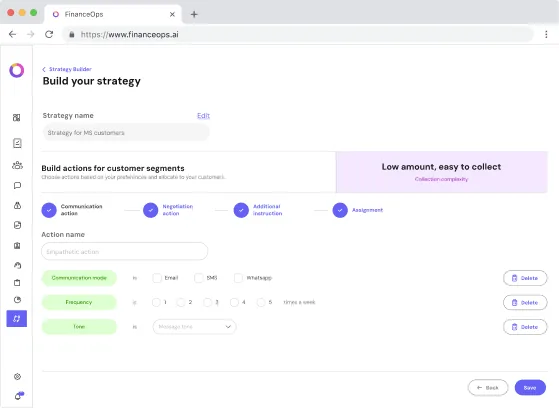
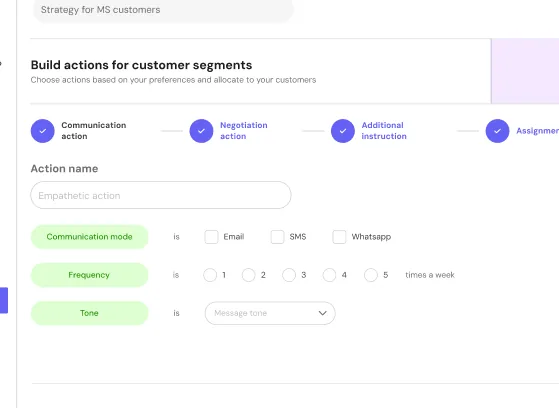
FinanceOps Agentic AI keeps autonomy governed through customer-defined strategies, traceable actions, access controls, automated compliance rules, and customer-side human review. Strategy Builder lets collections, legal, and compliance teams define the cadence, negotiation limits, escalation paths, and other guardrails the agents must follow. If the AI lacks enough information to act safely, the correct outcome is not a guess. It is an exception ticket.
How to Compare Agentic AI Collections Software Cost
License price is the easiest number to compare and often the least useful.
Traditional platforms are commonly evaluated through seats, implementation fees, dialer or communication costs, and internal labor. Agentic AI collections software may use platform, usage, or outcome-linked pricing. These models are not comparable until the buyer measures the operating work around them.
Build the business case around:
- Cost per resolved account: Total technology, communication, and labor cost divided by accounts resolved.
- Manual touches per resolution: How many human actions occur from delinquency to cash application?
- Time to first intelligent action: How quickly does the system respond to a meaningful event?
- Promise-to-pay completion: Does the platform monitor and recover broken commitments?
- Exception rate: What percentage of accounts still require human review?
- Reconciliation latency: How long until recovered cash is reflected correctly in the system of record?
- Compliance QA effort: How much sampling, correction, and documentation work remains?
A platform that sends messages cheaply but creates manual work in disputes, payments, and reconciliation is not autonomous. It has simply moved the cost downstream. FinanceOps Invoicing closes that gap through automated invoice tracking, payment retries, dispute routing, and real-time reconciliation.
For a related financial lens, see How AI Reduces DSO Without Raising Collection Costs.
How to Buy Agentic AI Collections Software
Do not evaluate autonomy through a slide deck. Ask the vendor to demonstrate one account moving through changing conditions.
Use this sequence during a live evaluation:
- Start with a delinquent account that has valid consent and no prior engagement.
- Ask the platform to explain why it selected the account, channel, time, tone, and offer.
- Change the scenario: the customer replies on another channel.
- Trigger a failed payment or broken promise.
- Introduce a dispute or hardship signal.
- Show the human escalation, decision history, and policy that caused it.
- Resolve the account and verify CRM, payment, notes, and reconciliation updates.
Then ask five hard questions:
- Which actions can the system complete without human approval?
- Which signals change its strategy in real time?
- What forces an immediate stop or escalation?
- Can we inspect why every action occurred?
- What work still happens outside the platform?
If the demo ends after “the AI drafted a message,” you are looking at AI assistance, not agentic AI collections software.
Should You Replace a Traditional Collections Platform?
Most established teams should not start with a big-bang replacement. The lower-risk path is to prove autonomy on a bounded segment, then expand based on outcomes.
A practical migration looks like this:
- Select one portfolio segment with clear policies and measurable pain.
- Connect the minimum data required for reliable decisions.
- Define permitted actions, stop conditions, and human escalation paths.
- Run the autonomous workflow alongside the existing system of record.
- Measure recoveries, manual touches, complaints, exceptions, and reconciliation accuracy.
- Expand only when the agentic operating model outperforms the current workflow.
This hybrid approach lets the traditional platform retain system-of-record responsibilities while FinanceOps Agentic AI becomes the execution and decisioning layer. Over time, queues shrink because more accounts are resolved before a collector needs to touch them.
Is Agentic AI Collections Software Better?
Agentic AI collections software is better for organizations that need collections capacity to scale without scaling manual decision-making at the same rate. Traditional collections platforms are better when human-led case management is intentional, data is incomplete, or governance is not ready.
The winning architecture is often governed autonomy: AI handles routine, high-volume decisions and actions; people own policy, exceptions, and accountability.
FinanceOps Agentic AI is designed for that model across servicing and collections. It does not just recommend what a collections team should do next. Within approved controls, it can act, observe the result, continue the workflow, and bring the customer’s team in when judgment is genuinely required.