Automated dunning is not literally disappearing. Banks will still send payment reminders, past-due notices, and follow-ups. What is disappearing is the idea that a timed sequence of those messages can serve as a complete collections operating model.
That distinction matters in 2026. The Federal Reserve reports that auto and credit card delinquencies remain high relative to the past decade. Its latest commercial-bank data also show a 2.62 percent consumer-loan delinquency rate and a 2.85 percent credit-card delinquency rate in the second quarter of 2026. At the same time, federal banking agencies are proposing updated third-party risk guidance intended to support prudent innovation.
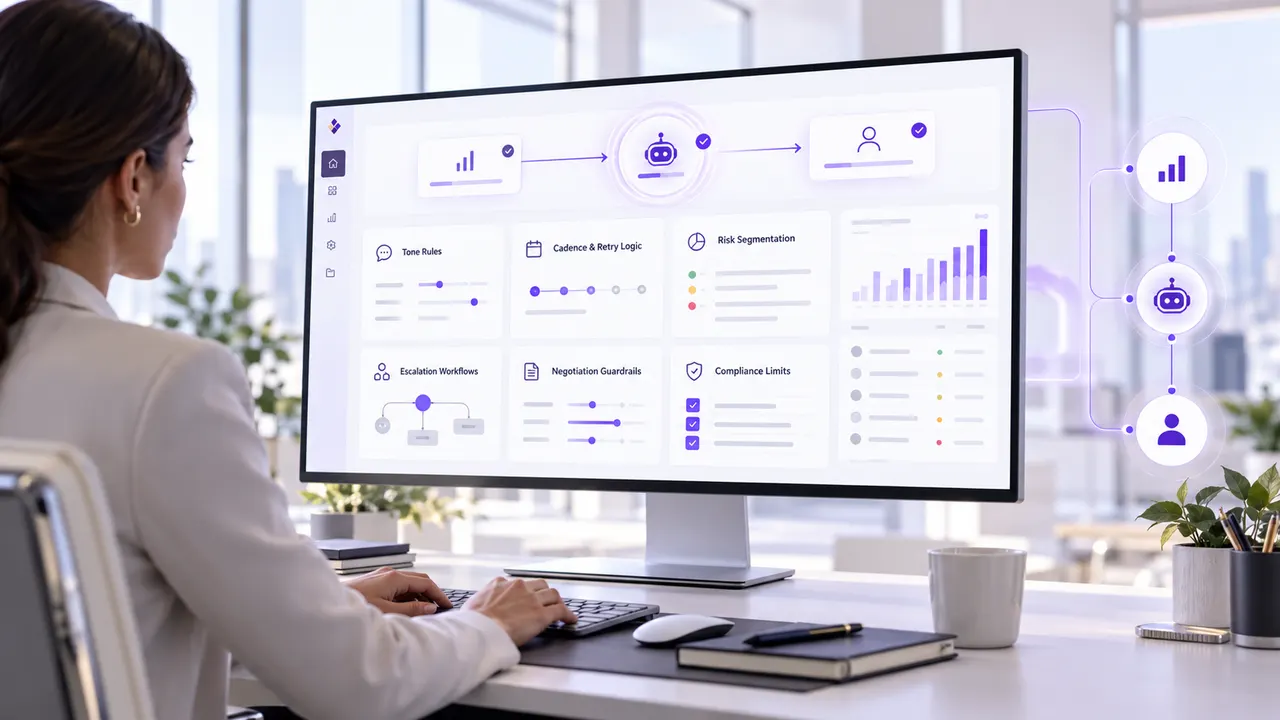
Banks do not need a louder reminder engine. They need an operating layer that can observe an account, apply policy, select an approved action, verify the result, and escalate the exceptions it should not handle alone.
That is the difference between automated dunning and agentic collections.
My view after building financial infrastructure
I have spent more than a decade building financial infrastructure at Visa, PayPal, and Nirvana Money. That experience left me with a simple standard: money has to move correctly at volume, because a small mistake never stays small.
The same standard applies to servicing and collections. A successful text message is not the outcome. A completed, correctly posted payment might be. A kept promise to pay might be. A compliant hardship arrangement might be. A clean handoff to a specialist might be.
The architecture must optimize for those outcomes while staying inside bank policy, customer consent, contact rules, and operational controls. That is why I believe the next generation of AI collections software will be judged less by how much content it generates and more by how reliably it executes a governed workflow.
Automated dunning is a timer. Collections is a state machine.
Traditional automated dunning usually begins with a schedule:
- An account reaches a date or delinquency threshold.
- A predefined email, text, or letter is sent.
- The system waits.
- It sends the next message.
- A collector handles whatever the sequence cannot resolve.
This improves consistency, and it remains useful for straightforward notices. But the system generally knows what time it is, not what state the account and customer are actually in.
Collections is different. Account state changes after every event: a customer replies, disputes the balance, makes a partial payment, promises to pay Friday, revokes consent for a channel, requests hardship support, or completes a payment that has not yet posted. The next action should change with that state.
A bank-grade agentic system therefore behaves like a controlled state machine. It continuously determines what is true, what is allowed, what action is appropriate, whether that action succeeded, and whether a human should take over.
| Operating question | Automated dunning | Agentic collections |
|---|---|---|
| What triggers work? | Date, balance, or aging bucket | Account state, behavior, response, risk, and policy |
| What does the system remember? | Campaign step | Conversation, commitment, payment, consent, and exception state |
| How is the next action selected? | Fixed sequence | Approved decision logic within defined limits |
| How does it communicate? | Mostly outbound messages | Coordinated two-way conversations across approved channels |
| How does it resolve? | Link to pay or route to staff | Payment, promise to pay, plan, dispute, hardship, or escalation |
| How is success verified? | Message sent or link clicked | Payment posted, commitment kept, exception cleared, or handoff completed |
| How is it governed? | Template and schedule approval | Policy constraints, action limits, audit trail, testing, and human control |
The important change is not “more AI.” It is moving from task automation to accountable execution.
Why the old model breaks inside banks
The shortcomings of automated dunning become expensive when a bank operates across credit cards, auto loans, personal loans, mortgages, and commercial credit.
It treats different customers as the same queue
Two customers can be 15 days past due for completely different reasons. One forgot. One is waiting for payday. One believes the balance is wrong. One already made a payment through another channel. A schedule sees the same aging bucket. An effective collection operation sees four different next actions.
It loses context between channels
A borrower explains a hardship on a call, then receives an unrelated email asking for immediate full payment. Another customer agrees by text to pay on Friday, then gets an automated call on Thursday. These are not merely awkward experiences. They reveal fragmented state across servicing and collections systems.
It optimizes activity instead of resolution
Delivery rates, open rates, and dial counts are easy to measure. They do not tell a bank whether a promise was kept, a payment posted correctly, a complaint was avoided, or an account returned to good standing.
It creates exception work after every “automation”
Failed payments, partial payments, disputes, deceased-account notifications, bankruptcy indicators, repossession or foreclosure coordination, and hardship requests still enter manual queues. If the system cannot classify and route those states with context, automation simply moves the bottleneck.
It separates outreach from money movement
A collections platform cannot stop at conversation. Payment authorization, real-time status, posting, cash application, reconciliation, and audit evidence are part of the same operational chain. A message that produces an unposted or misapplied payment is not successful automation.
The architecture banks actually need
I think about agentic collections as a five-stage control loop:
Observe. Build a current account view from delinquency, payment, engagement, channel, consent, promise-to-pay, dispute, and hardship signals.
Reason. Evaluate the available actions against bank strategy, product rules, customer context, and compliance constraints.
Act. Take one bounded action, such as initiating an approved conversation, collecting a payment, offering an eligible arrangement, or routing an exception.
Verify. Confirm what happened. Did the payment settle and post? Was the promise kept? Did the account state change? Did a handoff reach the correct queue?
Escalate. Stop autonomous action when confidence, authorization, policy, or customer need requires a human specialist.
This is how agentic payment automation becomes operationally useful without becoming uncontrolled. The agent is autonomous inside a box the bank defines. The box includes data access, eligible actions, settlement parameters, channel permissions, contact windows, approvals, and escalation conditions.
Banks should be able to test that box with dummy accounts and synthetic scenarios before exposing a live portfolio. They should see the resulting decisions in dashboards, reproduce why an action occurred, and monitor both collection outcomes and operational risk.
For a deeper walkthrough of this model, see how autonomous collections software works. For the strategic distinction between categories, see agentic AI collections software versus traditional platforms.
Seven connected capabilities, not seven isolated features
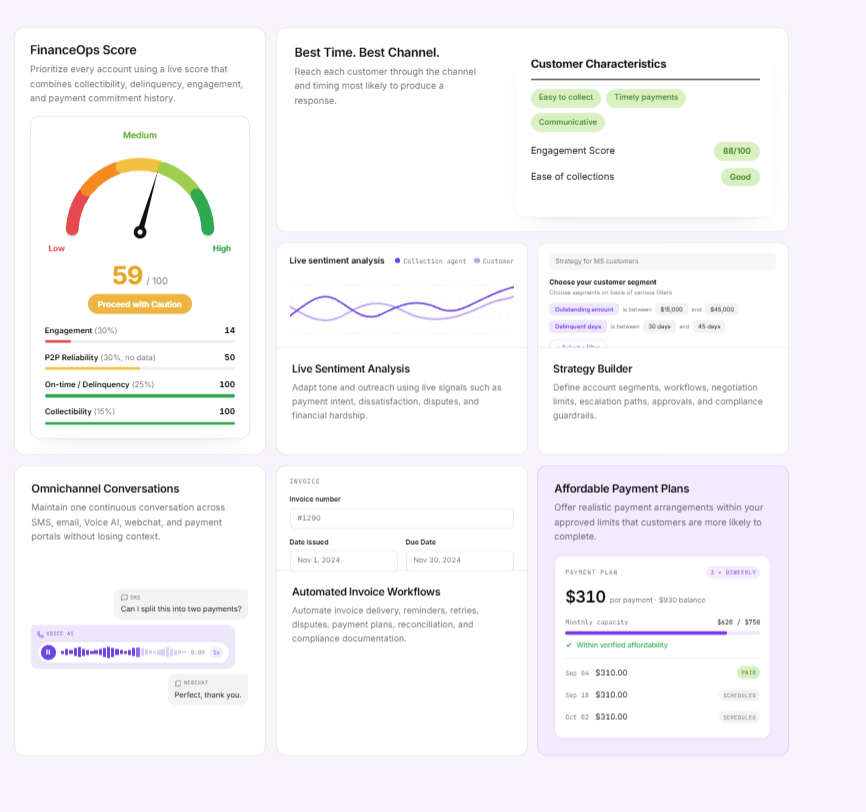
FinanceOps brings seven capabilities into the same control loop. Their value comes from the way they share state.
1. FinanceOps Score
The FinanceOps Score prioritizes each account using collectibility, delinquency, engagement, and payment commitment history. This gives the system a live operating signal instead of a static aging bucket.
For a bank, prioritization should answer more than “who owes the most?” It should help determine which account is ready for self-service resolution, which promise needs follow-up, which customer may need assistance, and which exception belongs with a trained specialist.
2. Best Time, Best Channel, and Best Contact
This capability selects when and where an approved outreach is most likely to produce a response. The goal is not contact volume. It is effective, permission-aware contact with less unnecessary repetition.
The decision can change as new engagement signals arrive. A customer who responds to text should not remain trapped in an email-first sequence merely because that sequence was configured months ago.
3. Live Sentiment Analysis
Sentiment is a runtime input, not a decorative dashboard metric. It can help the system adapt tone, recognize friction, and identify when a conversation should slow down or move to a person.
Sentiment should never override bank policy. It should inform action selection inside policy, particularly when the customer expresses confusion, frustration, vulnerability, or financial hardship.
4. Two-Way Omnichannel Communication
Agentic collections maintains one continuous conversation across voice, SMS, email, webchat, and payment pages. A response on one channel updates what happens on the others.
That continuity is essential. It reduces contradictory messages and gives collectors a useful account summary when the workflow escalates. It also turns outreach into an interaction where the customer can ask a question, explain a constraint, or complete a resolution.
5. User-Controlled Strategy Builder
The Strategy Builder is the policy and control plane. Bank teams define segments, workflows, negotiation limits, escalation paths, approvals, and compliance guardrails.
This is where a bank turns collection policy into executable logic. Business users need control without waiting for custom engineering every time a portfolio rule changes. Technology teams need versioning, testability, access controls, and traceable execution.
6. Affordability-Based Payment Plans
A plan should be both permissible and realistic. This capability offers arrangements within bank-approved limits using verified affordability and customer context.
The agent does not invent terms. It evaluates eligible options, explains them, records the customer’s choice, and routes cases outside the approved range. That distinction is central to responsible autonomous action.
7. Automated Invoice Management
For commercial banking and receivables workflows, automation must connect invoice delivery, reminders, retries, disputes, payment plans, reconciliation, and supporting documentation.
This closes the loop between outreach and the ledger. It also helps operations teams distinguish a customer who will not pay from one who cannot match an invoice, disputes a charge, or sent funds that have not been applied.
Together, these capabilities turn Autopilot, Strategy Builder, and automated invoicing into a connected execution system for bank servicing and collections.
What a bank workflow looks like
Consider a customer whose auto-loan payment is past due.
A dunning platform sends the day-five text. If there is no payment, it sends the day-ten email. If the customer replies that the payment will arrive Friday, the schedule may continue unless another system suppresses it.
An agentic workflow changes state when the reply arrives. It validates that a promise-to-pay date is permitted, records the commitment, adjusts unnecessary outreach, monitors the due event, and checks whether the payment posts. If the payment succeeds, the workflow closes. If it fails, the agent selects the next approved step. If the customer raises a dispute, requests hardship help, or falls outside a policy limit, the system routes the full context to the correct specialist.
The workflow is not impressive because it generated a natural-sounding response. It is valuable because it coordinated servicing, collections, payment, verification, and escalation as one accountable process.
How banks should migrate beyond automated dunning
Replacing a familiar workflow should be staged.
Start in observation mode
Run the agent against historical or shadow data. Compare its proposed prioritization and next actions with actual collector decisions. Test normal cases, edge cases, conflicting signals, missing fields, and prohibited actions.
Choose a bounded portfolio
Begin with a clearly defined product, delinquency range, customer segment, and set of eligible actions. Avoid using a first deployment as a test of every integration and policy at once.
Encode controls before expanding autonomy
Define contact permissions, action limits, payment-plan boundaries, complaint and hardship triggers, human approvals, and stop conditions. Make those controls visible to risk, compliance, operations, and technology stakeholders.
Verify the complete outcome
Measure right-party engagement, kept promises, successful payments, cure rate, exception volume, reconciliation accuracy, complaint indicators, and human handoff quality. Do not declare victory because message volume increased.
Expand only after repeatable evidence
Add products, channels, segments, and autonomous actions when the bank can show that the existing workflow is accurate, stable, explainable, and operationally controlled.
Banks evaluating this transition can also use our guide to dunning fundamentals to separate the useful mechanics of reminders from the wider requirements of a modern collections operation.
Five questions I would ask any AI collections software provider
- What persistent state does the system maintain? Ask how it represents payments, promises, consent, channel activity, disputes, hardship, and escalations across sessions.
- Which actions can the bank constrain? Look for explicit eligibility rules, limits, approvals, and stop conditions, not a generic promise of configurable guardrails.
- How does the system prove an outcome? Require verification of settlement, posting, reconciliation, and handoff, not only communication analytics.
- Can teams test and reproduce decisions? Demand scenario testing, version history, audit evidence, and an explanation of the inputs and rules behind each action.
- What happens when the system is uncertain? A credible architecture knows when to stop, preserve context, and involve a person.
The FinanceOps solution for banks is designed around these bank servicing and collections requirements.
Automated dunning is not the destination
Scheduled reminders solved a real problem. They made repetitive outreach faster and more consistent. But banks now need systems that can manage a changing account state, not simply advance a campaign step.
Agentic collections is the next operating model because it connects decisioning, conversation, payment, verification, and escalation inside bank-defined controls. The winning architecture will not be the one that sounds most human. It will be the one that behaves most reliably when money, policy, and customer circumstances change at the same time.
That is the standard I would use to evaluate AI collections software in 2026.