A bank does not need another collections queue. It needs a controlled way to move an account from payment issue to resolution, with servicing context, borrower communication, payment activity, and staff judgment connected throughout the process.
That is the real test of AI collections software: can it improve recovery capacity and operating visibility while fitting the bank's risk, technology, and vendor oversight requirements?
This 2027 buyer guide helps CFOs, COOs, and collections directors evaluate platforms, run sharper diligence, and design a pilot that can demonstrate value across credit card, personal loan, auto, mortgage, and other consumer lending portfolios.
The quick test: verify the system's scope, decision boundaries, integration fit, vendor evidence, and measurable net value before you scale.
Why the buying decision has changed
Collections teams are expected to work large portfolios across multiple products, stages of delinquency, channels, and servicing systems. When account status, contact history, payment activity, and next actions sit in separate tools, staff spend time assembling context instead of resolving accounts. A platform that simply adds another queue can automate tasks while preserving the handoffs that slow the work down.
Modern AI collections software can help coordinate repeatable work, but the bank still needs to define where automation stops, which actions need approval, and how exceptions reach the right employee. The goal is not autonomy for its own sake. It is more consistent execution of bank-approved workflows with enough evidence to review outcomes.
Regulatory language needs care. The interagency revised model risk management guidance issued in April 2026 describes a risk-based approach tailored to an institution's model risk profile, size, and complexity. The OCC's summary of the revised guidance says generative and agentic AI models are outside that guidance's scope. That is not a blanket exemption from risk management or vendor oversight. Banks should involve their own compliance, legal, model risk, information security, and third-party risk teams to determine which policies and controls apply to a specific use case.
For a deeper look at bank governance considerations, see How Can Banks Govern AI Collections Compliance in 2027?.

Five questions to ask before selecting a platform
1. What work will the system actually perform?
Start with a defined operating scope. Does the platform prioritize accounts, prepare an agent with account context, send approved outreach, interpret a response, update a workflow, support payment follow-up, or route an exception? Ask the vendor to map each capability to a specific user, system, decision, and outcome.
Separate recommendations from execution. A model that proposes a next action creates a different control and staffing model than an agent that can initiate contact or update a case. The vendor should explain the sequence step by step, including the data used, decisions made, actions taken, and points where a person can intervene.
Ask how the platform distinguishes routine account servicing from collection activity, and how it handles hardship, disputes, complaints, deceased borrowers, bankruptcy notices, identity concerns, and other bank-defined exceptions. Do not accept a broad promise of “human in the loop.” Ask what event triggers review, who receives it, what context they see, and whether the workflow pauses while the review is pending.
2. Can the bank set and evidence the boundaries?
The bank should be able to specify permitted actions, contact cadence, channel rules, approved language, escalation thresholds, role permissions, and prohibited actions. These controls need to be visible to business owners and reviewable by compliance and operations.
Ask for a live demonstration of a rule being applied to an account. The vendor should show why the system selected an action, which rule governed it, what information was used, and where the decision is recorded. Look for version history when a strategy changes, access controls for who can change it, and a reliable way to test changes before they affect active accounts.
An audit trail should make it possible to reconstruct an account's path: relevant input, rule or strategy, attempted communication, response, staff action, payment event, and final outcome. Verify the retention, export, and search capabilities against your institution's requirements. A dashboard is useful, but it is not a substitute for a traceable record.
3. How will it fit the bank's technology environment?
Map the full flow across the core banking system, loan servicing platform, CRM, payment processor, dialer or communications tools, case management, data warehouse, and reporting environment. For each connection, identify the system of record, data owner, direction of data movement, update frequency, error handling, and reconciliation owner.
Ask how the platform works with the bank's existing systems and whether it can be introduced without replacing the core or servicing platform. Confirm supported integration patterns, authentication, encryption in transit and at rest, data minimization, environment separation, monitoring, and incident response. Ask what happens when an upstream feed is late, incomplete, duplicated, or unavailable.
A credible answer includes an implementation map, data dictionary, test plan, reconciliation process, service-level expectations, and named owners on both sides. It should also cover reversals and corrections, not only the happy path. See FinanceOps Agentic Payments for how payment follow-up and reconciliation can connect to the wider recovery workflow.
4. Can the vendor pass bank-level diligence?
Treat the technology provider as a third-party relationship that needs review in proportion to the service and its risk. The agencies' interagency third-party risk management guidance describes a lifecycle approach and says practices should reflect the bank's risk profile, complexity, and the criticality of the activity.
Build diligence around the bank's own requirements. Request current security and assurance documentation, architecture and data-flow diagrams, privacy and retention terms, subcontractor details, business continuity and disaster recovery evidence, incident notification commitments, access-control design, vulnerability management practices, and support and exit plans. Confirm which evidence is current, what scope it covers, and whether exceptions or remediation items are open.
For AI-specific review, ask whether customer data is used to train or improve shared models, what model providers or subprocessors receive data, how prompts and outputs are logged, how changes are tested, and how the vendor monitors performance drift or unexpected behavior. Request the information your model risk and third-party risk teams need to make their own assessment. A vendor statement that a platform is “compliant” is not a substitute for the bank's review.
5. Can the bank prove operational and financial value?
Agree on the baseline before the pilot starts. Choose a defined product, delinquency stage, account population, and time period. Compare results with a suitable historical or control group where feasible, and document differences that could affect the comparison.
Track a balanced set of measures:
- Recovery: dollars collected, cure rate, roll rate, recoveries by delinquency stage, and net recovery after cost.
- Operations: accounts worked per employee, manual touches per account, time to resolution, exception volume, and reconciliation effort.
- Borrower experience: right-party contact, promise-to-pay kept rate, complaints, repeat contacts, and channel response.
- Control performance: policy exceptions, escalation completion, data quality issues, and audit-record completeness.
Define each metric and its denominator. For example, a higher contact rate alone does not prove better recovery, and a lower queue count may reflect changed routing rather than resolved accounts. Segment results by product, risk band, stage, channel, and treatment. Finance leaders should see the cost per resolved account and net recovery impact, not only automation volume. Compare incremental recovery and verified labor capacity released against total cost to own, including implementation, integration, platform fees, bank oversight, and ongoing operations.
Use the bank's existing recovery rate, portfolio risk, and promise-to-pay definitions where possible. If definitions differ by team, reconcile them before comparing vendors.

A bank-ready evaluation scorecard
Use this checklist in an RFP, security review, or executive discussion. Ask each vendor for evidence, an accountable owner, and a demonstration for every “yes.”
| Evaluation area | Evidence to request | CFO or operations test |
|---|---|---|
| Business scope | Workflow map showing actions, data, and human decision points | Does it address a defined portfolio bottleneck? |
| Bank control | Configurable rules, permissions, approval paths, and change history | Can the bank set limits and change them without losing oversight? |
| Explainability | Account-level record of inputs, action, governing rule, and outcome | Can a reviewer reconstruct why an action occurred? |
| Integration | Architecture, data map, reconciliation, error handling, and implementation plan | Does it fit the bank's system of record and operating model? |
| Security and resilience | Current assurance materials, incident plan, recovery evidence, and subcontractor list | Can the vendor meet bank requirements through disruption and exit? |
| Measurement | Baseline, pilot design, metric definitions, and segmented reporting | Can the bank measure net value, quality, and control performance? |
Score gaps as implementation work, not as vague roadmap promises. If a key control, evidence artifact, integration, or owner is “coming soon,” record it as a dependency with a date and acceptance test. For a broader feature checklist, read AI Collections Software: Features Every Enterprise Should Evaluate.
Design the pilot to earn the right to scale
A pilot should test the workflow and the operating model, not just the model's ability to produce an output.
- Choose a contained use case. Select one product and stage with a clear operational problem, measurable volume, and known baseline.
- Set decision boundaries. Document what the system may recommend, what it may execute, what requires approval, and what must stop or escalate.
- Validate data and controls. Reconcile source fields, test permissions and contact rules, simulate exceptions, and confirm that records can be reviewed and exported.
- Run with active oversight. Review a sample of decisions and outcomes, track exceptions, and give frontline staff a clear way to report an issue.
- Compare results and decide. Assess recovery, servicing, workload, borrower experience, and control evidence against the agreed baseline. Expand only when the bank's owners accept the results and remaining risks.
Set stop conditions before launch. Examples include an unexplained increase in complaints, inaccurate account context, missing audit records, a reconciliation break, or an escalation queue that exceeds agreed capacity. The bank should know who can pause the workflow and how it will return to the prior process.
A staged rollout can start with staff-facing recommendations, then move to limited automated actions only after the bank has tested the controls and operating evidence. This keeps the implementation aligned with the bank's risk appetite. Read more about why human oversight matters in AI-driven debt recovery and how to evaluate an AI payment recovery platform.
Where FinanceOps fits
FinanceOps positions its platform as a governed operating layer for first-party collections, payment recovery, and servicing workflows. For bank teams, begin with your use case, approved policies, data environment, and vendor review requirements.
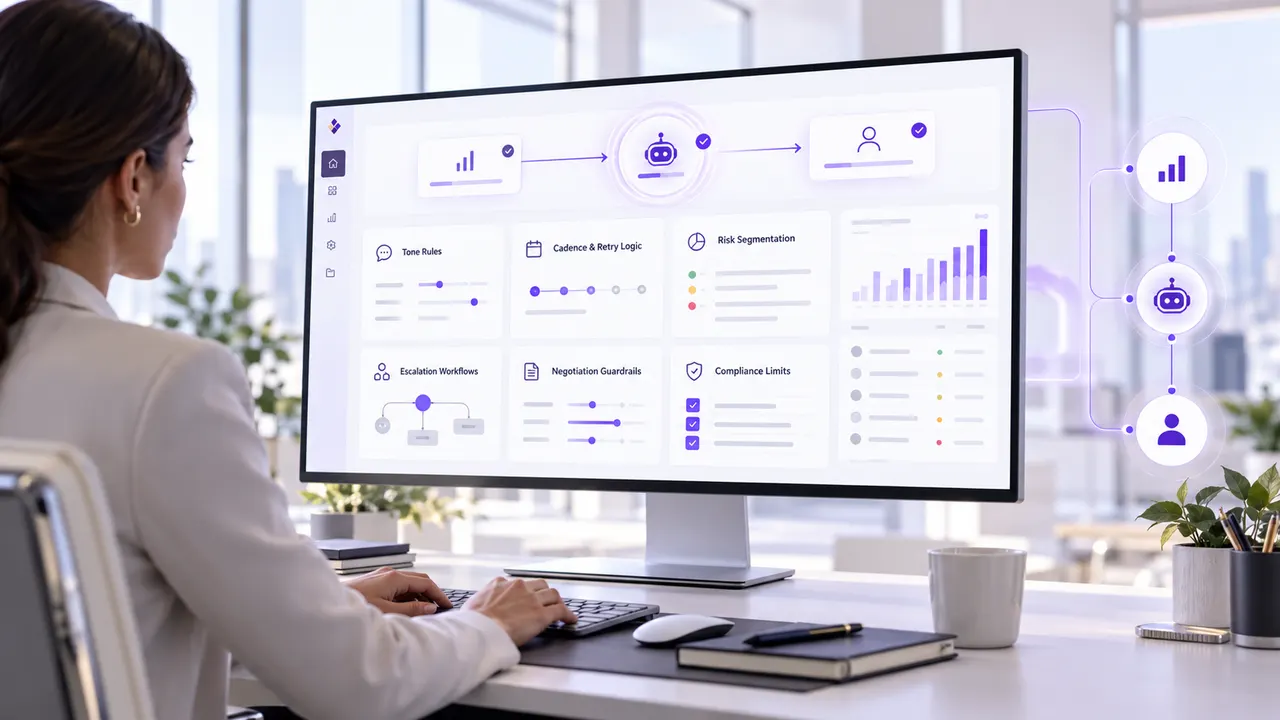
Autopilot executes collections workflows. Strategy Builder lets teams configure parameters such as cadence, tone, segmentation, and escalation. The Dashboards product provides portfolio visibility, while Agentic Payments connects payment activity with recovery and reconciliation workflows.
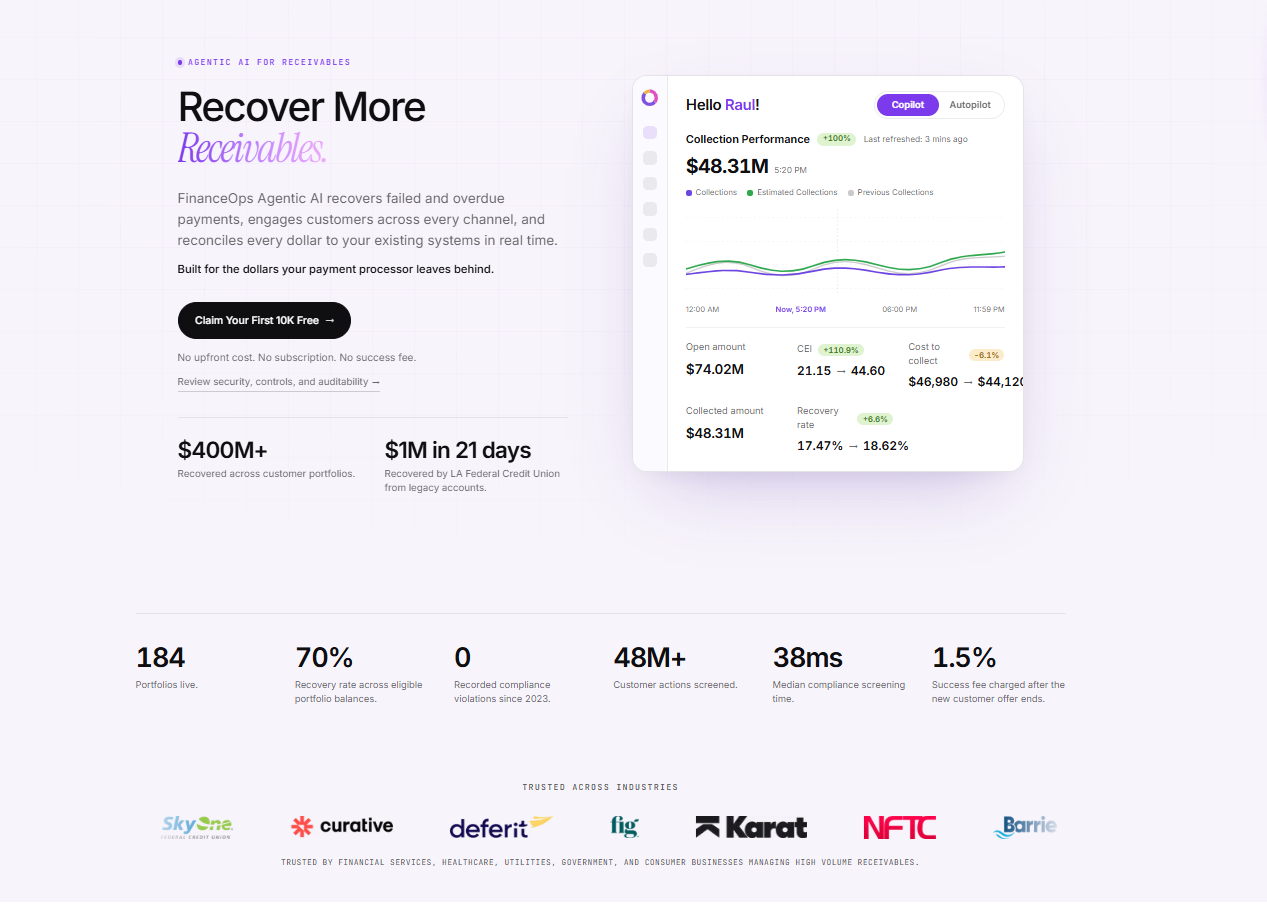
FinanceOps reports $400M+ recovered across customer portfolios, 184 portfolios live, and a 70% recovery rate across eligible portfolio balances. These are company-level figures, not bank-specific results. The published financial-institution case studies currently feature credit unions; they can illustrate relevant workflows, but should not be treated as proof of bank-specific performance. Review the case studies and ask for the metric definitions, portfolio scope, measurement periods, and supporting evidence relevant to your use case.
When assessing FinanceOps or any vendor, ask to see your intended workflow, the rules governing each action, connected data, exception handling, audit records, and pilot measures. Confirm integration scope and security evidence with the vendor and your internal review teams. For a comparison of agentic and conventional platforms, see Agentic AI Collections Software vs. Traditional Platforms.