
Agentic AI for accounts receivable is not another layer of reminders. It is a governed operating layer that can observe a member account, decide the next permitted action, execute it across systems, verify the outcome, and bring a person in when judgment is required.
I spent more than a decade inside banking, capital markets, treasury innovation, and credit risk before building FinanceOps. Across those roles, I kept seeing the same contradiction: financial institutions could price risk to multiple decimal places, yet once a loan became delinquent, servicing and collections often fell back to aging buckets, static queues, fragmented channels, and manual follow-up.
That model was expensive when liquidity was cheap. In 2026, it is strategically weak.
The NCUA's 2026 Supervisory Priorities state that overall delinquency and the rolling 12-month loss rate in federally insured credit union loan portfolios are at their highest point in more than a decade. The agency also identifies asset quality, higher funding costs, and structural liquidity constraints as continuing pressures on earnings and balance-sheet resilience.
At the same time, the NCUA's first-quarter 2026 performance data show $1.73 trillion in loans outstanding across federally insured credit unions and 145.8 million members.
That is the real context for agentic AI. Banks and credit unions do not need AI because AI is fashionable. They need a better way to manage servicing and collections at portfolio scale without turning every change in member behavior into another task for an employee.
My Thesis: AR Is a Decision-Latency Problem
Most AR platforms tell a team what already happened:
- An account moved into a new aging bucket.
- A payment failed.
- A member missed a promise.
- An email went unanswered.
- A dispute was opened.
- A balance remained unreconciled.
The report may be accurate. The operational question is what happens next.
Someone still has to decide whether to call or text, whether identity and consent requirements are satisfied, whether the member needs information or a payment arrangement, whether a promise remains credible, whether a complaint requires a stop, and whether the payment actually reached the ledger.
Every manual handoff creates latency. In servicing and collections, latency has a financial cost. Member intent decays. Disputes age. contact opportunities disappear. Recoverable accounts migrate into harder buckets. Paid accounts receive avoidable follow-up because reconciliation arrived late.
This is why the future of AR belongs to systems that can move from signal to governed action in real time.
What Agentic AI Means for Banks and Credit Unions
Agentic AI for accounts receivable is software that pursues an approved financial outcome across a multi-step workflow. It operates inside the institution's policies, uses live context, takes permitted actions, verifies results, and escalates exceptions.
The operating loop is simple:
- Observe: Read balances, due dates, payment history, conversation history, engagement, promises, disputes, and connected-system events.
- Decide: Select the next appropriate action based on policy, risk, member context, and prior outcomes.
- Act: Communicate, answer a question, provide approved payment options, record a promise, trigger follow-up, or update a system.
- Verify: Confirm delivery, response, payment, cash application, and reconciliation.
- Adapt or escalate: Continue the permitted workflow or route hardship, fraud, disputes, legal matters, complaints, and policy exceptions to an authorized employee.
That is materially different from automating a reminder. It is the difference between completing a task and owning the routine path to resolution.
For a deeper definition, read how FinanceOps Agentic AI connects collections data. For the account-level architecture, see How Autonomous Collections Software Actually Works.
| Operating model | What it does | Where work stops |
|---|---|---|
| Rules-based automation | Executes a fixed trigger and action | Stops when member behavior falls outside the rule |
| AR copilot | Summarizes, recommends, or drafts for an employee | Stops until a person reviews and acts |
| Agentic AR | Pursues an approved outcome across systems and channels | Stops at a control boundary or genuine exception |
Why Rules and Copilots Are Not Enough
Rules-based automation is valuable when the environment is predictable. Send a reminder five days before the due date. Create a task at 15 days past due. Stop a sequence when a payment posts.
The problem is that member behavior does not follow a clean decision tree.
A member may ignore email but reply to SMS. They may want to pay but need an invoice copy. They may dispute one line while accepting the rest. They may agree to a plan, miss the first installment, then pay through another channel. A payment may arrive without enough remittance information to reconcile it correctly.
A rule cannot interpret all of that. A copilot can help an employee interpret it, but the employee still owns every step.
An agent changes the unit of work. The employee does not own every reminder, reply, check, and system update. The agent owns the routine workflow inside defined limits. The employee owns judgment.
That distinction is especially important for banks and credit unions. The goal is not to remove people from servicing and collections. It is to stop spending scarce human attention on work that can be executed consistently, while making sure sensitive member situations reach the right person faster.
Our comparison of agentic AI collections software and traditional platforms breaks down that architectural difference. The Accounts Receivable Automation 2026 Guide covers the broader transition from task automation to connected execution.
Governed Autonomy Is the Product
Financial institutions should be skeptical of any vendor that treats autonomy as permission for a model to improvise.
In regulated servicing and collections, an agent must know both what it can do and when it must stop.
A production-grade system needs:
- Account and action eligibility rules.
- Approved tone, timing, channel, and contact-frequency policies.
- Identity, consent, disclosure, and data-access controls.
- Payment and negotiation limits.
- Stop conditions for disputes, hardship, fraud, legal matters, and complaints.
- Human approvals for sensitive actions.
- Complete decision and action logs.
- Versioned strategies with measurable outcomes.
- Verification before an account is treated as resolved.
- Escalation with the full member and account context intact.
The NCUA's 2026 priorities make the governance point explicit. When lending, servicing, or collection functions are outsourced, examiners may assess the credit union's third-party risk-management practices.
That means a black-box AI demo is not enough. A bank or credit union needs to know which data the agent used, which policy authorized the action, what the agent did, what happened next, and why the account was escalated.
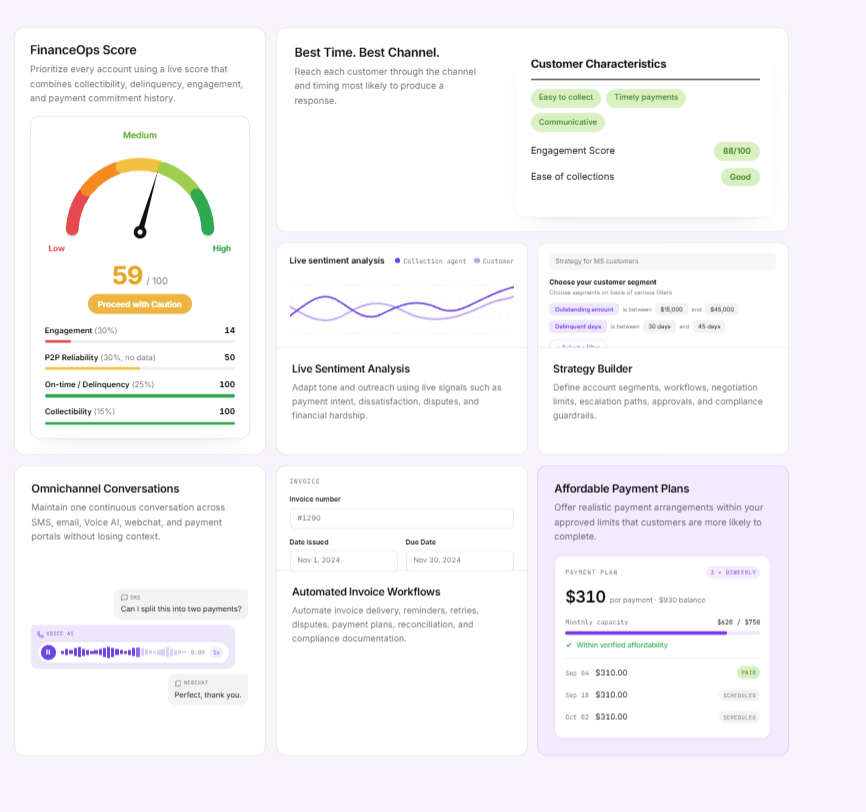
FinanceOps calls this governed autonomy. Strategy Builder lets authorized teams define the operating boundaries. Autopilot executes routine servicing and collections inside them. Automated Invoice Management connects invoice status, payment activity, cash application, and reconciliation so a conversational outcome becomes financial truth.
The dedicated FinanceOps solution for banks and credit unions brings those capabilities together around member-first servicing, compliant collections, payment resolution, and real-time reconciliation.
The Architecture Banks Should Demand
A credible agentic AR platform needs four connected layers.
1. Systems of record
Core banking, loan servicing, ERP, CRM, payment processors, bank data, and communication platforms remain authoritative. Agentic AI should sit above those systems and orchestrate them, not force the institution into another system replacement.
2. Intelligence
Models interpret payment behavior, engagement, contactability, sentiment, dispute signals, risk, and the probability of different outcomes. Intelligence should prioritize action, not merely produce another score for an employee to review.
3. Orchestration
The agent selects and executes permitted actions across channels and systems. It carries context forward when the member changes channel, supplies new information, makes a partial payment, or breaks a promise.
4. Governance and verification
Policies, permissions, audit logs, monitoring, reconciliation, and human escalation make the system accountable. Without this layer, autonomy is a liability.
The final layer is where most AI demos become vague. Drafting a good message is easy to demonstrate. Safely managing a changing account from early delinquency through payment, exception handling, and reconciliation is the real product.
Customer Proof: SkyOne and LAFCU
The strongest argument for agentic AR is not a model benchmark. It is what happens in a live credit-union portfolio.
SkyOne Federal Credit Union
SkyOne needed to manage rising delinquencies without expanding its collections team or continuing to absorb high vendor costs. FinanceOps automated member engagement, payment arrangements, follow-up, and reconciliation.
The approved case-study results include:
- 90% lower operational cost.
- Cost per collection reduced to $3.65 from a range of $50 to $150.
- 8 times more payments processed.
- $1.5 million in monthly recovery volume.
- A 10 times increase in recovery rates within 30 days.
- 80% of promise-to-pay commitments honored.
SkyOne did not solve the problem by hiring more collectors. It changed the operating model. Read How SkyOne Cut Costs 90% and Boosted Payments 8x.
LA Federal Credit Union
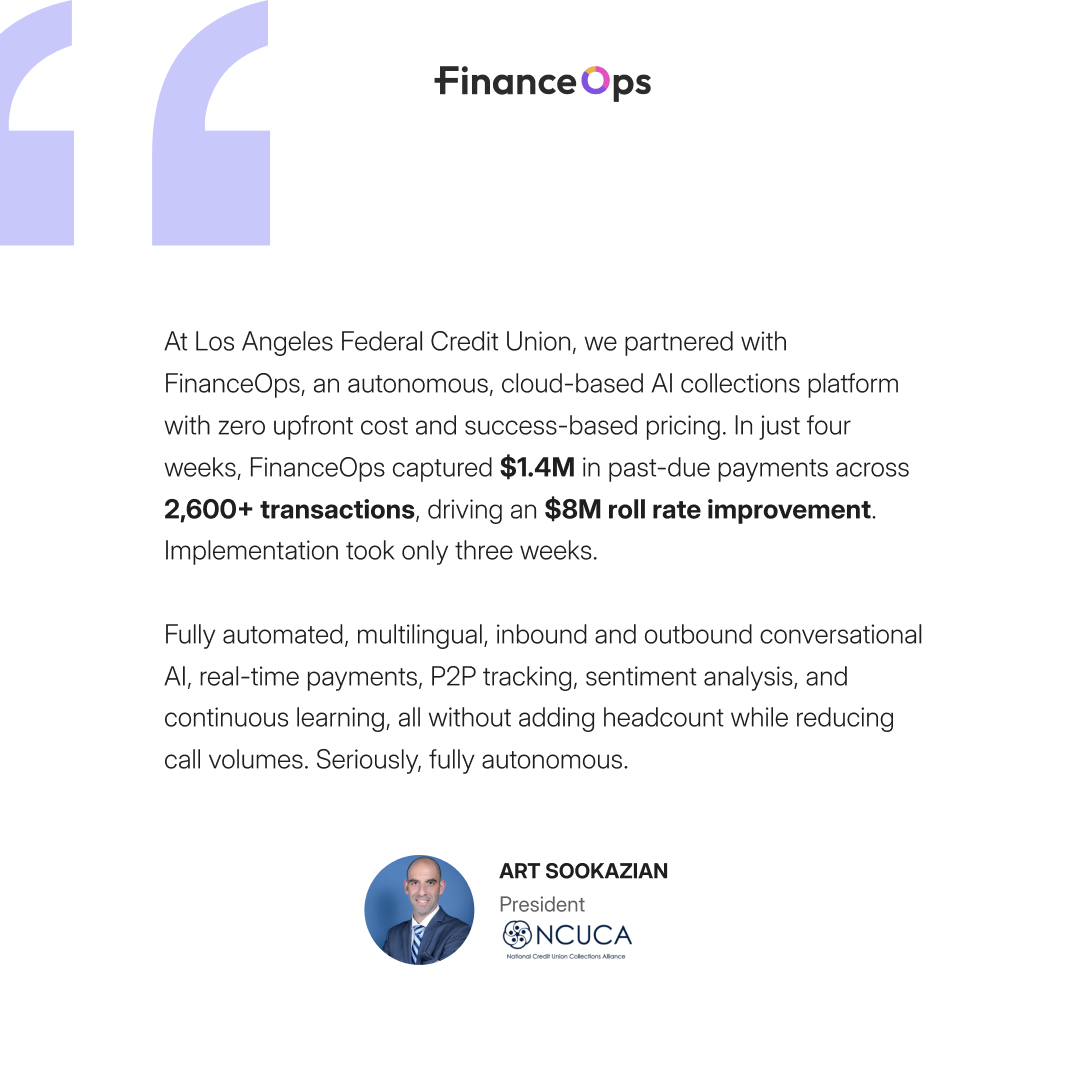
LAFCU activated FinanceOps at 15 days past due, before accounts migrated into later-stage delinquency. In the first 21 days, the program processed approximately 1,650 payments, achieved a 48% recovery rate, created only six cases for human review, and required under 10 minutes of human effort per day.
LAFCU's 30 to 60 DPD potential delinquency balance fell from approximately $12 million to $3.8 million, a reduction of more than 65%. The 30+ delinquency ratio declined by 12 basis points.
This is what governed execution looks like: earlier member engagement, multilingual servicing and collections, clear escalation, and very little manual intervention. Read How LAFCU Collected $1M+ and Cut Delinquency 65%.
The Economic Case Is Decision Speed, Not Just Headcount
The first question many executives ask is how many hours AI can save. That matters, but it is not the full business case.
The larger value is the time removed between a useful signal and the right action.
A member who is ready to resolve an account today may not be ready next week. A dispute sitting in an inbox continues to age. A failed payment that is not addressed immediately becomes another broken arrangement. A payment that is not reconciled can trigger an unnecessary contact and damage trust.
Agentic AI reduces that decision latency. It allows a bank or credit union to respond when the signal is fresh, keep the workflow moving, and reserve employees for cases where empathy, authority, or complex judgment changes the outcome.
Leaders should measure:
- Dollars resolved and cost per dollar recovered.
- DSO and migration between delinquency stages.
- Manual touches per resolved account.
- Right-party contact and meaningful engagement.
- Promise-to-pay completion.
- Dispute and exception resolution time.
- Payment application and reconciliation accuracy.
- Complaints, policy deviations, and escalation quality.
If a platform reports activity but cannot prove resolved cash, controlled cost, member treatment, and policy adherence, it is measuring the machinery instead of the outcome.
The article 7 Signs Your AR Team Is Losing Money to Manual Collections shows where that hidden operational cost usually appears.
My 2026 Prediction: The Best AR Software Will Be Accountable for Outcomes
When software gives people tools, it is priced by access: seats, licenses, calls, messages, and modules.
When software performs work, institutions will increasingly expect the commercial model to align with results.
That shift matters because pricing shapes product behavior. A vendor paid for message volume is rewarded for sending more messages. A vendor paid for seats is rewarded for adding users. A platform measured against resolved cash, cost to collect, policy compliance, and member experience has a different incentive.
The same shift will happen inside the institution. Leaders will stop asking how many calls, tasks, or promises were logged. They will ask how much cash was resolved, how quickly, at what cost, with how many manual interventions, and inside which policy boundaries.
This is bigger than automation. It is a change in accountability.
How to Evaluate Agentic AR
Do not evaluate an agent on one perfect conversation. Evaluate it on a changing member account.
Give the vendor a scenario where the member ignores email, responds by SMS, asks for a document, disputes part of the balance, accepts a payment arrangement, misses an installment, pays through another rail, and raises a sensitive complaint.
Then ask:
- What can the agent observe across systems?
- Which actions can it take without approval?
- Which controls make the wrong action impossible?
- How does it verify payment and reconciliation?
- What does the employee receive when the agent escalates?
- Can the institution audit the complete decision path?
- Does the vendor measure outcomes or activity?
If the result is another queue for employees, the platform is assisted automation. If the system can continue the permitted workflow, verify the outcome, update the record, and escalate only the genuine exception, it is agentic operations.
The Future of AR Is Accountable Execution
The problem in accounts receivable has never been a shortage of reminders. It is the gap between knowing what happened and doing the next right thing.
Banks and credit unions already have systems that record balances, transactions, and member history. What they need is an intelligence and execution layer that can act on that information continuously.
The core system will remain the source of record. People will continue to own policy, empathy, and judgment. Agentic AI will run the thousands of routine decisions between them.
That is how servicing and collections move from reactive queues to a real-time liquidity operation.
That is why agentic AI is the future of accounts receivable.