
Bank collections in 2027 will be shaped by how quickly a bank turns a missed payment into a governed next action. That requires current account context, borrower communication, servicing, payment follow-up, and recovery decisions to work together as accounts move through the early stages of delinquency. Agentic AI can coordinate defined tasks across that journey while bank-approved policies and staff retain control of sensitive decisions and exceptions.
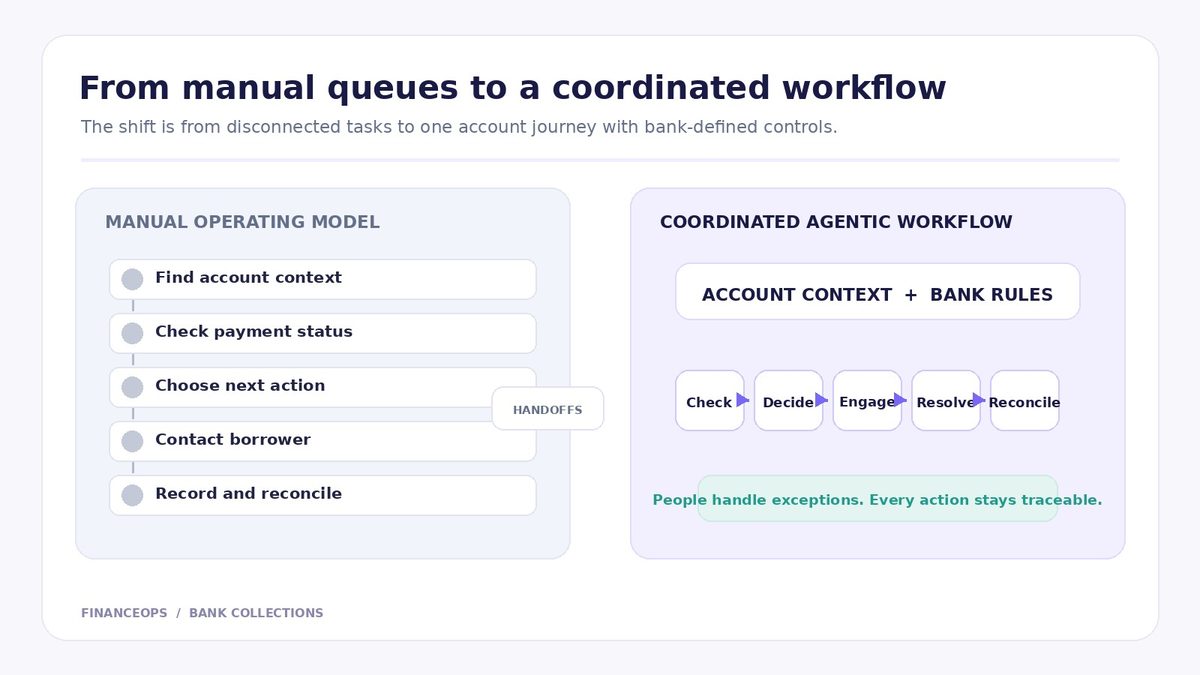
This is not simply a shift from human collectors to software. It is a move from disconnected tasks and manual collection workflows to an operating model that reads account context, takes an approved next step, records the result, and moves each account toward resolution.
The national numbers show why portfolio-level measurement matters. The Federal Reserve reported a seasonally adjusted delinquency rate of 2.85% on credit card loans at all commercial banks in Q2 2026, down from 3.04% in Q2 2025. That industry average does not show performance by individual bank, product, risk segment, or delinquency stage. Use it as context, not a substitute for portfolio-level analysis. View the Federal Reserve data.
Why bank collections need a different operating model
A bank's collections team may work across credit cards, auto loans, personal loans, mortgages, home-equity accounts, and other credit products. Each portfolio has its own servicing rules, customer commitments, data sources, and escalation paths. A single manual queue or fixed contact sequence can make it difficult to coordinate those differences at scale.
The pressure shows up in familiar places:
- Account information is spread across core banking, loan servicing, customer relationship, dialer, payment, and case-management systems.
- Teams spend time finding the latest balance, payment status, prior contact, and approved next action before they can have a useful conversation.
- Borrowers may need help with a payment issue, an account question, or a hardship request, but the path from conversation to resolution can involve several handoffs.
- A payment may post after an outreach task is already in motion, creating avoidable work and a risk of poor customer experience.
- Supervisors need to understand not only whether an account was contacted, but why a particular action was chosen and what happened next.
These challenges do not mean every bank needs to replace its collections platform or rebuild its core. They point to a coordination problem: getting approved work done across the systems and teams already in place.
What agentic AI means in bank collections
Agentic AI refers to systems that can work toward a defined goal through multiple steps. In bank collections, that could mean reviewing an account's current status, selecting an action permitted by bank policy, communicating through an approved channel, recording the response, and routing an exception to an employee.
That is different from a basic automated reminder. A reminder follows a preset trigger and message. An agentic workflow can use the account context available to it to choose among defined actions, keep track of the interaction, and respond to new information within its approved boundaries.
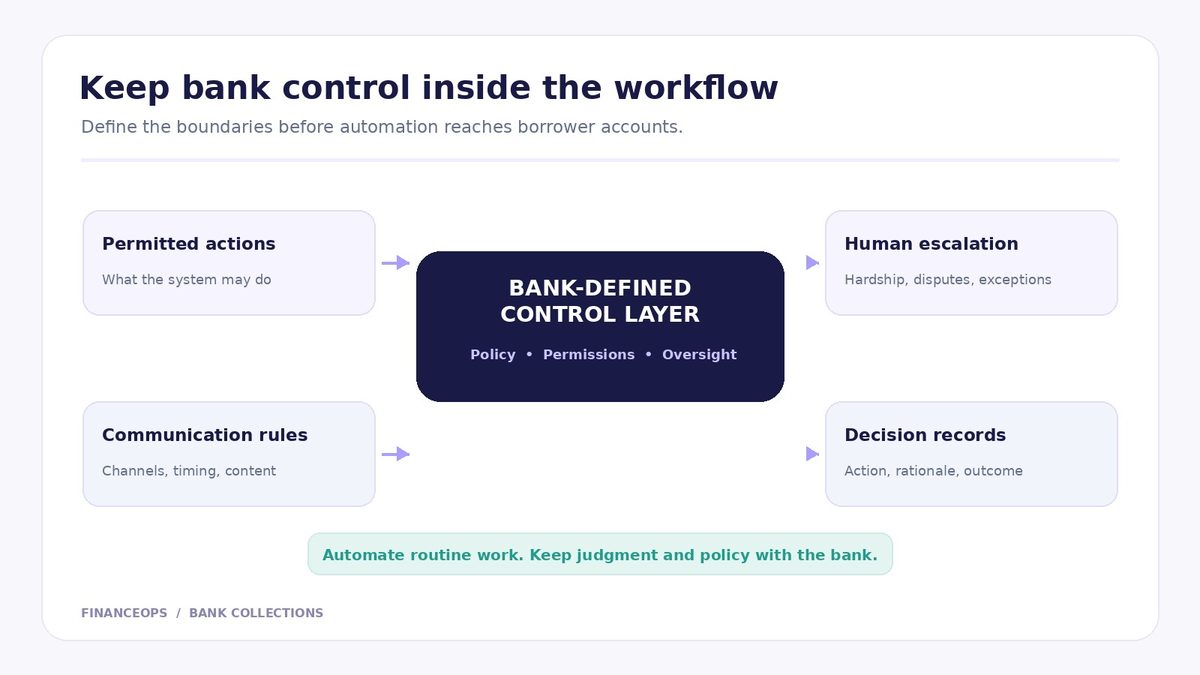
The key phrase is within its approved boundaries. For a deeper look at the distinction between agentic and rule-based collections, see Agentic AI Collections Software vs. Traditional Platforms. A bank should define what the system can do independently, what requires approval, and what must be routed to a person. Agentic AI should make the workflow more coordinated and explainable, not make the bank's policies less visible.
From a manual queue to a managed workflow
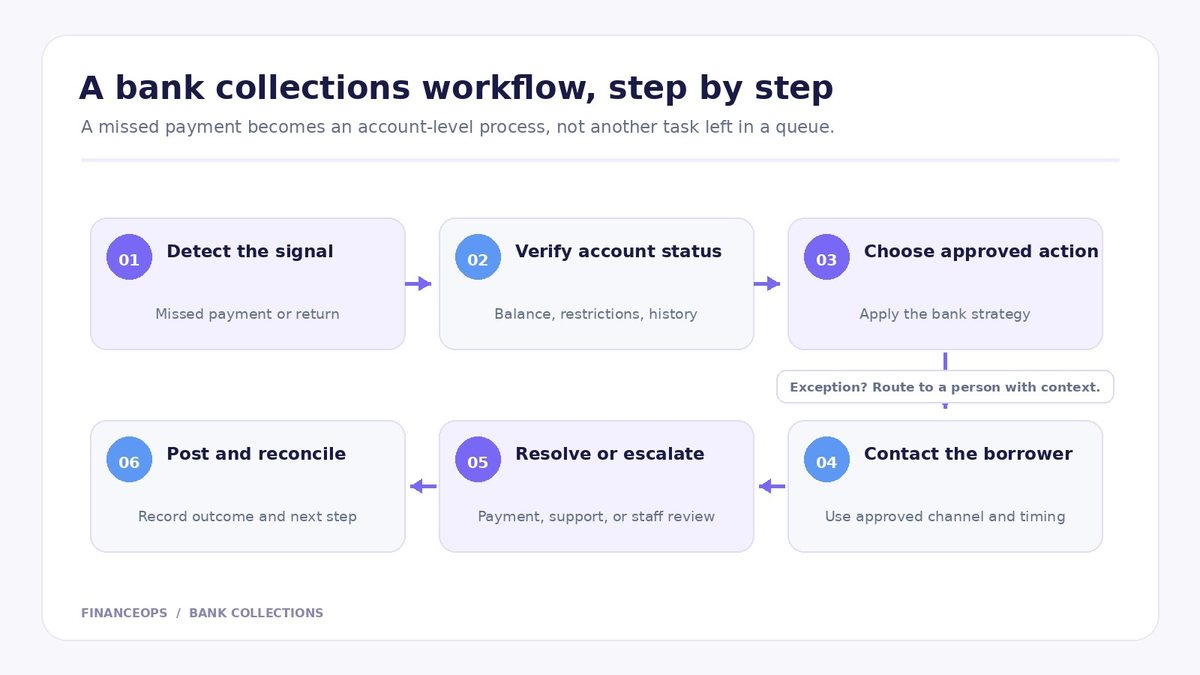
Consider an account that has missed a scheduled payment. A coordinated collections workflow could:
- Check account status. Confirm the current balance, delinquency stage, payment activity, account restrictions, and prior interactions from authorized systems.
- Select an approved next step. Apply the bank's configured strategy for that account, product, and stage.
- Reach the borrower appropriately. Use the communication channel, timing, and content permitted by the bank's rules and the account's communication preferences.
- Understand the response. Identify whether the borrower needs payment assistance, has already paid, disputes the balance, requests a different arrangement, or needs staff support.
- Act or escalate. Complete only actions the bank has authorized. Route hardship, disputes, complaints, identity concerns, and other exceptions to the appropriate team.
- Track the outcome. Record the interaction, follow-up commitment, payment status, and next step so the account record reflects what happened.
- Reconcile and learn. Compare activity with subsequent payment and portfolio outcomes, then use approved monitoring and review processes to assess the strategy.
The workflow is not identical for every product. A credit card account, auto loan, and mortgage can have different servicing requirements and escalation paths. The bank should configure the workflow to reflect those differences instead of forcing every account through one generic sequence.
What bank leaders should expect from AI collections software
When evaluating AI collections software for banks, leaders should look beyond whether a system can send messages or place calls. The more important question is whether it can operate reliably within the bank's account, servicing, payment, and governance environment.
Bank-approved decision boundaries
The bank should be able to define eligible actions, prohibited actions, approval thresholds, communication rules, and escalation triggers. Those controls need to be understandable to collections operations, compliance, risk, and technology teams.
Current account context
A workflow is only as dependable as the information it can use. Account status, recent payments, prior borrower interactions, disputes, arrangements, and restrictions should be considered before an action is taken. Integration should preserve the bank's systems of record and make clear where the authoritative account data resides.
Human review for exceptions
Automation is useful for repeatable work. Human judgment remains important when a borrower raises a complex hardship concern, disputes an account, reports a sensitive event, or requests an action outside the system's authority. See why human oversight matters in AI-driven debt recovery. Define escalation ownership and response expectations before deployment.
Complete activity records
Bank teams need a traceable view of what information was considered, which approved action was selected, what communication occurred, and whether a person reviewed or changed the outcome. Clear records support operational review, complaint handling, internal controls, and vendor oversight.
Portfolio-level measurement
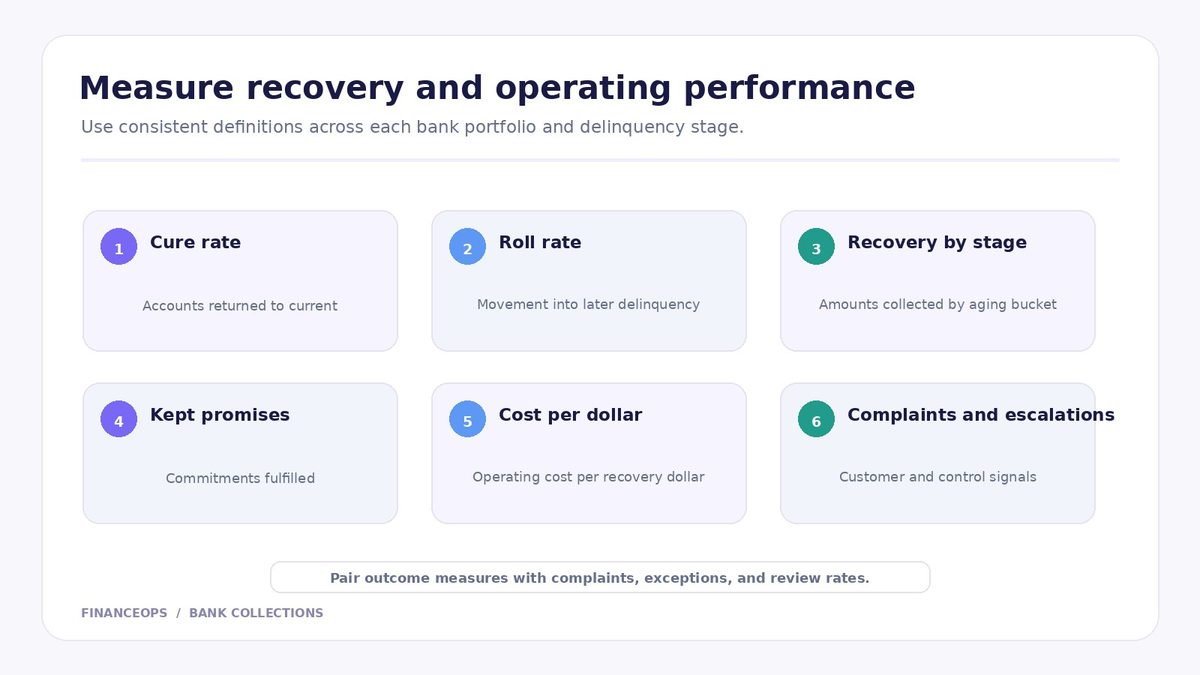
Reporting should connect workflow activity to outcomes. Useful measures may include accounts worked per employee, right-party contact rate, kept-promise rate, cure rate, roll rate, recovery by delinquency stage, cost per dollar recovered, repeat contact, complaint volume, and escalation rates. Define each metric and its denominator before comparing results across portfolios or time periods. A portfolio risk view can help teams interpret those measures by segment.
Governance belongs in the design
AI governance for banks is evolving. In April 2026, the Federal Reserve, OCC, and FDIC issued revised interagency model risk management guidance that calls for an approach tailored to a banking organization's model risk profile, size, and operational complexity. The Federal Reserve's SR 26-2 letter says the guidance is expected to be most relevant to banking organizations with more than $30 billion in assets that it regulates. In a May 2026 speech, Federal Reserve Vice Chair for Supervision Michelle Bowman said the revised guidance does not apply to generative or agentic AI, while noting that other risk-management and governance practices should support their adoption. Banks should review current agency guidance and their own policies with qualified risk, legal, and compliance teams before deployment. For an operational framework, see how banks can govern AI collections compliance in 2027, and our overview of AI and FDCPA-related controls. Read the Federal Reserve's SR 26-2 letter and Vice Chair Bowman's remarks on AI in the financial system.
For collections leaders, that means discussing governance in operational terms:
- Which account and customer data can the system access?
- Which decisions can it make, and which require human approval?
- How are bank-specific policies and updates reviewed?
- How are communication preferences and restrictions enforced?
- How are errors, complaints, and unexpected outcomes detected and escalated?
- What records can the bank and its reviewers inspect?
- How will the bank monitor performance when portfolios, products, or strategies change?
These questions help make an AI initiative reviewable by the teams responsible for operating and overseeing it. They also help prevent a narrow automation pilot from becoming an opaque process that is difficult to explain.
A practical path to agentic collections
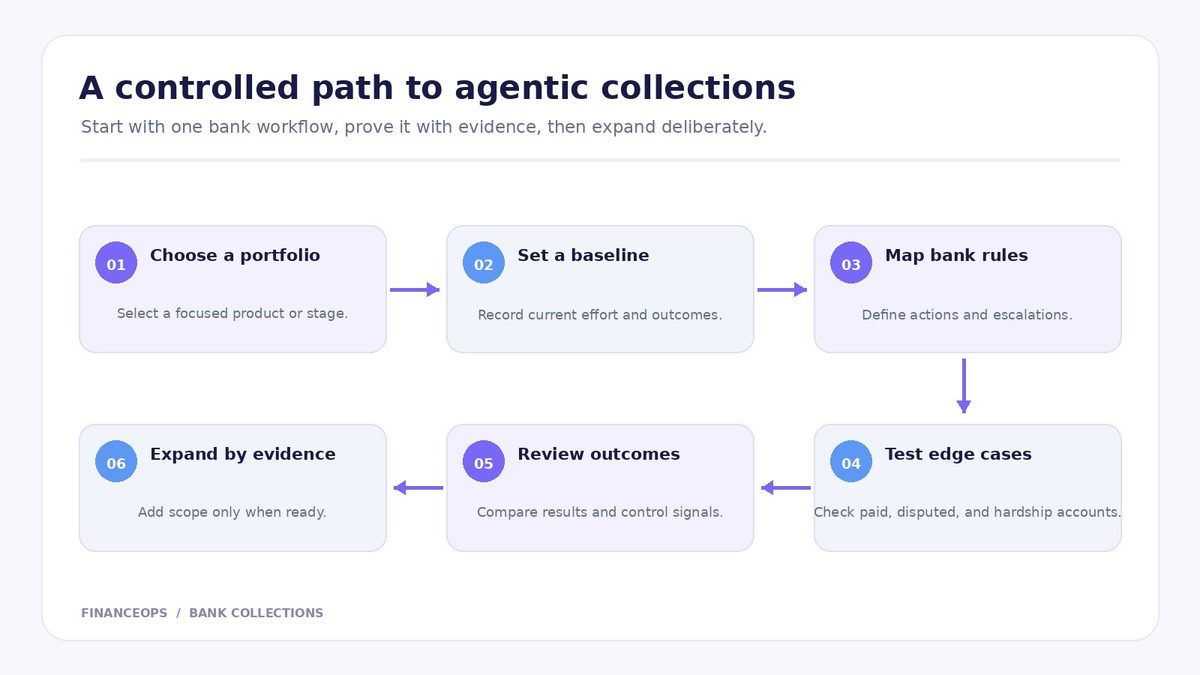
Banks do not need to automate every delinquency stage at once. A controlled rollout can begin with one portfolio and a clearly bounded workflow. For an early-stage use case, read why early-stage collections can deliver higher ROI.
Start with the operational bottleneck. Identify a part of collections where staff time is being consumed by repetitive account review, status checks, routine outreach, or follow-up coordination.
Set a baseline. Document current volumes, staffing effort, contact and payment outcomes, exceptions, complaints, and the time required to move an account from one step to another.
Map the bank's rules. Bring collections operations, servicing, compliance, risk, technology, and vendor-management stakeholders into the design. Specify permitted actions, decision limits, required records, and escalation paths.
Test with realistic cases. Include accounts with recent payments, disputes, hardship signals, communication restrictions, returned payments, and incomplete or conflicting information. Confirm the workflow behaves as intended before expanding its authority or volume.
Review results by portfolio. Compare the pilot with the baseline using consistent definitions. Look at customer outcomes, operational capacity, recoveries, exceptions, and control performance together.
Expand only when the evidence supports it. Add products, stages, or actions in steps. Keep ownership of policy, strategy, and oversight with the bank.
How FinanceOps supports bank servicing and collections
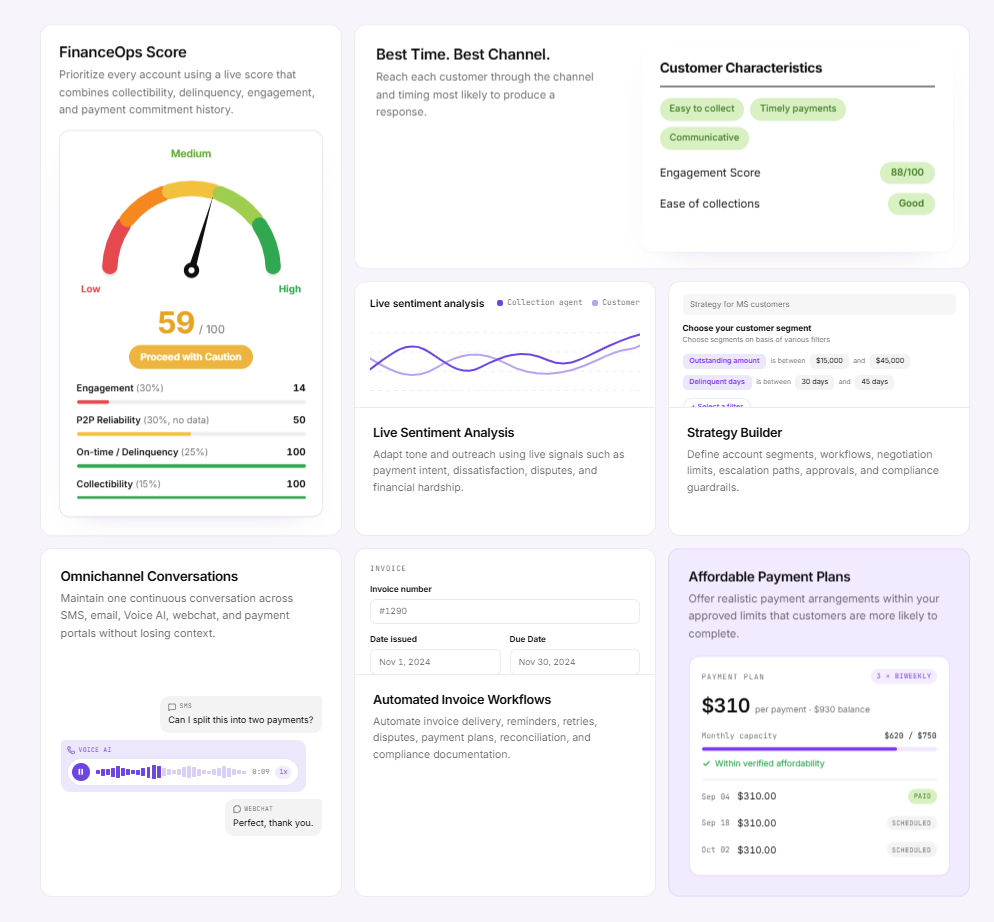
FinanceOps Agentic AI supports servicing and collections workflows across financial operations. Autopilot coordinates routine account work; Copilot supports staff-led interactions; Strategy Builder configures approved strategies and boundaries; Dashboards gives teams portfolio-level visibility; and Agentic Payments connects payment activity with follow-up and recovery. See FinanceOps solutions for banks for bank-specific context, or Fintech solutions for adjacent lending operations.
The practical question for a bank is whether an AI workflow can fit its portfolio, rules, systems, and review requirements. A useful evaluation should map one real account journey from the first missed payment through borrower contact, resolution, payment posting, and account reconciliation.