
When finance leaders search for alternatives to Bill.com, they are usually looking for more than another invoicing platform.
The real question is whether the next platform can improve the entire receivables lifecycle, from invoice creation and payment acceptance to collections, dispute resolution, failed-payment recovery, cash application, and reconciliation.
Bill.com is a practical solution for businesses that need invoice creation, automated reminders, online payments, payment tracking, and accounting synchronization. Its accounts receivable platform connects with systems such as NetSuite, Sage Intacct, QuickBooks, Xero, and Microsoft platforms.
However, enterprise finance teams often need more advanced capabilities. They may need to prioritize accounts based on payment behavior, understand why customers are not paying, manage disputes, recover failed transactions, support payment arrangements, and maintain control over automated actions.
That is where the right Bill.com alternative can create a meaningful difference.
Key Takeaways
- Billtrust, FinanceOps, HighRadius, Versapay, Quadient AR, and Paystand serve different parts of the enterprise receivables lifecycle.
- FinanceOps Agentic AI combines customer engagement, collections automation, payment recovery, flexible payment plans, and Agentic Payments in one governed workflow.
- The right platform should be evaluated on recovery performance, ERP integration, dispute handling, payment intelligence, auditability, implementation effort, and total cost per resolved account.
Why Companies Look Beyond Bill.com
Bill.com is designed to simplify core invoicing and payment workflows. This makes it useful for companies that want to automate invoice delivery, payment reminders, payment collection, and accounting synchronization.
As receivables operations become more complex, the limitations of basic workflow automation become more visible.
Enterprise teams may manage:
- Multiple legal entities
- Large invoice volumes
- Different payment channels
- Complex ERP environments
- Disputed invoices
- Failed card and ACH payments
- Long payment cycles
- Customer-specific payment arrangements
- Multiple collections teams
The question is no longer only whether an invoice was sent. Finance leaders also need to understand what is preventing payment and which action is most likely to resolve the account.
The U.S. Treasury’s 2026 Centralized Receivables Service reflects this broader view of receivables management. Its operating model connects batch-file transmission, digital payment channels, installment agreements, customer support, payment posting, reporting, and escalation through the full receivables lifecycle. Read the Treasury’s 2026 receivables fact sheet.
What Buyers Should Compare
The questions buyers ask when evaluating accounts receivable automation are practical:
- Can the platform reduce DSO?
- Can it connect to existing ERP systems?
- Does it improve payment recovery?
- Can it manage disputes and exceptions?
- Does it support multiple payment channels?
- Can it automate customer engagement?
- Can it reconcile payments accurately?
- When should a human become involved?
- Can finance leaders measure cost per resolved account?
These questions are more useful than comparing feature counts alone.
The best platform is not necessarily the one with the longest feature list. It is the one that fits the company’s receivables model and produces measurable improvement in cash flow, payment completion, customer experience, and operational efficiency.
Enterprise AR Platform Comparison
| Platform | Best for | Payment support | Main consideration |
|---|---|---|---|
| Billtrust | B2B invoicing and invoice-to-cash operations | Payment acceptance, electronic billing, cash application, and payment workflows | Evaluate depth of customer engagement and recovery decisioning |
| FinanceOps | Intelligent collections and payment recovery | Failed-payment recovery, payment links, flexible plans, omnichannel engagement, and Agentic Payments | Best fit when recovery outcomes and autonomous execution are priorities |
| HighRadius | Broad enterprise order-to-cash transformation | Payments, cash application, collections, deductions, credit, and e-invoicing | Assess implementation complexity and deployment timelines |
| Versapay | Collaborative accounts receivable | Customer payment communication, invoice visibility, dispute collaboration, and payment workflows | Test predictive recovery and failed-payment handling |
| Quadient AR | Structured collections automation | Payment reminders, promises to pay, payment visibility, and collections workflows | Evaluate exception management and payment-plan flexibility |
| Paystand | Digital payment infrastructure | B2B payment rails, settlement, payment acceptance, and reconciliation | Payment infrastructure may need to be paired with recovery workflows |
Billtrust
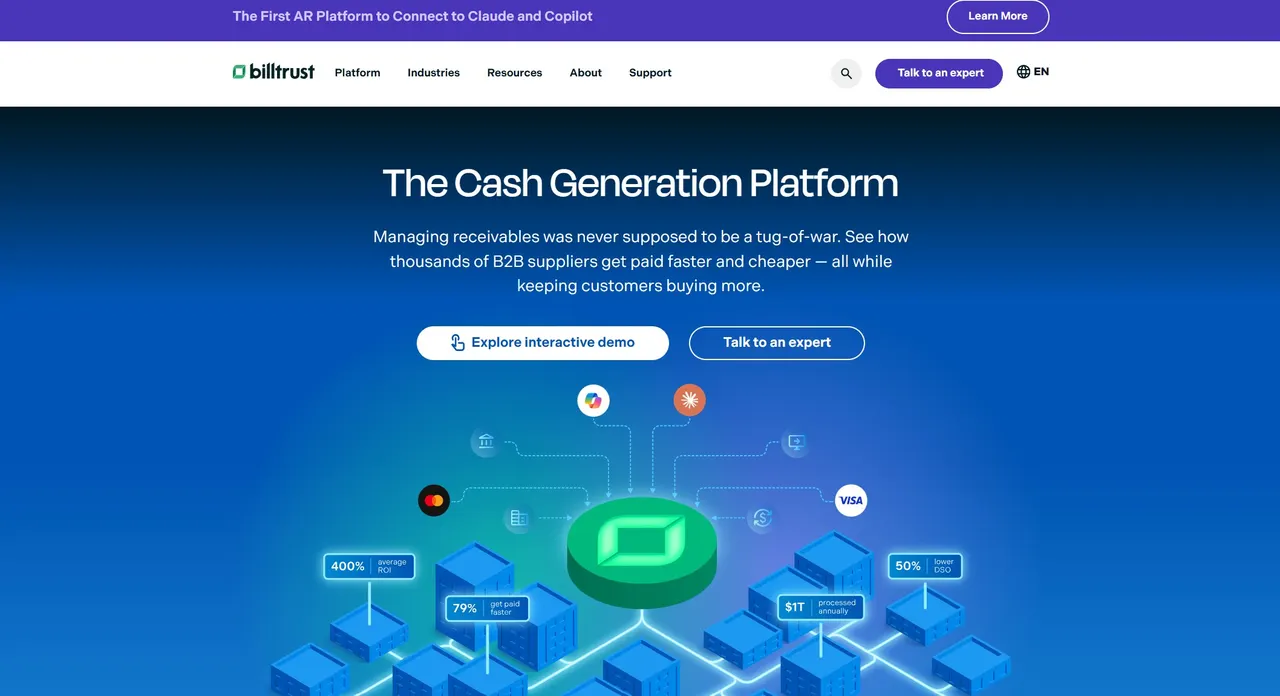
Billtrust is a strong option for businesses that want to modernize B2B invoicing, electronic billing, payments, cash application, and invoice-to-cash operations.
Its strength is the breadth of its B2B receivables infrastructure. Billtrust is relevant for companies managing large invoice volumes, multiple payment methods, and complex customer billing operations. Its product positioning covers electronic invoicing, payment application, collections, cash application, and broader accounts receivable workflow management.
Billtrust is a good fit when the primary objective is standardizing invoice-to-cash operations. Buyers should also evaluate how deeply the platform supports customer engagement after an invoice becomes overdue. There is a difference between automating invoice delivery and actively determining the best action to resolve an unpaid balance.
FinanceOps Agentic AI
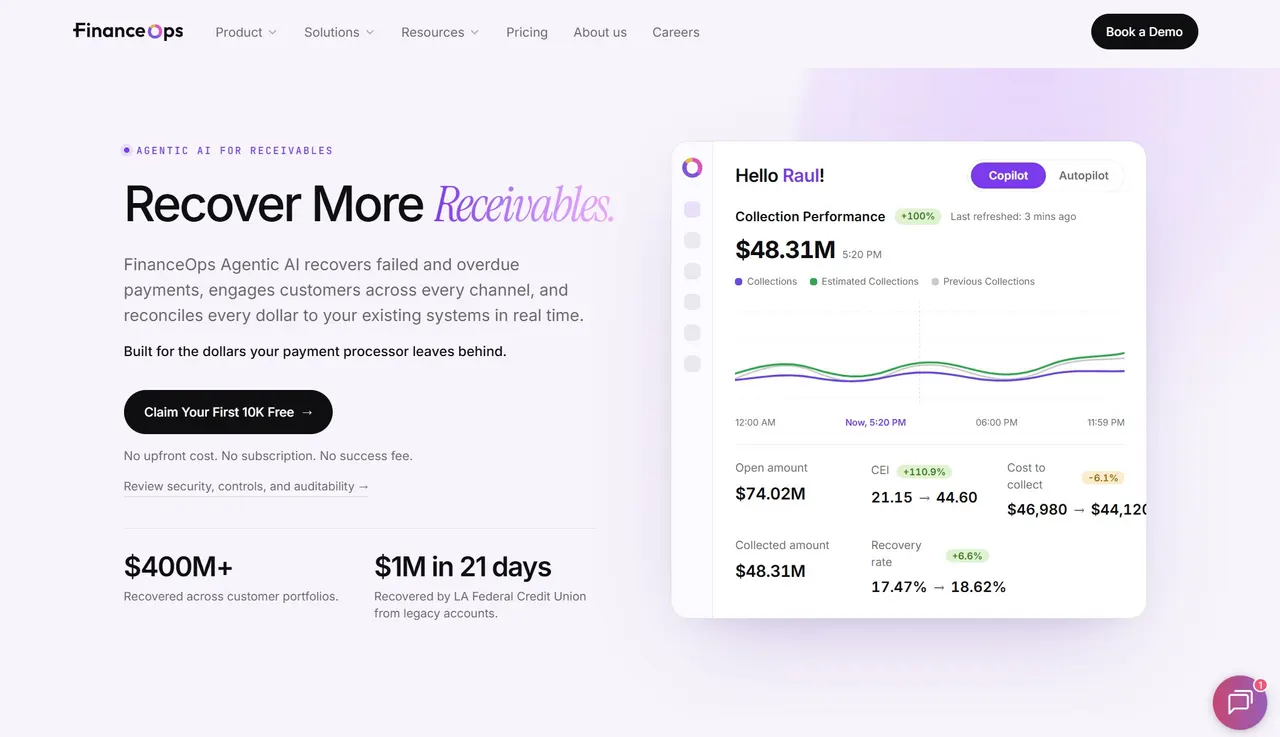
FinanceOps Agentic AI is designed for organizations that want to improve what happens after an invoice is issued, a payment fails, or an account becomes overdue.
FinanceOps combines AI accounts receivable automation, customer intelligence, AI-powered communication, payment decisioning, workflow automation, flexible payment plans, collections execution, and reconciliation.
The platform supports customer conversations through voice, SMS, and email while helping finance teams determine the next best action for each account. Depending on the situation, that action may involve sending a message, creating a payment request, offering a payment arrangement, initiating payment recovery, escalating a dispute, or routing the account to the customer-side team.
Unlike basic software for accounts receivable, FinanceOps connects payments, customer communication, collections, and recovery within one governed operating model.
HighRadius
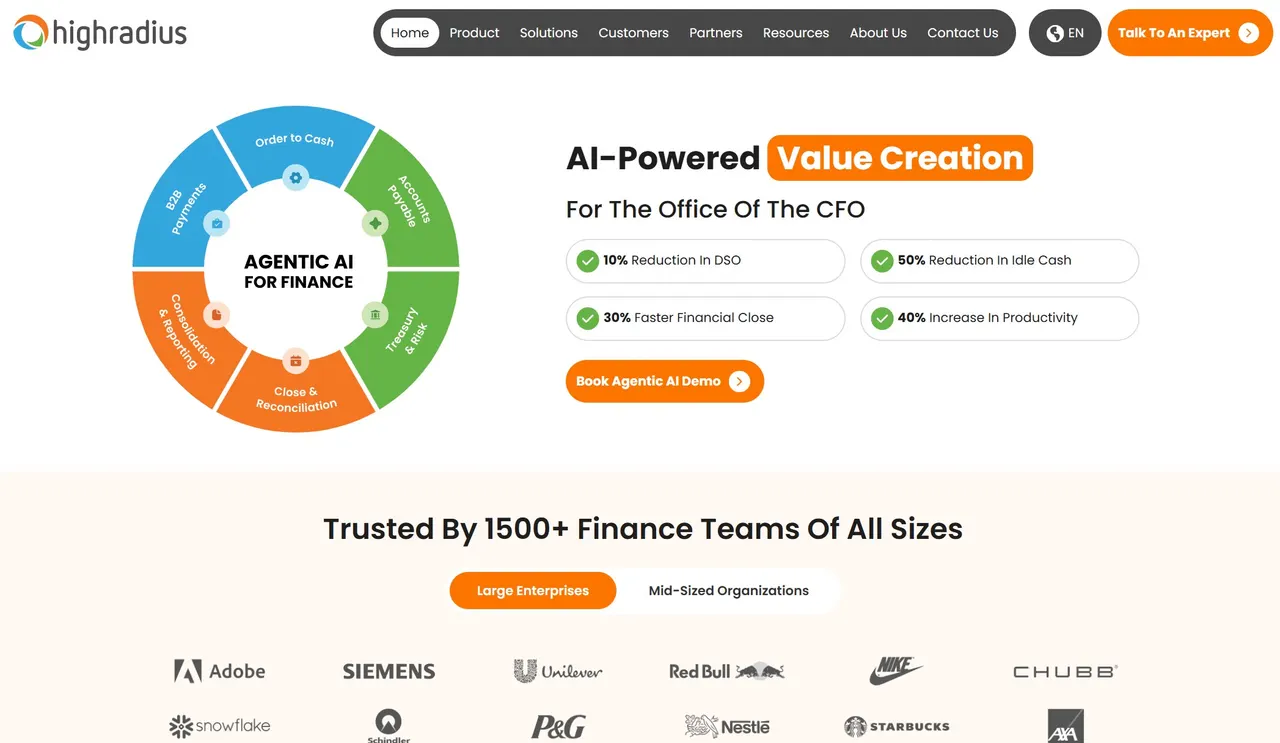
HighRadius is designed for large enterprises pursuing broad order-to-cash transformation.
Its platform covers collections, cash application, deductions, credit management, e-invoicing, payments, and treasury. HighRadius currently positions its platform around more than 180 AI agents across finance workflows.
HighRadius is a strong fit for finance organizations that want to consolidate multiple finance workflows into a broad enterprise platform.
The key evaluation question is implementation complexity. Enterprise buyers should understand how long it will take to configure the platform, connect existing systems, define workflows, and demonstrate measurable outcomes.
Versapay
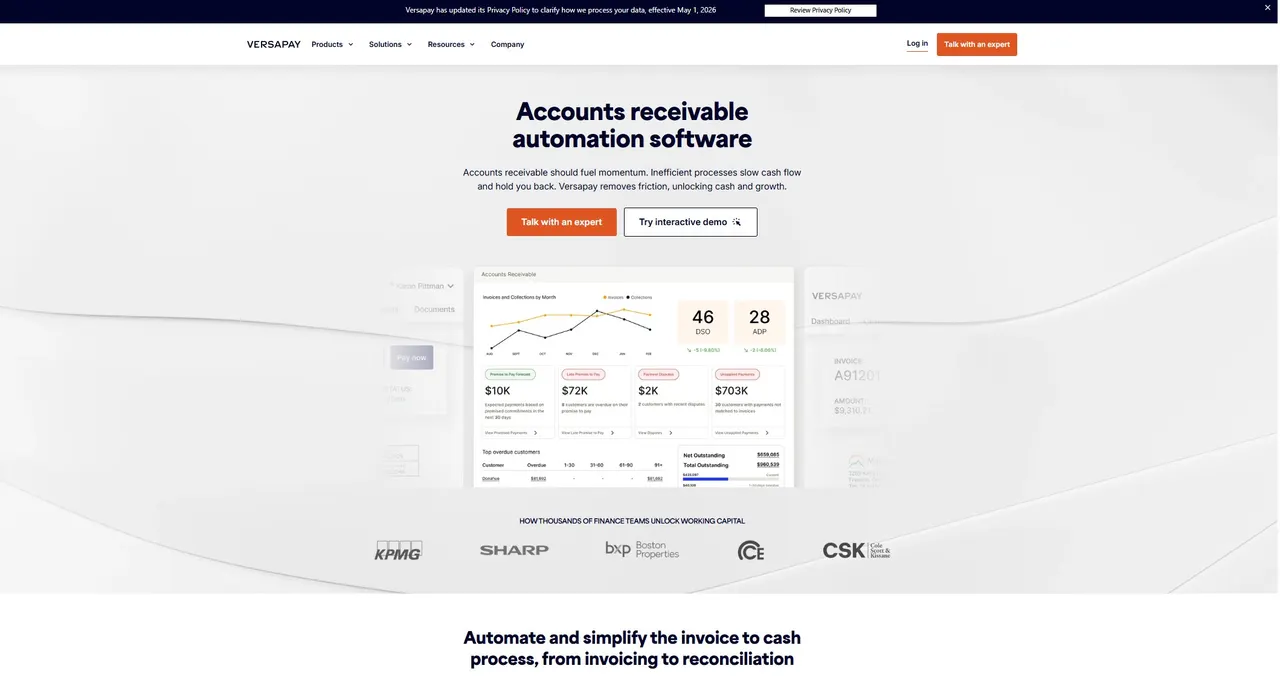
Versapay focuses heavily on collaborative accounts receivable. Its platform helps finance teams communicate with customers, share invoice information, manage disputes, and improve payment visibility. This makes Versapay a strong option for companies where customer collaboration is central to the receivables process.
Versapay is particularly relevant when finance teams need better visibility into invoice status and more direct communication between buyers and sellers.
The main question for buyers is whether collaboration alone is enough. If the business also needs predictive payment recovery, failed-payment resolution, voice and SMS engagement, and dynamic next-best-action decisioning, those capabilities should be tested during evaluation.
Quadient AR
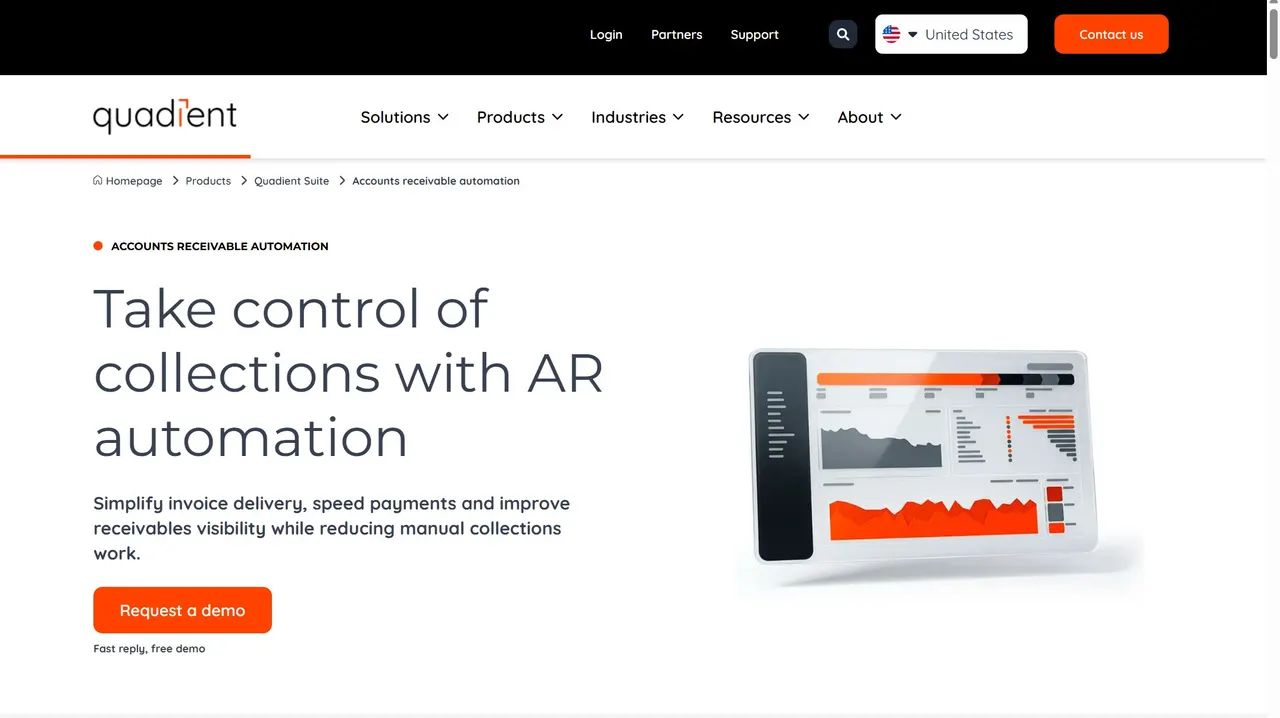
Quadient AR, formerly known as YayPay, supports collections workflow automation, payment behavior analysis, cash-flow visibility, reminders, and promise-to-pay management.
It is a relevant option for finance teams that want structured collections processes, better aging visibility, and more consistent follow-up.
Quadient AR can help teams move away from spreadsheets and manually managed collection queues. Its value is strongest when finance teams need a more organized system for prioritizing accounts and tracking collections activity.
Buyers should assess whether the platform can support complex customer situations, including disputes, hardship, failed transactions, payment-plan changes, and human escalation.
Paystand
Paystand is more payment-led than traditional collections platforms.
Its focus is helping businesses modernize B2B payment acceptance and reduce friction within the invoice-to-cash process. Paystand may be a strong fit for organizations that want digital payment rails, faster settlement, and improved payment reconciliation.
However, payment infrastructure does not automatically solve payment recovery.
Buyers should ask how the platform handles failed payments, customer follow-up, account prioritization, payment disputes, and collections escalation after a payment attempt does not succeed.
Paystand is most relevant when the primary objective is improving payment infrastructure and digital settlement.
How Agentic Payments Supports Recovery
Traditional payment systems identify whether a transaction succeeded or failed. Agentic Payments goes further by evaluating why a payment failed and determining what should happen next.
A payment may fail because of an expired card, insufficient funds, a changed bank account, a processor issue, timing, customer behavior, a dispute, or the absence of a realistic payment option.
FinanceOps Agentic Payments can use these signals to prioritize recovery actions, support automated payment retries, create payment links, initiate customer communication, offer flexible payment options, and escalate cases requiring human judgment.
This allows businesses to move from payment processing to payment intelligence.
The system can connect payment events with customer conversations, collections strategies, account history, and existing financial systems. This matters because payment recovery is rarely only a technical transaction problem. It is often a customer communication and decision-making problem.
Learn more about the FinanceOps Agentic Payments platform and AI payment collection agents.
How FinanceOps Connects AR Workflows
FinanceOps is designed to connect the full receivables journey:
- Invoice creation and delivery
- Payment tracking
- Failed-payment detection
- Customer engagement
- Collections prioritization
- Payment-plan support
- Dispute and exception handling
- Payment reconciliation
- Reporting and auditability
This creates a more continuous operating model between billing, payments, customer support, and collections.
For organizations that want to modernize the invoice lifecycle, FinanceOps also provides automated invoicing workflows.
For a broader view of autonomous collections, read Automated Dunning Is Dead: Agentic Collections Has Arrived.
How to Choose the Right Platform
Bill.com remains a sensible option for companies that mainly need invoicing, reminders, payment collection, and accounting synchronization.
Billtrust is stronger for B2B invoice-to-cash operations. FinanceOps is suited to intelligent collections and payment recovery. HighRadius supports broad enterprise order-to-cash transformation. Versapay focuses on customer collaboration. Quadient AR supports structured collections workflows. Paystand focuses on payment infrastructure and digital settlement.
The best way to evaluate vendors is to give each platform the same data and scenarios:
- Aged receivables
- Failed payments
- Disputes
- Payment-plan requests
- Unresponsive customers
- Escalation rules
- Reporting requirements
- Reconciliation requirements
Then compare recovery rate, resolution time, payment success, exception quality, auditability, implementation effort, and cost per resolved account.
The best demo is not a feature tour. It is a controlled test using the company’s actual operational scenarios.