
Blog
Accounts Receivable Automation: 2026 Guide
May 21, 2026


Blog Summary
Your collections team is working harder than ever. Delinquency is still climbing. The problem is not your people, it is the infrastructure underneath them.
In 2024, federally insured credit unions hit an 84 basis point delinquency rate, the highest since 2012, while net charge-offs rose to 71 basis points, up from 59 the year before, according to the National Credit Union Administration. Collections teams are running at full capacity and recovery performance is not keeping pace.
This blog explains why that gap exists, where manual B2C collections workflows break down structurally, and how accounts receivable automation, specifically agentic AI built for the credit union mission, closes it. Whether you are evaluating your first automation investment or benchmarking your current workflow against what is now possible, this is the operational reference you need.
Table of Contents
What Is Accounts Receivable Automation for Credit Unions?
The B2C Collections Cycle: Where Each Stage Breaks Down
Why Manual Member Collections Fail at Scale
Traditional Collections vs. Agentic AI: The Performance Gap
How FinanceOps Agentic AI Transforms B2C Collections
Six Core Capabilities That Make Collections Intelligent
Key Metrics Every Credit Union Should Track
Key Takeaways
FAQs
What Is Accounts Receivable Automation for Credit Unions?
Accounts receivable automation for credit unions is the use of intelligent technology to manage the complete member collections lifecycle, from first delinquency notice through payment plan management, dispute handling, cash application, and reconciliation, without relying on manual outreach or disconnected systems.
For credit unions, AR automation is not simply about sending fewer manual emails or scheduling reminders on a fixed calendar. It is about treating every delinquent member account as an individual case that requires a tailored approach, while preserving the member-first culture that defines the credit union mission.
That requires systems capable of four things simultaneously:
Analyzing each member's behavior and risk profile in real time
Adapting communication tone and channel to the individual
Executing compliant outreach across portfolios of thousands
Preserving the human judgment that protects long-term member relationships
The market reflects how urgently this problem is being addressed. The global accounts receivable automation market will grow from $3.52 billion in 2024 to $4.03 billion in 2025 at a compound annual growth rate of 14.3%, reaching $7.22 billion by 2029, according to Research and Markets (2024). Credit unions and community financial institutions are among the fastest-adopting segments, because the combination of rising delinquency, compliance complexity, and member relationship obligations makes the case for intelligent automation more urgent here than in almost any other financial services context.
How this blog uses "accounts receivable automation": Throughout this piece, AR automation refers specifically to member-facing B2C collections workflows, the outreach, negotiation, and resolution process for delinquent consumer accounts. It does not cover commercial or B2B receivables management, which involves different regulatory frameworks and workflow requirements.
The B2C Collections Cycle: Where Each Stage Breaks Down
The credit union B2C collections cycle runs through six connected stages. A structural failure at any one compounds into the stages that follow, which is why incremental fixes to individual steps rarely produce the recovery improvements credit unions are looking for. The problem is systemic, and so is the solution.
Stage 1: Delinquency identification and risk scoring
Most credit unions lose recovery opportunity at this first stage before a single outreach attempt is made. Acting in the first 1 to 30 days of delinquency recovers 85% of early-stage accounts, according to ACA International's 2023 Collections Industry Benchmarking Report. Waiting until 90 days or beyond leaves teams working accounts where the recovery probability has often fallen below 20%.
Manual risk scoring based on aging buckets alone cannot distinguish which early-stage accounts are at the highest roll-forward risk and which will self-cure without intervention. The result: outreach capacity is distributed evenly across accounts that require very different levels of urgency, a structural mismatch that drains resources and delays intervention on the accounts that need it most.
What it costs: Every high-risk account that ages from 30 to 60 days without contact enters a recovery band that costs two to three times more to work per account. The loss happens before collections have made a single call.
Stage 2: First outreach
First outreach is the most consequential touchpoint in the entire cycle. It is also where most credit union collections workflows operate on a fixed schedule that ignores individual member behavior entirely: a letter on day 5, a call on day 10, regardless of when and how each member actually engages.
A member who responds to SMS on weekday mornings and never answers calls from unknown numbers will not be reached by a scripted voice call at 2:00 pm on a Tuesday. That missed contact is not a compliance issue or a staffing issue. It is an infrastructure issue, a system that cannot match outreach to the member's actual responsiveness pattern.
What it costs: KPMG's 2024 AI in Financial Services report documents right-party contact rate improvements of 30% to 50% within 90 days of deploying AI-driven contact optimization. Every percentage point of RPC improvement at this stage directly reduces roll-forward volume into expensive mid- and late-stage delinquency.
Stage 3: Payment plan negotiation
Payment plans set through standard negotiation produce high initial commitment rates and high abandonment rates. A member who commits to a monthly payment they cannot sustain misses the first installment, requires re-contact, and often disengages from the collections process entirely. The account that appeared resolved on day 15 is back in the delinquency queue on day 45, having consumed two collections interactions and produced no resolution.
What it costs: Plan abandonment forces a second full collections cycle on an account that has already grown harder to recover, and on a member relationship that has already been strained by one failed resolution process.
Stage 4: Ongoing collections and escalation
Effective ongoing collections require adapting cadence and tone to what members are actually signaling in real time, not executing a fixed calendar. Members showing cooperative engagement need a different approach than those exhibiting avoidance patterns. Members with detected hardship cues need flexibility-first communication, not firm escalation language. Standard collections systems cannot make these distinctions at the individual account level without significant manual oversight.
Stage 5: Dispute management
In the B2C context, dispute handling carries member relationship implications that extend well beyond the delinquent account. A member who feels their dispute was dismissed or handled impersonally is unlikely to remain a member after resolution. Manual dispute tracking across email threads and case notes creates accountability gaps, resolution delays, and inconsistent experiences that are invisible in aggregate performance data but deeply felt by the members who experience them.
Stage 6: Cash application and reconciliation
Manual cash application of partial payments, off-schedule installments, and multi-channel remittances produces regular mismatches. Collections actions triggered against accounts that have already made payment damage member trust and simultaneously create FDCPA exposure, a combination that is costly to remediate and entirely preventable with automated reconciliation.
Why Manual Member Collections Fail at Scale
Three structural failure modes define the manual B2C collections problem at credit unions today. Each is well-documented, each is measurable, and each has a direct cost that manual process improvements cannot eliminate.
1. Fixed-schedule outreach with no behavioral intelligence
Applying the same contact cadence to every account regardless of risk profile, member behavior, or engagement history is a design failure, not a resource one. KPMG's 2024 AI in Financial Services report documents right-party contact rate improvements of 30% to 50% within the first 90 days of deploying AI-driven contact optimization.
Every percentage point improvement in right-party contact rate at the early delinquency stage directly reduces the volume of accounts aging into mid- and late-stage buckets, where recovery costs are two to three times higher per account. Manual fixed-schedule outreach cannot produce early-stage precision at the volume modern credit union portfolios require, and that imprecision has a compounding dollar cost that shows up in net charge-off rates, not collections activity reports.
2. Tone mismatch at scale
One of the most expensive and least-tracked failure modes in credit union collections is sending the wrong communication tone to the wrong member at the wrong moment. A member experiencing job loss who receives firm escalation language is significantly more likely to file a formal complaint, opt out of further contact, and exit the credit union entirely.
Deloitte's 2024 Financial Services AI Outlook found that sentiment-aware AI interactions reduce formal consumer complaints in collections environments by up to 35% and improve payment commitment rates by 22%. For credit unions, the complaint reduction is not a customer service metric. It is a regulatory exposure metric under the FDCPA and the Telephone Consumer Protection Act (TCPA). A single pattern of non-compliant tone, detected in a regulatory examination rather than caught internally, can trigger enforcement action whose remediation cost dwarfs the value of the delinquent accounts involved.
3. Manual compliance management
Manual compliance tracking is no longer viable at modern delinquency volumes. TCPA contact frequency limits, FDCPA disclosure requirements, state-specific consent rules, and CFPB Regulation F documentation obligations all require consistent, timestamped records of every contact attempt across every channel.
Manual tracking creates gaps. Gaps create liability. And liability compounds as the portfolio grows. A systemic compliance failure that manual tracking failed to catch does not produce one violation, it produces a pattern of violations, which is what regulators act on.
Traditional Collections vs. Agentic AI: The Performance Gap
Dimension | Traditional Collections | FinanceOps Agentic AI |
Contact strategy | Fixed schedule, uniform across portfolio | Behavioral: optimal time, channel, and decision-maker per account |
Tone management | Static templates | Real-time sentiment detection with dynamic adjustment |
Channel management | Single or dual channel | Omnichannel: SMS, email, Voice AI, webchat, self-service portals |
Language support | English only | Multilingual: Spanish, French, Arabic, Tagalog, and more |
Payment planning | Template-based negotiation | Affordability-based, calibrated to actual member repayment capacity |
Compliance governance | Manual tracking, audit gaps | Built-in FDCPA, TCPA, and CFPB Regulation F at every step |
Member experience | Transactional | Contextual and relationship-preserving |
Recovery rate | 20–25% average | Up to 70% at early stage |
Cost per recovery | High and rising | 1.5% of traditional cost, a 98.5% reduction |
For credit unions, the member experience column carries weight that extends well beyond any single quarter's recovery numbers. A member whose delinquency is handled with empathy, accuracy, and flexibility is a member who may remain with the credit union after the account resolves, and continue contributing to membership growth, loan volume, and deposit relationships for years. A member processed through impersonal, rigid collections infrastructure that never adapted to their circumstances typically does not.
How FinanceOps Agentic AI Transforms B2C Collections
FinanceOps Agentic AI is not a reminder scheduler or a rule-based automation layer. It is an autonomous member collections intelligence system that analyzes account data in real time, determines the optimal next action for each account individually, executes that action across the most effective channel, and adapts continuously based on member response, without requiring manual intervention on each account.
Documented results: a mid-size US credit union, 2024
In Q4 2023, a federally insured credit union serving approximately 85, 000 members faced a sharp delinquency surge driven by post-pandemic consumer credit deterioration. Cost per collection climbed from $50 to $150 as volume outpaced collections capacity, with no corresponding improvement in recovery performance. The team was working more hours and recovering less per dollar spent. After deploying FinanceOps Agentic AI in Q2 2024:
Operational costs fell 90% within the first 90 days
Payment volume grew 8x over the same period
Cost per collection dropped to as low as $3.65
Recovery rate on early-stage accounts (1–30 days) improved from 22% to 61%
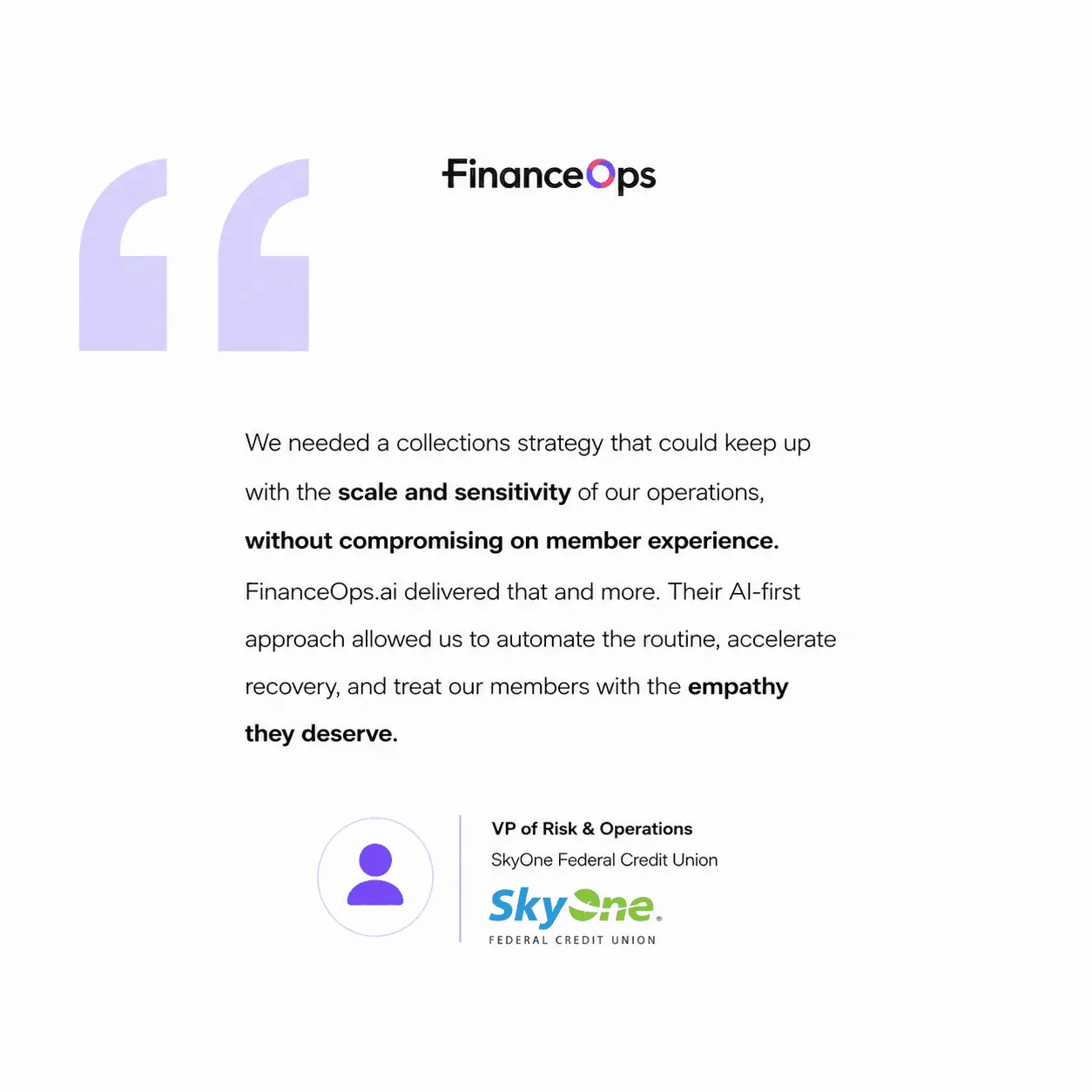
The credit union's collections team did not shrink. They shifted, from executing manual outreach on every account to managing the judgment-intensive cases and member relationships that produce outcomes automation cannot.
Six Core Capabilities That Make Collections Intelligent
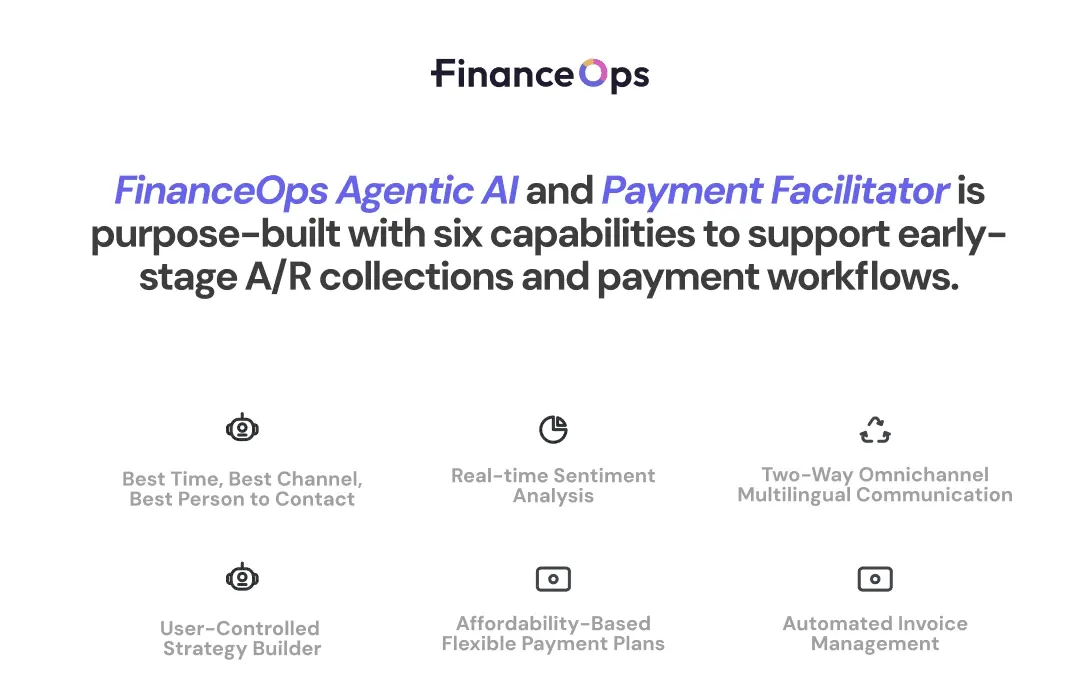
1. Best time, best channel, best contact
FinanceOps Agentic AI analyzes behavioral patterns, repayment history, device usage data, and historical engagement signals for every member account before a single outreach attempt is made. It identifies the specific hour and day each member is most likely to respond, determines the channel with the highest response probability, and verifies whether the contact on record is the actual payment decision-maker for that household.
The outcome mirrors what KPMG documents for AI-driven contact optimization: right-party contact rate improvements of 30% to 50% within 90 days. Every contact that reaches the right person at the right moment through the right channel is one that does not become another unresolved touch in a manual follow-up queue, and one that does not age the account further toward late-stage delinquency.
2. Live sentiment analysis
FinanceOps Agentic AI tracks tone, hardship signals, engagement likelihood, and compliance risk indicators in real time across SMS, email, webchat, and Voice AI interactions. The system responds to what members actually communicate, not what a fixed template assumes:
A member showing financial stress signals receives empathetic, flexibility-first communication focused on sustainable resolution options
A member with payment capacity but avoidance behavior receives a clear, low-friction path to resolution
A member whose language patterns indicate escalating distress triggers an automatic routing protocol that prioritizes human review before the next outreach
These adjustments happen without human intervention on every interaction, across every account in the portfolio simultaneously, protecting both the member relationship and the credit union's regulatory posture at the scale that manual triage cannot reach.
3. Two-way omnichannel multilingual communication
FinanceOps Agentic AI maintains full conversation context across SMS, email, Voice AI, webchat, and self-service portals. A member who begins a payment negotiation over SMS and continues through the member portal arrives at the same conversation in the same state, no reset, no need to repeat their circumstances, no friction that erodes the willingness to engage.
Built-in multilingual capabilities, including Spanish, French, Arabic, and Tagalog, remove language barriers that affect a significant share of credit union member populations. For credit unions serving linguistically diverse communities, multilingual collections is not a convenience feature. It is a member access obligation and a measurable recovery performance driver: members who receive and negotiate payment options in their preferred language commit to plans more consistently and complete them at higher rates.
4. User-controlled strategy builder
Collections teams define all operational parameters: tone thresholds by risk band, contact cadence and retry logic, account segmentation rules, escalation workflows, negotiation guardrails, and FDCPA, TCPA, and CFPB Regulation F compliance limits. FinanceOps Agentic AI executes those parameters consistently across every account, every day, without variability, fatigue, or deviation from credit union policy.
The credit union retains complete strategic oversight. Every action the system takes is documented in an audit-ready record, contact attempt, channel used, member response, compliance status, at every touchpoint. There is no black box. Collections managers can see precisely what the system did, why it did it, and what outcome it produced. Compliance auditors receive complete, timestamped documentation without manual assembly.
5. Affordability-based flexible payment plans
Plans set through conventional negotiation are calibrated to what the collector can secure in the moment, not what the member can actually sustain. FinanceOps Agentic AI evaluates each member's real repayment capacity, drawing on payment history, income and expense signals, and real-time sentiment data, before proposing any payment schedule.
The result is weekly, bi-weekly, monthly, or custom installment plans built around what the member can genuinely commit to. Completion rates rise. Plan abandonment falls. Fewer accounts re-enter the delinquency cycle requiring a second collections intervention. The credit union's net charge-off position improves not through more aggressive collection, but through better-structured resolution that produces commitments members actually keep.
6. Automated invoice and communications management
FinanceOps Agentic AI automates the complete collections invoice communications lifecycle: payment notices timed to individual member engagement behavior, retry logic for failed payments, automatic reconciliation against payment records, dispute intake and routing, and audit-ready compliance documentation at every stage.
Collections staff stop executing administrative processes and start applying judgment where it produces outcomes automation cannot, complex hardship negotiations, escalated member disputes, and relationship-sensitive situations that require human presence and contextual reasoning. Overhead is eliminated, not redistributed to a different manual queue.
Key Metrics Every Credit Union Should Track
These six metrics form a complete collections performance dashboard. Tracked together, they show not just where recovery performance stands today but where it will stand in 60 and 90 days if current workflows do not change.
Delinquency rate by aging bucket: The industry reached 84 basis points in 2024 (NCUA, Q4 2024). A rising concentration in the 60-day and 90-day buckets is a direct signal that early-stage outreach is failing to prevent forward roll, and that recovery costs are silently compounding in the background.
Right-party contact rate (RPC): The single most important leading indicator of early-stage collections performance. A low RPC rate means the workflow is generating activity, calls made, letters sent, time logged, without generating recovery. Volume without contact is cost without return. RPC rate is where every collections workflow diagnosis should begin.
Promise-to-pay kept rate: A high commitment rate paired with a low kept rate signals unsustainable payment plans, not insufficient follow-up. If members are agreeing to terms they cannot maintain, the problem is in the negotiation design, not the reminder cadence. This metric identifies plan structure failures before they compound into second-cycle delinquency.
Net charge-off rate: The NCUA reported 71 basis points in 2024, up from 59 basis points the prior year. Every account resolved at the early delinquency stage is one that never reaches charge-off, preserving both the member relationship and the capital position that regulatory examiners scrutinize.
Cost per recovery: The documented FinanceOps Agentic AI benchmark: reduction from over $150 to under $5 per collection within 90 days of deployment. This metric creates the clearest picture of collections ROI, and it is the one most credit union CFOs are not currently tracking with precision. If you do not know your cost per recovery today, calculating it is the highest-value diagnostic step you can take before any automation evaluation.
Formal complaint rate: CFPB formal complaints are a simultaneous signal of member harm and regulatory exposure. Deloitte's 2024 data documents up to a 35% reduction in formal complaints with sentiment-aware AI. For credit unions operating under heightened CFPB scrutiny, this metric belongs on the monthly collections dashboard alongside delinquency rate, not reviewed only when a complaint is received.
Key Takeaways
Delinquency is at a decade high and the structural causes are not going away. The NCUA reported 84 basis points in 2024 and net charge-offs rising to 71 basis points. Collections teams are at maximum capacity with infrastructure that was not designed for this volume or this compliance environment. Adding headcount without changing the infrastructure produces proportionally more cost, not proportionally better recovery.
The performance gap between scheduled automation and agentic AI is structural and widening. Traditional automation executes fixed schedules. Agentic AI analyzes behavioral patterns in real time, determines the optimal contact moment and channel for each individual member, adjusts tone based on live sentiment signals, and executes governed outreach within full FDCPA, TCPA, and CFPB compliance boundaries, simultaneously, across every account in the portfolio, every day.
For credit unions, the member relationship is the business case. A member whose delinquency is handled with empathy, accuracy, and flexibility is a member who stays, and who continues to represent loan volume, deposit balances, and referral value long after the delinquent account resolves. FinanceOps Agentic AI delivers both outcomes: up to 70% recovery rates at 1.5% of the cost of traditional collections, with member-first communication embedded in every interaction through real-time sentiment analysis and multilingual omnichannel engagement.
Ready to see what agentic B2C collections look like for your credit union?
Book a free FinanceOps Agentic AI demo, see the platform working against your actual portfolio profile, with your compliance rules built in from day one.
FAQs
What is accounts receivable automation for credit unions?
Accounts receivable automation for credit unions is the use of intelligent technology to manage the full member collections cycle, from first delinquency notice through payment plan management, dispute handling, and cash reconciliation, without relying on manual outreach or disconnected systems. Modern AR automation uses agentic AI to analyze member behavior, adapt communication in real time, and execute compliant outreach across multiple channels simultaneously, while preserving the member-first culture that defines the credit union mission.
What is the current delinquency rate at US credit unions?
According to the National Credit Union Administration (NCUA), the delinquency rate at federally insured credit unions reached 84 basis points in 2024, the highest level since 2012. Net charge-offs rose to 71 basis points, up from 59 basis points the prior year, reflecting sustained pressure from a consumer debt environment that has been deteriorating since 2022. Early-stage intervention, specifically in the 1-to-30-day window, remains the single highest-leverage point for improving these aggregate figures.
How does agentic AI improve B2C collections for credit unions?
Agentic AI analyzes each member's behavioral patterns, repayment history, and real-time sentiment signals to determine the optimal contact time, channel, and tone before any outreach is sent. It proposes payment plans structured around actual member repayment capacity, maintains full conversation context across channels, adjusts approach based on live member signals, and keeps every interaction within FDCPA, TCPA, and CFPB Regulation F compliance boundaries, without requiring human intervention on each individual account. The result is higher right-party contact rates, higher plan completion rates, and lower cost per recovery than manual or rule-based workflows produce.
What compliance requirements apply to credit union collections?
Credit union B2C collections are governed by the Fair Debt Collection Practices Act (FDCPA), the Telephone Consumer Protection Act (TCPA), CFPB Regulation F, and state-specific contact frequency and consent laws that vary by jurisdiction. FinanceOps Agentic AI encodes all of these requirements directly into every workflow step, with automatic contact frequency limits, opt-out management, required disclosures, and timestamped audit records for every member interaction, producing the documentation trail that regulatory examiners require and that manual tracking consistently fails to deliver at scale.
How does affordability-based payment planning improve recovery rates?
Standard negotiation produces plans calibrated to what the collector can secure in the moment, not what the member can sustain over time. Members who commit to unaffordable payment amounts miss the first installment, require re-contact, and frequently disengage entirely, sending accounts back into the delinquency queue after a costly collections cycle that produced no resolution. FinanceOps Agentic AI evaluates actual repayment capacity using payment history, income and expense signals, and sentiment data before proposing any plan. The result is higher completion rates, lower abandonment, fewer re-delinquency cycles, and a direct improvement in net charge-off rate.
What does FinanceOps Agentic AI cost compared to traditional credit union collections?
FinanceOps Agentic AI delivers up to 70% recovery rates at 1.5% of the cost of traditional collections, a 98.5% reduction in cost per recovery. In documented deployments, a federally insured credit union reduced its cost per collection from over $150 to under $5 within 90 days, with total operational costs falling 90% and payment volume growing 8x during the same period. The platform is priced as a percentage of recovered funds, meaning credit unions pay for performance rather than activity.
What languages does FinanceOps Agentic AI support?
FinanceOps Agentic AI supports Spanish, French, Arabic, Tagalog, and additional languages. For credit unions serving linguistically diverse communities, multilingual collections capability is both a member access obligation and a measurable recovery performance driver. Members who receive and negotiate their payment options in their preferred language understand the terms more clearly, commit to plans more consistently, and complete those plans at higher rates, producing better outcomes for the member and better recovery performance for the credit union.
How long does it take to deploy FinanceOps Agentic AI?
FinanceOps Agentic AI is designed for rapid deployment without disrupting existing core systems. Credit unions typically see the platform fully operational within weeks, with compliance rules, segmentation logic, and communication parameters configured to the credit union's specific policies before the first member outreach is sent. Performance improvements in right-party contact rate and early-stage recovery are typically measurable within the first 30 days of live operation.
Blog Summary
Your collections team is working harder than ever. Delinquency is still climbing. The problem is not your people, it is the infrastructure underneath them.
In 2024, federally insured credit unions hit an 84 basis point delinquency rate, the highest since 2012, while net charge-offs rose to 71 basis points, up from 59 the year before, according to the National Credit Union Administration. Collections teams are running at full capacity and recovery performance is not keeping pace.
This blog explains why that gap exists, where manual B2C collections workflows break down structurally, and how accounts receivable automation, specifically agentic AI built for the credit union mission, closes it. Whether you are evaluating your first automation investment or benchmarking your current workflow against what is now possible, this is the operational reference you need.
Table of Contents
What Is Accounts Receivable Automation for Credit Unions?
The B2C Collections Cycle: Where Each Stage Breaks Down
Why Manual Member Collections Fail at Scale
Traditional Collections vs. Agentic AI: The Performance Gap
How FinanceOps Agentic AI Transforms B2C Collections
Six Core Capabilities That Make Collections Intelligent
Key Metrics Every Credit Union Should Track
Key Takeaways
FAQs
What Is Accounts Receivable Automation for Credit Unions?
Accounts receivable automation for credit unions is the use of intelligent technology to manage the complete member collections lifecycle, from first delinquency notice through payment plan management, dispute handling, cash application, and reconciliation, without relying on manual outreach or disconnected systems.
For credit unions, AR automation is not simply about sending fewer manual emails or scheduling reminders on a fixed calendar. It is about treating every delinquent member account as an individual case that requires a tailored approach, while preserving the member-first culture that defines the credit union mission.
That requires systems capable of four things simultaneously:
Analyzing each member's behavior and risk profile in real time
Adapting communication tone and channel to the individual
Executing compliant outreach across portfolios of thousands
Preserving the human judgment that protects long-term member relationships
The market reflects how urgently this problem is being addressed. The global accounts receivable automation market will grow from $3.52 billion in 2024 to $4.03 billion in 2025 at a compound annual growth rate of 14.3%, reaching $7.22 billion by 2029, according to Research and Markets (2024). Credit unions and community financial institutions are among the fastest-adopting segments, because the combination of rising delinquency, compliance complexity, and member relationship obligations makes the case for intelligent automation more urgent here than in almost any other financial services context.
How this blog uses "accounts receivable automation": Throughout this piece, AR automation refers specifically to member-facing B2C collections workflows, the outreach, negotiation, and resolution process for delinquent consumer accounts. It does not cover commercial or B2B receivables management, which involves different regulatory frameworks and workflow requirements.
The B2C Collections Cycle: Where Each Stage Breaks Down
The credit union B2C collections cycle runs through six connected stages. A structural failure at any one compounds into the stages that follow, which is why incremental fixes to individual steps rarely produce the recovery improvements credit unions are looking for. The problem is systemic, and so is the solution.
Stage 1: Delinquency identification and risk scoring
Most credit unions lose recovery opportunity at this first stage before a single outreach attempt is made. Acting in the first 1 to 30 days of delinquency recovers 85% of early-stage accounts, according to ACA International's 2023 Collections Industry Benchmarking Report. Waiting until 90 days or beyond leaves teams working accounts where the recovery probability has often fallen below 20%.
Manual risk scoring based on aging buckets alone cannot distinguish which early-stage accounts are at the highest roll-forward risk and which will self-cure without intervention. The result: outreach capacity is distributed evenly across accounts that require very different levels of urgency, a structural mismatch that drains resources and delays intervention on the accounts that need it most.
What it costs: Every high-risk account that ages from 30 to 60 days without contact enters a recovery band that costs two to three times more to work per account. The loss happens before collections have made a single call.
Stage 2: First outreach
First outreach is the most consequential touchpoint in the entire cycle. It is also where most credit union collections workflows operate on a fixed schedule that ignores individual member behavior entirely: a letter on day 5, a call on day 10, regardless of when and how each member actually engages.
A member who responds to SMS on weekday mornings and never answers calls from unknown numbers will not be reached by a scripted voice call at 2:00 pm on a Tuesday. That missed contact is not a compliance issue or a staffing issue. It is an infrastructure issue, a system that cannot match outreach to the member's actual responsiveness pattern.
What it costs: KPMG's 2024 AI in Financial Services report documents right-party contact rate improvements of 30% to 50% within 90 days of deploying AI-driven contact optimization. Every percentage point of RPC improvement at this stage directly reduces roll-forward volume into expensive mid- and late-stage delinquency.
Stage 3: Payment plan negotiation
Payment plans set through standard negotiation produce high initial commitment rates and high abandonment rates. A member who commits to a monthly payment they cannot sustain misses the first installment, requires re-contact, and often disengages from the collections process entirely. The account that appeared resolved on day 15 is back in the delinquency queue on day 45, having consumed two collections interactions and produced no resolution.
What it costs: Plan abandonment forces a second full collections cycle on an account that has already grown harder to recover, and on a member relationship that has already been strained by one failed resolution process.
Stage 4: Ongoing collections and escalation
Effective ongoing collections require adapting cadence and tone to what members are actually signaling in real time, not executing a fixed calendar. Members showing cooperative engagement need a different approach than those exhibiting avoidance patterns. Members with detected hardship cues need flexibility-first communication, not firm escalation language. Standard collections systems cannot make these distinctions at the individual account level without significant manual oversight.
Stage 5: Dispute management
In the B2C context, dispute handling carries member relationship implications that extend well beyond the delinquent account. A member who feels their dispute was dismissed or handled impersonally is unlikely to remain a member after resolution. Manual dispute tracking across email threads and case notes creates accountability gaps, resolution delays, and inconsistent experiences that are invisible in aggregate performance data but deeply felt by the members who experience them.
Stage 6: Cash application and reconciliation
Manual cash application of partial payments, off-schedule installments, and multi-channel remittances produces regular mismatches. Collections actions triggered against accounts that have already made payment damage member trust and simultaneously create FDCPA exposure, a combination that is costly to remediate and entirely preventable with automated reconciliation.
Why Manual Member Collections Fail at Scale
Three structural failure modes define the manual B2C collections problem at credit unions today. Each is well-documented, each is measurable, and each has a direct cost that manual process improvements cannot eliminate.
1. Fixed-schedule outreach with no behavioral intelligence
Applying the same contact cadence to every account regardless of risk profile, member behavior, or engagement history is a design failure, not a resource one. KPMG's 2024 AI in Financial Services report documents right-party contact rate improvements of 30% to 50% within the first 90 days of deploying AI-driven contact optimization.
Every percentage point improvement in right-party contact rate at the early delinquency stage directly reduces the volume of accounts aging into mid- and late-stage buckets, where recovery costs are two to three times higher per account. Manual fixed-schedule outreach cannot produce early-stage precision at the volume modern credit union portfolios require, and that imprecision has a compounding dollar cost that shows up in net charge-off rates, not collections activity reports.
2. Tone mismatch at scale
One of the most expensive and least-tracked failure modes in credit union collections is sending the wrong communication tone to the wrong member at the wrong moment. A member experiencing job loss who receives firm escalation language is significantly more likely to file a formal complaint, opt out of further contact, and exit the credit union entirely.
Deloitte's 2024 Financial Services AI Outlook found that sentiment-aware AI interactions reduce formal consumer complaints in collections environments by up to 35% and improve payment commitment rates by 22%. For credit unions, the complaint reduction is not a customer service metric. It is a regulatory exposure metric under the FDCPA and the Telephone Consumer Protection Act (TCPA). A single pattern of non-compliant tone, detected in a regulatory examination rather than caught internally, can trigger enforcement action whose remediation cost dwarfs the value of the delinquent accounts involved.
3. Manual compliance management
Manual compliance tracking is no longer viable at modern delinquency volumes. TCPA contact frequency limits, FDCPA disclosure requirements, state-specific consent rules, and CFPB Regulation F documentation obligations all require consistent, timestamped records of every contact attempt across every channel.
Manual tracking creates gaps. Gaps create liability. And liability compounds as the portfolio grows. A systemic compliance failure that manual tracking failed to catch does not produce one violation, it produces a pattern of violations, which is what regulators act on.
Traditional Collections vs. Agentic AI: The Performance Gap
Dimension | Traditional Collections | FinanceOps Agentic AI |
Contact strategy | Fixed schedule, uniform across portfolio | Behavioral: optimal time, channel, and decision-maker per account |
Tone management | Static templates | Real-time sentiment detection with dynamic adjustment |
Channel management | Single or dual channel | Omnichannel: SMS, email, Voice AI, webchat, self-service portals |
Language support | English only | Multilingual: Spanish, French, Arabic, Tagalog, and more |
Payment planning | Template-based negotiation | Affordability-based, calibrated to actual member repayment capacity |
Compliance governance | Manual tracking, audit gaps | Built-in FDCPA, TCPA, and CFPB Regulation F at every step |
Member experience | Transactional | Contextual and relationship-preserving |
Recovery rate | 20–25% average | Up to 70% at early stage |
Cost per recovery | High and rising | 1.5% of traditional cost, a 98.5% reduction |
For credit unions, the member experience column carries weight that extends well beyond any single quarter's recovery numbers. A member whose delinquency is handled with empathy, accuracy, and flexibility is a member who may remain with the credit union after the account resolves, and continue contributing to membership growth, loan volume, and deposit relationships for years. A member processed through impersonal, rigid collections infrastructure that never adapted to their circumstances typically does not.
How FinanceOps Agentic AI Transforms B2C Collections
FinanceOps Agentic AI is not a reminder scheduler or a rule-based automation layer. It is an autonomous member collections intelligence system that analyzes account data in real time, determines the optimal next action for each account individually, executes that action across the most effective channel, and adapts continuously based on member response, without requiring manual intervention on each account.
Documented results: a mid-size US credit union, 2024
In Q4 2023, a federally insured credit union serving approximately 85, 000 members faced a sharp delinquency surge driven by post-pandemic consumer credit deterioration. Cost per collection climbed from $50 to $150 as volume outpaced collections capacity, with no corresponding improvement in recovery performance. The team was working more hours and recovering less per dollar spent. After deploying FinanceOps Agentic AI in Q2 2024:
Operational costs fell 90% within the first 90 days
Payment volume grew 8x over the same period
Cost per collection dropped to as low as $3.65
Recovery rate on early-stage accounts (1–30 days) improved from 22% to 61%

The credit union's collections team did not shrink. They shifted, from executing manual outreach on every account to managing the judgment-intensive cases and member relationships that produce outcomes automation cannot.
Six Core Capabilities That Make Collections Intelligent

1. Best time, best channel, best contact
FinanceOps Agentic AI analyzes behavioral patterns, repayment history, device usage data, and historical engagement signals for every member account before a single outreach attempt is made. It identifies the specific hour and day each member is most likely to respond, determines the channel with the highest response probability, and verifies whether the contact on record is the actual payment decision-maker for that household.
The outcome mirrors what KPMG documents for AI-driven contact optimization: right-party contact rate improvements of 30% to 50% within 90 days. Every contact that reaches the right person at the right moment through the right channel is one that does not become another unresolved touch in a manual follow-up queue, and one that does not age the account further toward late-stage delinquency.
2. Live sentiment analysis
FinanceOps Agentic AI tracks tone, hardship signals, engagement likelihood, and compliance risk indicators in real time across SMS, email, webchat, and Voice AI interactions. The system responds to what members actually communicate, not what a fixed template assumes:
A member showing financial stress signals receives empathetic, flexibility-first communication focused on sustainable resolution options
A member with payment capacity but avoidance behavior receives a clear, low-friction path to resolution
A member whose language patterns indicate escalating distress triggers an automatic routing protocol that prioritizes human review before the next outreach
These adjustments happen without human intervention on every interaction, across every account in the portfolio simultaneously, protecting both the member relationship and the credit union's regulatory posture at the scale that manual triage cannot reach.
3. Two-way omnichannel multilingual communication
FinanceOps Agentic AI maintains full conversation context across SMS, email, Voice AI, webchat, and self-service portals. A member who begins a payment negotiation over SMS and continues through the member portal arrives at the same conversation in the same state, no reset, no need to repeat their circumstances, no friction that erodes the willingness to engage.
Built-in multilingual capabilities, including Spanish, French, Arabic, and Tagalog, remove language barriers that affect a significant share of credit union member populations. For credit unions serving linguistically diverse communities, multilingual collections is not a convenience feature. It is a member access obligation and a measurable recovery performance driver: members who receive and negotiate payment options in their preferred language commit to plans more consistently and complete them at higher rates.
4. User-controlled strategy builder
Collections teams define all operational parameters: tone thresholds by risk band, contact cadence and retry logic, account segmentation rules, escalation workflows, negotiation guardrails, and FDCPA, TCPA, and CFPB Regulation F compliance limits. FinanceOps Agentic AI executes those parameters consistently across every account, every day, without variability, fatigue, or deviation from credit union policy.
The credit union retains complete strategic oversight. Every action the system takes is documented in an audit-ready record, contact attempt, channel used, member response, compliance status, at every touchpoint. There is no black box. Collections managers can see precisely what the system did, why it did it, and what outcome it produced. Compliance auditors receive complete, timestamped documentation without manual assembly.
5. Affordability-based flexible payment plans
Plans set through conventional negotiation are calibrated to what the collector can secure in the moment, not what the member can actually sustain. FinanceOps Agentic AI evaluates each member's real repayment capacity, drawing on payment history, income and expense signals, and real-time sentiment data, before proposing any payment schedule.
The result is weekly, bi-weekly, monthly, or custom installment plans built around what the member can genuinely commit to. Completion rates rise. Plan abandonment falls. Fewer accounts re-enter the delinquency cycle requiring a second collections intervention. The credit union's net charge-off position improves not through more aggressive collection, but through better-structured resolution that produces commitments members actually keep.
6. Automated invoice and communications management
FinanceOps Agentic AI automates the complete collections invoice communications lifecycle: payment notices timed to individual member engagement behavior, retry logic for failed payments, automatic reconciliation against payment records, dispute intake and routing, and audit-ready compliance documentation at every stage.
Collections staff stop executing administrative processes and start applying judgment where it produces outcomes automation cannot, complex hardship negotiations, escalated member disputes, and relationship-sensitive situations that require human presence and contextual reasoning. Overhead is eliminated, not redistributed to a different manual queue.
Key Metrics Every Credit Union Should Track
These six metrics form a complete collections performance dashboard. Tracked together, they show not just where recovery performance stands today but where it will stand in 60 and 90 days if current workflows do not change.
Delinquency rate by aging bucket: The industry reached 84 basis points in 2024 (NCUA, Q4 2024). A rising concentration in the 60-day and 90-day buckets is a direct signal that early-stage outreach is failing to prevent forward roll, and that recovery costs are silently compounding in the background.
Right-party contact rate (RPC): The single most important leading indicator of early-stage collections performance. A low RPC rate means the workflow is generating activity, calls made, letters sent, time logged, without generating recovery. Volume without contact is cost without return. RPC rate is where every collections workflow diagnosis should begin.
Promise-to-pay kept rate: A high commitment rate paired with a low kept rate signals unsustainable payment plans, not insufficient follow-up. If members are agreeing to terms they cannot maintain, the problem is in the negotiation design, not the reminder cadence. This metric identifies plan structure failures before they compound into second-cycle delinquency.
Net charge-off rate: The NCUA reported 71 basis points in 2024, up from 59 basis points the prior year. Every account resolved at the early delinquency stage is one that never reaches charge-off, preserving both the member relationship and the capital position that regulatory examiners scrutinize.
Cost per recovery: The documented FinanceOps Agentic AI benchmark: reduction from over $150 to under $5 per collection within 90 days of deployment. This metric creates the clearest picture of collections ROI, and it is the one most credit union CFOs are not currently tracking with precision. If you do not know your cost per recovery today, calculating it is the highest-value diagnostic step you can take before any automation evaluation.
Formal complaint rate: CFPB formal complaints are a simultaneous signal of member harm and regulatory exposure. Deloitte's 2024 data documents up to a 35% reduction in formal complaints with sentiment-aware AI. For credit unions operating under heightened CFPB scrutiny, this metric belongs on the monthly collections dashboard alongside delinquency rate, not reviewed only when a complaint is received.
Key Takeaways
Delinquency is at a decade high and the structural causes are not going away. The NCUA reported 84 basis points in 2024 and net charge-offs rising to 71 basis points. Collections teams are at maximum capacity with infrastructure that was not designed for this volume or this compliance environment. Adding headcount without changing the infrastructure produces proportionally more cost, not proportionally better recovery.
The performance gap between scheduled automation and agentic AI is structural and widening. Traditional automation executes fixed schedules. Agentic AI analyzes behavioral patterns in real time, determines the optimal contact moment and channel for each individual member, adjusts tone based on live sentiment signals, and executes governed outreach within full FDCPA, TCPA, and CFPB compliance boundaries, simultaneously, across every account in the portfolio, every day.
For credit unions, the member relationship is the business case. A member whose delinquency is handled with empathy, accuracy, and flexibility is a member who stays, and who continues to represent loan volume, deposit balances, and referral value long after the delinquent account resolves. FinanceOps Agentic AI delivers both outcomes: up to 70% recovery rates at 1.5% of the cost of traditional collections, with member-first communication embedded in every interaction through real-time sentiment analysis and multilingual omnichannel engagement.
Ready to see what agentic B2C collections look like for your credit union?
Book a free FinanceOps Agentic AI demo, see the platform working against your actual portfolio profile, with your compliance rules built in from day one.
FAQs
What is accounts receivable automation for credit unions?
Accounts receivable automation for credit unions is the use of intelligent technology to manage the full member collections cycle, from first delinquency notice through payment plan management, dispute handling, and cash reconciliation, without relying on manual outreach or disconnected systems. Modern AR automation uses agentic AI to analyze member behavior, adapt communication in real time, and execute compliant outreach across multiple channels simultaneously, while preserving the member-first culture that defines the credit union mission.
What is the current delinquency rate at US credit unions?
According to the National Credit Union Administration (NCUA), the delinquency rate at federally insured credit unions reached 84 basis points in 2024, the highest level since 2012. Net charge-offs rose to 71 basis points, up from 59 basis points the prior year, reflecting sustained pressure from a consumer debt environment that has been deteriorating since 2022. Early-stage intervention, specifically in the 1-to-30-day window, remains the single highest-leverage point for improving these aggregate figures.
How does agentic AI improve B2C collections for credit unions?
Agentic AI analyzes each member's behavioral patterns, repayment history, and real-time sentiment signals to determine the optimal contact time, channel, and tone before any outreach is sent. It proposes payment plans structured around actual member repayment capacity, maintains full conversation context across channels, adjusts approach based on live member signals, and keeps every interaction within FDCPA, TCPA, and CFPB Regulation F compliance boundaries, without requiring human intervention on each individual account. The result is higher right-party contact rates, higher plan completion rates, and lower cost per recovery than manual or rule-based workflows produce.
What compliance requirements apply to credit union collections?
Credit union B2C collections are governed by the Fair Debt Collection Practices Act (FDCPA), the Telephone Consumer Protection Act (TCPA), CFPB Regulation F, and state-specific contact frequency and consent laws that vary by jurisdiction. FinanceOps Agentic AI encodes all of these requirements directly into every workflow step, with automatic contact frequency limits, opt-out management, required disclosures, and timestamped audit records for every member interaction, producing the documentation trail that regulatory examiners require and that manual tracking consistently fails to deliver at scale.
How does affordability-based payment planning improve recovery rates?
Standard negotiation produces plans calibrated to what the collector can secure in the moment, not what the member can sustain over time. Members who commit to unaffordable payment amounts miss the first installment, require re-contact, and frequently disengage entirely, sending accounts back into the delinquency queue after a costly collections cycle that produced no resolution. FinanceOps Agentic AI evaluates actual repayment capacity using payment history, income and expense signals, and sentiment data before proposing any plan. The result is higher completion rates, lower abandonment, fewer re-delinquency cycles, and a direct improvement in net charge-off rate.
What does FinanceOps Agentic AI cost compared to traditional credit union collections?
FinanceOps Agentic AI delivers up to 70% recovery rates at 1.5% of the cost of traditional collections, a 98.5% reduction in cost per recovery. In documented deployments, a federally insured credit union reduced its cost per collection from over $150 to under $5 within 90 days, with total operational costs falling 90% and payment volume growing 8x during the same period. The platform is priced as a percentage of recovered funds, meaning credit unions pay for performance rather than activity.
What languages does FinanceOps Agentic AI support?
FinanceOps Agentic AI supports Spanish, French, Arabic, Tagalog, and additional languages. For credit unions serving linguistically diverse communities, multilingual collections capability is both a member access obligation and a measurable recovery performance driver. Members who receive and negotiate their payment options in their preferred language understand the terms more clearly, commit to plans more consistently, and complete those plans at higher rates, producing better outcomes for the member and better recovery performance for the credit union.
How long does it take to deploy FinanceOps Agentic AI?
FinanceOps Agentic AI is designed for rapid deployment without disrupting existing core systems. Credit unions typically see the platform fully operational within weeks, with compliance rules, segmentation logic, and communication parameters configured to the credit union's specific policies before the first member outreach is sent. Performance improvements in right-party contact rate and early-stage recovery are typically measurable within the first 30 days of live operation.
6 minutes
Posted by
Arpita Mahato
Content Writer
Other Blogs
View other blogs
Stay Updated with Us
Enter your email below and subscribe to our weekly newsletter
Instant Access
Boost Productivity
Easy Setup

Transform Your Financial Processes
Join thousands of businesses already saving time and money with FinanceOps

Transform Your Financial Processes
Join thousands of businesses already saving time and money with FinanceOps

Transform Your Financial Processes


