
Two accounts are 30 days overdue. Both owe the same amount. One customer has confirmed a payment date and kept previous commitments. The other has replied twice to explain a billing discrepancy that nobody has resolved.
An aging report puts them in the same bucket. A useful collections process sends them down different paths.
That is the problem FinanceOps Score addresses: helping teams prioritize accounts with more context than balance and days past due alone. This guide explains its four core signals, how to interpret them, and how to turn prioritization into a next step your team can stand behind.
What is FinanceOps Score?
FinanceOps Score is a live account-prioritization signal for collections. FinanceOps describes it as combining collectibility, delinquency, engagement, and payment commitment history. The four named components are Collectibility Score, Delinquency Risk Score, Customer Engagement Score, and Promise-to-Pay Score.
Its practical role is to help answer: Which account deserves attention now, and what should we examine before deciding how to help?
An account can deserve urgent attention because a problem needs fixing. The useful next step might be a billing review, a commitment follow-up, or an approved payment conversation.
FinanceOps' product overview provides the current public description. The examples below explain how a collections team can use these signal areas in everyday work.
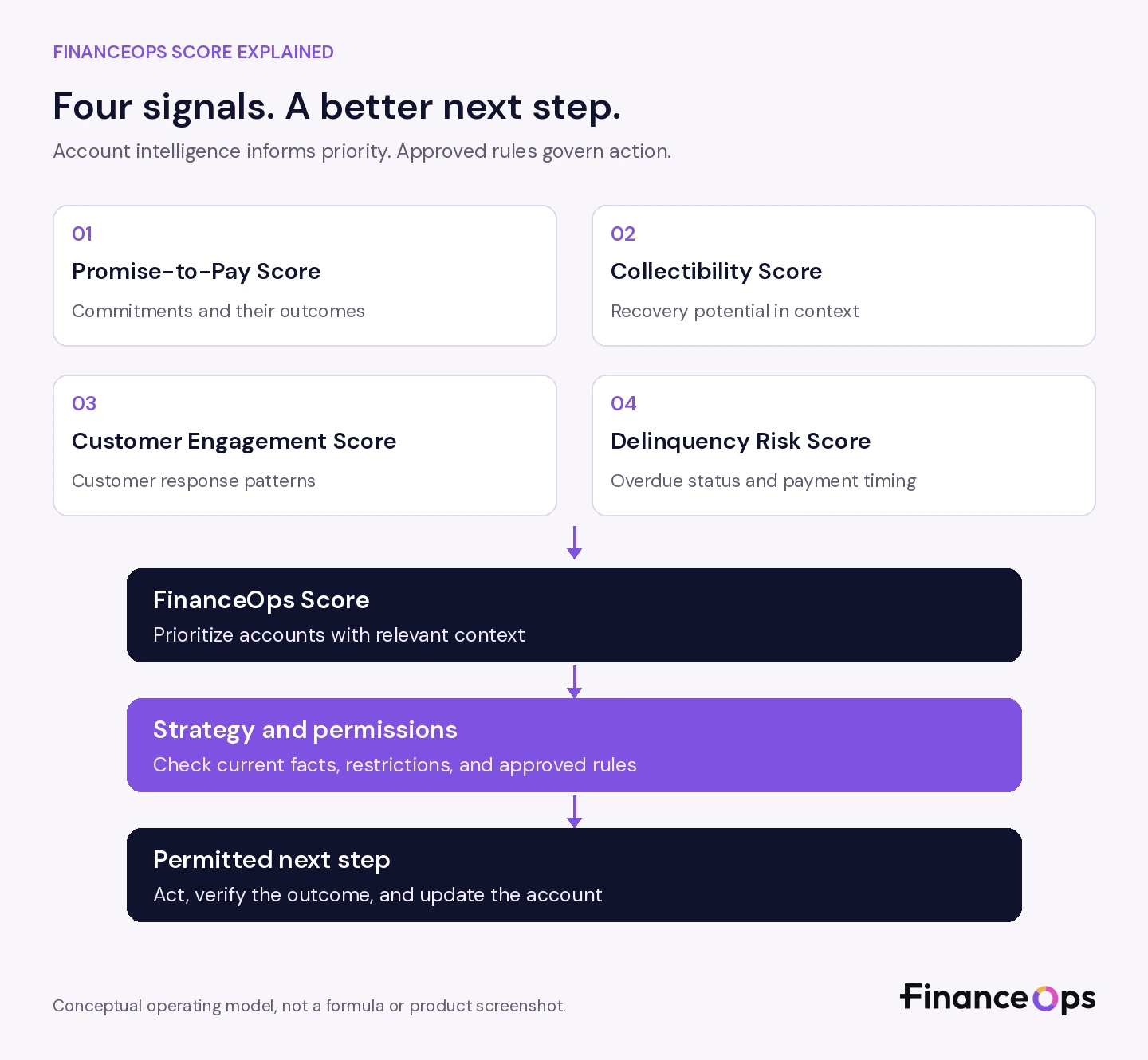
The four signals, explained through everyday account situations
1. Promise-to-Pay Score: a commitment needs an outcome
“I'll pay on Friday” is useful information. It is not received cash.
The Promise-to-Pay signal concerns payment commitments and their history. To understand that context, a team should distinguish a promise recorded, its agreed amount and date, a payment initiated, and a confirmed payment outcome.
Consider a customer who has kept several commitments but asks for a different date this month. Compare that with an account carrying an expired promise and no confirmed payment. The same follow-up cadence may not suit both.
A returned payment needs particular care. It can explain why the record does not match the customer's understanding. Before treating a promise as broken, check the agreed terms, payment status, allocation, and any unresolved exception.
The operating question is simple: What happened after the commitment? The useful answer comes from reliable account records, not a persuasive conversation alone.

2. Collectibility Score: recovery potential needs context
Collectibility concerns the prospect of recovering an overdue balance. It helps teams look beyond which account is oldest or largest.
For an operational review, inspect whether the balance is valid, the account is eligible for the proposed action, and an unresolved issue is obstructing payment. These are operational checks to make before acting, rather than a list of the model's inputs.
A collectible balance may still require a billing correction or a staff conversation before payment can happen. Prioritizing it should bring the appropriate work forward.
3. Customer Engagement Score: a response is a clue, not consent
Engagement concerns customer response patterns. A customer who is actively replying presents a different situation from one whose contact information may be incorrect.
But an open message, a portal visit, and a meaningful reply are different events. None automatically establishes authorization for a payment or a new contact channel.
Read the context of the engagement. “Please explain this charge” should lead to an explanation or review. “I need help with the installment” should lead to an approved support path.
High activity can reflect confusion or frustration. Low activity can reflect a delivery failure. A team that treats either as an automatic reason to intensify reminders can miss the actual barrier.
4. Delinquency Risk Score: timing matters, but it is not the whole story
Delinquency concerns overdue status and payment timing. The signal helps bring the time dimension into account prioritization.
The useful review includes what has changed: a newly missed due date, an overdue installment, or a payment that has posted since the last account update.
An aging bucket describes elapsed time. A predictive signal adds a forward-looking perspective to prioritization. For example, a newly missed installment may deserve a different review from an overdue balance awaiting a correction.
Read component values according to their displayed labels. The interface shown later uses “On-time / Delinquency,” so a larger number should not automatically be described as greater delinquency risk.
What “predictive” does, and does not, tell you
Predictive recovery intelligence uses available account signals to support forward-looking decisions. Its value is in improving the order and relevance of work under uncertainty.
A score is not automatically a payment probability. A value of 80 does not mean an 80% chance of payment unless the provider defines that interpretation and validates it for a specified outcome and time horizon.
FinanceOps Score supports collections prioritization. It should not be presented as a credit bureau score, a recovery guarantee, or payment authorization.
Before interpreting a numeric score, establish four things:
- Target: What outcome is the score intended to predict or prioritize?
- Horizon: Over what period is that outcome assessed?
- Scale: What do values and component directions mean?
- Evidence: How well does that interpretation hold for accounts like yours?
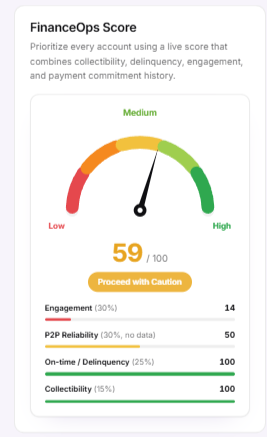
Confirm the production formula, refresh behavior, and any probability interpretation in your deployment documentation. The screenshot in this article illustrates one displayed account view.
For the wider operating model, read How Does Autonomous Collections Software Actually Work?.
Same balance, different next step
Here is a hypothetical example, not a FinanceOps prediction or customer result.
| Account context | What the team should verify | Appropriate direction to consider |
|---|---|---|
| A: $500 overdue, customer confirms Friday payment, previous commitments kept | Agreed amount and date, payment status, permitted follow-up | Support the agreed commitment and verify its outcome |
| B: $500 overdue, customer disputes one charge and is actively replying | Disputed amount, supporting records, review owner and applicable restrictions | Route the issue for resolution before further affected collection activity |
| C: $500 overdue, no meaningful response, messages may not be reaching the customer | Contact accuracy, delivery results, approved channels and restrictions | Correct the contact problem or route for staff review |
The balances match. The work does not.
Account A needs commitment follow-through. Account B needs an answer about the charge. Account C needs a contact check. Prioritization becomes useful when it brings the right task forward, instead of putting every account into the same reminder sequence.

From a score to an approved action
The handoff between prioritization and treatment is where recovery intelligence becomes operational.
Start with the current account record. Review the relevant signals and any exceptions. Apply the approved strategy, check permissions and restrictions, then carry out the permitted action. Record the result against the account.
A dispute, hardship request, consent change, or payment update should not disappear beneath a composite number. Those facts can change which action is appropriate regardless of the account's position in a queue.
Keep an explanation of the decision that staff can use: the score snapshot available at the time, material account facts, the rule applied, the action taken, and its outcome. Ask which of those records the deployed system exposes and retains.
Agentic AI in Finance explains how this fits into a broader automation model.
A live score is only as useful as the account state behind it
A payment has posted, but yesterday's balance still appears in the collections queue. The prioritization may look sophisticated while the next message is already wrong.
Data freshness matters for both scoring and action eligibility. Set expectations for payment updates, reversals, commitments, contact changes, and unresolved cases. Identify the authoritative system for each record and make integration failures visible.
Missing history deserves its own interpretation. An account with no recorded promises is not the same as an account with repeatedly broken promises. Ask how the system distinguishes unknown information from an unfavorable outcome.
Also separate score refresh from model retraining. New account data may change a score without changing the underlying model. Ask separately how account scores update and how model changes are evaluated.
Before an affected action runs, check the freshness and eligibility requirements for that action. If essential information is unavailable, use the agreed hold or review path.
How to tell whether prioritization is actually helping
A priority group that pays more is encouraging. It does not, by itself, prove that a new treatment caused additional recovery. Some customers would have paid under the existing process.
Evaluate two questions separately.
Does the score rank accounts usefully? Define the outcome and observation window, then compare verified outcomes across score bands. Keep starting balances, account age, eligibility, and relevant segment differences visible. For promises, distinguish kept commitments from messages that merely sound positive.
Does acting on the score improve results? Where practical, compare an eligible pilot group with a comparable control group receiving the existing process. Measure received and applied payments with a documented treatment for returns, refunds, and credits.
| Measure | Why it matters |
|---|---|
| Recovery by starting balance and account segment | Shows where prioritization is useful rather than hiding differences in an overall average |
| Kept promises and completed arrangements | Tests outcomes after commitments |
| Time to resolve disputes or payment exceptions | Checks whether the process removes obstacles |
| Staff time and total treatment cost | Reveals the operational cost of the recovery approach |
| Complaints, repeated contacts, and blocked actions | Keeps customer experience and policy boundaries visible |
If a score is explicitly presented as a probability, calibration matters too: predicted probabilities should correspond to observed outcomes over the defined horizon. Ranking quality and probability accuracy are different tests.
Review performance when portfolio conditions or data sources change. NIST's AI Risk Management Framework offers a voluntary resource for managing AI risk. It is not a certification of FinanceOps or a substitute for your applicable policies.
Where FinanceOps Score fits in the FinanceOps workflow
FinanceOps Score provides a prioritization signal. Strategy Builder is the place to review configured treatment paths and limits. Evaluate Autopilot for eligible automated work and Copilot for staff-assisted cases.
The important demonstration is an account moving through those responsibilities: what is known, why it is prioritized, which action is allowed, and what happens when the customer raises an exception.
FinanceOps dashboards describe portfolio and workflow reporting, including commitment outcomes and account behavior. Use that visibility to review results, not just activity volume.
How to read the FinanceOps Score screenshot
The supplied interface shows an overall score of 59/100, a Medium indicator, and “Proceed with Caution.” Its component labels connect to the four signal areas:
- Engagement corresponds to Customer Engagement Score.
- P2P Reliability corresponds to Promise-to-Pay Score.
- On-time / Delinquency represents the payment-timing signal discussed under Delinquency Risk Score.
- Collectibility corresponds to Collectibility Score.
The example shows Engagement at 14 and P2P Reliability at 50, with “no data” beside P2P. That annotation matters: a displayed value without history is not evidence of a customer breaking promises. On-time / Delinquency and Collectibility each show 100, but those values do not establish that a payment has been received.
The card also displays component percentages. Treat these as the configuration illustrated in this screenshot, rather than universal production weights. The practical takeaway is to inspect the component labels and missing-data context before deciding what the overall number means for an account.
Bring three accounts to the conversation
Choose one account with a kept commitment, one with an unresolved issue, and one with limited history. Ask the team to explain the score interpretation and show the next permitted action for each.
Then introduce a new payment or dispute. Observe what changes, which record owns the update, and how the next action is checked.
For industry context, see FinanceOps for credit unions and FinanceOps for utilities. Compare the proposed scope and costs with FinanceOps pricing.
The goal is a queue your team can explain and a customer interaction that moves the account toward a clear outcome. Recovery intelligence earns its value when it helps both happen.