
Agentic AI for accounts receivable coordinates customer conversations, account information, and authorized actions toward a resolved invoice. It can help teams work through the exceptions that a reminder alone cannot settle.
A customer replies, “We need the purchase order before accounts payable can release this.” The invoice is still overdue, but the next useful step is documentation. Another payment reminder may add noise while the same blocker remains.
For an AR manager, the practical question is whether the software helps complete that work and keeps the financial record accurate.
How Is Agentic AR Different From a Reminder Sequence?
A reminder sequence follows a configured schedule. An agentic workflow can interpret a response, retrieve permitted information, request an allowed action, and use the result to decide what comes next.
NIST's explanation of agentic AI describes goal-directed behavior and adaptation to changing conditions. In AR, those conditions include a disputed amount, missing purchase order, approved payment commitment, or transaction waiting to be applied.
Rules remain useful. They can set due-date triggers, approval thresholds, and limits around the workflow. Generative AI can interpret a reply or prepare an explanation. These capabilities can work together.
Read AI Collections vs. Traditional Platforms for the category comparison.
What Happens When Documentation Is Missing?
Return to the customer waiting for a purchase order reference. A useful process would:
- Identify the invoice and customer account.
- Check whether the required reference exists in an authorized system.
- Send approved documentation or route the missing item to its owner.
- Record the customer response and expected next step.
- Verify whether payment or another unresolved issue followed.
If the reference cannot be found, the workflow needs a staff handoff. Inventing a purchase order number would create another problem.
Keep attachments and messages connected to the invoice so the next person can understand the blocker without asking the customer to repeat it.

Which System Owns the Invoice?
Define ownership before connecting tools. The ERP or accounting system may own the invoice balance and adjustment history. A payment system may own transaction status. A resolution workflow may own the conversation and task history.
The agent should use verified references to connect those records. It should not infer payment posting from a customer's message or overwrite a balance based on an explanation it generated.
Document how partial payments, credit notes, disputed portions, and multiple invoices are represented. Otherwise, a correct transaction can still be applied to the wrong obligation.
Where Should Human Review Remain?
A customer asking for a copy invoice differs from requesting a credit or challenging a contractual charge. Give each task its own authority.
Staff should handle decisions outside the permitted scope, conflicting records, and investigations that need commercial judgment. The handoff should include the invoice, issue, attempted actions, and reason for review.
Set a completion state for the handoff itself. Moving a case to a queue does not prove someone resolved it.
How Does FinanceOps Support Invoice Resolution?
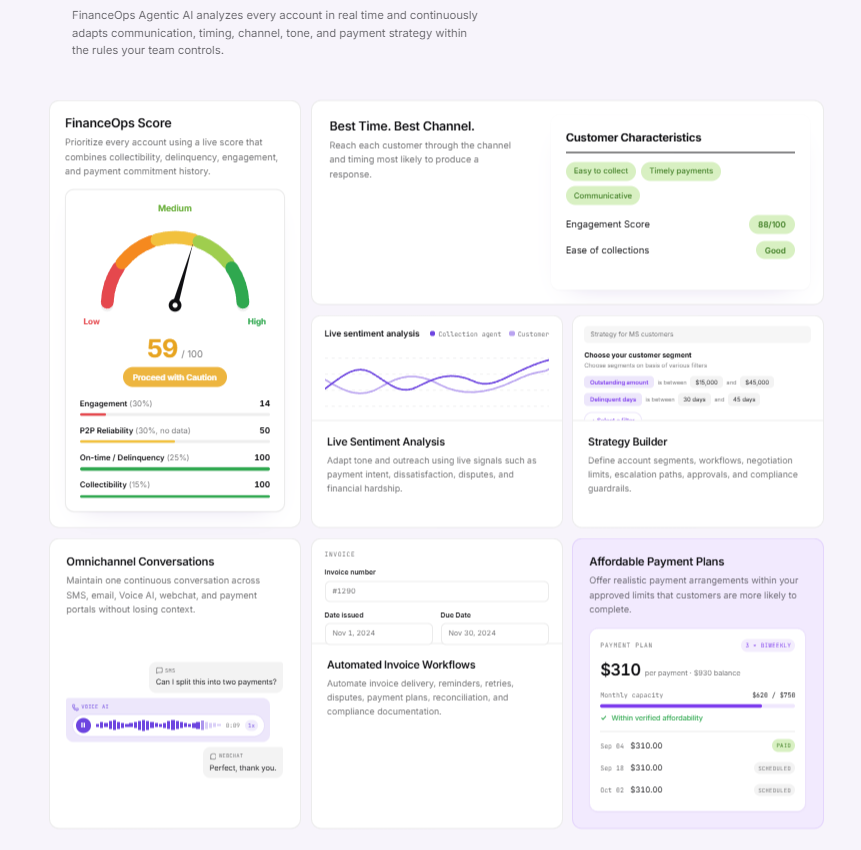
FinanceOps combines account intelligence, omnichannel conversations, treatment controls, and financial follow-up. Strategy Builder supports configured paths for eligible accounts and exceptions.
Invoice workflows help connect delivery, follow-up, disputes, and payment activity. Agentic Payments addresses the payment journey, while Dashboards support operational review.
Scope the deployment around your accounting records and actual resolution process. The relevant test is whether it reduces the work needed to complete an invoice outcome.
How Should an AR Team Start?
Choose a frequent exception with a clear owner, such as missing documentation or a payment awaiting application. Measure the current touches and resolution time before changing the workflow.
Test a successful case, a missing document, a conflicting balance, a partial payment, and a request requiring approval. Confirm that account updates reach the correct record and that staff can review the history.
Review FinanceOps pricing alongside integration and remaining staff work. Expand once the process produces reliable outcomes across the agreed cases.