
A collector opens an account showing a $700 statement balance. Only $200 is overdue. Before the next call or email, the collector needs to know whether that $200 is still unpaid, whether the customer raised a billing issue and what follow-up the account permits.
A monthly statement is a dated summary of account activity, usually showing an opening balance, charges, payments, credits and a closing balance. For a collector, it is a reconciliation reference, not a complete instruction for today's outreach.
This guide is for in-house collectors, collections managers, A/R leaders and finance operations teams handling their organization's receivables. It explains how to use statements to request the right amount, avoid repeated payment questions and hand unresolved issues to the right owner.
The examples use invoice-based accounts. Loans, credit cards and other regulated products can have different statement and delinquency requirements.
What should collectors check on a monthly statement?
Before contacting the customer, establish which amounts are current, which are overdue and whether later account activity changed the position.
| Collector's check | Why it matters before contact |
|---|---|
| Account reference and authorized recipient | Match the correct account and use the approved verification process |
| Statement period and cutoff | Know how old the displayed information is |
| Opening balance and dated invoices | Explain the origin of the outstanding amount |
| Applied payments and approved credits | Avoid requesting amounts already resolved in the ledger |
| Unapplied receipts or pending updates | Identify payment mismatches requiring reconciliation |
| Current versus overdue balance | Request only the amount appropriate to the account and terms |
| Invoice due dates | Establish days past due without resetting terms at each statement |
| Latest conversation, commitment and review status | Avoid a follow-up that ignores an unresolved issue |
| Permitted contact and payment routes | Choose an eligible channel and authorized next step |
Intuit's explanation of statements and invoices distinguishes an account summary from a request for payment for specific goods or services. The monthly statements glossary provides a shorter definition.
Is a monthly statement the same as an invoice?
An invoice normally identifies a specific amount billed for goods or services. A monthly statement brings account activity together over a period and may include several invoices, payments and credits.
| Document | Main question it answers | Operational use |
|---|---|---|
| Invoice | What was billed, and when is it due? | Establish the specific receivable and its terms |
| Monthly statement | How did the account balance change during this period? | Explain and reconcile activity across the account |
| Aging report | How much remains unpaid, and how overdue is it? | Segment receivables using a defined aging basis |
A new statement does not, by itself, replace the original invoice terms or reset its due date. A change in payment terms needs the relevant authority and an accurate account update.
What does a monthly statement look like? A worked example
Consider a fictional business account with a statement period of October 1 through October 31, 2026. Its opening balance is $450. A new $500 invoice is added, and a $250 payment is applied during the month.
| Statement component | Amount |
|---|---|
| Opening balance | $450 |
| New invoice charges | $500 |
| Applied payments | -$250 |
| Approved credits and other adjustments | $0 |
| Closing balance | $700 |
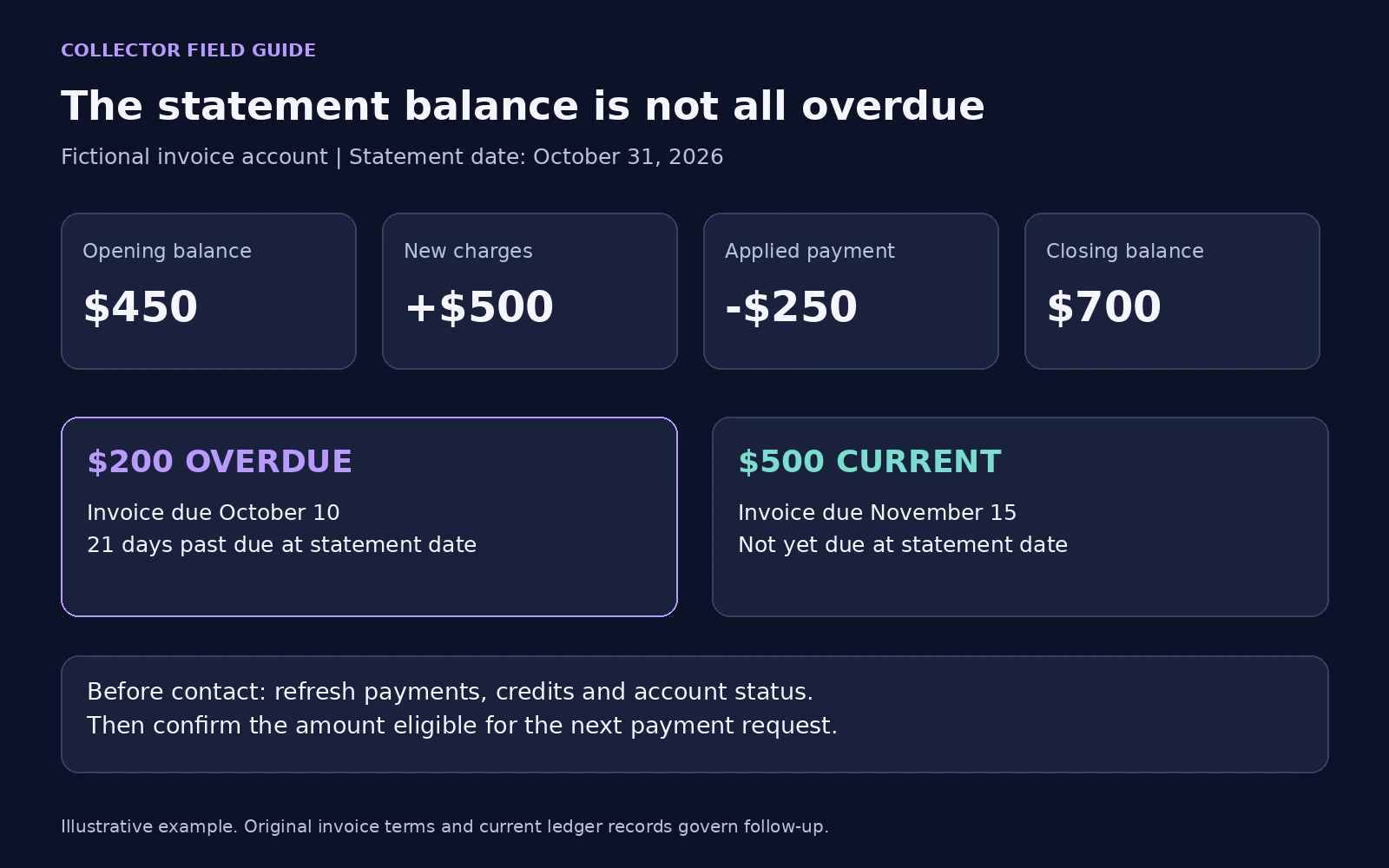
For this simplified example:
Closing balance = opening balance + new charges - applied payments - credits.
The original $450 invoice was due October 10. The $250 payment was applied to that invoice on October 25, leaving $200 overdue at October 31. The new $500 invoice is due November 15 and remains current at the statement date.
The statement therefore shows $700 outstanding, comprising $200 overdue and $500 not yet due. Asking for the entire $700 as an overdue amount would misrepresent this example account.
This is a synthetic illustration, not a customer result or a universal statement format. Other accounts may include authorized interest, fees, reversals or adjustments requiring their own reconciliation.
How do monthly statements connect to aging buckets?
A statement explains account activity. Aging buckets classify the unpaid amounts by a defined time basis, commonly days past the contractual due date.
In the example, the remaining $200 is 21 days past due on October 31 and falls in a 1-30-day overdue bucket. The $500 due November 15 remains current. One customer can have balances in multiple buckets at the same time.
Use the aging view to identify overdue items, then use the latest account and conversation record to decide whether to contact the customer or resolve an exception.
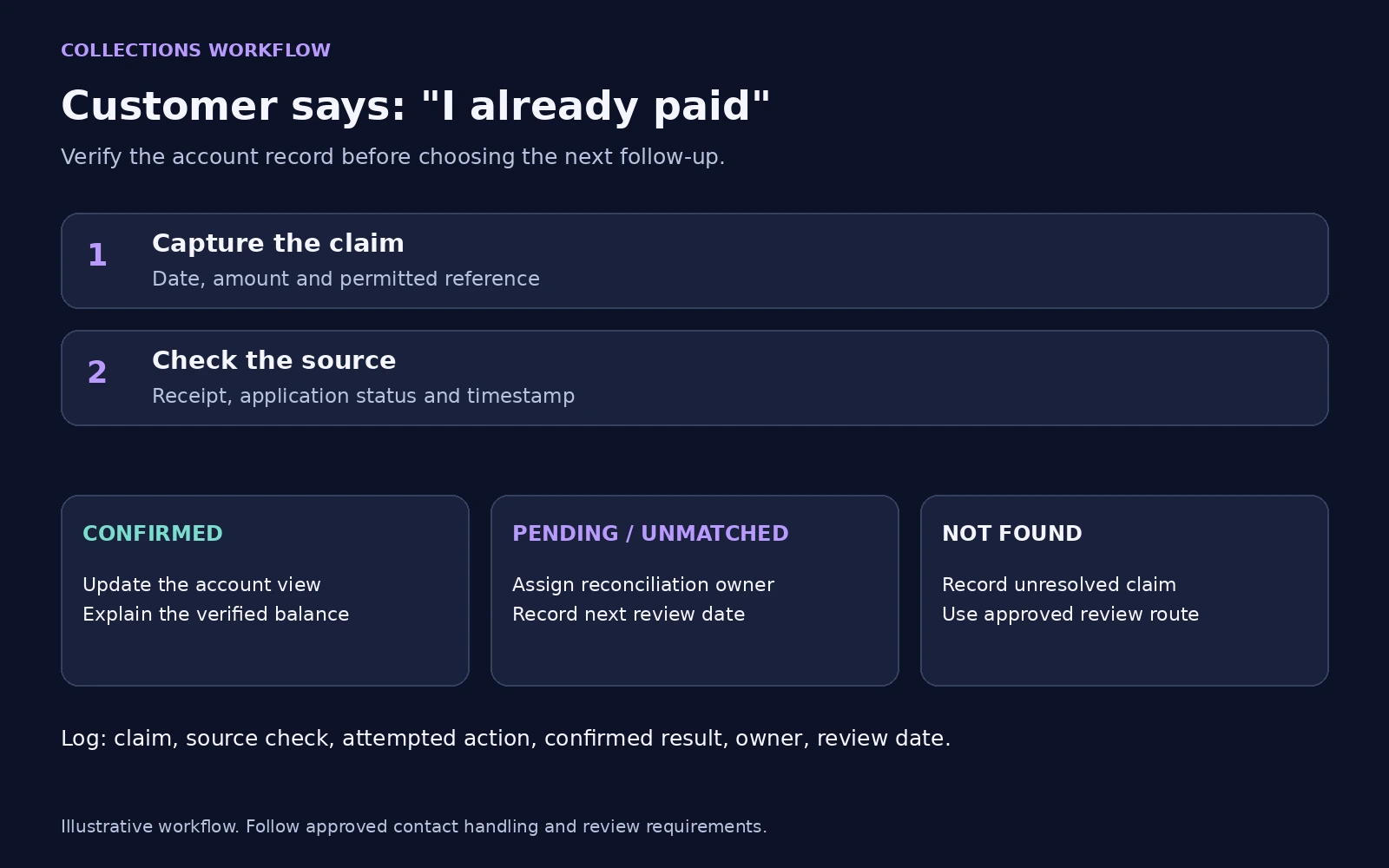
What should happen when a customer says, "I already paid"?
Check the current account record before repeating a payment request. The statement shows a dated position; the connected ledger may now contain later activity.
An account team can use a simple review sequence:
- Identify the payment: Record the customer's stated date, amount and permitted reference details.
- Check the source: Look for the receipt and its application status in the authorized system of record.
- Preserve uncertainty: An unmatched receipt, pending transaction or delayed update is not a confirmed account resolution.
- Choose the approved next step: Explain the verified position or route the mismatch to the responsible team before further routine requests.
Keep a customer's report of payment separate from a payment the account record confirms. The receivables tracker guide explains why commitments, reported payments and confirmed cash need distinct fields.
How can Collectors Brain help with statement follow-up?
Collectors Brain is designed to connect available account records, customer conversations and configured policies so a collector's next step reflects the latest evidence.
In the $700 example, suppose the customer reports paying the overdue $200 after the statement date. The workflow should check the connected payment record. A confirmed, applied payment changes the overdue amount. An unmatched receipt remains a reconciliation task. A billing question follows its approved review route. A statement alone cannot establish which outcome occurred.
The intended connection is specific: statement context identifies the balance, the current account record confirms its status, and approved rules govern the next action. Confirm the supported inputs, actions and review routes for your deployment.
Read AI Collections With Context: Meet Collectors Brain for the product direction and AI Collections Compliance: Where Human Review Fits for exception handling.
| Account evidence | What needs checking | Example of an authorized next step |
|---|---|---|
| A statement shows $200 overdue | Whether later payments or credits changed that amount | Explain the confirmed balance or request review |
| A customer questions an invoice | The disputed item and the applicable review process | Record the concern and follow the approved dispute workflow |
| A customer states a payment date | The commitment, account eligibility and follow-up policy | Record the commitment and apply permitted contact handling |
| The payment update is delayed | Source timestamp, transaction reference and unresolved status | Preserve the uncertainty and route for confirmation |
The statement amount is one input. A reply, an account restriction or a confirmed payment can change which action is appropriate. Contact permissions and approved policies remain boundaries on the workflow.
For the wider operating model, read Intelligent Collections: An Operating Guide for Finance Teams.
Should a monthly statement trigger an automatic reminder?
Use a separate eligibility check before a reminder is sent. Issuing a statement does not establish that every listed amount is overdue or that every account is eligible for the same contact.
Check the current balance, relevant due dates, contact permissions, unresolved issues and any approved payment arrangement. A dispute or missing payment update may require review. A customer requesting assistance may need the configured support workflow.
Required statement delivery and discretionary follow-up also serve different purposes. Configure each according to the account, agreement and applicable requirements rather than treating one calendar event as permission for every communication.
Is a monthly statement a debt validation notice?
A monthly statement and a debt validation notice serve different functions. An ordinary account summary should not be assumed to satisfy the separate validation requirements that apply to covered debt collection.
The CFPB explains the validation information covered debt collectors must provide. Determine the requirements for the actual product, jurisdiction and collection role with the responsible compliance or legal team.
How should a collector explain the statement balance?
Use the account's verified position and make the overdue portion explicit. The following wording is illustrative, after approved identity verification and eligibility checks:
When $200 remains overdue: “Your October statement shows $700 outstanding. Of that, $200 was due October 10, and $500 is due November 15. The account record I checked today still shows the $200 unpaid. Is there a question about that invoice I can help resolve?”
When payment is reported but unmatched: “Thank you for letting me know. I haven't confirmed that payment in the account record yet. What date was it sent?” Record the response and follow the approved reconciliation route. Ask any further reference question separately.
Do not describe an unmatched payment as failed, promise a contact pause that has not been applied, or call the full statement balance overdue.
What should the collector record before closing the task?
Leave the next person enough context to act without asking the customer to repeat the same explanation. Record the source timestamp, confirmed overdue amount, customer's stated issue, action attempted, confirmed result, unresolved item, responsible owner and next review date.
For example: “Customer reports $200 paid on November 2. Receipt not yet matched in the ledger checked November 3. Reconciliation assigned to cash application. Next review November 4.” This describes an unresolved payment claim, not a completed recovery.
What should collections managers measure?
Track payment-mismatch cases, time to reconcile them, repeat contacts while an issue remains open and confirmed cash from the eligible accounts worked. Define the observation period and eligible population. Measure reconciliation time from assignment to a verified outcome, and report unresolved cases separately. A sent statement, customer reply or payment commitment is not confirmed cash.
These measures show whether statement follow-up is resolving balances or creating more reconciliation work.
Key takeaways for collectors
- Separate the total statement balance from the overdue amount.
- Refresh the account position before requesting payment.
- Verify reported payments and assign unresolved mismatches.
- Record the owner and next review date for every exception.
- Use Collectors Brain's product direction to evaluate how account context can support your approved workflow.