
A patient receives a payment reminder and replies, “That charge is being reviewed by the office.”
The account still shows a balance. The conversation contains a billing concern. The right response depends on the practice’s approved process and the evidence available to the workflow.
Human review in AI collections gives an authorized person responsibility for cases that need judgment, missing information, or an exception decision. In the Collectors Brain product direction, review is part of how the operation works, including how resolved cases can inform future guidance.
AI collections compliance is an operational requirement involving applicable rules, approved policies, implementation controls, and oversight. This article focuses on human review within that work. It explains product design principles rather than providing a legal interpretation or guaranteeing compliance.
Where human review fits in an AI debt collection workflow
An organization defines review triggers for its deployment. Those may include conflicting records, unsupported requests, disputes, hardship, failed actions, or uncertainty about which rule applies.
The trigger should be specific enough to explain why the case stopped. “Needs review because the payment status conflicts with the latest customer statement” gives a reviewer a clearer task than “AI confidence low.”
The system should also define what may happen while the case waits. Any permitted hold or follow-up needs an owner, a review condition, and a handling rule. An unanswered queue should not become an indefinite operational state.
What a reviewer needs
The case should show relevant account identifiers, source records and timestamps, the customer’s words, the rule involved, prior actions, and the decision being requested. Access must match the reviewer’s role.
Facts, statements, and inferences should remain distinct. “Customer says the office is reviewing the charge” is not the same as “the charge is invalid.” A summary should help a person inspect the evidence, not replace it.
In the patient example, a qualified staff member can check the billing record and decide the approved next step. The workflow should record that decision and confirm any resulting action.
Copilot describes FinanceOps’ human-led operating mode. For practice-specific billing context, explore the dental solution and healthcare solution; confirm the review roles and permissions for your organization.
One resolution does not create a universal rule
A reviewer might find that this specific charge needs correction. That outcome does not justify correcting every similar balance automatically. It may depend on facts unique to the account.
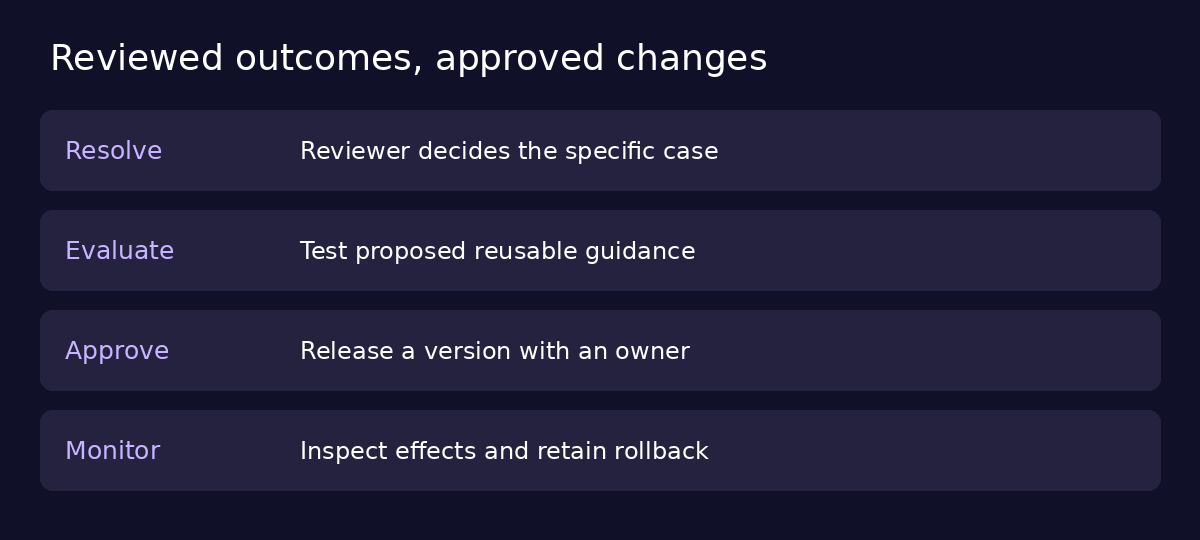
If the case reveals a reusable process gap, the team can propose an update to approved knowledge or workflow configuration. A separate review should decide whether the guidance generalizes and which cases it covers.
This is how Collectors Brain can be described as using reviewed outcomes responsibly. It does not mean every conversation automatically retrains a production model.
Human-in-the-loop AI collections: a review lifecycle
Capture the outcome and supporting evidence. Identify the proposed change. Is it a factual knowledge correction, a workflow rule, or an actual model change? These require different implementation and review processes.
Next, test the change against representative cases and relevant edge cases. An update that fixes one billing concern should not create an inappropriate option elsewhere.
An authorized owner then approves a versioned release. Monitoring should track the intended behavior and unexpected effects, with a rollback path if the change causes problems. The exact controls depend on the deployment and change type.
The Strategy Builder page provides context for configurable workflows. Request the relevant change-management, access, and oversight materials through the compliance policy library, then confirm the controls used for your deployment.
Preserve the customer’s concern
The patient’s message may reflect frustration or uncertainty. That signal can guide a respectful tone. It does not establish a clinical condition, coverage decision, hardship status, or ability to pay.
The useful response acknowledges the issue and follows the approved path to a person who can resolve it. It should not make an unsupported promise about the balance.
For the evidence that should travel with the case, read account context. For how an assistant can communicate the handoff, read context-aware Voice AI.
Measure resolution quality
Track queue age, ownership, completeness of evidence, and whether the authorized decision was actually carried out. Review recurring exceptions to find process gaps. A lower escalation rate alone is not proof of improvement; the workflow might simply be failing to flag difficult cases.
Pair efficiency measures with case-quality reviews. Ask whether customers reached the right path and whether reviewers can reconstruct what happened.
The payment-outcomes article applies the same discipline to confirmed financial results. The Collectors Brain guide explains how the parts connect.