
At 9:00 a.m., a reminder is scheduled. At 8:40 a.m., the customer has asked the billing team to review a charge. The reminder system still sees an overdue balance.
Two records can each be accurate and still produce the wrong next contact when nobody connects them.
Collections account context is the relevant history, current status, customer statements, and approved guidance needed to decide how an account should be handled. Collectors Brain is being developed to bring those pieces into the decision, subject to the sources and workflows enabled for a deployment.
Debt collection automation moves defined tasks through configured workflows. The account-context question is what should happen before a reminder, follow-up, or escalation runs. This article examines that decision through the Collectors Brain product direction.
What account context does debt collection automation need?
The useful starting point is information the organization is authorized to use: account identifiers, current balances, payment status, prior conversations, commitments, recorded disputes, and stated communication preferences.
Approved operating knowledge adds the handling rules. A commitment may require one follow-up path. A billing question may require another. Contact permissions and stop conditions also affect which actions remain available.
More data is not automatically better context. Each item should be relevant to the account, permitted for the purpose, and traceable to its source. Public profiles or demographic proxies should not be used to guess an individual’s willingness or ability to pay.
For a lending example, explore FinanceOps for banks and credit unions. A recorded commitment and a reported payment still need the source, freshness, and handling rules appropriate to that account.
Freshness changes the meaning of a fact
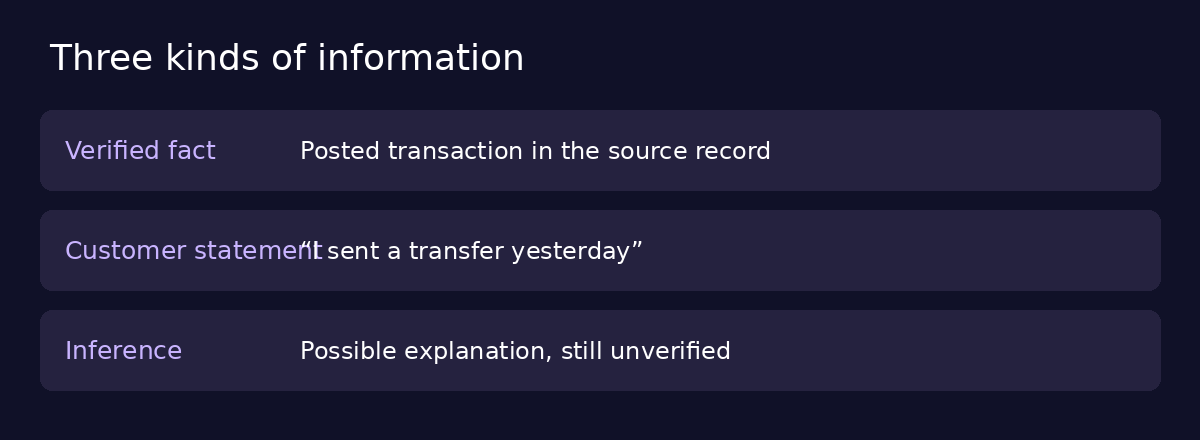
An unpaid balance from yesterday is not the same as a current payment status. A customer’s report of a transfer does not establish that it has posted. A conversation summary should not erase that distinction.
A useful account view makes the timestamp and source visible. It also identifies missing information. When the freshest record is too old for the decision, the workflow should obtain confirmation or route the uncertainty rather than produce a confident guess.
In the scheduled-reminder example, the Brain’s proposed role is to connect the billing-review request with the account and evaluate the configured next step. The workflow should establish whether the request requires review, whether routine outreach may continue, and who owns the decision.
A checklist for collections workflow automation
Before an action, ask five questions:
- Is this the correct account, with the required identity and access checks complete?
- Which record is authoritative for the fact being used?
- How fresh is that record?
- Does a prior interaction change the permitted next step?
- What happens if the information is missing or conflicting?
The answers are useful during implementation and during an exception review. They explain why an action was selected and where the process needs a person.
A promise is context, not cash
Suppose a customer agreed to pay Friday. On Thursday, the next contact should reflect that commitment under the organization’s policy. On Monday, the account needs a fresh status check before anyone labels the promise broken.
If the payment record is unavailable, “not confirmed” is more accurate than “did not pay.” A broken commitment classification needs the evidence and rules that support it.
This distinction carries through payment confirmation and economics. Reporting should preserve the difference between an agreement, an attempted transaction, and confirmed cash.
Make handoffs useful
An exception handed to a person should include the customer’s request, relevant facts, sources, timestamps, prior actions, and the reason for review. A summary can help, but the reviewer also needs access to supporting evidence.
For example: the customer requested a charge review; no decision is recorded; the scheduled contact is waiting on the configured handling rule. That is more actionable than a generic “customer unhappy” label.
Sentiment may help shape a respectful response. It cannot establish hardship, identity, eligibility, or ability to pay.
Copilot provides context for the human-led operating mode. Review the compliance policy library when defining access, evidence retention, and review responsibilities.
Where account context meets conversation
The same context should inform enabled channels without requiring the customer to start over. That ambition still depends on permissions, connected sources, and deployment design. The Voice AI article shows how an account-aware conversation can check evidence and respond within approved options.
When the right handling is unclear, human review provides the next path. A resolved case may later inform approved guidance, after review and testing.
What should an evaluation demonstrate?
Use a small set of representative cases, including a recent payment, an active commitment, and a billing concern. For each, ask the product team to show which evidence was retrieved, which rule governed the decision, and how stale data changed the outcome.
Track whether reviewers can reconstruct the decision and whether exceptions reach the correct owner. Do not judge account context by the length of an AI summary. Judge it by whether the next action is supported.
For the full operating model, read the Collectors Brain guide.
The Dashboards page provides portfolio-reporting context, while Strategy Builder covers workflow configuration. In a walkthrough, ask which account evidence and configured rules are visible in the specific Collectors Brain release.