
“Can you stop calling? I spoke to someone yesterday.”
The customer has given the workflow a new instruction. The next response needs to address it.
Conversational AI for debt collection interprets customer requests and generates responses within a configured workflow. Voice AI delivers those conversations through an enabled voice channel. Collectors Brain is designed to connect the conversation with account evidence, approved actions, and human review.
Start with what the customer actually said
The customer’s request contains new information. They report a prior conversation and ask for a change in contact. A useful workflow should capture the request accurately and apply the organization’s approved contact-preference process.
Before discussing protected account details, the interaction must satisfy the identity checks required for that deployment. AI disclosure and communication requirements should also be configured for the applicable use case.
The Brain’s role is not to infer the customer’s circumstances from their tone. It is to connect the statement with available evidence and select a permitted response.
How should Voice AI debt collection handle a commitment?
Assume the required identity checks are complete and the configured workflow permits the following response:
Customer: “I already arranged to pay on Friday.”
Assistant: “I can see a commitment recorded for Friday. Let me check the current account status before we discuss another payment.”
That response is appropriate only if the commitment is actually available in the record. If it is not, the assistant should say what remains unconfirmed and follow the approved review path.
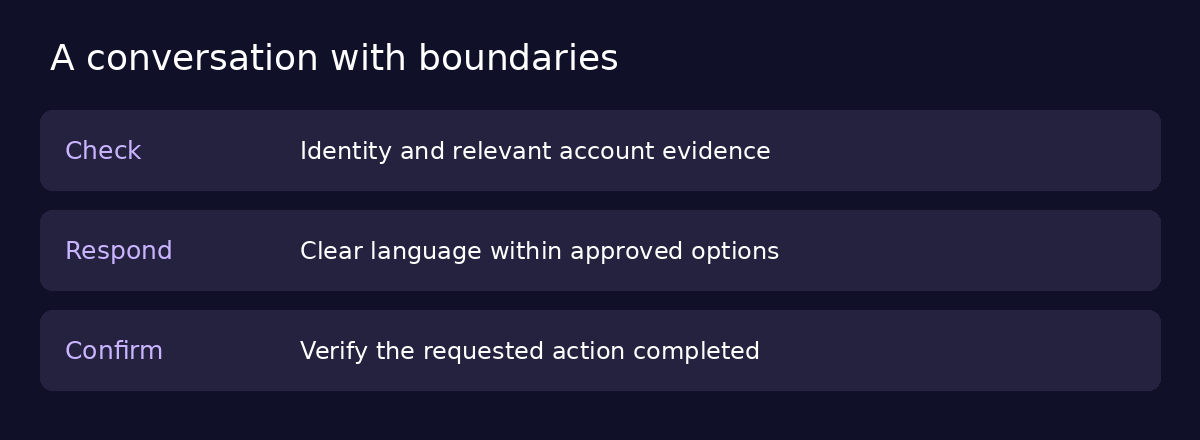
The workflow then checks the latest relevant status and the rules for an active commitment. If policy permits a change to outreach, it requests that change and checks whether the connected system accepted it. If the action fails, it records the failure and routes the case as configured.
The customer should not hear “that is updated” before the update is confirmed.
Compare the configured routine-work model described in Autopilot with the human-led model described in Copilot. Strategy Builder provides additional context for defining the permitted options and escalation rules.
A natural conversation still needs firm limits
Language generation can help explain an approved option clearly. The permitted options themselves come from configured policy and validated workflows.
An assistant should not invent a discount, extend a deadline, waive a charge, or promise an exception because that sounds helpful. When a request exceeds its authority, the next step is a defined handoff.
The account-context article explains the evidence that should support these decisions. The human-review article covers what happens when a person’s judgment is required.
For an industry-specific evaluation, use the utilities solution to frame questions about hardship and service-related requests, or the banks and credit unions solution for borrower and member workflows. Confirm the handling approved for your program.
Adapt the explanation, preserve the rules
A customer may ask for a shorter explanation, a callback, or another enabled communication channel. An approved voice profile and stated preferences can shape delivery within the workflow.
That is different from using psychological profiling to push a payment. A conversational signal is not proof that someone can afford an option. A hardship statement should follow the configured hardship process, with human review where required.
For leaders, the useful question is whether the conversation stays clear when the expected script no longer fits.
A requested callback, handled with context
Consider a customer who requested a callback and said, “Please keep it brief.” In an illustrative configured workflow, those recorded preferences support a concise opening at the requested time:
“Hi, I’m your provider’s AI assistant, calling at the time you requested. Is now still a good time?”
Confirm the required identity checks before discussing account details. The communication preference can shape pace and explanation; it does not establish ability to pay or authorize a different payment option. This is an illustrative script, not a recorded customer call or proof of a deployed workflow.
Carry the handoff with the customer
When a case needs review, capture what the customer requested, the identity-check status, relevant account evidence, actions attempted, and why the workflow stopped. Transfer only the information the receiving role is permitted to see.
An incomplete transfer can force the customer to repeat the story. A complete transfer can give the reviewer a useful starting point without pretending the unresolved issue is already settled.
Use the compliance policy library to request relevant control documentation alongside the demonstration. Evaluate the documented controls alongside the actual behavior of the proposed workflow.
How to evaluate AI debt collection calls
Ask for demonstrations that include an interruption, an unavailable payment record, a disputed balance, a request outside approved options, and a failed workflow action. Check what the assistant says, what it attempts, and what the operational record shows afterward.
A successful conversation is not merely one that sounds human. It should leave a supported disposition: an answered question, a recorded request, an authorized action, or an exception with an owner.
The payment-outcomes article explains why verbal agreement and confirmed payment must stay separate. The Collectors Brain guide connects the full sequence.
Two responses to “I already paid”
Illustrative scripts, subject to the organization’s identity, disclosure, and handling requirements. Assume any required identity checks are complete.
When the authoritative record confirms posting:
Customer: “I already paid.”
Assistant: “The account record shows your payment has posted. I can explain the balance currently shown on the account.”
The assistant should not imply the entire balance is cleared if the confirmed payment only covers part of it.
When confirmation is unavailable:
Customer: “I already paid.”
Assistant: “I can’t confirm that payment from the information available here. I can send your payment-status question for review.”
The second response offers only the review action assumed to be enabled in this example. After requesting it, the workflow must check that the case was created before telling the customer it has been submitted.
A practical Voice AI acceptance test
| Test case | What good handling should demonstrate |
|---|---|
| Customer interrupts | Stops the current response and addresses the new request |
| Customer requests no more calls | Captures the request and follows the approved contact-preference process |
| Payment record is unavailable | States the uncertainty without inventing a status |
| Customer requests an unsupported concession | Preserves the action limit and offers the configured review path |
| Connected action fails | Does not announce success; records the failure and routes it as configured |
| Human handoff is required | Passes permitted evidence, the request, and attempted actions to the responsible reviewer |