
A customer says, “I already paid.” The balance still appears overdue, and the latest payment file predates the reported transfer.
Another reminder could ignore a real payment. Marking the account paid could create a different error. The next step needs evidence.
AI collections uses artificial intelligence to support defined account-handling tasks. Collectors Brain is being developed to connect those tasks with account context, approved rules, and confirmed outcomes, so an action has a reason and its result can be checked.
What is AI collections, and where does Collectors Brain fit?
Collectors Brain is FinanceOps’ customer-facing operations intelligence system being developed to bring approved business knowledge, account context, customer conversations, configured policies, and workflow outcomes together. Its purpose is to guide the next appropriate collections action and carry out defined work through enabled workflows, with human review when needed.
The Brain is the coordinating intelligence; AI agents and connected workflows carry out the actions it is authorized to select. Approved knowledge, channels, integrations, and review queues support that work. Your team defines the operating boundaries and resolves cases that require judgment. The capability available to a particular customer depends on the release, connected systems, and approved configuration.
Explore the broader FinanceOps collections workflow, including Autopilot for configured routine work and Copilot for human-led handling. Confirm which workflows are available for your Collectors Brain deployment.
Why the next action needs more than a balance
A balance explains what the ledger currently shows. It does not explain every conversation around it. A customer might be waiting for a billing correction, following an agreed payment plan, or asking someone to investigate a duplicate charge.
When those details sit in separate systems, staff must reconstruct the account before deciding what to do. The customer may have to repeat the same explanation. Automating another reminder does not resolve that missing context.
Collectors Brain is designed around a more useful question: given the available evidence and the organization’s rules, what should happen next?
How Collectors Brain is designed to work
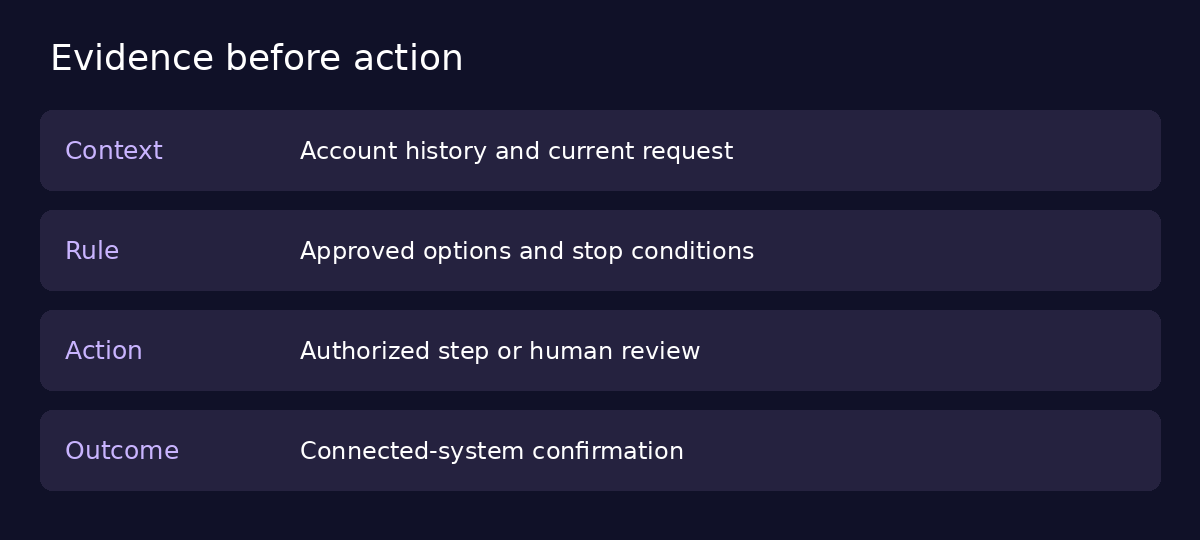
First, assemble relevant evidence. Account records, payment information, prior interactions, commitments, and approved references need a source and a timestamp. Missing or conflicting information should remain visible.
Second, interpret the current request. “I already paid” is a customer statement. A posted transaction in the authoritative payment record is a verified fact. Those are different forms of evidence.
Third, apply the organization’s configured rules. Those rules define permitted options, contact limits, stop conditions, approvals, and escalation paths. Generated language should not override them.
Fourth, execute an authorized step. Depending on the validated workflow, that could mean answering a question, recording a commitment, initiating an approved payment flow, or routing an exception.
Finally, verify and record the result. A requested action and a completed action are different states. The record should show what the connected system confirmed.
The Strategy Builder page explains FinanceOps’ approach to workflow configuration. Use the compliance policy library to request the evidence relevant to your review and confirm how those controls apply to the proposed deployment.
Follow one account through the decision
Consider the customer who reported a bank transfer. In an illustrative configured workflow, the Brain checks the latest available payment record and finds no posted payment. The record is older than the customer’s reported transfer.
The appropriate response is not to declare the balance cleared. The Brain can explain that confirmation is pending and route the case for review. If policy allows a temporary outreach hold, that hold should have a recorded reason, owner, and expiry or review condition.
When a fresh authoritative record confirms the applicable payment state, the workflow can update the account accordingly. If no confirmation arrives, the case stays unresolved and follows the approved review path.
The intelligence is visible in the sequence: evidence, rule, action, confirmation.
Explore the four decisions behind the Brain
Start with account context: what should be available before a reminder goes out? Then explore Voice AI: how should a conversation respond when new information changes the situation?
The next article examines human review and approved guidance, including how resolved exceptions can inform future handling. The final article connects payment confirmation and collection economics, so operational activity does not get mistaken for recovered cash.
How should you evaluate AI debt collection software?
Measure eligible recovered cash, the completeness of payment confirmation, time spent resolving exceptions, and whether account handling follows approved rules. Record the population and measurement period. Separate customer statements, promises, attempts, posted payments, and reconciled payments.
FinanceOps’ broader recovery offering advertises 1.5% of recovered collections plus $1 per payment. Collectors Brain access, included workflows, and final commercial terms should be confirmed for the applicable program. A performance-based fee deserves the same clarity as the workflow itself.
| Evaluation area | What to ask for |
|---|---|
| Account context | Show the source, freshness, and relevant prior interactions. |
| Approved actions | Demonstrate a permitted action, a blocked action, and a human handoff. |
| Execution | Show the connected-system response, including failed or pending actions. |
| Outcomes | Distinguish commitments, attempts, posted payments, and reconciled payments. |
| Governance | Identify the owner, approved configuration, and change-review process. |
Bring a real account to the conversation
A useful evaluation starts with an account that your team had to reconstruct: a disputed charge, a missed commitment, or a payment that could not be confirmed. Ask to see the evidence used, the rule applied, the action allowed, and the result recorded. That is how an account-aware operation becomes concrete.
Match the example to your operating environment: banks and credit unions, healthcare, and utilities have different customer needs and handling requirements. Choose an account scenario and review path specific to your industry.
A useful AI collections demo follows the account, not just the conversation
| Account moment | Evidence to inspect | Decision to demonstrate | Result to verify |
|---|---|---|---|
| “I already paid” | Payment source and timestamp; customer statement | Confirm status or route uncertainty | Applicable payment state or an owned review case |
| Active commitment | Recorded date, amount, and latest status | Apply the commitment-handling rule | Correct follow-up state |
| Billing concern | Customer request and any existing review | Follow the approved billing-review path | Case owner and recorded disposition |
| Request outside approved options | Requested option and configured limits | Block the unsupported action and hand off | No unauthorized change; review recorded |
Run a bounded evaluation before expanding
Choose one account cohort, a fixed measurement window, and a limited set of authorized actions. Agree on eligibility, evidence freshness, review ownership, and the payment state used to measure recovery.
Run routine cases alongside missing-data, conflicting-record, and failed-action cases. A demonstration passes when the outcome is supported and reconstructable, including when the correct result is an unresolved case assigned to a person.
Compare confirmed recovery and handling effort against a matched baseline. Record complaints, incorrect actions, and unresolved exceptions alongside efficiency measures. Expand only the workflows whose behavior and controls have been validated. These are evaluation criteria, not claimed Collectors Brain results.