
A customer agrees to pay $200. The payment link opens. A transaction is submitted. The dashboard marks the case successful.
Which of those events proves cash was recovered?
The answer depends on the confirmed payment state and the reporting definition. A promise is not a payment. A submitted transaction may still be pending or fail. Even a posted payment is different from a reconciled one.
AI collections payment confirmation means checking the authoritative payment record before reporting the applicable financial outcome. Collectors Brain is designed to connect approved actions with verified workflow results, subject to the integrations and release available for the deployment.
The cost of debt collection includes the resources and fees used to recover eligible overdue balances. To evaluate that cost, define what counts as confirmed recovery before comparing software, staff, or partner fees. This is a collection-cost analysis, separate from the corporate-finance cost of borrowed capital.
Why collection costs need confirmed payment states
An operational record should preserve meaningful differences:
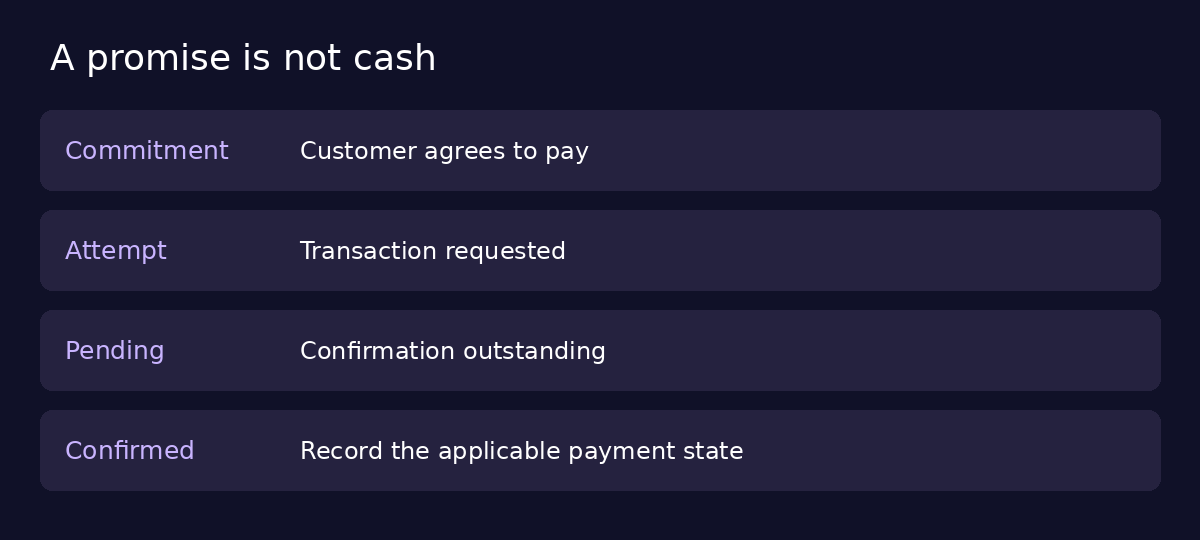
- A commitment records what the customer agreed to do.
- A payment attempt records that a transaction was initiated.
- Pending status indicates confirmation is still outstanding.
- Settlement, posting, and reconciliation describe different stages whose definitions depend on the payment systems and accounting process.
A workflow should say which state it has confirmed and where that confirmation came from. It should not collapse every stage into a single “paid” label.
Follow a failed confirmation
In an illustrative configured workflow, the customer completes an approved payment step. The connected service returns a timeout. The Brain cannot know from that timeout alone whether the transaction succeeded.
The next step should check transaction status through the approved process and avoid an unverified duplicate attempt. Any retry needs the deployment’s authorization and duplicate-prevention controls.
The conversation should explain what remains pending. If the status cannot be established, the case should reach the configured review path with the transaction reference and actions already attempted.
That outcome may be operationally unresolved. It is still more accurate than declaring success or charging the customer again without confirmation.
Connect recovery reporting to evidence
Define recovered cash, eligibility, attribution, measurement period, and treatment of reversals before comparing results. Keep collected dollars separate from contact volume, answered calls, commitments, and opened payment links.
A useful review asks: which accounts were eligible, what cash was confirmed, how was it attributed, and what remains unresolved? This lets leaders compare performance without turning activity into a financial claim.
The account-context article explains why fresh payment data matters before contact. The Voice AI article shows why the customer should hear only what the record supports.
Explore Agentic Payments for FinanceOps’ broader payment-workflow positioning and Dashboards for reporting context. During evaluation, establish which connected system confirms each payment state and how that state appears in reporting.
What should debt collection software pricing include?
FinanceOps’ public recovery offering advertises a 1.5% fee on recovered collections plus $1 per payment. That is a commercial reference for the broader offering, not a confirmed standalone Collectors Brain price or promise that every workflow is included.
The Collectors Brain waitlist registers interest; it does not activate an account or guarantee an access date. Ask which workflows, services, processing charges, and implementation requirements apply to the proposed program.
The FinanceOps pricing page lists Autopilot at 1.5% of collections plus $1 per payment and directs Copilot buyers to sales. Confirm the applicable plan, included services, and written terms rather than applying that headline to every Collectors Brain program.
An illustrative fee calculation
Assume $100,000 in eligible recovered cash and 500 successful recovered payments, with the stated 1.5% plus $1 structure applying to those payments.
The percentage fee is $1,500. The per-payment fee is $500. Together, the collection fee is $2,000.
That leaves $98,000 before separately priced payment processing, Voice AI, optional services, or other agreed charges. The example is arithmetic under stated assumptions, not a quote, forecast, or complete operating-cost comparison.
The agreement determines eligibility, attribution, payment counts, and billing. Those definitions matter as much as the headline percentage.
A practical collection-cost formula
Total collection cost = applicable software or partner fees + payment-related charges + internal staff and exception-handling cost + other agreed operating costs.
Cost per recovered dollar = total collection cost ÷ eligible confirmed recovered dollars.
Use the same cohort, period, and recovery definition in each comparison. If the illustration above has $2,000 in collection fees on $100,000 recovered, the collection-fee component is 2%, or $0.02 per recovered dollar. That is not the all-in cost until the remaining applicable costs are included. If confirmed recovery is zero, the ratio cannot be calculated.
Collections payment reconciliation checks how a confirmed transaction matches the account and ledger. A payment can be confirmed at one stage while reconciliation remains outstanding; record those states separately.
How to compare the cost of debt collection
A fee comparison should consider the total cost of the applicable service and the operational outcome it supports. Track confirmed recovery, exception handling, reconciliation effort, and the quality of customer handling using an agreed baseline.
Do not count an unresolved payment as recovered because it makes the cost-to-collect ratio look better. Do not compare portfolios without accounting for differences in eligibility, age, balance, and measurement period.
For cases that need a person, human review explains how the unresolved issue can receive an owner and a controlled next step. For the full product story, read the Collectors Brain guide.
For a product-specific cohort, the fintech solution and banks and credit unions solution provide industry context. Use the compliance policy library to request relevant evidence on payment handling, data access, and operational controls.