
A collector's queue contains two invoices that are 45 days overdue. One customer reports a payment that has not been matched. The other has not responded. The aging report groups them together, but the collector needs different next steps.
Aging buckets group unpaid receivables into time ranges using a defined report date and aging basis. Due-date aging commonly separates Current, 1-30, 31-60, 61-90 and 91+ days past due.
For in-house collectors, collections managers and A/R leaders, the useful question is: which accounts are eligible for outreach, which need reconciliation or specialist review, and what should happen next?
This guide explains the calculation, then turns the report into a practical collections work queue. Its invoice examples apply to first-party receivables. Product-specific loan delinquency calculations may differ.
What do standard aging buckets tell a collector?
They show how long the remaining balance has been overdue under the report's stated method. They do not establish why it is unpaid or which contact is permitted.
| Bucket | Due-date definition | Collector's first check |
|---|---|---|
| Current | Due today or later | Keep pre-due servicing separate from overdue follow-up |
| 1-30 days | 1 through 30 days past due | Verify the latest balance, payment update and customer response |
| 31-60 days | 31 through 60 days past due | Review unresolved issues, prior contact and commitments |
| 61-90 days | 61 through 90 days past due | Identify blockers, ownership and permitted next steps |
| 91+ days | More than 90 days past due | Review account eligibility and any specialist-review requirements |
These are example reporting boundaries, not mandatory collection schedules or legal thresholds. Intuit's aging-report guidance describes configurable reporting dates and aging periods. Oracle Receivables documentation also explains configurable aging buckets and an as-of date.
For the short definition, visit the aging buckets glossary.
Should aging start from the invoice date or the due date?
Use the due date when the purpose is to measure how late payment is. Invoice-date aging measures the time since the invoice was issued. Label the basis because the two calculations answer different questions.
For example, an invoice issued October 1, 2026 with a due date of October 31 is 16 days past due on November 16. It is 46 days old from issuance. Those values can place it in different buckets depending on the reporting method.
Intuit distinguishes current balances from past-due balances using the transaction's due date. If a due date is missing, investigate the governing terms and system treatment rather than silently assigning an invented date.
How do you calculate days past due?
For this due-date example:
Days past due = max(0, report date - contractual due date), measured in calendar days.
Use date-only values under a defined reporting timezone. Place due-today and future-due balances in Current, then assign positive days past due to one nonoverlapping range.
Keep three rules explicit:
- Use one as-of date for every record in the report.
- Assign each unpaid amount to one bucket at a time.
- Age the remaining balance after applied payments and approved adjustments.
If your portfolio uses different boundaries or product-specific delinquency calculations, document them. Do not treat this invoice example as a rule for every loan or account type.
What does an aging-bucket report look like? A worked example
The following synthetic portfolio is measured as of November 16, 2026. All amounts are remaining unpaid balances, and there are no additional adjustments in this example.
| Invoice | Contractual due date | Remaining balance | Days past due | Bucket |
|---|---|---|---|---|
| A | November 30, 2026 | $2,500 | 0 | Current |
| B | November 4, 2026 | $1,500 | 12 | 1-30 |
| C | October 2, 2026 | $700 | 45 | 31-60 |
| D | August 30, 2026 | $300 | 78 | 61-90 |
| E | July 19, 2026 | $1,000 | 120 | 91+ |
| Total | $6,000 |
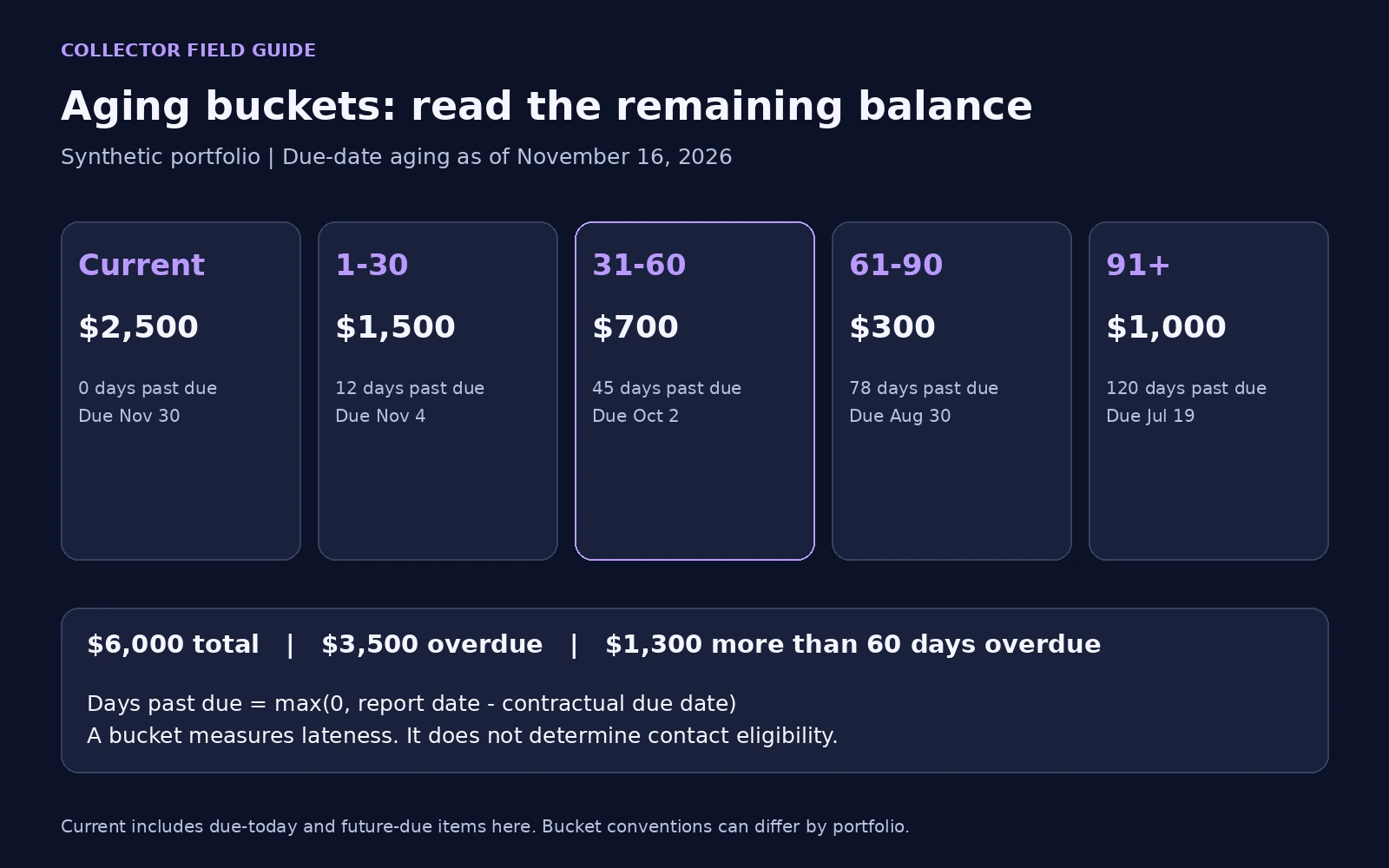
The overdue balance is $3,500. The balance more than 60 days past due is $1,300. That older balance represents 21.7% of total receivables, calculated as $1,300 divided by $6,000.
Specify the denominator. Dividing $1,300 by the overdue balance of $3,500 would produce a different measure: 37.1% of overdue receivables. Both calculations can be useful, but their labels must remain distinct.
How should partial payments and credits affect aging?
If a $1,000 invoice receives a $400 payment that is applied to that invoice, the remaining balance is $600 before other adjustments. Age the remaining $600 using the relevant due date and reporting convention.
A payment sitting as an unapplied receipt needs reconciliation. It should not disappear from operational review simply because the invoice still looks overdue. Likewise, a customer's statement that payment was sent needs verification against the account record.
The accounts receivable tracker guide separates commitments, reported payments and confirmed amounts. Those distinctions help explain why a balance remains in an aging bucket.
Which aging-report mistakes create unnecessary collector work?
- Sorting by age before checking payment status: A reported payment or unapplied receipt may need reconciliation before another request.
- Treating one customer as one bucket: Different invoices can have different due dates and unresolved issues.
- Resetting age after a partial payment: Reduce the remaining balance; change the due date only when an authorized change in terms supports it.
- Treating a commitment as payment: Keep the agreed date separate from confirmed cash.
- Assigning an exception without an owner: Record the responsible team and next review date so the issue does not return to an ordinary contact queue unresolved.
How should collectors prioritize accounts within an aging bucket?
Start by separating accounts requiring reconciliation or review from accounts eligible for routine outreach. Then apply the prioritization method your team has approved.
A useful order is:
- Check data freshness and payment status. Identify pending updates, reported payments and unapplied receipts.
- Apply account restrictions and review requirements. Follow the approved handling for disputes, contact restrictions and sensitive situations.
- Review commitments and conversation history. Check agreed dates and previous requests before choosing follow-up.
- Prioritize eligible work. Use your approved criteria, such as balance, age, scheduled review date and engagement history.
- Assign an owner and next action. Keep reconciliation, billing review, customer contact and specialist work distinguishable.
An older account is not automatically the first account to call. Its current state determines whether a call belongs in the queue.
| Account in the 31-60 bucket | Additional evidence to check | Example next step, subject to policy |
|---|---|---|
| The customer reports paying yesterday | Payment source, reference and application status | Check the payment and explain the confirmed position |
| The invoice amount is disputed | Disputed item, supporting records and review status | Follow the approved dispute-handling process |
| An agreed payment date is still in the future | Commitment terms, eligibility and contact policy | Apply permitted follow-up handling |
| An invoice lacks a purchase-order reference | Required document and responsible internal owner | Route the billing blocker for resolution |
| No response has been received | Current account facts, permissions and prior contact | Choose an eligible outreach action or review route |
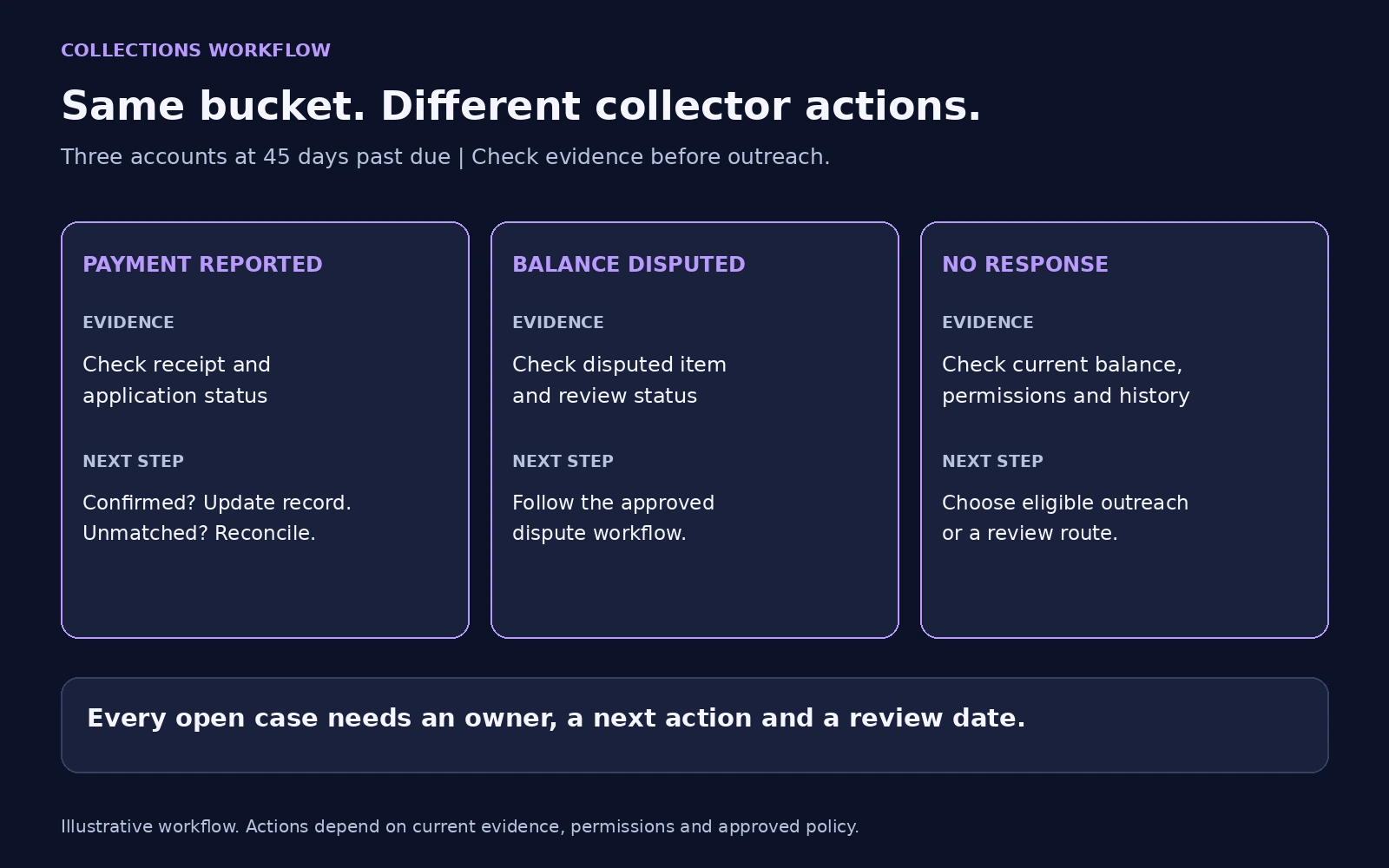
This is a proposed operating framework. Confirm the workflows available in your deployment. For a practical account-level approach, read Debt Collection Automation: Context Before Contact.
How do aging buckets connect to Collectors Brain?
Collectors Brain is designed to bring available account records, conversations, approved knowledge and configured policies together to guide the next appropriate collections action.
An aging bucket can contribute a measure of lateness. Before acting, the workflow still needs to check the latest payment position, the customer's stated concern, the permitted options and whether a person should review the case.
In the worked example, Invoice C is 45 days overdue. Suppose its customer reports a payment. An appropriate workflow would check the source record before repeating the request. If the update is unresolved, it should preserve that uncertainty and follow the configured review path. The aging label remains useful without becoming the only basis for the response.
Strategy Builder provides product context for configured rules. Confirm the specific inputs, actions and approval requirements available for your deployment. For the broader product direction, read Intelligent Collections: An Operating Guide for Finance Teams.
How do monthly statements and aging reports work together?
A monthly statement explains the account's activity and balance over a reporting period. An aging report classifies unpaid amounts at a defined date. Reconcile the two before using either as the basis for follow-up.
A customer can have one current invoice and another overdue invoice. Presenting the total account balance as entirely late can create confusion. A payment made after the statement date can also change the account position before the next aging run.
For the short account-summary definition, see the monthly statements glossary.
What should collections managers measure by aging bucket?
Pair the aging snapshot with outcomes from a defined starting population. Agree on the observation period, account-versus-balance basis and payment-confirmation rule before comparing collector performance.
Read AI Collections With Context: Meet Collectors Brain for the coordinating product direction and AI Collections Compliance: Where Human Review Fits for exception handling.
A simple roll-forward example
Start with 20 invoice accounts in the 31-60 bucket. At the next defined reporting date, six of those same accounts are in an older bucket. The account-based roll-forward rate is 6 / 20 = 30%, using the original 20 accounts as the denominator.
That does not mean the other 70% paid. They may remain in the same bucket, receive credits, be reclassified or be written off. Reconcile every starting account's outcome. Report new accounts entering the bucket separately, and do not compare this account-based rate with a balance-based rate.
| Manager's measure | Definition to agree before reporting |
|---|---|
| Cash collected by starting bucket | Confirmed eligible cash, attributed to each account's bucket at the start of the observation period |
| Kept commitments | Commitments fulfilled by the agreed date under a defined payment-confirmation rule |
| Open exceptions | Payment mismatches, disputes and billing blockers, each with an owner and review date |
| Cohort roll-forward | The same starting accounts or balances moving to an older range under a stated method |
| Collector effort | Time spent on contact, reconciliation and review, measured consistently |
Use these measures to compare work allocation and outcomes. A shrinking 91+ balance can reflect cash, credits, write-offs or reclassification. Reconcile those movements before claiming recovery.
Key takeaways for collections teams
- Define the report date, due-date basis and bucket boundaries.
- Age the remaining invoice balance after applied payments and approved adjustments.
- Separate reconciliation and review cases from eligible outreach.
- Give each exception an owner, next step and review date.
- Measure confirmed cash and cohort movement separately.
Collectors Brain is designed to connect the aging signal with available account context, conversations and approved policies. Evaluate that connection using a real collector workflow and the evidence available for your deployment.