
The next payment problem is not authorization
The payments industry is entering a new phase. AI agents can now discover products, compare options, initiate transactions, and complete purchases with limited human involvement. Payment networks, digital wallets, and open protocols are building the infrastructure required to make agent-led transactions secure, authorized, and scalable.
That progress matters. But it leaves an important operational question unanswered:
What happens when the payment fails?
A card can be declined. An ACH payment can be returned. A recurring payment can expire. A payment can be authorized but not settled. A customer can dispute the balance, request assistance, or become unreachable through the selected channel.
In each case, the transaction has stopped, but the financial obligation has not.
The system must still determine what happened, whether another attempt is appropriate, which channel should be used, what compliance requirements apply, and whether the account can be resolved without human intervention. That is where the next generation of agentic payments must focus.
Key Takeaways
- Transaction completion is only one part of the payment lifecycle. The harder operational problem often begins after a payment fails.
- Failed payment recovery requires context, not simply more retries. The right action depends on payment status, account history, customer behavior, consent, timing, and policy.
- The strongest agentic payment systems will connect processing, servicing, communication, collections, reconciliation, and resolution in one governed workflow.
The current agentic payments model
Most current agentic payment initiatives focus on the front half of the transaction.
An AI agent may search for a product, create a cart, request authorization, submit a payment, or manage a purchase inside a digital experience. Open payment protocols are also being developed to provide stronger proof of user intent, authorization, and transaction controls.
This is an important evolution in commerce. It reduces friction at checkout and allows customers to delegate more actions to software.
However, the model generally ends when the transaction is declined, returned, disputed, or left unresolved.
The payment processor may return a declined code. The payment gateway may record the failure. The merchant system may create an exception. But the operational decision that follows often moves into a separate queue, spreadsheet, servicing system, call center, or external collections process. The payment was automated. The recovery process was not.
Agentic Payments vs. Payment Recovery
| Capability | Traditional Payment Automation | Agentic Commerce | Agentic Payment Recovery |
|---|---|---|---|
| Primary objective | Process scheduled or predefined payments | Help users discover and complete purchases | Resolve failed, overdue, disputed, or incomplete payments |
| Core action | Execute a fixed payment rule | Initiate and complete a transaction | Evaluate account context and select the next best action |
| Data used | Payment status and transaction rules | Product, authorization, and checkout data | Payment history, account status, customer responses, disputes, consent, and affordability signals |
| What happens after failure | Retry, create an exception, or send the account to a queue | Return the transaction result to the merchant or user | Classify the failure, communicate with the customer, retry when appropriate, or escalate |
| Communication role | Limited or disconnected | Primarily supports the purchase journey | Supports two-way conversations across approved channels |
| Human involvement | Manual exception handling | Authorization or approval when required | Human escalation for disputes, hardship, complaints, policy exceptions, and complex cases |
| Final outcome | Payment processed or failed | Purchase completed or abandoned | Payment recovered, account resolved, or case escalated with full context |
Why a failed payment requires more than a retry
A payment failure is not a single event with a single response. The reason matters.
A temporary issuer decline may justify a carefully timed retry. An expired card may require updated payment credentials. An ACH return may require a different payment method. A dispute may require the account to be paused while the underlying issue is reviewed. A hardship request may require a payment arrangement or customer support intervention.
A system that treats every failure the same way creates unnecessary cost and avoidable risk.
The right decision requires the system to evaluate several signals together:
- Payment status and failure reason
- Previous payment history
- Account balance and aging
- Open disputes or complaints
- Consent and communication preferences
- Contact history and channel response
- Hardship or affordability signals
- Payer, policy, and regulatory restrictions
- Whether the account requires human review
This is the difference between retry automation and payment resolution.
Retry automation asks, “Should we attempt the payment again?”
Payment resolution asks, “What is the most appropriate next action to resolve this account?”
The scale of the problem is growing
The need for better failed-payment recovery is becoming more important as receivables grow and delinquency remains elevated.
The National Credit Union Administration reported that federally insured credit unions held $1.76 trillion in loans in the second quarter of 2026, representing a 4.9% increase over the previous year. The same report placed the systemwide delinquency rate at 96 basis points.
The Federal Reserve’s May 2026 Financial Stability Report also stated that credit card and auto loan delinquencies remained high compared with the past decade.
These figures do not represent a precise measurement of private-sector failed payments. They do show the size of the receivables base exposed to payment interruption and delinquency. As balances increase, the cost of managing exceptions manually increases with them.
Five operational gaps after payment failure
1. The processor stops where the real work begins
Payment infrastructure is designed to authorize, route, settle, and report transactions. When a payment fails, the processor can identify the event, but it usually does not own the full account-resolution workflow. The result is a handoff.
The failed transaction moves from the processor to accounts receivable, servicing, customer support, or collections. Important context can be lost during that transition.
2. More retries do not always create more recovery
Repeated attempts may be useful in some cases, but they are not a complete recovery strategy.
A retry can fail because the timing is wrong, the payment method is no longer valid, the account is disputed, the customer cannot afford the full amount, or the selected communication channel is ineffective.
A faster retry on the wrong account, at the wrong time, through the wrong channel simply creates another failure.
3. Compliance review often happens after the decision
When collections communications are handled through fragmented workflows, teams may review compliance after an outreach attempt has already been selected or sent.
That is the wrong sequence.
Where Regulation F applies, debt collectors must comply with requirements relating to collection communications, validation information, disputes, and prohibited conduct. The rule applies based on the entity’s legal role and activity, not automatically to every healthcare provider, lender, merchant, or original creditor.
Communication channels also require separate review. AI-generated or artificial voice communications may trigger Telephone Consumer Protection Act considerations, including consent requirements.
Compliance cannot be treated as a post-processing report. It needs to be part of the account-level decision.
4. Context disappears when the channel changes
A customer may receive an email, respond by SMS, speak with a voice agent, and then request a payment link.
If each channel operates independently, the customer may have to repeat the same information several times. The business may also lose the history of what was explained, promised, disputed, or agreed.
That creates friction for the customer and uncertainty for the organization.
A connected workflow should carry forward the account balance, payment history, prior communications, customer intent, requested support, and next approved action.
5. Agentic AI is being applied to only half of the payment journey
The industry is understandably focused on agents that can spend money.
The next opportunity is to build agents that can help businesses recover money already owed, while operating within approved policies and escalation rules.
That requires a different objective. The goal is not simply to complete a purchase. It is to move an account from failed payment to resolved outcome.
What a complete agentic payment workflow should do
A complete agentic payment workflow should connect five operational layers.
Payment and receivables management
The system should identify the payment event, determine whether it succeeded, failed, settled, reversed, or remains pending, and update the account accordingly.
It should also support:
- Real-time payment status updates
- Failed payment classification
- Intelligent retry decisions
- Payment method updates
- Refund and reversal tracking
- Chargeback and dispute visibility
- Account-level reconciliation
Servicing and account management
Payment activity cannot be separated from the account relationship.
The system should understand the customer’s history, current balance, prior arrangements, preferences, and account status before selecting the next step.
This may include a reminder, a billing explanation, an updated payment method, a payment arrangement, or a human escalation.
First-party collections
When an account becomes overdue, the organization should be able to manage approved recovery activity under its own operating model and brand.
This gives the business greater control over:
- Communication policy
- Payment options
- Escalation rules
- Customer experience
- Dispute handling
- Recovery economics
- Audit documentation
External collection placement may still be appropriate for certain accounts, but it should be a controlled decision, not the default destination for every failed payment.
Customer communication and support
The system should support two-way communication across approved channels, including SMS, email, voice, webchat, and portals where appropriate.
The important capability is not simply sending more messages. It is preserving context while allowing the customer to:
- Ask questions
- Dispute an amount
- Request assistance
- Update payment information
- Select a payment option
- Make a commitment
- Escalate to a human
Agentic decisioning
Agentic AI should evaluate the account, select an approved action, execute that action, observe the result, and determine the next step.
That is different from fixed automation.
Rules-based automation follows a predetermined sequence. Agentic decisioning can adapt the sequence based on payment outcomes, customer responses, account signals, and policy constraints.
The system still needs boundaries. It should operate within approved strategies, communication controls, payment permissions, escalation rules, and audit requirements.
FinanceOps Agentic Payments
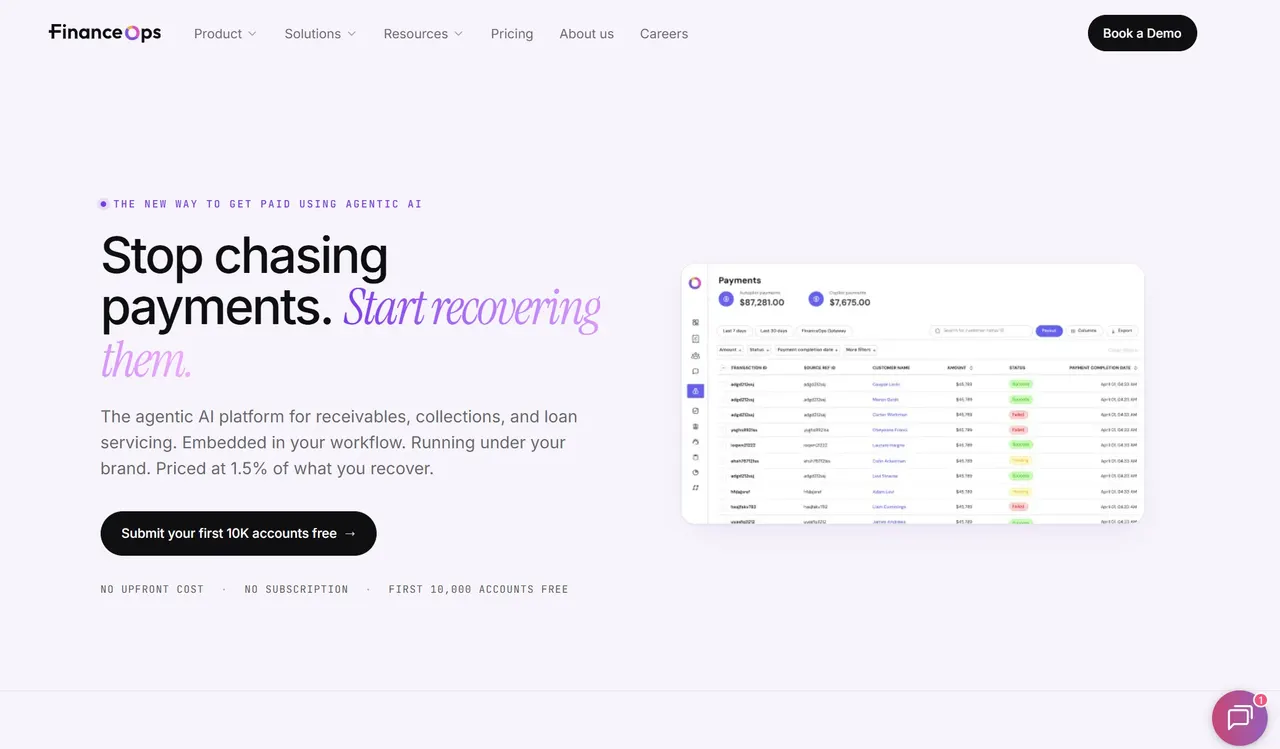
FinanceOps Agentic Payments is designed around the full payment lifecycle, including what happens after a transaction fails.
The platform connects payments, receivables, servicing, customer communication, first-party collections, reconciliation, and resolution within one account-level workflow.
The process begins by identifying the payment event. It then evaluates the account context, determines the approved next action, communicates through the appropriate channel, supports payment or resolution, and records the outcome.
When the account requires judgment, the workflow can route it to the appropriate internal team with its payment history, communication history, dispute status, and account context intact.
This creates a more practical model for agentic payments:
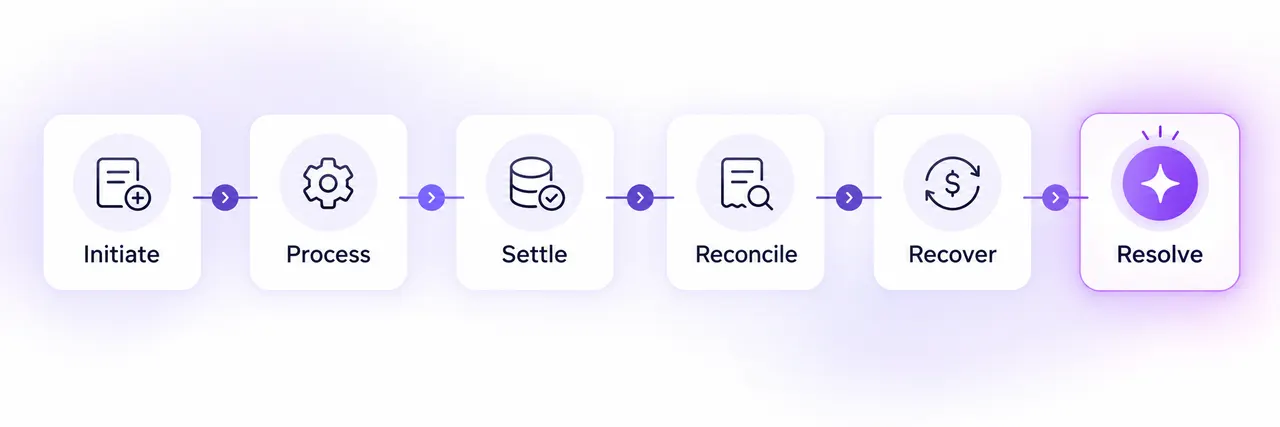
The payment event is not the end of the workflow. It is one event in a longer financial journey.
The real test for agentic payments
Businesses evaluating agentic payments should ask more than:
- Can the agent initiate a transaction?
- Can it authorize a payment?
- Can it complete the checkout?
- Can it manage a subscription?
They should also ask:
- What happens after a card declines?
- How are ACH returns handled?
- Can the system distinguish a payment failure from a customer dispute?
- Does the workflow understand prior account activity?
- Can it select the appropriate channel and timing?
- Are applicable consent and communication rules checked before outreach?
- Can the customer move from conversation to payment without losing context?
- Can the system reconcile the outcome back to the account?
- When does the workflow escalate to a human?
- Can the business audit every decision and action?
These questions define whether the system is truly agentic across finance operations or simply automated at checkout.
The first generation of agentic payments is focused on helping AI agents complete transactions. The next generation must address what happens when those transactions fail.
For businesses managing receivables at scale, the opportunity is not to retry every payment faster. It is to understand why the payment failed, determine the most appropriate next action, communicate with the customer in context, and move the account toward resolution within approved controls.
Agentic payments should not end at authorization. They should connect processing, servicing, communication, collections, reconciliation, and recovery into one governed financial workflow. That is how a failed payment becomes a resolved account.
See FinanceOps Agentic Payments in Action
FinanceOps connects payment processing, receivables, customer support, collections, and resolution workflows to help businesses manage the full lifecycle of every account.