FinanceOps
Book a Demo
AI Collections Software

AI Collections Software: Features Every Enterprise Should Evaluate

A buyer's guide to AI collections software. See the 7 features that separate real automation from a glorified reminder tool, and what to ask vendors.

Arpita Mahato11 min read

If you're evaluating AI collections software right now, you've probably noticed the category is crowded and the marketing sounds nearly identical across vendors. Everyone claims to be "AI-powered." Everyone promises "automation." Almost none of them tell you what's actually happening under the hood, or whether their AI is doing real decision-making versus running a scheduled email sequence with a chatbot bolted on.

AI collections software is technology that uses artificial intelligence to make real-time, signal-based decisions about who to contact, when, through which channel, and with what offer, distinct from automated collections software, which schedules and sends outreach on a fixed, rules-based cadence without adaptive decision-making.

This blog is built for the evaluation stage. You already know you need automated debt collection software. What you need now is a way to tell the difference between platforms that genuinely change your recovery economics and platforms that automate the same manual process you're already running, just faster. (If you're earlier in your research, our post on why right-party contact rates are stuck at 26% industry-wide covers the broader industry context, and our breakdown of how AI collections platforms stay compliant with CFPB rules covers the regulatory side.)

In this blog, you'll find:

  • The 7 capabilities that separate real AI collections software from basic automation
  • What to actually ask a vendor during a demo, and the answers that should raise flags
  • A practical framework for scoring platforms against your enterprise's actual requirements
  • How FinanceOps Agentic AI is built against each of these criteria

Why This Evaluation Is Harder Than It Looks

Most AR and collections teams start their search with a reasonable assumption: any platform that says "AI" probably does roughly the same thing. It doesn't.

There's a meaningful difference between software that uses AI to write better-sounding reminder emails and software that uses AI to decide who to contact, when, through which channel, in what tone, with what offer, and how to document that decision for compliance review. The first is a content layer. The second is a decision layer. This distinction is also what separates a true collection agent replacement from a basic automation layer, a point most vendor marketing glosses over entirely. That's the gap this guide is meant to close.

The 7 Capabilities to Evaluate

Here's the quick-reference version first, scan this to see the full shape of the evaluation, then read the detailed breakdown below for the reasoning behind each one.

7 Capabilities of FinanceOps Agentic AI
# Capability What It Solves FinanceOps Product
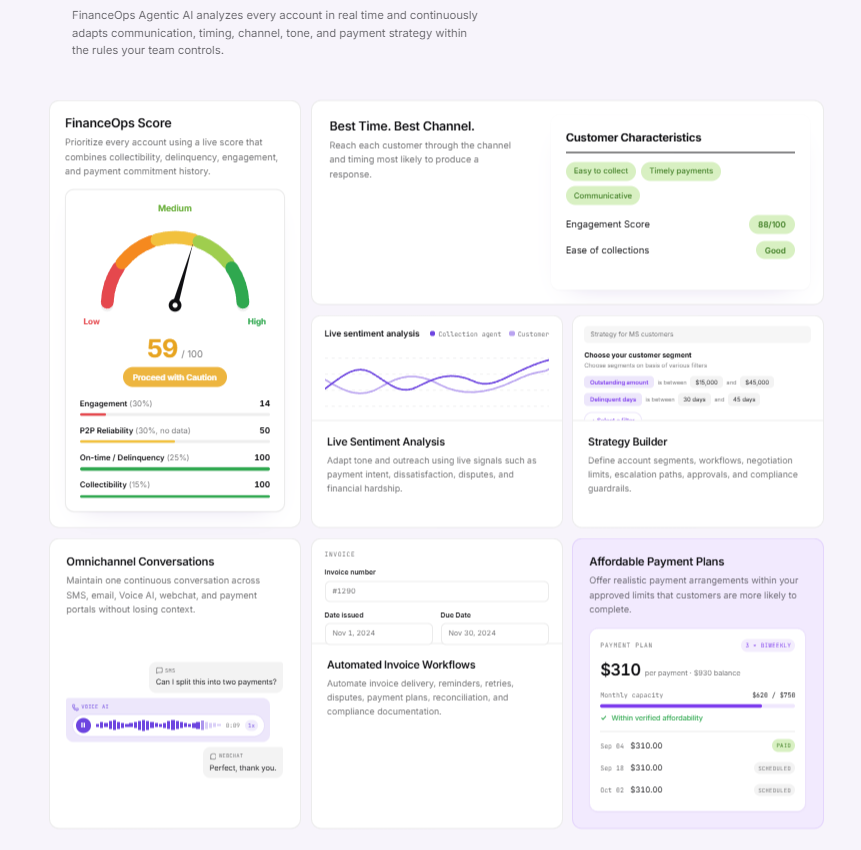
1 Predictive Account Scoring Prioritization based on recoverability, not just aging FinanceOps Score
2 Timing and Channel Prediction Reaching the right person, on the right channel, at the right time Autopilot
3 Live Sentiment and Tone Adaptation Matching tone to the customer's actual emotional state, in real time Autopilot
4 Omnichannel, Continuous Context Keeping conversation history intact across channel switches Autopilot
5 Governed, Auditable Strategy Control Compliance rules enforced automatically, with a documented reason for every decision Strategy Builder
6 Affordability-Based Payment Plans Personalized repayment structures instead of one settlement rate for everyone Autopilot
7 Automated, Reconciled Invoice Lifecycle Closing the loop from contact to reconciled cash without a manual handoff Invoicing

1. Predictive Account Scoring

What to look for: Does the platform score every account before outreach even happens, using multiple weighted signals, or does it just sort accounts by days-past-due?

Why it matters: A DPD-based system treats a $50,000 account and a $500 account the same way if they're both 45 days late. That's not intelligence, it's a spreadsheet with a due-date column. Real predictive scoring weighs collectibility, delinquency risk, engagement history, and prior payment-commitment behavior together, so your team's time and outreach budget go toward accounts that are actually likely to convert.

How FinanceOps does it: FinanceOps Score evaluates every account in real time on four weighted signals, collectibility, delinquency, engagement, and promise-to-pay history, before a single message goes out. Your team sees exactly where to focus, instead of guessing based on balance size or aging bucket alone.

2. Timing and Channel Prediction

What to look for: Does the platform predict the best time and channel for each individual account, or does it apply one fixed cadence to your entire portfolio?

Why it matters: Right-party contact (RPC) rate, whether an outreach attempt actually reaches the intended person, is the metric that determines whether any downstream capability (negotiation, sentiment analysis, payment plans) even gets a chance to work. A platform that sends every account the same fixed-time email and call regardless of that individual's actual response patterns is leaving recovery potential on the table before the message even goes out. (Editorial note: published RPC benchmarks vary meaningfully by source and methodology, worth confirming which figure you're citing and why before using a specific percentage externally.)

How FinanceOps does it: Autopilot scores every account for the optimal moment, channel, and true decision-maker, directly targeting the contact problem instead of treating it as already solved.

3. Live Sentiment and Tone Adaptation

What to look for: Can the platform detect a customer's emotional tone in real time and adjust its approach mid-conversation, or is every interaction scripted identically regardless of how the person responds?

Why it matters: A customer who responds with frustration or hardship signals needs a different approach than one who's simply forgotten a payment. Static scripts treat both the same way, which increases friction, damages the relationship, and reduces the odds of resolution.

How FinanceOps does it: Live Sentiment Analysis, part of Autopilot, reads tone and hardship cues across SMS, email, and voice in real time, and adjusts urgency and approach accordingly, so a successful contact doesn't get wasted on the wrong tone.

4. Omnichannel, Continuous Context

What to look for: If a customer starts a conversation over SMS and switches to email, does the platform remember the full conversation, or does the customer have to start over?

Why it matters: Fragmented channel handling is one of the most common reasons collections platforms lose momentum on an otherwise responsive account. If your system treats each channel as a separate silo, you're effectively running several disconnected collections processes instead of one coherent one.

How FinanceOps does it: Bidirectional, Multilingual Orchestration, built into Autopilot, keeps full context across every channel and language, so a contact attempt that succeeds on one channel isn't lost if the customer switches to another.

5. Governed, Auditable Strategy Control

What to look for: Can your compliance and collections leadership actually define and control the rules the AI operates within, tone, cadence, contact frequency, escalation thresholds, and can every decision be explained after the fact?

Why it matters: The CFPB has been explicit that AI systems used in collections are held to the exact same standards as human agents. Per CFPB Director Rohit Chopra's prepared remarks, "there is no 'fancy new technology' carveout to existing laws." A platform that can't produce a clear, documented reason for why it contacted a specific account, at a specific time, in a specific way, isn't a compliance asset. It's a liability wearing an efficiency badge.

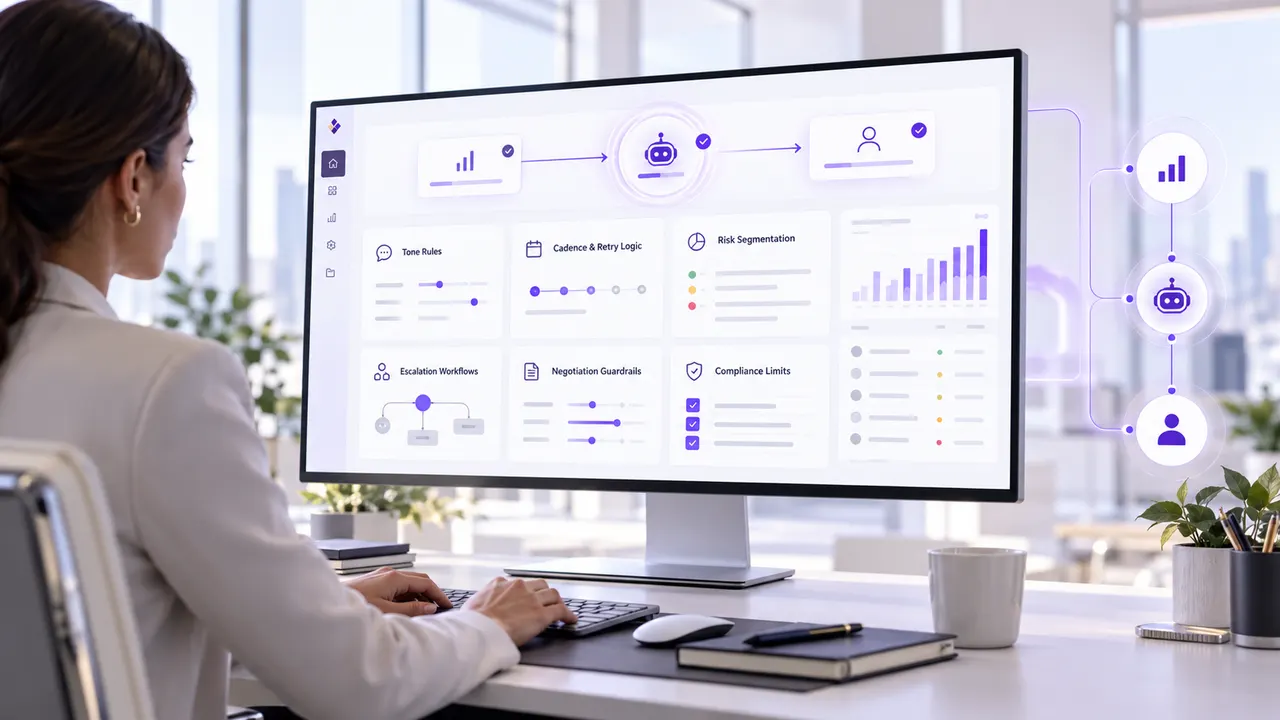
How FinanceOps does it: Strategy Builder lets your team encode FDCPA, TCPA, and UDAAP-aligned limits directly into every outreach decision, defining escalation paths, contact frequency, and negotiation parameters, so every AI-driven interaction stays explainable and audit-ready by design.

6. Affordability-Based Payment Plans

What to look for: Does the platform offer flexible, personalized payment arrangements based on each customer's actual financial situation, or is it a one-size-fits-all settlement percentage applied to every account?

Why it matters: A rigid settlement structure works for some accounts and fails for others. Personalized, affordability-based plans consistently convert better, because they're built around what a customer can realistically sustain rather than an arbitrary company-wide rule.

How FinanceOps does it: Affordability-Based Payment Plans, part of Autopilot, analyze each customer's financial signals to suggest personalized repayment structures, whether a simple installment plan or a fully customized schedule, turning a successful contact into a sustainable, higher-converting outcome.

7. Automated, Reconciled Invoice Lifecycle

What to look for: Does the platform close the loop end-to-end, generating, tracking, and reconciling invoices and payments automatically, or does contact success create a manual handoff back to your team?

Why it matters: A platform that's excellent at generating contact but requires manual reconciliation afterward just moves the bottleneck downstream. The value of automation collapses if a human still has to manually match every payment to every invoice, and it directly undermines efforts to reduce DSO without raising collection costs.

How FinanceOps does it: Invoicing ensures contact and payment application run continuously, so a successful conversation actually translates into reconciled cash, without a manual gap reopening the problem.

Questions to Ask Every Vendor During Evaluation

Use these directly in vendor demos. The quality and specificity of the answer tells you more than the sales deck will.

  1. "Walk me through what determines who gets contacted first on a given day." A vague answer ("our AI prioritizes based on risk") is a red flag. You want specifics: which signals, how they're weighted, and whether that logic is visible to your team.
  2. "Show me an example of your platform explaining why it made a specific outreach decision." If the vendor can't produce this in the demo, assume it can't produce it in an actual regulatory exam either.
  3. "What happens if a customer disputes a debt mid-conversation?" This tests whether compliance logic is baked into the AI's real-time behavior or handled as an afterthought. For a full breakdown of how compliant dispute handling should actually work, see our complete guide to collection dispute letters.
  4. "How does your platform handle a customer who responds on one channel and follows up on another?" This directly tests for the context-continuity gap described above.
  5. "What's your average right-party contact rate improvement, and how is that measured?" Ask for the methodology, not just the headline number.

The Business Case, Beyond Recovery Rate

It's tempting to evaluate AI collections software purely on projected recovery-rate lift, but the stronger business case usually includes three additional dimensions worth pressure-testing with any vendor:

  • Regulatory exposure reduction. A governed, auditable system reduces the odds of a costly FDCPA, TCPA, or UDAAP violation, which is a real financial risk, not just a compliance checkbox.
  • Headcount efficiency. The right platform should reduce the volume of manual, low-value outreach your team handles, freeing them for the accounts that genuinely need human judgment.
  • Customer relationship preservation. Empathetic, well-timed, well-toned outreach protects the long-term customer relationship in a way that generic, poorly-timed contact attempts actively damage.

Where FinanceOps Fits

FinanceOps Agentic AI was built around these seven capabilities specifically because they represent the decisioning layer most AR and collections platforms skip, a distinction we go deeper on in what Agentic AI actually means for accounts receivable. Scoring and timing prediction solve the contact problem before it happens. Sentiment analysis and omnichannel context make sure a successful contact doesn't get wasted. Governed strategy control keeps every decision compliant and explainable. Affordability-based plans and automated reconciliation make sure a successful contact turns into recovered, reconciled cash.

Key Takeaways

  • Most "AI collections software" is a content layer, not a decision layer. The real dividing line isn't whether a vendor uses AI, it's whether that AI decides who to contact, when, and how, or just writes nicer-sounding versions of the same fixed workflow.
  • A 26% industry-wide RPC rate means most platforms are already failing at step one. If a vendor can't explain how their timing and channel prediction beats that baseline, and by how much, that's a platform still solving yesterday's problem.
  • Compliance and capability aren't separate evaluation categories. Per the CFPB's own stated position, AI-driven collections decisions are held to the same standard as a human agent's. A platform that can't explain a specific decision after the fact isn't audit-ready, no matter how sophisticated its scoring looks in a demo.
  • The strongest business case goes beyond recovery-rate lift. Regulatory exposure reduction and headcount efficiency are just as real a return, and often easier to defend to a CFO than a projected recovery percentage.
  • The fastest way to separate real capability from marketing language is a live, specific demo request. Ask a vendor to walk one account from first contact to reconciled payment, and to explain the reasoning at every step, not just the outcome.

If you're currently evaluating vendors, the fastest way to separate real capability from marketing language is to ask for a live walkthrough of exactly how a single account moves from first contact to reconciled payment, and to insist the vendor explain the reasoning behind every step along the way. For the broader 2026 landscape of AR platforms, see our Best AR Automation Software (2026) comparison.

Evaluating AI Collections Capabilities?

Ask Every Vendor the Hard Questions. Then Ask Us.

See how FinanceOps Agentic AI prioritizes accounts, adapts customer outreach, preserves conversation context, and explains every decision.

Most Asked Questions

FAQs

What should I look for first when evaluating AI collections software?

Start with predictive account scoring and timing/channel prediction. These determine whether a message reaches the right person at all, before content quality or compliance features even become relevant.

Is automated debt collection software the same as AI collections software?

Not necessarily. "Automated" often just means scheduled and rules-based, while "AI collections software" implies the system is making real-time, signal-based decisions about who to contact, when, and how. Ask vendors directly which category their platform falls into.

How do I know if a vendor's AI is actually compliant, not just automated?

Ask for a live example of the platform explaining why it made a specific outreach decision, and confirm that compliance rules like TCPA calling windows and FDCPA disclosure requirements are enforced automatically, not manually monitored after the fact.

What's a reasonable right-party contact (RPC) rate to expect from a good platform?

Industry-wide RPC averages just 26% as of 2026. A platform genuinely using predictive timing and channel intelligence should meaningfully outperform that baseline. Ask vendors for their actual measured RPC improvement and how it's calculated.

Does AI collections software replace my collections team?

No, and vendors claiming full replacement should raise questions. The strongest platforms handle the high-volume, repetitive decisioning work (scoring, timing, first-touch outreach) so your team can focus on the complex, high-value accounts that genuinely need human judgment.