
Your AR automation platform can generate a perfect invoice, schedule a perfectly timed reminder, and personalize every line of copy. None of that matters if the message never reaches a human being. Right now, industry-wide, it usually doesn't.
Predictive Contact Intelligence is the layer that determines whether, when, and how an AR message reaches a specific, verified individual, covering timing prediction, channel prediction, and identity and legitimacy signaling, before content or scheduling logic even applies.
In this article, you'll find:
- Why right-party contact (RPC), not content or scheduling, is the real bottleneck in AR automation
- Government-sourced data on why legitimate outreach gets lost in robocall noise
- What "Predictive Contact Intelligence" actually means, broken into its three components
- How FinanceOps Agentic AI's seven capabilities are built to close this gap
- Our honest, opinionated read on what this means for your AR strategy going forward
Most AR automation platforms optimized for the part of the problem that was easiest to sell. Generating invoices faster. Scheduling reminders on a cadence. Personalizing subject lines. Delivery got treated as someone else's problem.
Legitimate outreach is now competing against billions of monthly robocalls for the same attention. AR automation has spent a decade optimising what gets said and when it gets scheduled. It has almost entirely ignored whether the message ever lands.
AR Automation Solved the Wrong Half of the Problem
Most AR automation platforms optimised for the part of the problem that was easiest to sell. Generating invoices faster. Scheduling reminders on a cadence. Personalising subject lines. Delivery got treated as someone else's problem.
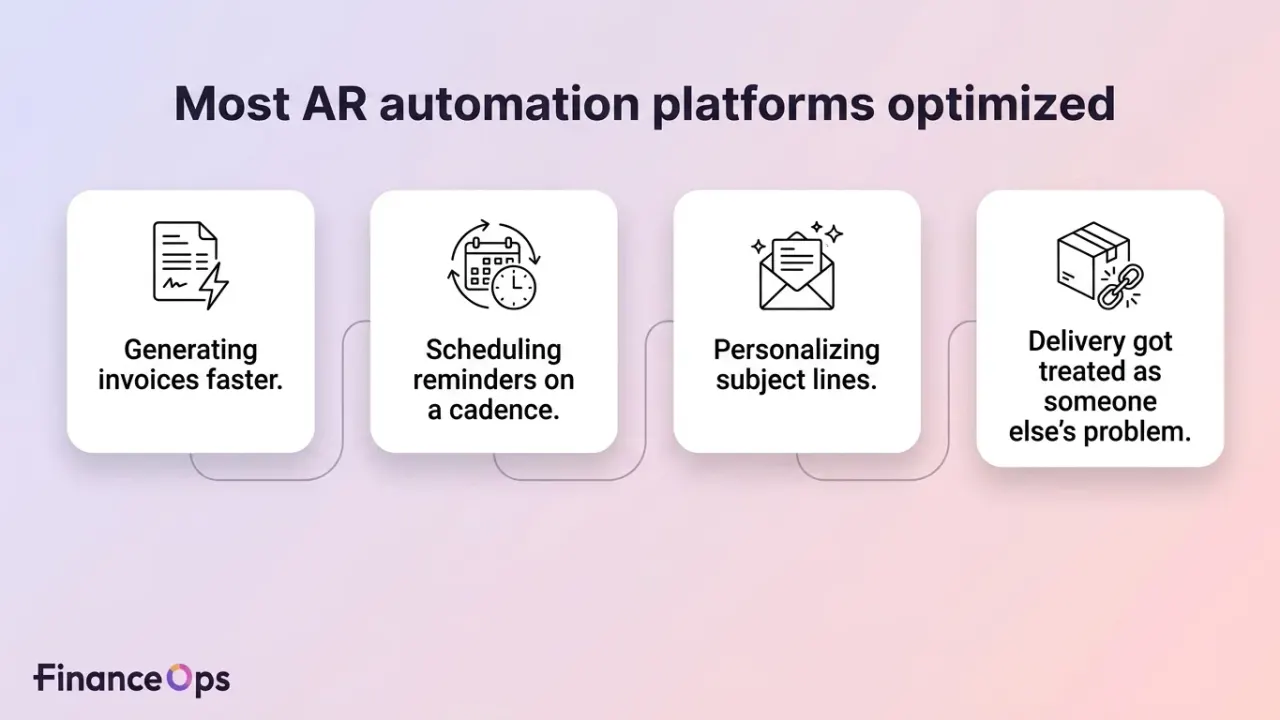
That's backwards. Content quality and scheduling logic have been genuinely solved for years. What hasn't been solved, and what almost nobody in this category is willing to say plainly, is that most of that well-crafted, well-timed outreach never reaches an actual person.
This is not a minor efficiency gap, but it certainly reflects the difference between an AR system that looks productive on a dashboard and one that actually moves cash.
The Number the Industry Doesn't Advertise: RPC at 26%
Right-party contact (RPC) is the industry term for reaching the actual person you're trying to reach, not a voicemail, not a wrong number, not a family member who picks up and hangs up. It's the single metric that determines whether any collections or AR strategy even has a chance to work.
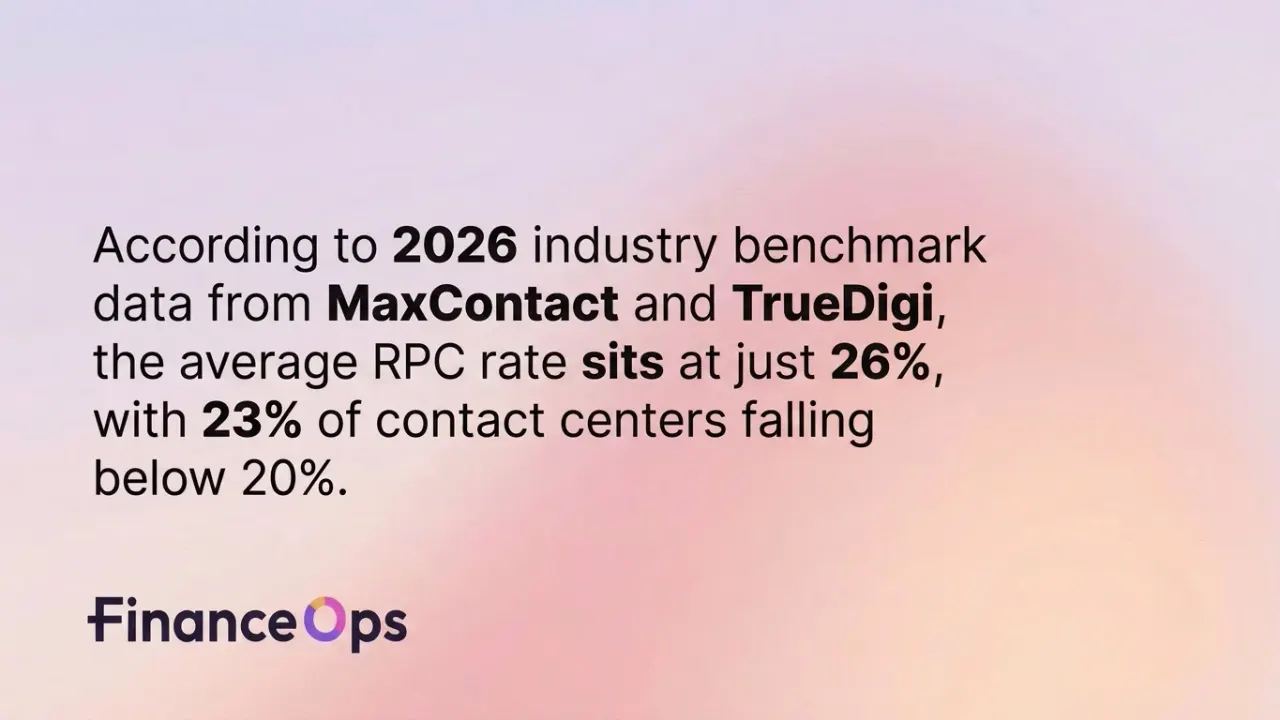
Put that in plain terms: for every four contact attempts a well-designed AR workflow makes, roughly three never reach the person who's supposed to receive them. Every downstream capability, sentiment analysis, payment plan negotiation, dispute handling, is irrelevant on three out of every four attempts, because the message never arrived in the first place.
Why Legitimate Contact Is Losing to Billions of Robocalls a Month
This is where the case moves from industry benchmark to verified government data, and it's the part of this argument we think gets ignored entirely in AR automation marketing.
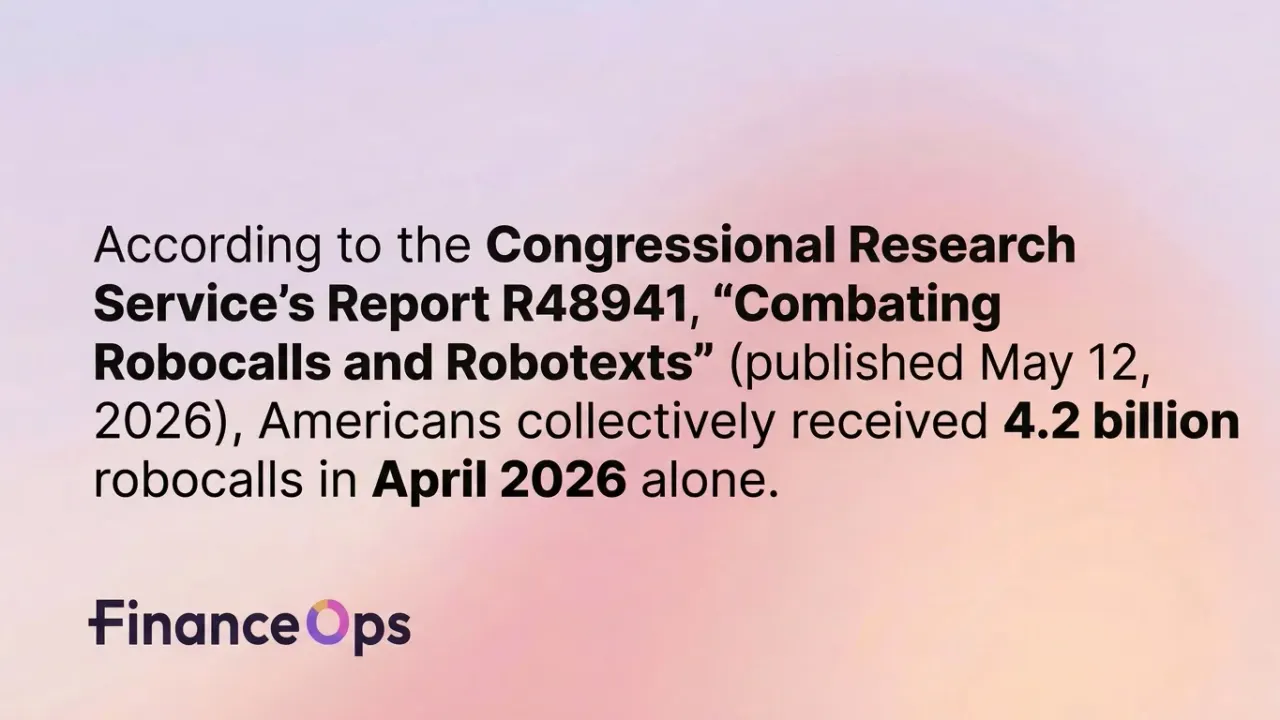
That's about 13 calls per person, roughly 140 million calls a day, or 1,600 calls per second. CRS is the nonpartisan research arm of Congress, so this is a primary government figure, not a vendor's estimate.
The same CRS report points to a specific, mechanical reason legitimate calls get caught in that noise: STIR/SHAKEN, the telecom industry's caller-ID authentication standard, verifies that a caller's number hasn't been spoofed. Calls that don't carry that verification are more likely to be labeled "spam likely" or blocked outright before a consumer ever sees them, the report confirms.
Put plainly, a legitimate, compliant AR contact attempt from an unoptimized system looks, to a spam filter and to a wary consumer, functionally identical to fraud. The infrastructure built to stop that call volume doesn't distinguish intent. It distinguishes signals: timing, channel, authentication, pattern. If your outreach doesn't actively manage those signals, it gets treated the same as the fraud it's competing against for attention.
Regulatory Pressure Is Rising, Not Stabilizing
The FTC's 2026 Biennial Report to Congress on the National Do Not Call Registry, published January 7, 2026, adds a second dimension: CFOs and collections heads should weigh directly. The National Do Not Call (DNC) Registry is the FTC's list of phone numbers that have opted out of telemarketing and unsolicited sales calls, and per the report, it's grown, not shrunk.
The registry now covers 258 million phone numbers, up 4.8 million in a single year, the FTC reports.
The agency also received 2.6 million Do Not Call complaints in FY2025, an increase over the prior year, with the majority driven by robocalls rather than live telemarketers.
Since the registry's 2003 inception, the FTC states it has filed 173 lawsuits against 570 companies and 449 individuals, collecting nearly $400 million in penalties.
Separately, the FCC's own consumer guidance confirms unwanted and spoofed robocalls remain its single top consumer complaint and top consumer protection priority.
One honest caveat, in the interest of the sourcing rigor this piece is built on: the FTC's own published DNC Reported Calls Data Set explicitly states that none of the individual complaint records are verified. They're raw, self-reported consumer data, useful for showing scale and trend, not for treating any single complaint as confirmed fact.
The trend line matters regardless. A growing registry and rising complaint volume mean the regulatory tolerance for undifferentiated, high-volume outbound contact is shrinking. An AR strategy built on volume rather than precision is fighting a shrinking margin for error, not a stable one.
What "Predictive Contact Intelligence" Actually Means
We'd define it precisely, because the phrase gets used loosely. Predictive Contact Intelligence is the layer that determines whether, when, and how a message reaches a specific, verified individual, before content or scheduling logic even applies. It has three components:
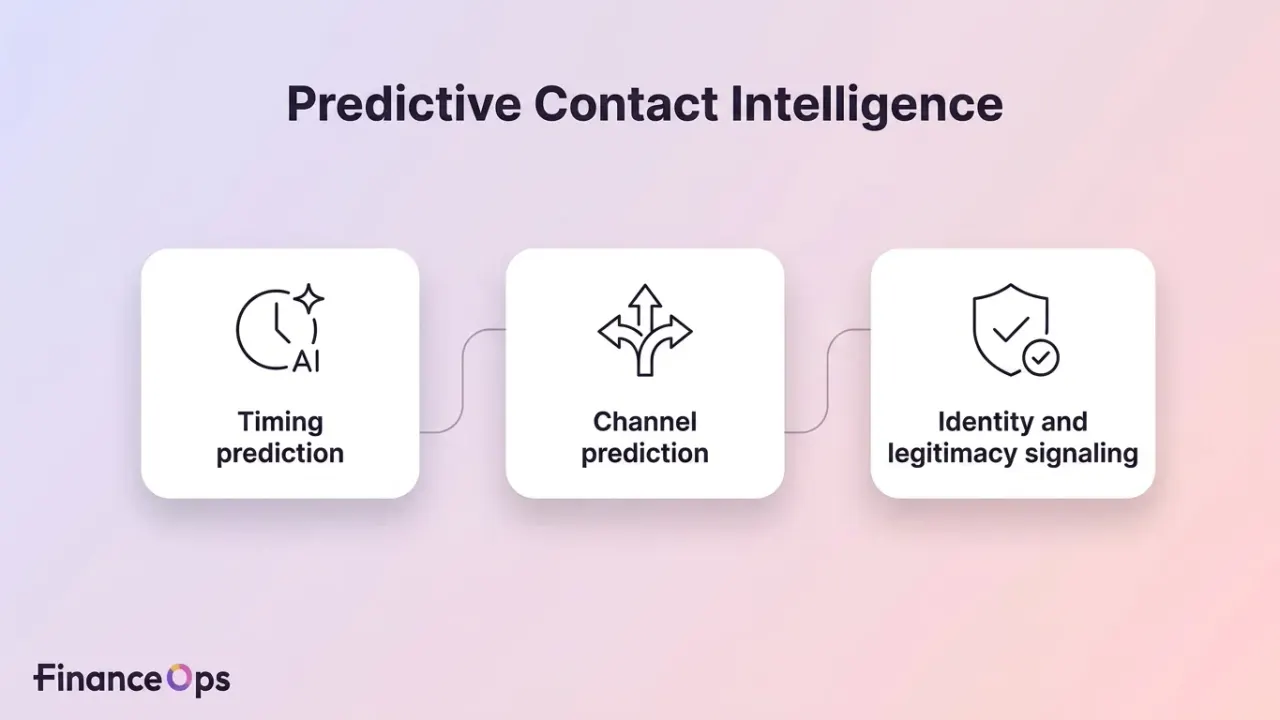
Timing prediction: When a specific individual is statistically most likely to actually respond, not a generic best-practice window applied to every account.
Channel prediction: Which channel, voice, SMS, or email, that individual actually engages with. A channel mismatch produces the same result as no contact at all. Industry field data from DROS.ai found SMS gets roughly 45% higher response rates than email, with open rates around 98%, and that omnichannel outreach can see up to 280% higher engagement than voice-only contact.
Identity and legitimacy signaling: Ensuring the outreach itself is authenticated and recognizable enough not to be silently filtered by the same infrastructure built to stop mass robocall traffic.
AR platforms that skip any one of these are only solving part of the delivery problem. Most address timing loosely, treat channel as a manual configuration choice, and don't address identity signaling at all. That's the actual gap this piece is naming. Industry analysis from Ainora suggests AI-driven contact optimization along these three dimensions can lift RPC by 2 to 4 times and increase payment conversations by 20 to 40%.
FinanceOps Agentic AI Capabilities Built With Predictive Contact Intelligence
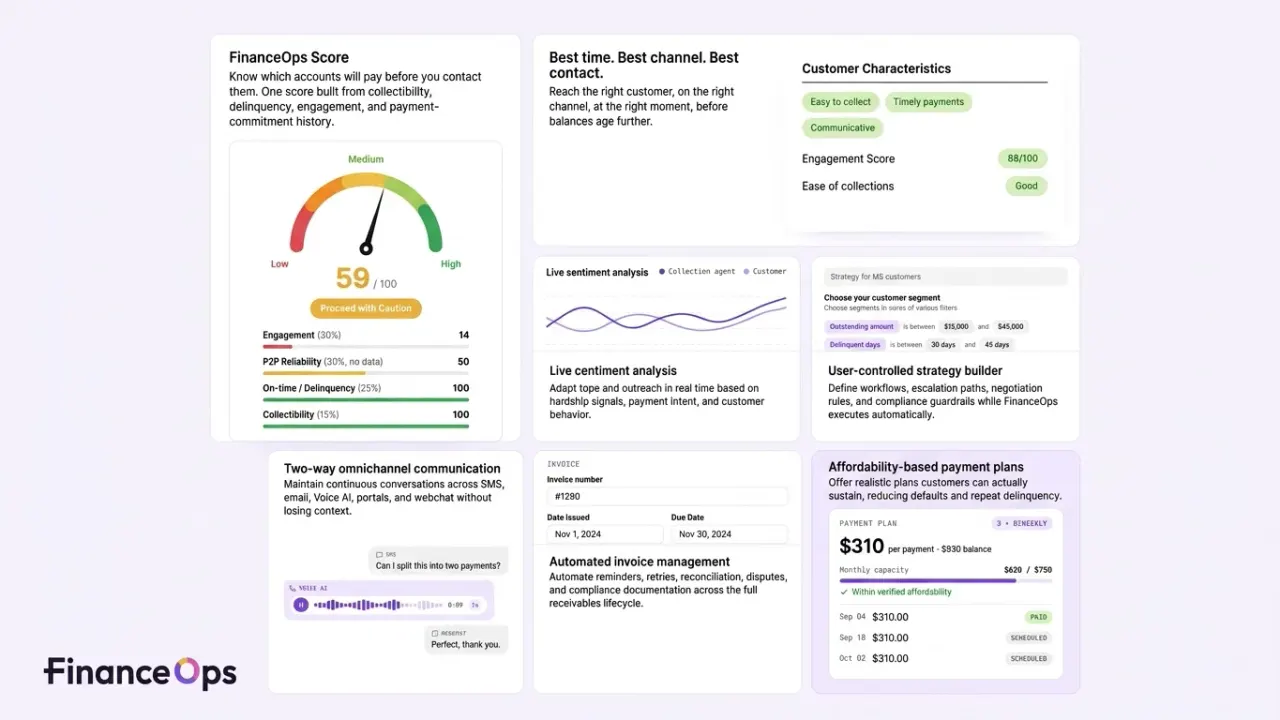
| Capability | Layer It Addresses | How It Closes the Gap |
|---|---|---|
| FinanceOps Score | Pre contact prioritization | Scores every account using collectibility, delinquency, engagement, and promise to pay history before outreach begins, prioritizing accounts most likely to convert contact into payment. |
| Best Time, Channel, Person | Timing and channel prediction | Identifies the optimal contact window, channel, and correct decision maker for each account, directly addressing the 26% right party contact problem. |
| Live Sentiment Analysis | Response quality after contact | Interprets tone, hardship cues, and payment intent in real time so a successful connection is matched with the appropriate response. |
| Bidirectional, Multilingual Orchestration | Channel continuity | Preserves conversation context across channels and languages, even when a customer moves from one channel to another. |
| Governed Strategy Builder | Compliance and identity legitimacy | Applies configured TCPA, FDCPA, and Do Not Call controls to outreach decisions, helping ensure contact attempts remain governed, appropriate, and distinguishable from spam. |
| Affordability Based Payment Plans | Conversion after contact | Turns right party contact into a sustainable payment arrangement, improving the likelihood that commitments are completed. |
| Automated Invoice Lifecycle | Continuous reconciliation | Connects customer engagement, payment processing, and cash application so successful contact translates into reconciled revenue without creating another manual gap. |
Read the table in order and the argument makes itself. FinanceOps Score and Best Time, Channel, Person exist specifically to solve the delivery problem this piece is built around. The other five capabilities exist to make sure a successful contact, once achieved, doesn't get wasted. That's a fundamentally different design philosophy than platforms that start with content and scheduling and treat delivery as an afterthought.
Key Takeaways
- Contact is not a solved problem, no matter what your vendor's pitch deck says. A 26% RPC rate industry-wide means most AR spend is going toward messages that never land. That's not a rounding error. That's the majority of your outreach budget doing nothing.
- Volume is not a strategy anymore, it's a liability. With the DNC registry growing by millions of numbers a year and complaint volume climbing per the FTC's own reporting, throwing more attempts at the problem doesn't just fail to fix RPC, it actively raises your regulatory exposure.
- If your platform can't tell you your RPC rate by account segment, that's not a minor gap in your reporting. It's a sign the platform was never built to solve this layer in the first place.
- The fix isn't better copy or smarter scheduling. Those are already solved. The fix is predictive intelligence about time, channel, and identity, applied before a single message goes out, not after it fails to land.
We think this is the single most consequential blind spot in AR automation today, and it's the one most vendors have the least incentive to talk about.