
Your collections team can't get faster by working harder, they're already at capacity. The only way DSO actually drops is by changing what gets automated versus what gets a human, and the data on that shift is now conclusive.
DSO reduction is really just a math problem: how much human effort does it take to convert a receivable into cash, and how much of that effort actually needed a human at all. Finance is already one of the fastest-adopting functions for AI, according to the U.S. Census Bureau, yet Deloitte's own research shows most AI investments take 2 to 4 years to pay off instead of the 7 to 12 months companies expect. AR is the exception to that pattern, not a confirmation of it. This piece breaks down why, with every claim sourced directly, what happens when the AI running your collections isn't governed by the same rules your compliance team already lives by, and how FinanceOps Agentic AI operationalizes each mechanism for banks, credit unions, and fintechs.
Blog Summary:
- According to the Federal Reserve Banks' Small Business Credit Survey, 56% of employer firms cited difficulty paying operating expenses and 51% cited uneven cash flows as major financial challenges in the past year, making DSO a board-level metric, not an accounting footnote.
- The U.S. Census Bureau's Business Trends and Outlook Survey found Finance and Insurance is the second-highest AI-adopting sector at 33.9%, nearly double the 19.8% national average.
- Deloitte's 2025 survey of 1,854 executives across Europe and the Middle East found 85% of organizations increased AI investment last year, but most see ROI stretch to 2 to 4 years instead of the expected 7 to 12 months, a gap that exists because most AI spend targets broad productivity tools, not a specific, measurable financial process.
- Billtrust and Wakefield Research found 99% of organizations using AI in AR saw DSO reductions, and 75% cut DSO by six days or more, a 10-day cut on a $100M revenue, 55-day DSO business unlocks $2.74 million in working capital.
- FinanceOps Agentic AI's six capabilities map directly onto the four mechanisms that drive DSO down, governed by a Strategy Builder that keeps the whole system compliant at scale.
What Is DSO, and Why Is It a Board-Level Metric?

Days Sales Outstanding measures how long it takes to convert a completed sale, or in banking terms, an issued invoice, fee, or receivable, into collected cash. It isn't an abstract accounting ratio, and treating it as a secondary metric is a mistake we see finance teams make repeatedly.
- What it actually measures: how much of your own money is sitting in someone else's account right now, not whether the sale itself was good.
- Why it's misfiled as a lagging metric: most institutions report it monthly, after the fact, when it's actually a leading liquidity indicator.
- What the Federal Reserve's own data shows: Federal Reserve Banks' Small Business Credit Survey points out that 51% of employer firms cite uneven cash flows as a financial challenge and 56% cite difficulty paying operating expenses, the two most common financial pressures small businesses report year over year.
For a bank or credit union, every one of those numbers is a receivable aging on the books longer than it should. Every extra day of DSO is a day of working capital that can't be redeployed.
Is Finance Actually Adopting AI, or Is This Overhyped?
Before getting into DSO specifically, it's worth knowing where finance stands on AI adoption, because the data undercuts the "wait and see" posture a lot of mid-sized institutions are still taking.
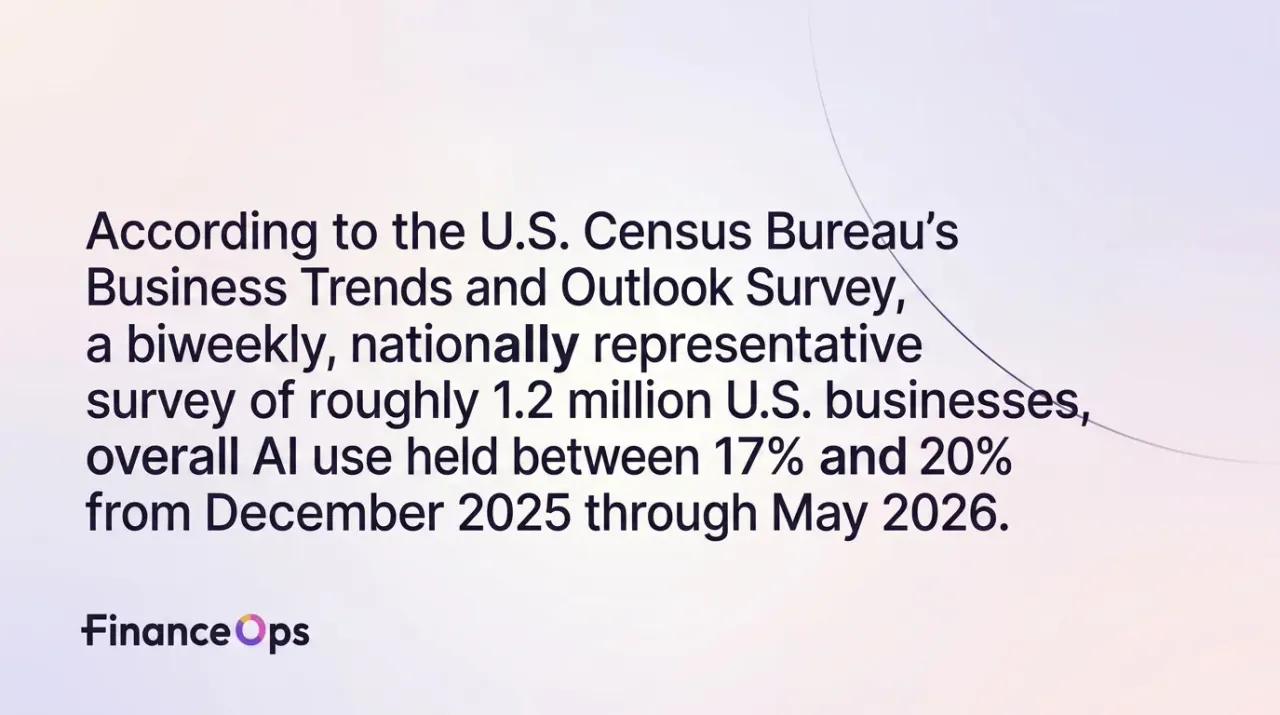
Finance and Insurance ranks as the second-highest adopting sector at 33.9%, behind only Information at 39.7%, and nearly double the 19.8% national average.
Adoption skews toward larger firms: 37% of firms with 250+ employees report using AI, versus 32% for firms with 100 to 249 employees, a gap that typically reflects internal build capacity, not actual ROI potential.
The Federal Reserve's own research points the same direction, from a different angle: a FEDS Notes analysis using the Fed's Survey of Business Uncertainty estimates 78% of the U.S. labor force works at firms that have adopted AI in some form, and 54% at firms using large language models specifically.
The two Fed and Census figures differ because they measure different units, firm-level adoption versus share of the labor force at adopting firms, and both are legitimate, government-sourced data points. Neither supports delaying investment on the theory that finance is somehow behind.
Does AI Investment in Finance Actually Pay Off?
This is where CFO skepticism is entirely reasonable, and where we'd push back on how the broader AI industry frames its own results.
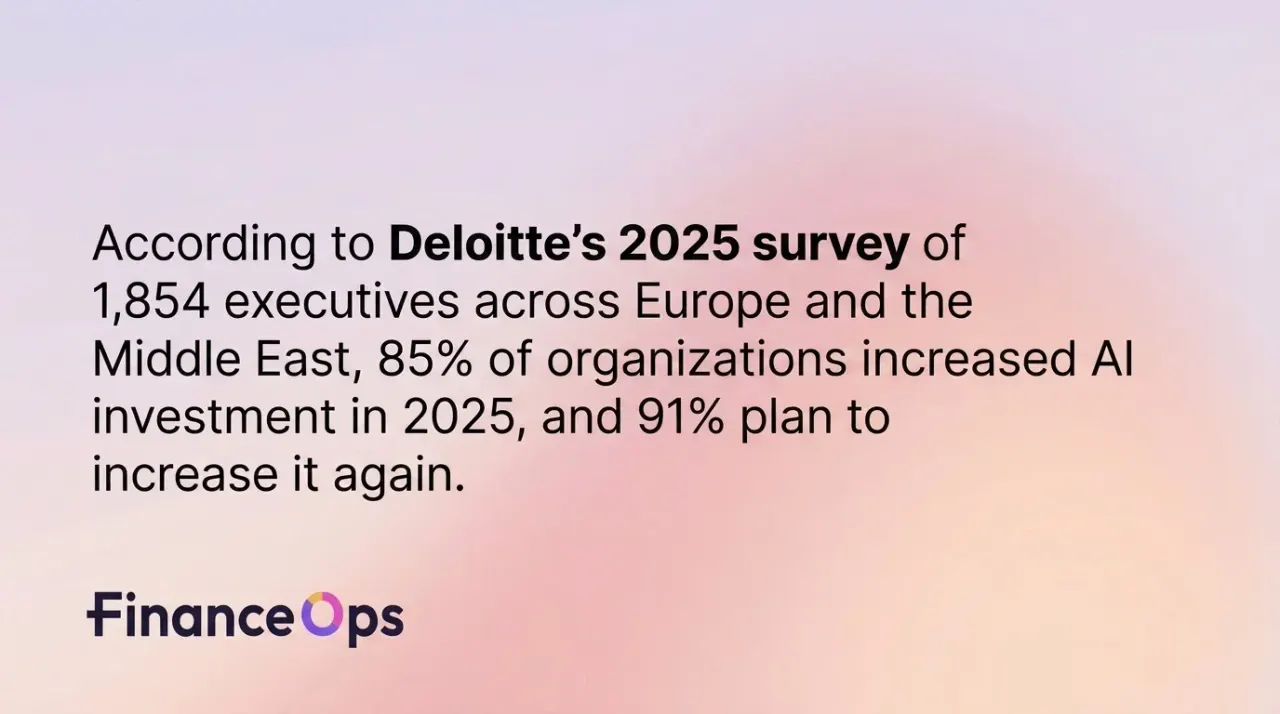
Yet most organizations report only reaching satisfactory ROI over 2 to 4 years, significantly longer than the 7 to 12-month payback period typically expected from conventional technology investments.
Our read on that gap: it's a measurement problem, not a technology problem. Most AI spend targets broad, horizontal tools, general copilots, productivity assistants, without a specific process or number attached to it. DSO reduction is the counterexample, precisely because it's narrow, measured in days and dollars, and checked against a number the finance team already tracks every month.
How Much Can AI Actually Reduce DSO?
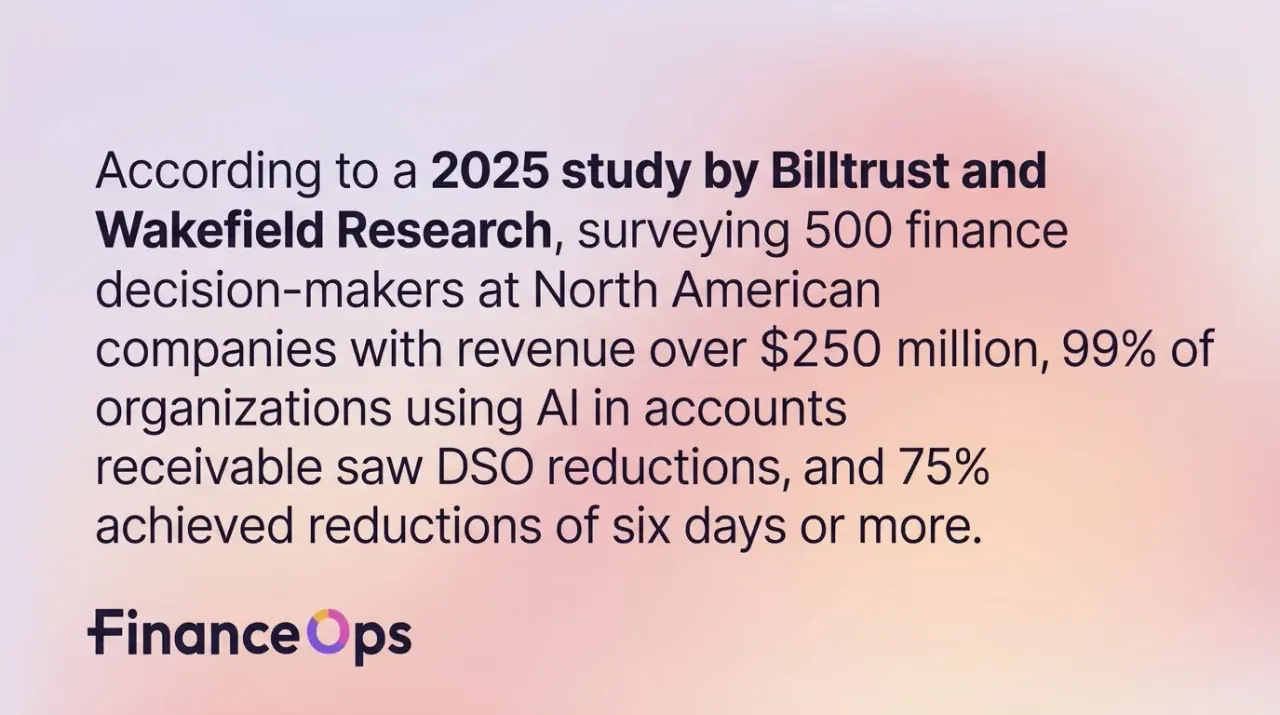
In dollar terms: a company with $100 million in revenue and a 55-day DSO unlocks $2.74 million in working capital simply by reducing DSO by 10 days, capital that was already earned and already owed, just not yet collected.
That's the case for treating this as a finance initiative with a measurable return, not an IT pilot with a vague one.
How Does AI Reduce DSO Without Increasing Collection Costs?
Here's the part most vendors gloss over: AI doesn't reduce DSO by working harder, and it doesn't reduce it by adding more collectors making more calls. It reduces DSO by being selective about where human effort goes, while automating everything that doesn't need a human at all.
| Mechanism | What It Actually Fixes | Where the Cost Savings Comes From |
|---|---|---|
| Automated, personalized dunning | Fixed-cadence reminders sent identically to every account, regardless of who responds | Collectors only engage accounts that need judgment, not every account on a calendar |
| Predictive prioritization | Accounts flagged as late only after they’re already delinquent | Effort shifts to prevention, 15 to 20 days before an account is even past due |
| Touchless cash application | Cash already received but sitting unapplied and unreconciled, “invisible” DSO | OCR/NLP matches remittance to invoice automatically, up to 98% accuracy, no manual matching |
| Intelligent dispute routing | Disputed invoices sitting unresolved for weeks while a human manually classifies them | AI classifies by reason code and pulls documents automatically, cutting resolution time |
The pattern across all four rows is identical: the cost reduction never comes from cutting staff. It comes from removing work that never needed a human in the first place, so the humans you already have spend their time exclusively on the accounts where a phone call or a negotiation actually changes the outcome.
How FinanceOps Agentic AI Automates DSO Reduction, Capability by Capability
Agentic AI refers to systems that answer questions but take early-stage empathetic outreach action, within rules a human team has defined in advance: initiating outreach, adjusting a plan, escalating a flagged dispute. Applied to receivables, this is what we call FinanceOps Agentic AI, a system built to manage the full DSO reduction lifecycle, not a generic chatbot bolted onto a billing portal.
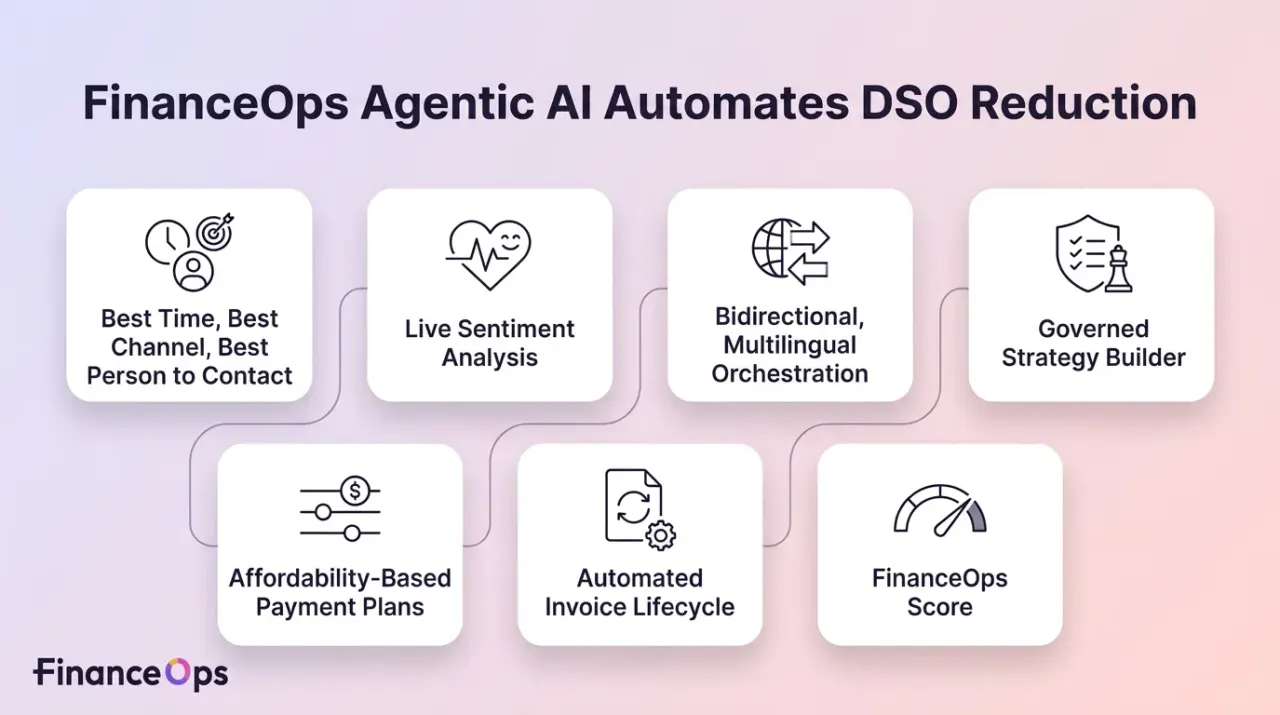
| FinanceOps Capability | Mechanism It Powers | Why It Matters for Banks & Credit Unions Specifically |
|---|---|---|
| Best Time, Best Channel, Best Person to Contact | Predictive prioritization | Scores every account for optimal timing, channel, and true decision-maker, raising right-party contact and cutting wasted attempts. Under the TCPA, autodialed contact without proper consent carries penalties of $500 to $1,500 per violation, trebled if willful, so knowing the right channel and consent status is risk management, not convenience. |
| Live Sentiment Analysis | Automated, personalized dunning | Reads tone, hardship cues, and escalation language in real time, catching distress before it becomes a formal complaint. A request to stop contact must be honored immediately; failing to detect that signal in real time is an enforcement risk independent of whether the underlying balance is valid. |
| Bidirectional, Multilingual Orchestration | Automated, personalized dunning | Keeps full context across SMS, email, Voice AI, webchat, and portals in multiple languages, so intent to pay never gets lost switching channels, and no manual re-keying step introduces a misdirected-disclosure risk. |
| Governed Strategy Builder | Governs all four mechanisms | Encodes TCPA, FDCPA, and banking compliance limits directly into execution, with zero variance across accounts. Aligns with federal regulators’ expectations, including NCUA’s AI Compliance Plan and NIST AI Risk Management Framework. |
| Affordability-Based Payment Plans | Intelligent dispute routing | Builds a schedule the customer can actually sustain from income, expense, and payment-history signals, not a fixed template. A plan that gets kept doesn’t need renegotiation, preventing DSO re-aging. |
| Automated Invoice Lifecycle | Touchless cash application | Runs issuance, reconciliation, retry logic, and dispute intake continuously, closing invisible DSO in real time instead of a month-end scramble. |
| FinanceOps Score | Prioritization engine | Blends collectibility, delinquency, engagement, and P2P history into a unified score, so every account is addressed in order of likelihood to resolve. |
Read across the table and the point is this: none of the seven capabilities exist in isolation. Governed Strategy Builder alone doesn’t reduce DSO; it makes the other six safe to run inside a regulated institution. FinanceOps Score ties it all together, ensuring accounts are prioritized and actions are executed in the right order. That’s the real argument for Agentic AI over basic RPA: the mechanisms only compound their effect when coordinated by a system reading real-time signals, not executing a static script.
Why a Governed Agentic System Beats a Pre-Trained AI Model
A generic, pre-trained AI model can draft a fluent message or hold a conversation, but it doesn't carry:
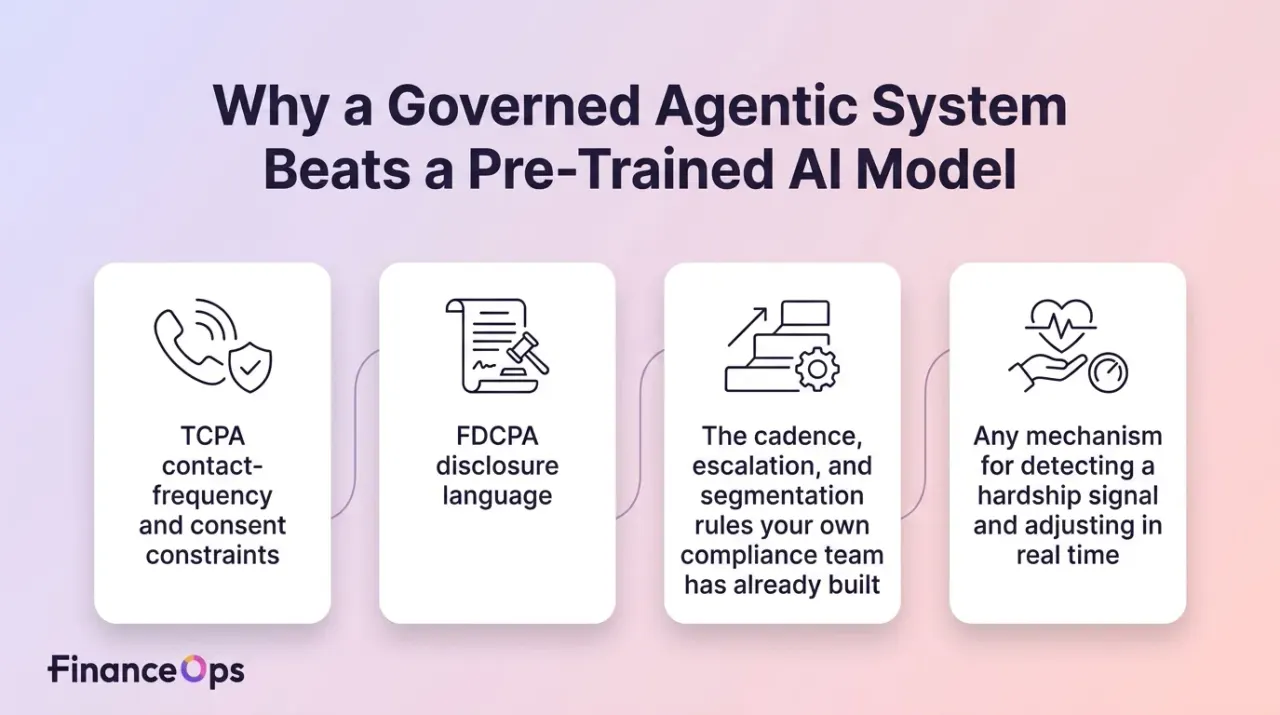
A generic, pre-trained AI model can draft a fluent message or hold a conversation, but it doesn't carry:
- TCPA contact-frequency and consent constraints
- FDCPA disclosure language
- The cadence, escalation, and segmentation rules your own compliance team has already built
- Any mechanism for detecting a hardship signal and adjusting in real time
That gap is exactly what the Strategy Builder and Live Sentiment Analysis are built to close, by encoding compliance logic and tone detection as enforced constraints on the model's output, not as suggestions it can ignore. In regulated collections work, governed intelligence beats generic intelligence, every time.
What This Mechanism Looks Like in Production
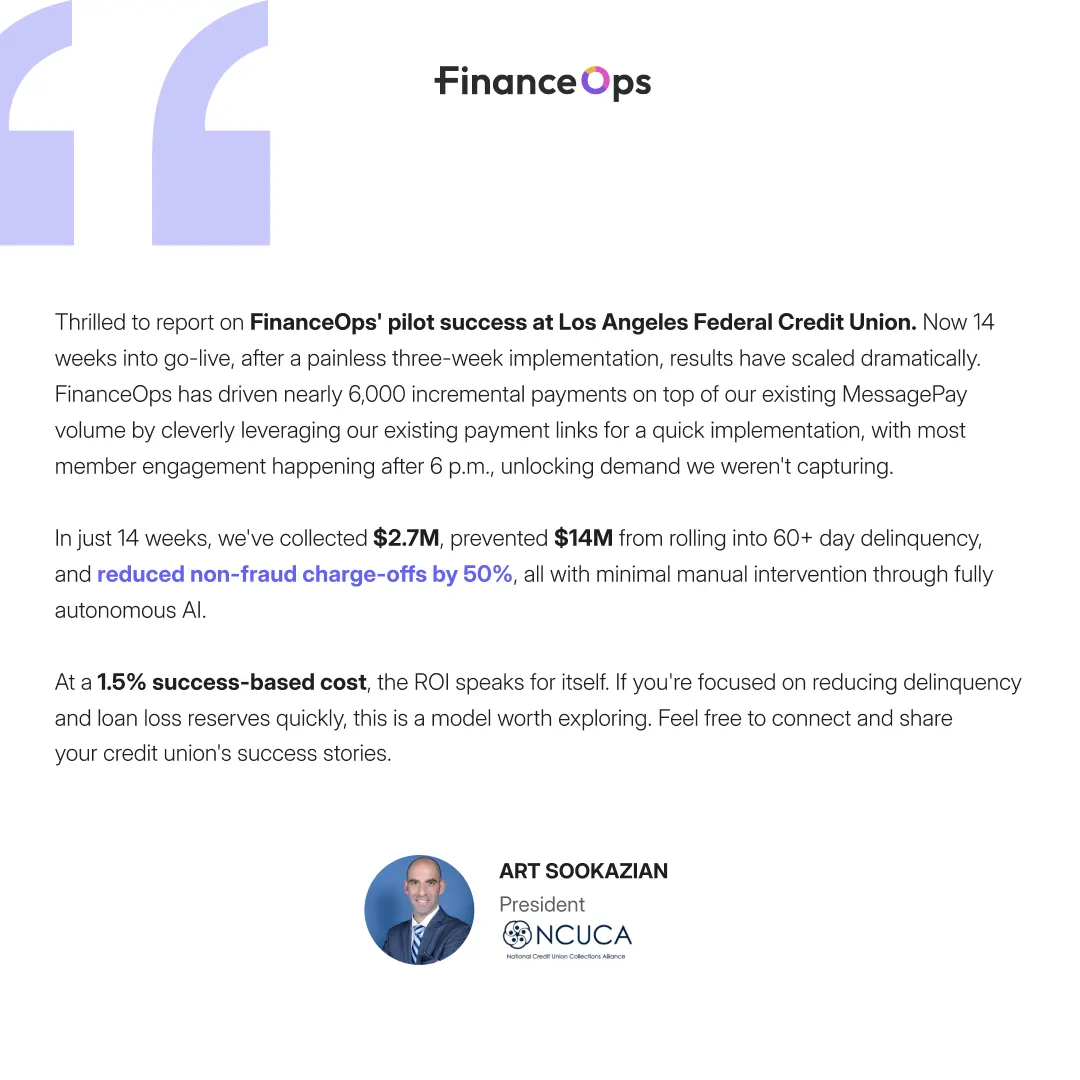
LA Federal Credit Union focused FinanceOps on its 30-to-60-day past-due balances, a segment most institutions manage with the same fixed-cadence reminders regardless of who responds. By applying best-time-to-contact targeting, affordability-aware outreach, and continuous invoice management, LAFCU achieved within 21 days:
- 65% delinquency reduction
- $1M+ collected
- 48% recovery rate
- Contact rate increase from 2% to 15%
A separate deployment at SkyOne Federal Credit Union resulted in a 90% drop in operating costs and 95% of accounts resolved entirely digitally. Both outcomes occurred within three weeks, demonstrating that the constraint was execution speed, not data availability.
Key Takeaways
- FinanceOps Score blends collectibility, delinquency, engagement, and P2P history into a unified score, ensuring the highest-risk accounts are addressed first.
- The Strategy Builder enforces TCPA, FDCPA, and other regulatory limits across all actions, making AI-driven DSO reduction safe, auditable, and scalable.
- Automating invoice lifecycles, intelligent dispute routing, and personalized outreach allows organizations to reduce 90 percent of operational effort while recovering up to 70 percent more revenue before accounts become delinquent.