
A failed payment can look like one exception in a processor log. Across customers, payment methods, and systems, it can become a cash-flow question no team can answer quickly.
The CFO needs to know what failed, what remains collectible, what has actually settled, and whether recovery is adding value.
Why Failed Payments Belong on the CFO’s Agenda
Payment exceptions often start in operational systems. A processor records a decline, an ACH file returns an entry, or a settlement does not match the expected amount. The issue then moves through billing, treasury, customer support, accounts receivable, and sometimes collections.
Each team may see one part of the event. The CFO needs one financial view.
A failed payment can affect:
- Cash timing: expected receipts may arrive late or not at all, changing the near-term cash forecast.
- Receivables visibility: an account may remain open even when a payment was attempted, while a successful transaction may still be missing from the ledger.
- Cost to resolve: staff time, processor fees, support contacts, and recovery activity can accumulate around small exceptions.
- Customer experience: repeated or poorly timed requests can frustrate a customer who already paid, has a dispute, or needs to update payment details.
- Control and auditability: finance teams need evidence of the original attempt, the status returned by the payment provider, any follow-up, and the final settlement or resolution.
This is why a failed-payment rate alone is not a CFO answer. The rate says how often attempts fail. It does not say how much cash is still exposed, how much later settled without intervention, or what it cost to resolve the exceptions.
First, Separate the Events
Teams often use “failed payment” to describe several different problems. Separating them prevents the wrong workflow from being applied to the wrong account.
| Event | What it means financially | Useful first check |
|---|---|---|
| Card authorization decline | The attempted charge was not authorized. The underlying invoice or balance may still be due. | Review the processor response, payment method status, and whether another attempt is permitted. |
| ACH return | An ACH entry was returned under a return reason code. The attempted debit should not be treated as settled cash. | Read the return code and follow the applicable Nacha process. Administrative returns such as R02, R03, and R04 point to account-detail problems, not a simple timing issue. |
| Timeout or unknown result | The system did not receive a definitive response. The payment may still have been accepted or processed. | Query the provider or settlement record before submitting another attempt. Use the processor’s idempotency features where available. |
| Settlement or posting mismatch | A provider may show a successful transaction while the bank deposit or ledger record is not yet matched. | Reconcile transaction, settlement, payout, and invoice identifiers before contacting the customer. |
| Unpaid invoice | No payment may have been attempted at all. This is an open receivable, not necessarily a failed transaction. | Check invoice delivery, terms, disputes, and account history before choosing a follow-up. |
Nacha maintains distinct ACH return reasons because the reason affects how an originator should handle a returned entry. For example, an invalid or closed account calls for account-data resolution, while other return reasons can reflect different conditions. See Nacha’s ACH return and risk guidance and the applicable rules for the transaction. For a broader overview of the processor layer, see FinanceOps’ guide to payment processors for collections and small businesses.
Verify a Timeout Before Retrying
An ambiguous API response is another special case. A timeout is not proof that the payment failed. Before trying again, confirm the transaction’s state with the provider. For API-initiated payments, idempotency keys can help prevent duplicate operations when a request must be safely retried. They do not replace settlement reconciliation.
A Failed Attempt Is Not Automatically Lost Revenue
For U.S. finance teams, card networks, ACH rules, payment providers, and accounting systems can each record a different stage of the same payment. For finance reporting, keep three outcomes separate:
- Cash delayed: the customer pays later, so the cash timing changes.
- Cash recovered: the account would otherwise have remained unpaid, and the organization receives settled funds.
- Revenue or credit loss: the accounting outcome depends on the contract, performance, collectability, and the organization’s accounting policy.
Under FASB Topic 606, revenue is recognized when or as an entity satisfies a performance obligation, subject to the standard’s requirements. A payment attempt by itself does not determine whether revenue has been earned, whether a receivable should be recognized, or whether a credit loss should be recorded. The controller and accounting policy determine those conclusions for the specific transaction.
This distinction matters when a CFO evaluates a recovery program. If an invoice was going to be paid through the normal process, the cash may have been accelerated rather than newly recovered. If a payment cleared but remained unapplied, the problem may be reconciliation rather than recovery. And if a payment attempt failed before the underlying service was delivered, the exposure may not be the same as an overdue receivable.
What Payment Recovery Automation Should Actually Measure
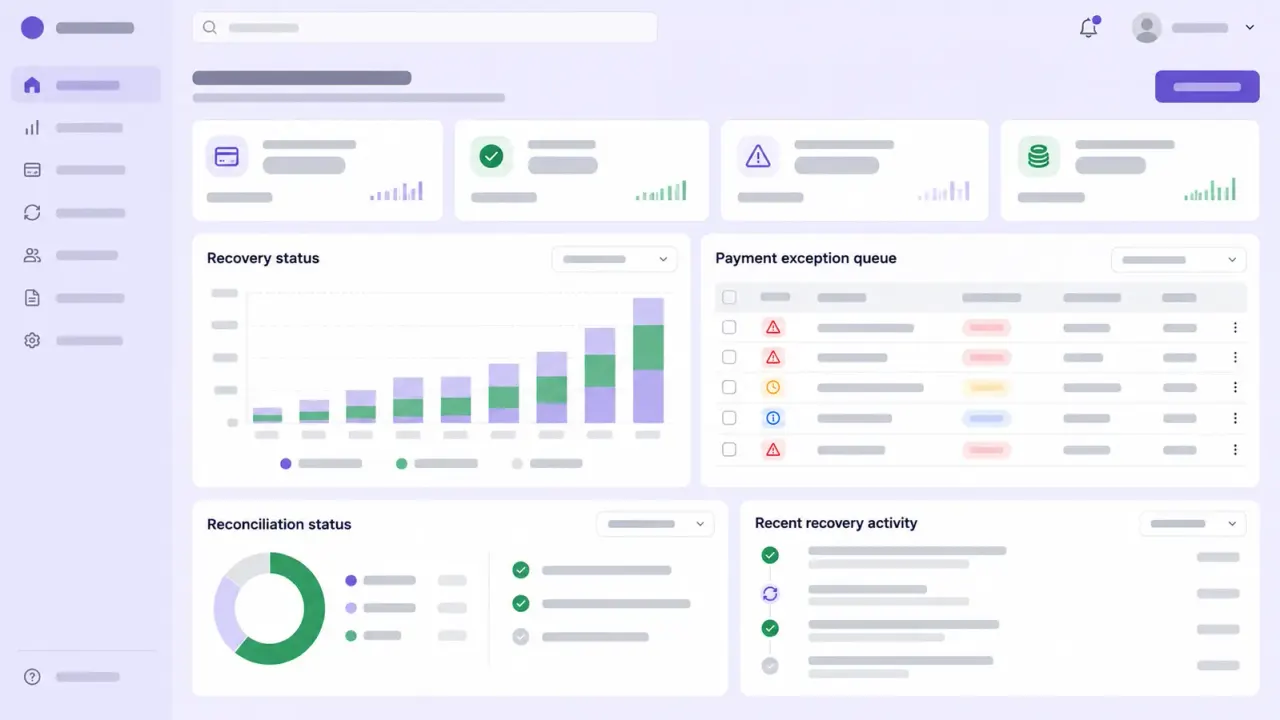
An automation platform can report how many messages it sent or how many payment attempts it initiated. Those are activity measures. CFOs need outcome measures that connect to cash, cost, timing, and control.
| Measure | Working definition | CFO question |
|---|---|---|
| Failure rate by rail and reason | Failed attempts divided by total attempts, segmented by method, response or return reason, and value | Where are failures concentrated, and are they operationally preventable? |
| Eligible balance at failure | Amount tied to failures for which the organization has an approved, actionable next step | How much of the apparent exposure can the team work now? |
| Recovery rate by cohort | Settled dollars recovered within a defined window divided by eligible dollars in the cohort | How much of the eligible balance reached the bank? |
| Incremental recovery | Settled cash in the tested workflow above a comparable current-process baseline | Did automation change the outcome, or did it only receive credit for ordinary payments? |
| Time to verified settlement | Time from the initial failure event to confirmed settled funds | How quickly did the exception stop affecting the cash forecast? |
| Cost per incremental dollar | Incremental recovery and servicing costs divided by incremental settled cash | Is the process economical after fees and staff effort? |
| Repeat failure and reversal rate | Recovered transactions that later fail, reverse, refund, or become disputed | Are apparent recoveries durable and correctly classified? |
| Unresolved exception age | Time that a failed, ambiguous, or unmatched item remains open | Which handoffs or data gaps are slowing closure? |
Definitions must stay consistent across teams. Set the cohort start event, recovery window, treatment of partial payments, and point at which cash counts as settled. Report attempt counts and dollar amounts separately. A single rate can hide the fact that many low-value attempts failed while a few large receivables dominate cash exposure.
Finance teams can connect these measures to their broader operating cash flow, receivables, and DSO management. DSO is useful in context, but it should not replace payment-event and settlement-level measures. A card decline, a slow-paying invoice, and unapplied cash affect different parts of the cash-conversion process.
Build the Economics Around Incremental Cash
A practical pilot should compare the proposed workflow with the current process. Use matched cohorts or a control design approved by finance and operations. Where an appropriate control is not possible, establish a documented baseline and state the limits of the comparison.
A simple model is:
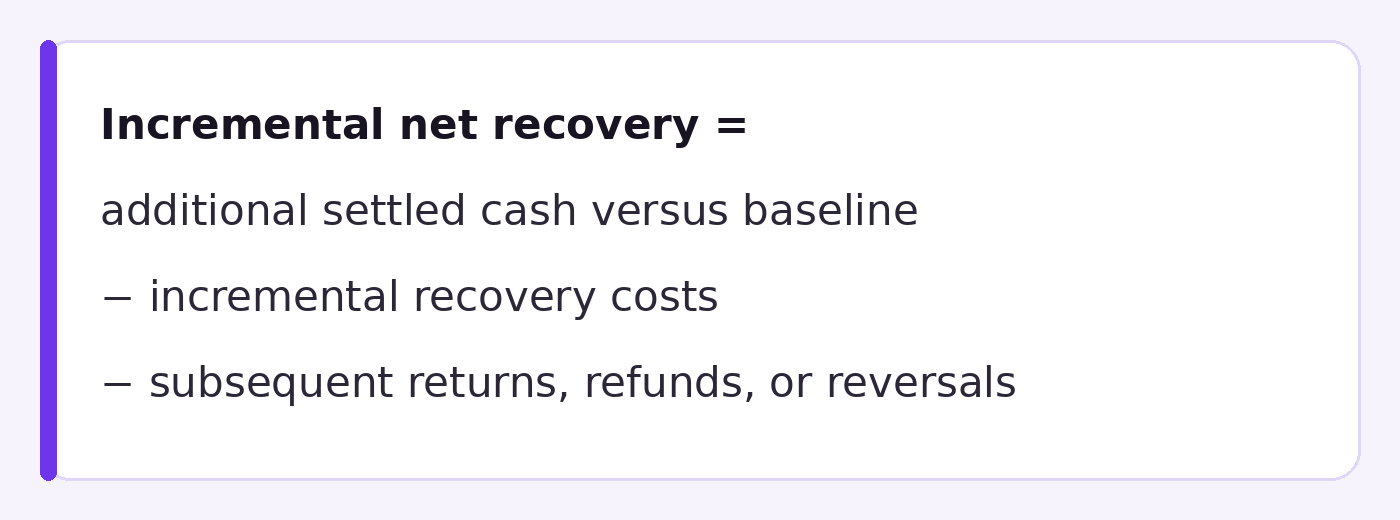
Include payment processing fees, recovery platform fees, staff time, and any other direct costs that change because of the workflow. Report cash acceleration separately. Receiving the same cash sooner can improve liquidity, but it is not the same as recovering an amount that would otherwise have remained unpaid.
For illustration only, suppose a defined cohort contains $500,000 in eligible failed-payment balances. If a controlled test produces a five-percentage-point increase in settled recovery compared with the current process, that represents $25,000 in additional cash for that cohort before costs. It is not $25,000 of new revenue or profit, and the example is not a forecast or a benchmark.
A credible evaluation also checks whether recovery is durable. Confirm that the payment settled, the invoice or account balance updated, and no later return or reversal invalidated the result. Track customer complaints and repeat contacts alongside the financial outcome.
Put Finance Controls Around Payment Status
For CFOs, the core design question is whether the financial record reflects the payment’s actual state. Keep attempt, authorization, capture, settlement, return, reversal, and invoice status distinct. A transaction marked “successful” by one system should not close the receivable until the organization’s agreed settlement and posting checks are complete.
For each event, retain the processor reference, invoice or account ID, payment method, amount, currency, timestamps, response or return reason, and the next owner. This creates a traceable path from the original attempt to the final cash or exception outcome.
A timeout needs special handling. It means the caller did not get a definitive response, not that the payment definitely failed. Check the provider or settlement record before another attempt. Where the processor supports them, idempotency keys help protect against duplicate operations when an API request is safely retried. They do not prove that funds settled.
The action should then match the known state and your policy. A correctable account detail, an eligible retry, a customer question, a dispute, and an unmatched settlement require different owners. Confirm the payment and update the invoice or ledger before closing the exception. The correct retry windows and communications depend on the rail, provider, customer relationship, contract, and internal policy.
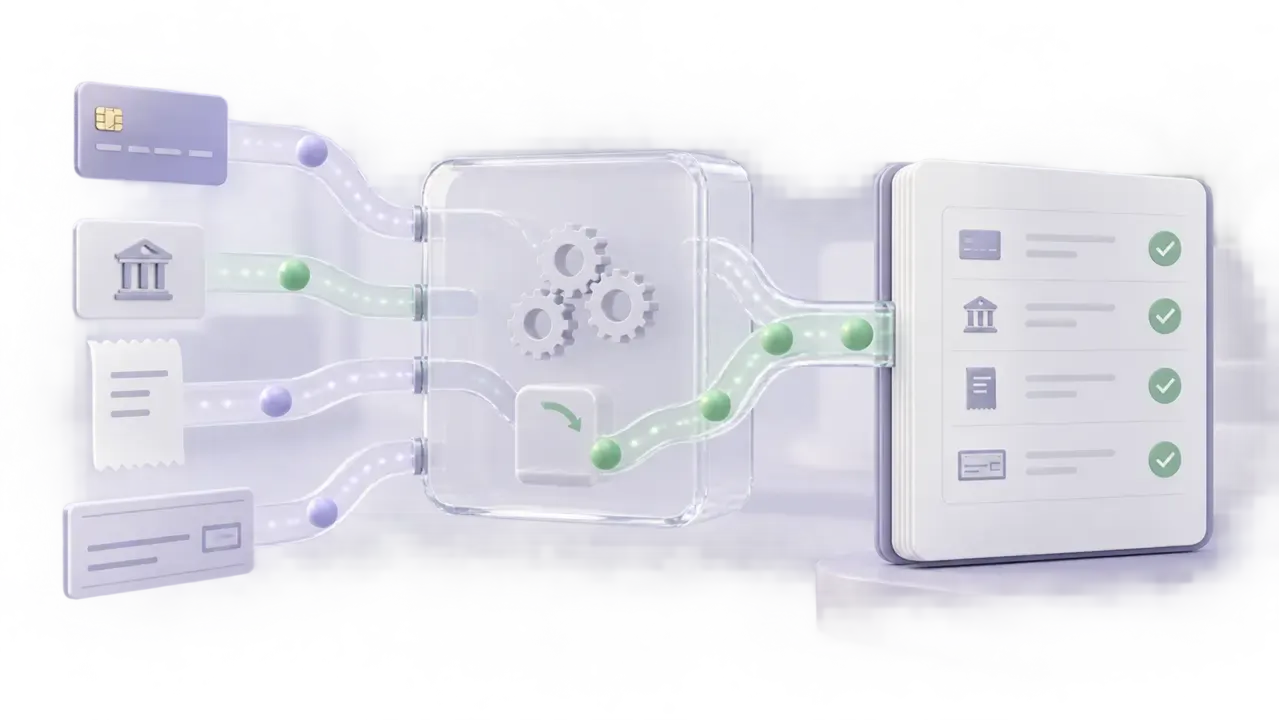
A payment exception is also a customer interaction when someone needs to act. A short, clear explanation and a practical way to resolve an issue can help avoid repeated contacts. The FinanceOps Agentic Payments product connects payment events with customer communication and recovery workflows. A business should evaluate the fit against its own payment rails, systems, authority limits, and controls.
Run a CFO-Led Pilot Before Scaling
A focused pilot can answer whether automation improves the economics without adding avoidable risk.
- Choose one segment: define the payment rails, customer or invoice type, and failure reasons included. Exclude unknown or disputed items until the review path is clear.
- Set the definitions first: agree on what counts as an attempt, an eligible balance, recovered cash, settlement, reversal, and recovery cost.
- Establish a baseline: measure current recovery, resolution time, cost, repeat failures, and open exception age for a defined period.
- Compare fairly: test the new workflow against the current process using comparable cohorts and the same recovery window.
- Review exceptions: inspect cases involving duplicate attempts, unresolved status, disputes, outdated account data, and customer support requests.
- Scale only on evidence: expand when incremental settled cash and operational improvement exceed costs without worsening customer or control outcomes.
When an event progresses from a failed payment attempt to a past-due account, the operating problem changes from transaction handling to account resolution. FinanceOps’ Enamel Dentistry case study is an example of recovery work on aged patient balances. It illustrates an adjacent stage of receivables recovery, not a benchmark for card decline or ACH return rates.
FinanceOps connects payment activity with receivables, servicing, collections, and reconciliation through Agentic Payments and Invoicing. Teams can review the broader FinanceOps solutions and its receivables data management approach. The fit depends on the failure types, systems, and controls in the organization’s own process.
Payment recovery automation should give finance leaders a clearer answer to four questions: what failed, what can be resolved, what settled, and what the process cost.