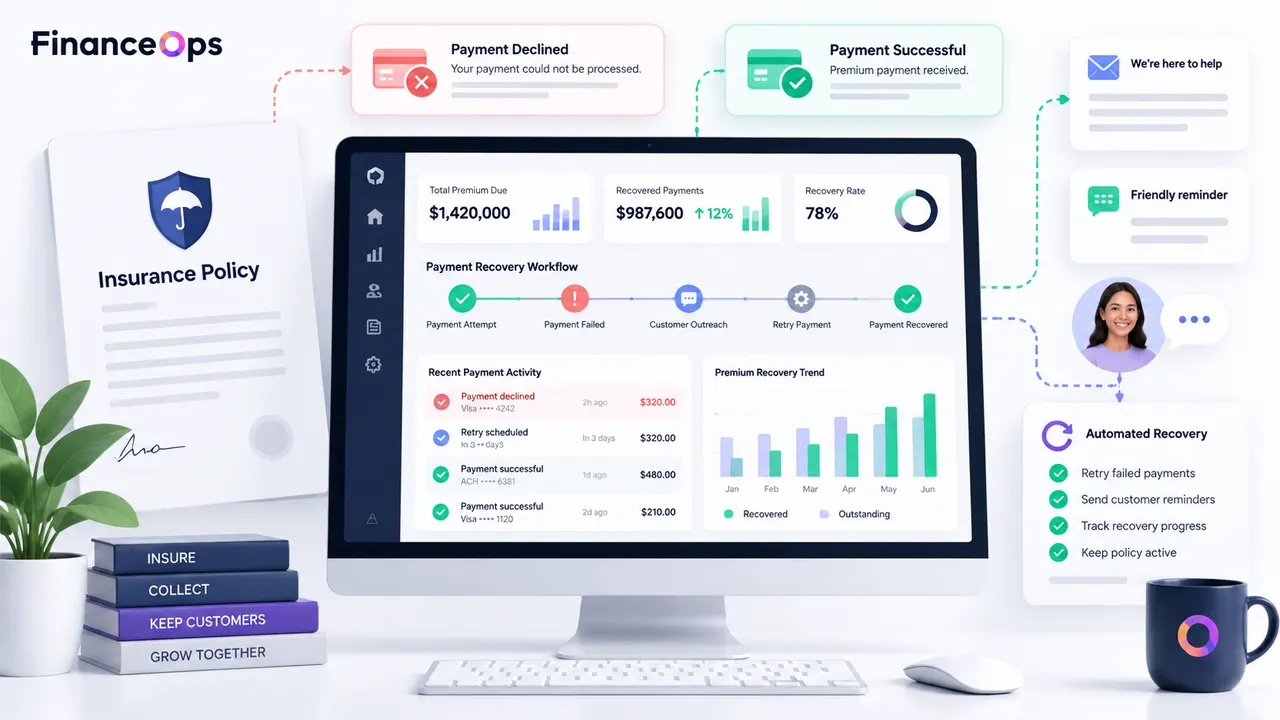
Payment infrastructure has become increasingly intelligent. Banks, credit unions, and fintech lenders have invested heavily in digital payments, automated servicing, and faster transaction experiences. Customers can make payments instantly, access lending products digitally, and manage financial obligations across multiple channels.
However, when payments fail, the recovery process often remains reactive. A failed payment is not simply a transaction event. It creates a series of operational decisions that impact cash flow, customer experience, collections efficiency, and financial visibility. For CFOs and collections leaders, the important questions are:
- Why did the payment fail?
- Can the payment be recovered?
- What is the right next action?
- Does the account require servicing, collections intervention, or reconciliation?
The next evolution of payments is not only about moving money successfully. It is about creating an intelligent recovery layer that understands payment events, customer context, servicing decisions, collections actions, and financial outcomes. This is where agentic payments change the payment recovery model.
Key Takeaways
Agentic payments move financial institutions from reactive payment handling to proactive recovery operations.
- Agentic payments understand payment failures instead of only detecting them: Traditional payment systems identify failed transactions. Agentic AI evaluates the reason behind the failure and determines the most appropriate next action.
- Recovery requires connected financial workflows: Banks, credit unions, and fintech lenders need systems that connect payment activity with customer conversations, servicing processes, collections workflows, and reconciliation.
- A failed payment does not always mean lost revenue: Some payments require customer action, some require operational correction, and others require collections intervention.
- AI adoption requires governance: Financial institutions need controlled execution, explainable decisions, audit trails, and human oversight.
- FinanceOps Agentic AI creates an intelligent payment recovery operating layer: It connects payment recovery, collections, servicing, and reconciliation into one workflow.
Why Payment Recovery Is Becoming a CFO-Level Challenge
Financial institutions operate complex payment ecosystems. A single payment journey may involve:
- Payment processors
- Core banking platforms
- Loan servicing systems
- Customer communication channels
- Collections platforms
- Finance reconciliation systems
Each system captures important information. The processor knows whether a transaction succeeded. The servicing system knows the account status.
The collections team understands customer conversations. The finance team understands settlement and reconciliation. The challenge is that this information often exists across disconnected systems.
According to the Federal Reserve Bank of New York’s Household Debt and Credit Report, U.S. household debt continues to remain at historically high levels, increasing the complexity of managing consumer credit portfolios and repayment activity. For financial institutions, the challenge is not simply handling more payment failures.
The challenge is understanding which actions create the highest probability of resolution.
Payment Processing Is Not Payment Recovery
Payment processing answers:
Did the transaction succeed?
Payment recovery answers:
What should happen next?
These are different operational problems.
A payment failure could represent:
| Payment Situation | Required Action |
|---|---|
| Expired card | Guide customer toward payment method update |
| ACH return | Understand return reason and determine next step |
| Temporary financial difficulty | Provide appropriate resolution options |
| Customer dispute | Route through servicing workflow |
| Payment received but unmatched | Complete reconciliation process |
The correct response depends on understanding the situation behind the payment event.
Why Traditional Payment Retries Are Not Enough
Traditional payment automation usually follows fixed rules.
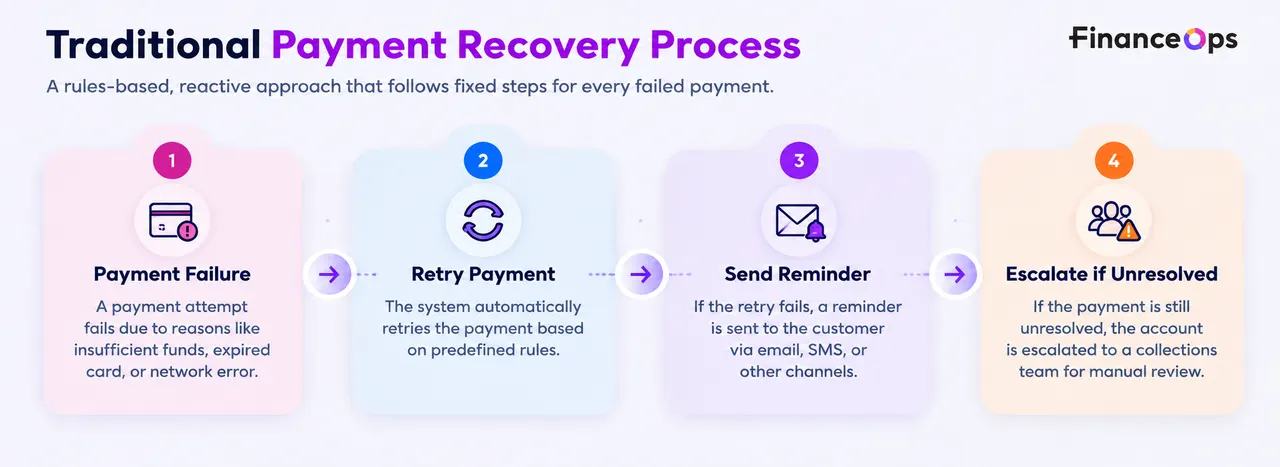
This approach works for predictable scenarios. However, modern lending environments involve more complex customer situations.
An expired card requires a different workflow than a borrower experiencing temporary financial pressure.
A payment that succeeded but was not reconciled requires a different action than a genuine collection issue. The limitation is not automation. The limitation is the absence of context.
What Are Agentic Payments?
Agentic payments use AI agents to analyze payment events, understand customer and account context, determine the appropriate next action, and execute approved workflows. Unlike traditional automation, agentic payments evaluate multiple signals:
- Payment history
- Account behavior
- Customer interactions
- Servicing information
- Recovery policies
- Compliance requirements
FinanceOps Agentic AI applies this approach by connecting payment recovery, customer engagement, collections execution, and reconciliation.
Explore: FinanceOps Agentic Payments
https://financeops.ai/products/agentic-payments
Agentic Payment Recovery Workflow
The workflow should show how AI moves payment recovery from detection to resolution.
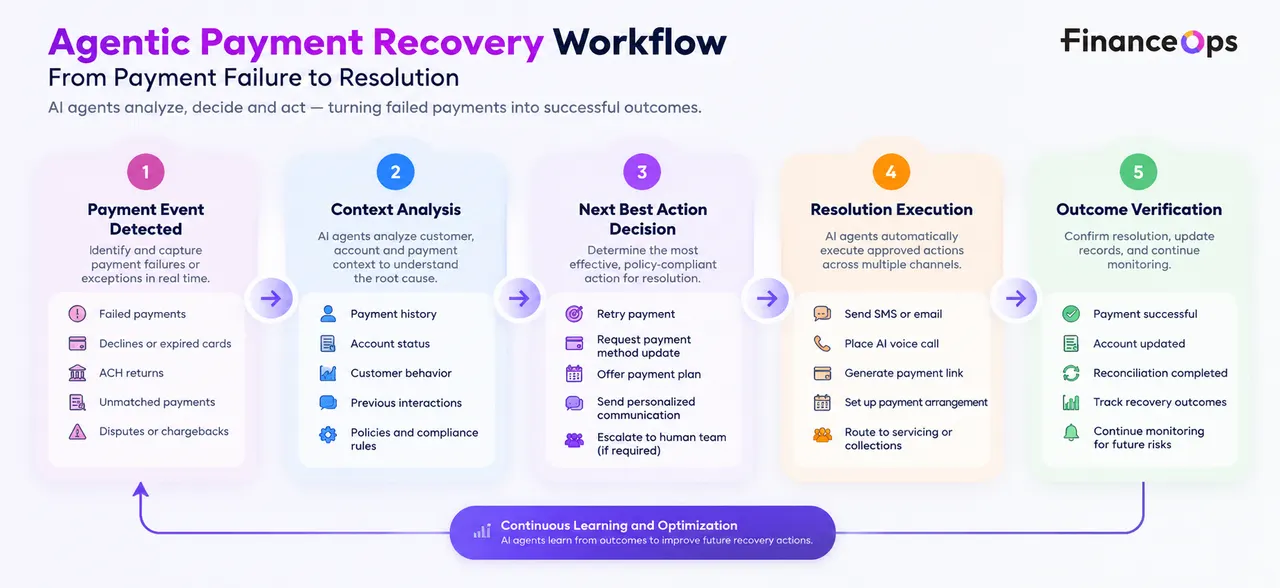
1. Payment Event Detection
The system identifies failed payments, returned transactions, or unresolved payment exceptions.
↓
2. Context Analysis
AI evaluates payment history, account information, customer behavior, and previous interactions.
↓
3. Next Best Action Decision
The system determines the appropriate approved action based on policies and business rules.
↓
4. Resolution Execution
The workflow initiates the required customer communication, payment action, or servicing process.
↓
5. Outcome Verification
The system confirms payment resolution, reconciliation status, or escalation requirements.
Agentic Payments Across Banks, Credit Unions, and Fintech Lenders
Banks: Improving Recovery Across Large Lending Portfolios
Banks manage millions of payment interactions across credit cards, consumer loans, mortgages, and lending products.
The challenge is balancing recovery performance with customer experience and regulatory expectations. Agentic payments help banks:
- Identify payment issues earlier: AI analyzes payment signals and account context before problems become larger recovery challenges.
- Prioritize recovery opportunities: Teams can focus resources on accounts where intervention is most valuable.
- Automate approved workflows: Routine recovery actions can execute while maintaining policy controls.
Learn more: FinanceOps Solutions for Banks
https://financeops.ai/solutions/banks
Credit Unions: Creating Better Member Resolution Experiences
Credit unions operate with a relationship-focused approach. Their objective is not simply collecting payments. It is helping members resolve financial obligations while maintaining trust. Agentic payment recovery enables credit unions to:
- Understand member circumstances.: AI evaluates account context before recommending actions.
- Reduce repetitive operational work: Teams spend less time handling predictable payment exceptions.
- Escalate complex cases appropriately: Human teams remain involved when judgment is required.
Fintech Lenders: Connecting Digital Lending With Smarter Repayment
Fintech lenders have transformed how customers access credit. However, repayment operations often remain less intelligent than origination workflows. Agentic payments help fintech lenders:
- Improve borrower engagement: AI enables more relevant communication based on payment context.
- Scale recovery operations: Institutions can manage growing portfolios without increasing manual effort proportionally.
- Connect lending and repayment intelligence: Customer understanding continues beyond credit approval.
Learn more: FinanceOps Fintech Solutions
https://financeops.ai/solutions/fintech
Governance Is the Foundation of Agentic Payments

Financial institutions cannot adopt AI without maintaining control. Agentic payment systems must operate within clear financial guardrails.
Decision Control: Keeping AI execution within approved boundaries: Financial teams define which actions AI can perform, where approval is needed, and when human review is required.
Explainability: Understanding AI decisions: Teams need visibility into why a decision was made and what factors influenced the workflow.
Auditability: Maintaining operational accountability: Every action should be recorded for compliance review and internal governance.
Human Oversight: Keeping experts involved where needed: Complex situations, disputes, and sensitive customer cases require human judgment.
Learn more: FinanceOps Compliance https://financeops.ai/compliance
“For decades, financial operations have been built as a collection of disconnected systems, each responsible for one part of the customer and payment journey. The real opportunity with AI is not to add another automation layer to that structure. It is to create one intelligent operating layer where payment events, customer conversations, servicing decisions, collections actions, and reconciliation continuously inform one another. That is how AI becomes the financial backbone of a business, rather than just another software tool.”
— Yogesh Jeswani, Chief Technology Officer and Co-founder, FinanceOps
How FinanceOps Agentic AI Enables Intelligent Payment Recovery
FinanceOps Agentic AI creates a connected operating layer that brings together payment intelligence, customer interactions, recovery workflows, and financial outcomes. Instead of treating failed payments as isolated events, the platform helps institutions understand the situation, determine the right action, execute approved workflows, and verify the final outcome.
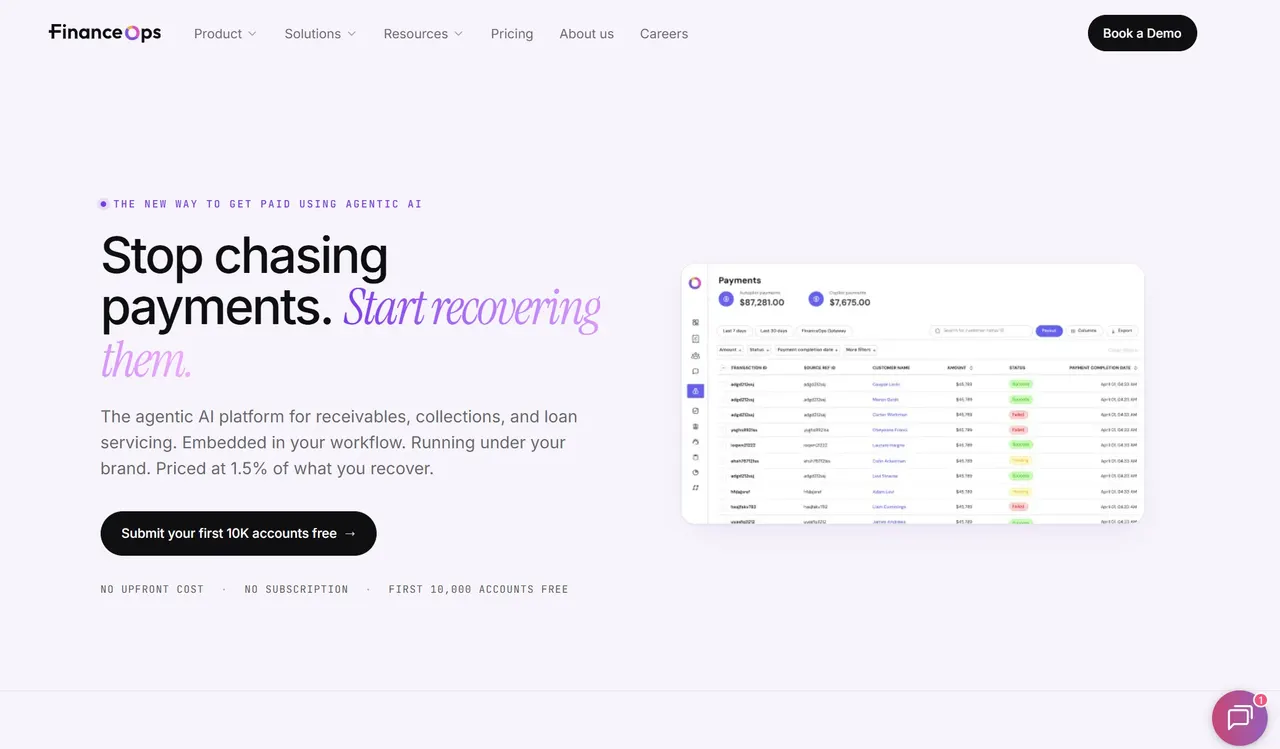
FinanceOps Agentic AI connects:
- Payment Events: Understanding what happened at the transaction level: FinanceOps Agentic AI analyzes payment failures, declines, returns, and exceptions to identify the underlying issue. This allows financial institutions to distinguish between different scenarios, such as an expired card, temporary payment issue, reconciliation mismatch, or a situation requiring collections intervention.
- Customer Communication: Creating context-aware engagement: Payment recovery often depends on reaching customers through the right channel with the right message. FinanceOps Agentic AI uses customer context and previous interactions to support more relevant communication workflows while maintaining consistency and compliance.
- Servicing Workflows: Connecting payment recovery with account resolution: Not every payment failure requires collections. Some situations require servicing actions, payment updates, or customer support. By connecting servicing workflows with payment intelligence, institutions can route accounts toward the most appropriate resolution path.
- Collections Actions: Prioritizing recovery opportunities: FinanceOps Agentic AI helps collections teams focus on accounts where intervention can create the highest impact. AI-driven workflows can support prioritization, recommended actions, and automated execution of approved recovery strategies.
- Payment Execution: Moving from recommendations to action: Instead of stopping at identifying a problem, FinanceOps Agentic AI can support approved payment actions such as payment requests, payment updates, arrangements, or other resolution workflows based on institutional policies.
- Reconciliation: Verifying financial outcomes: Recovery does not end when an action is taken. FinanceOps Agentic AI helps connect recovery activities with payment outcomes, ensuring institutions can understand whether payments were completed, accounts were updated, and financial records were accurately reconciled.
Financial institutions can use FinanceOps Agentic AI to:
- Improve payment recovery visibility across fragmented systems: Finance teams gain a clearer view of payment failures, recovery actions, and final outcomes by connecting data across payment, servicing, collections, and reconciliation workflows.
- Automate approved recovery workflows while maintaining control: AI can execute predefined actions within business rules and compliance boundaries, reducing manual effort while ensuring financial teams maintain oversight of critical decisions.
- Reduce manual exception handling for operational teams: Instead of manually reviewing every failed payment, teams can allow AI to handle predictable scenarios and focus human attention on complex cases requiring judgment.
- Maintain governance and accountability in AI-driven workflows: FinanceOps Agentic AI supports controlled execution through policy-based workflows, decision visibility, and auditability, helping financial institutions adopt AI responsibly.
- Create measurable recovery outcomes instead of activity metrics: Institutions can move beyond tracking retries, reminders, and outreach volume to measure what matters: recovered cash, faster resolution, improved efficiency, and better customer outcomes.
FinanceOps Agentic AI transforms payment recovery from a reactive process into an intelligent operating model where payment events, customer decisions, collections actions, and financial outcomes continuously inform one another.
Move From Reactive Payment Recovery to Intelligent Resolution
Payment failures should not automatically become manual collection cases.
Banks, credit unions, and fintech lenders need an intelligent recovery layer that understands context, executes approved actions, and improves financial outcomes.