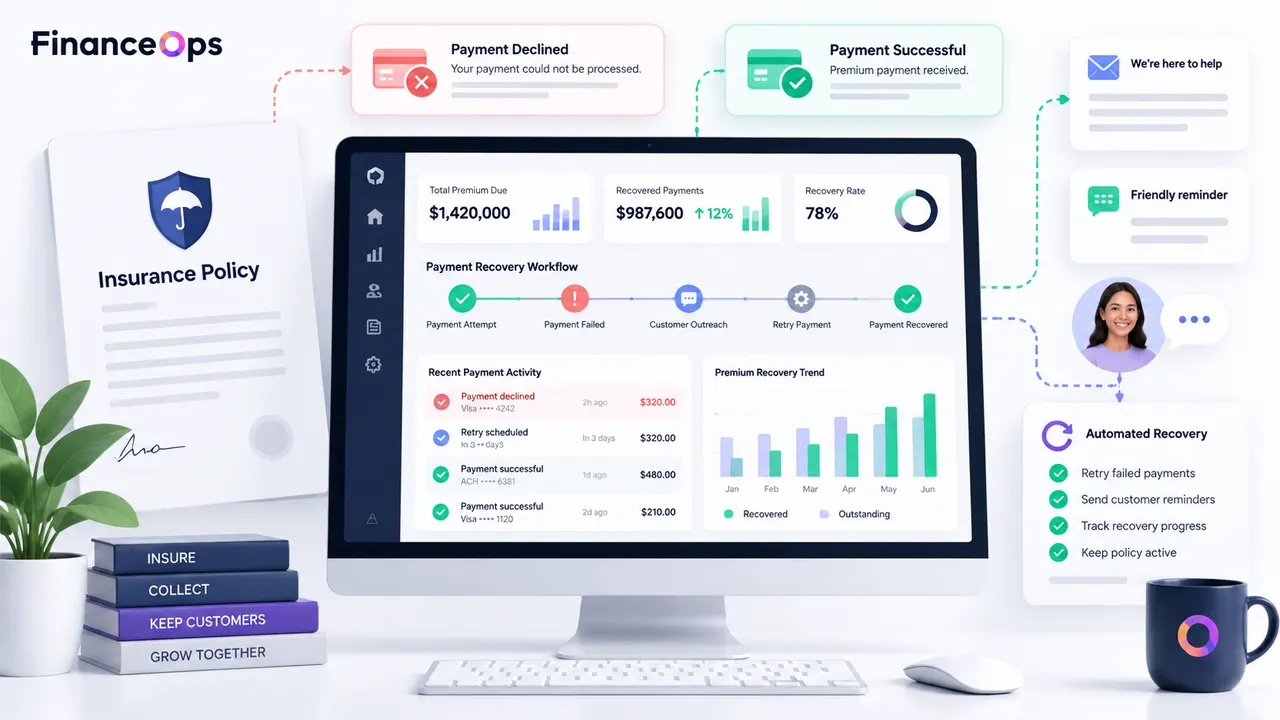
An insurance customer updates a payment card after a declined renewal charge. The insurer's payment service confirms the new card. But billing still shows an unpaid premium, a cancellation notice may already be queued, and customer service has no clear view of the payment outcome.
The issue is not simply a failed transaction. It is a failed handoff between premium billing, payment processing, policy servicing, and reconciliation.
For insurance CFOs, premium billing leaders, and policy servicing teams, AI payment recovery is useful only when it supports the next authorized, verifiable action: explain a failed payment, offer a permitted way to pay, recognize a posting exception, or escalate a policy-status issue.
Quick answer: AI agents can improve insurance premium payment recovery by identifying failed-payment events, connecting approved outreach to payment options, helping customers resolve billing questions, and routing reconciled payment outcomes back to servicing systems. They must not independently override grace periods, decide policy cancellation or reinstatement, or retry payments without appropriate authorization.
This guide focuses on insurance premiums and policyholder billing, not insurance claims adjudication or healthcare provider collections.
Why insurance payment recovery breaks after the first failed attempt
Premiums can be billed annually, monthly, by installment, or through other contracted arrangements. Failures are not interchangeable.
A transaction can be declined by a card issuer, returned by a bank, interrupted by an outdated payment credential, or successfully processed but not applied to the correct policy. A policyholder may also contest a premium adjustment or assume an autopay instruction remains active when it has changed.
A basic notification can alert the customer. It cannot determine whether the policy is current, whether a payment attempt may be repeated, or whether a regulatory notice is required.
Five operational failure points
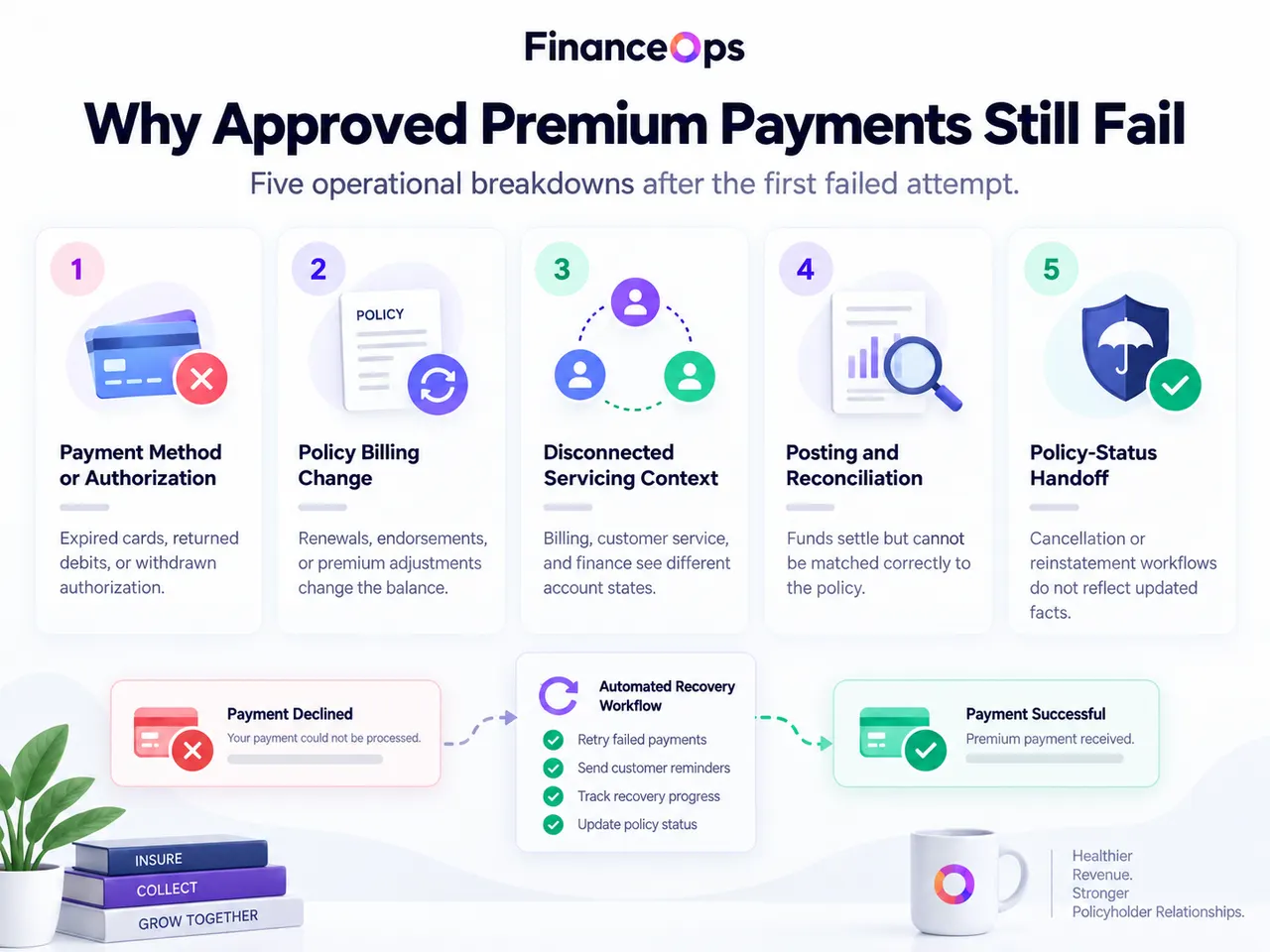
| Failure point | What goes wrong | Required response |
|---|---|---|
| Payment method or authorization | Card expires, debit is returned, or authorization is withdrawn | Confirm permitted payment options and authorization |
| Policy billing change | Endorsement, renewal, adjustment, or installment amount changes | Verify authoritative premium and due date |
| Incomplete servicing context | Customer service and billing record different account states | Investigate before sending contradictory follow-up |
| Posting and reconciliation | Collected funds cannot be matched to the policy | Hold improper follow-up and resolve the exception |
| Policy-status handoff | Cancellation or reinstatement workflows do not reflect updated facts | Escalate to authorized policy servicing and apply legal rules |
The central design principle is simple: recover the premium without confusing a payment event with a policy decision.
Premium recovery is not the same as policy reinstatement
Insurance is a regulated contract. What happens after nonpayment varies by line of business, state or province, policy language, carrier rules, and customer circumstances.
Grace periods, cancellation notices, effective dates, and reinstatement requirements cannot be replaced by an AI-generated general rule. The NAIC's Consumer Guide to Home Insurance distinguishes cancellation from nonrenewal and explains that required cancellation-notice periods vary by state. This is an example for homeowners insurance, not a universal rule for every insurance product.
A failed-payment workflow should therefore hold distinct states for premium amount due, payment status, policy status, and permitted next action. A successfully paid balance does not, on its own, prove that a canceled policy is reinstated. Only the carrier's authorized policy administration process can determine the applicable result.
How an insurance payment recovery workflow should operate
| Stage | Operational record | Key control |
|---|---|---|
| 1. Billing event | Premium due, policy reference, timing, customer class | Confirm current policy and invoice information |
| 2. Payment exception | Failed, returned, pending, settled, reversed | Use processor event codes; do not infer settled cash |
| 3. Policy and permission check | Policy status, payment authorization, contact permission, applicable rules | Restrict or hold actions that are not permitted |
| 4. Customer resolution | Updated payment method, approved schedule, billing question | Confirm identity and approved terms |
| 5. Financial application | Cleared funds allocated to correct premium or policy | Reconcile exceptions and later reversals |
| 6. Policy servicing | Billing and servicing updated; authorized notices or decisions | Separate finance recovery from policy authority |
| 7. Audit trail | Event, action, date, rule, outcome, owner | Preserve evidence for operations and review |
An effective process can be automated in parts, but cancellation, coverage, hardship, and reinstatement decisions should remain governed by the insurer's authorized processes.
Where AI agents improve the process
1. Identify the real reason a premium payment failed
A decline should not trigger the same message in every case. Card expiry, customer cancellation of authorization, bank return, duplicate attempt, pending settlement, and an amount dispute call for different next steps.
For U.S. ACH debits, Nacha distinguishes an unauthorized payment (R10) from a transaction that does not conform to an existing authorization (R11). Its reinitiation rules also restrict when a returned debit may be resubmitted. These distinctions matter: an AI agent should not indiscriminately retry returned premium debits.
An AI-assisted workflow can help classify the event, retrieve approved context, and provide the correct explanation or staff escalation. It should use payment-provider facts, not guess the payment reason from a conversation.
2. Choose permitted outreach that reaches the policyholder
Automated reminders are least useful when they repeat the wrong information. Approved communication can reflect the latest amount, permitted channels, prior interactions, and a timely route to support.
Where customer preferences and engagement history are available, FinanceOps can help identify an appropriate channel and contact time. Consent and jurisdiction-specific contact restrictions always take precedence over engagement optimization.
3. Connect customer responses to a resolution path
A policyholder might say: “My bank shows this was paid,” “I got a new card,” or “Why is my premium higher this month?”
The first requires reconciliation, the second may require an authorized payment update, and the third may require a billing or policy servicing review.
AI agents should distinguish payment intent from billing dispute or policy question, maintain conversation context across supported channels, and send cases to the right authorized team.
4. Manage approved arrangements without inventing policy terms
Some premium billing programs permit installments or revised schedules; others may restrict them by product or policy status. Any arrangement must conform to insurer rules and applicable requirements.
The success measure is not how many customers accepted a new date. It is how many eligible installments were collected, applied, and appropriately reflected in the policy record.
5. Verify applied funds instead of counting promises
A payment link click, promise-to-pay, authorization, processor submission, settlement, and policy-ledger application are different events. Only verified account data should drive the next step.
Build explicit exception queues for unmatched funds, delayed events, payment reversals, and inconsistent policy references.
How FinanceOps Agentic AI supports premium recovery
FinanceOps should be evaluated as a governed first-party collections and payment-resolution operating layer, connected to the insurer's billing, payment, and policy administration systems through scoped integrations.
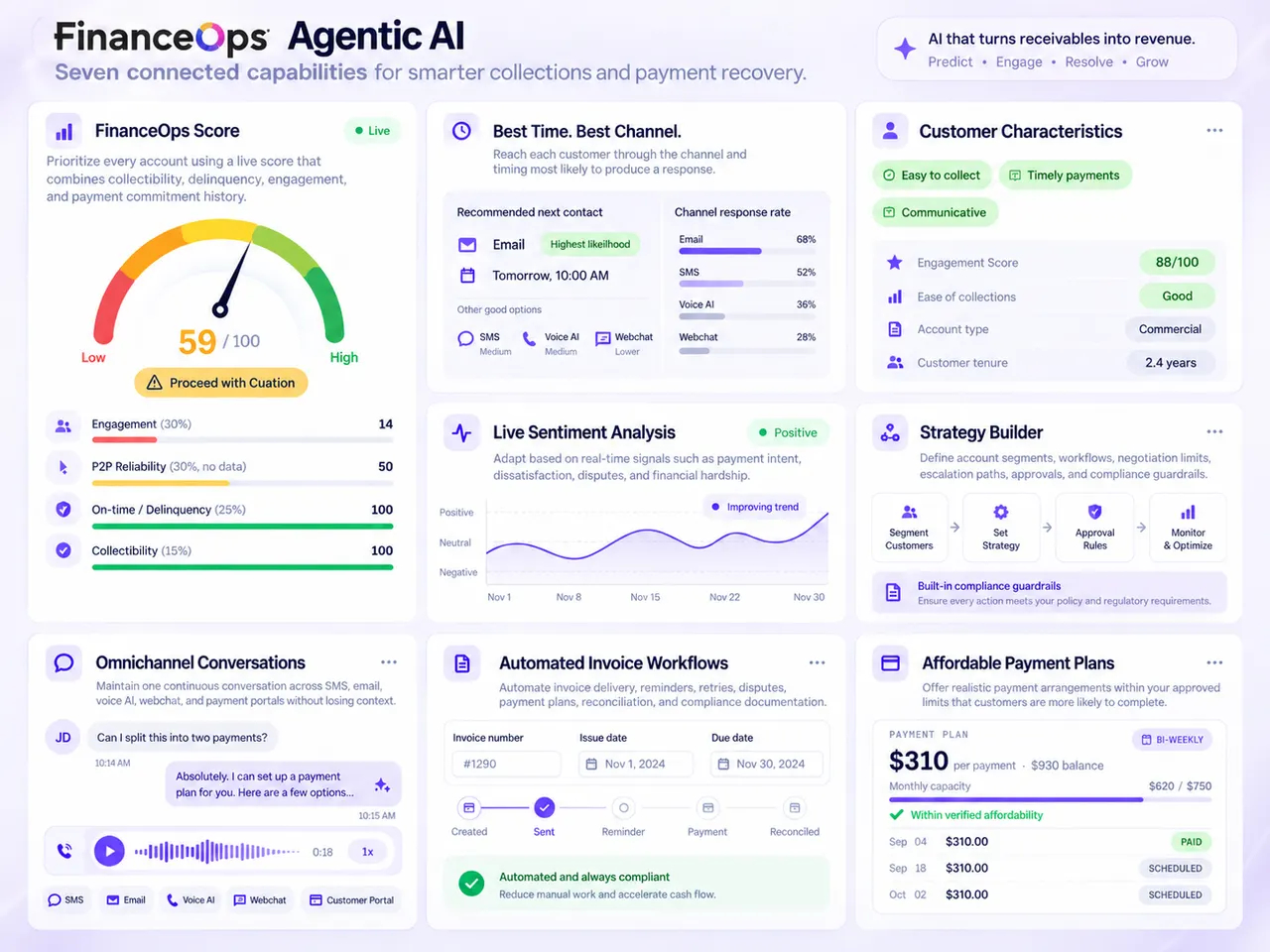
- FinanceOps Score supports account prioritization using delinquency, collectibility, engagement, and payment-commitment signals. Scores should not override coverage or policy-protection rules.
- Best Time, Best Channel supports permitted outreach timing and channel selection based on available engagement context.
- Live Sentiment Analysis helps recognize possible confusion, distress, dissatisfaction, or payment intent. These are estimates, not determinations of affordability or legal status.
- Two-Way Omnichannel Conversations carry context across configured SMS, email, voice, webchat, and portal journeys.
- Strategy Builder applies insurer-approved outreach rules, negotiation limits, escalation paths, and controls.
- Flexible Payment Plans support permitted installment arrangements and follow-through where the insurer allows them.
- Automated Invoice Workflows connect notices, premium balances, payment events, reconciliation, and billing exceptions through supported integrations.
Agentic Payments connects payment recovery activities with status verification and approved follow-up. The Resolution Center routes policy, billing, and servicing exceptions to the appropriate human owner.
This does not mean FinanceOps replaces an insurer's policy administration or claims system, or automatically guarantees compliance with every state insurance rule. Before deployment, confirm supported payment rails, processor event fields, policy-system integration scope, data permissions, and the insurer's approval matrix.
Learn about FinanceOps Autopilot, the first-party AI-led collections platform, and FinanceOps pricing for the applicable commercial model. For broader payment recovery architecture, read Agentic Payments: How AI Makes Payment Recovery Proactive. For AI versus conventional collections workflows, see Agentic AI Collections Software vs. Traditional Platforms.
How to measure recovery without creating policy or customer risk
| Metric | What to measure |
|---|---|
| Eligible failed-payment resolution rate | Successfully resolved eligible payment exceptions / eligible exceptions in a defined cohort |
| Applied premium cash | Reconciled premium receipts net of relevant refunds and reversals |
| Time to resolve payment exceptions | Median elapsed time from exception to verified outcome |
| Unmatched-payment rate | Payment events without an accepted policy-ledger match |
| Cost per resolved exception | Fully loaded cost / verified resolutions |
| Wrong-contact or repeat-contact rate | Outreach made despite updated payment status or unresolved review |
| Policy servicing accuracy | Timely alignment of approved notices and policy-status changes |
| Customer impact | Disputes, complaints, assistance escalations, and failed handoffs |
Measure by product, billing channel, policy status, and jurisdiction. A higher raw recovery rate is not a win if it includes incorrect notices, invalid payment retries, or avoidable servicing harm.
CFO example: Model recovered cash, not automation volume
Assume a hypothetical portfolio has 10,000 failed premium-payment events in a month. Of those, 7,000 are eligible for automated follow-up after all required policy and authorization checks. If 2,100 are resolved and $315,000 is settled and correctly applied, the resolution rate within that eligible cohort is 30% and verified applied premium cash is $315,000 before further reversals.
Neither figure says whether a policy was reinstated; the policy administration system must establish that separately. Compare those outcomes with an eligible baseline, net fees and human work, and control measures.
Five insurance scenarios to test in a vendor pilot
- A renewal premium is declined, then paid through another accepted channel before a scheduled reminder.
- A customer revokes automatic payment authorization; the system must not treat a retry as automatically permissible.
- A premium endorsement changes the billed amount after an outreach campaign is queued.
- A payment settles but is matched to the wrong policy, creating a reconciliation exception.
- A policy has entered a cancellation-related review status when the customer asks about reinstatement.
For each test, inspect the data source, permitted next action, human approval boundary, payment ledger, policy administration update, customer communication, and audit record.
Run a controlled pilot with clear eligibility criteria and a comparison cohort. Exclude protected or disputed accounts from inappropriate treatments, measure baseline recovery and resolution times, and review wrong-contact events alongside applied cash. Prefer net, reconciled results over the number of messages sent.
Ask the vendor to label every capability as available now, configuration required, integration required, or not supported. This prevents a conceptual workflow diagram from being mistaken for a production-ready insurance integration.
For broader procurement and ROI methodology, see Enterprise AI Collections: An Evidence Checklist and AI Collections ROI: Measure Cash, Cost, and Customer Impact.
The recovery workflow must respect the policy lifecycle
A failed premium payment should trigger an informed, authorized response, not an undifferentiated reminder sequence.
The difference between a successful recovery operation and a risky one is whether payment events, customer conversations, billing records, and policy servicing stay consistent.
FinanceOps Agentic AI can help insurers make approved customer contact more effective, resolve payment exceptions, and measure applied premium cash. See the FinanceOps Autopilot product for the collections workflow and Agentic Payments for payment recovery design. Policy status and coverage decisions remain with the carrier's authorized processes.
Evaluate payment recovery by what is verified, reconciled, and appropriately resolved—not by the number of reminders sent.