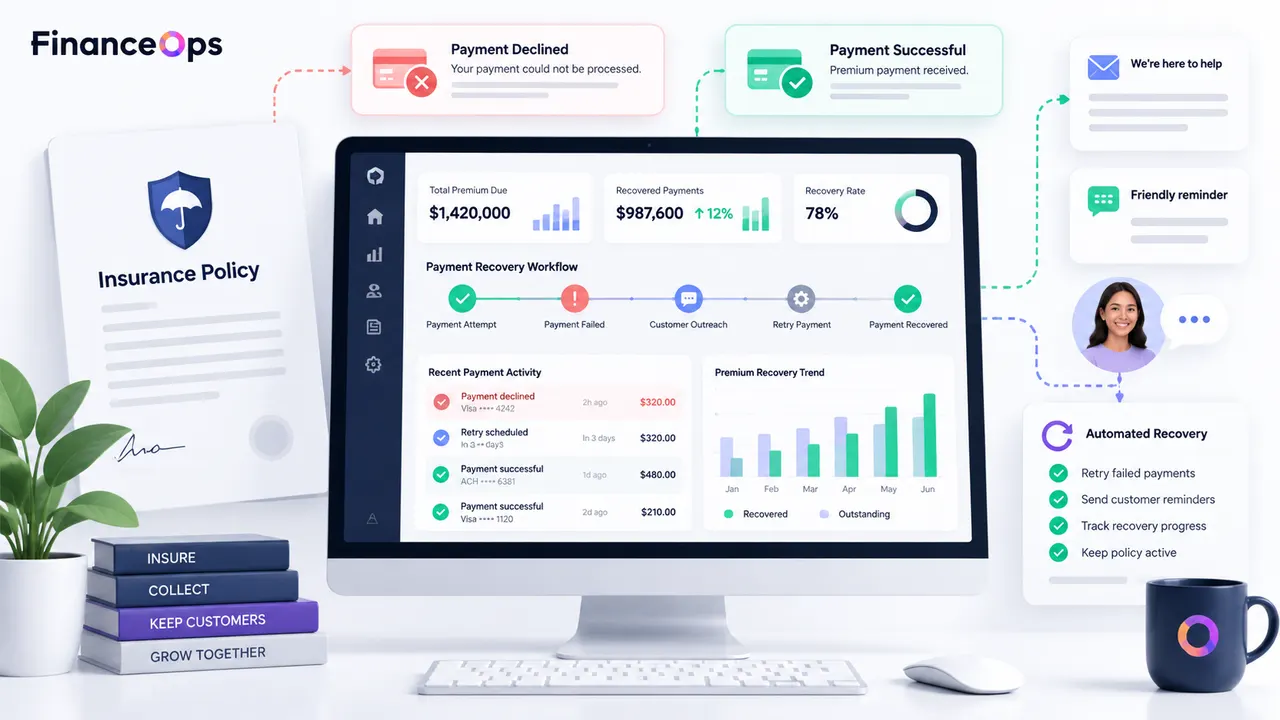
A policyholder can intend to keep coverage and still miss a premium because a payment fails, a bill is disputed, or the insurer's servicing records fall out of sync. Preventable payment friction becomes a coverage risk when the insurer cannot identify the obstacle, resolve it under approved rules, and verify the policy record in time.
Blog Summary
- Five operational reasons premium payments can remain unresolved even when policyholders intend to maintain coverage.
- The U.S. insurance rules governing grace periods, payment authorization, notices, and insurer-controlled coverage decisions.
- How connected premium billing, policyholder servicing, and FinanceOps Agentic AI can support verified payment resolution.
In May 2025, the North Carolina Department of Insurance announced that The Members Insurance Company and Universal Insurance Company had agreed to provide more than $2.6 million in policyholder refunds, including interest, and pay $113,000 in combined fines following a market conduct examination. Regulators cited incorrect charges, premium-rate notification problems, and delayed claims payments. Read the North Carolina regulator's announcement.
This was not a finding that willing policyholders lost coverage because an autopay transaction failed. It illustrates a narrower, important point: billing and servicing inaccuracies can become expensive operational and regulatory problems.
Now consider a different situation. A policyholder has paid by autopay for years. Their card expires. A notice arrives in a rarely checked inbox. The next installment becomes due before anyone addresses the failure. The customer still wants the insurance. The required payment, however, has not been completed.
For a CFO or Premium Billing Director, the question isn't how many reminders went out. It's which unresolved payment obstacles are moving toward a policy deadline, and whether the insurer can take the right permitted action in time.
Five reasons an intended premium payment goes unresolved
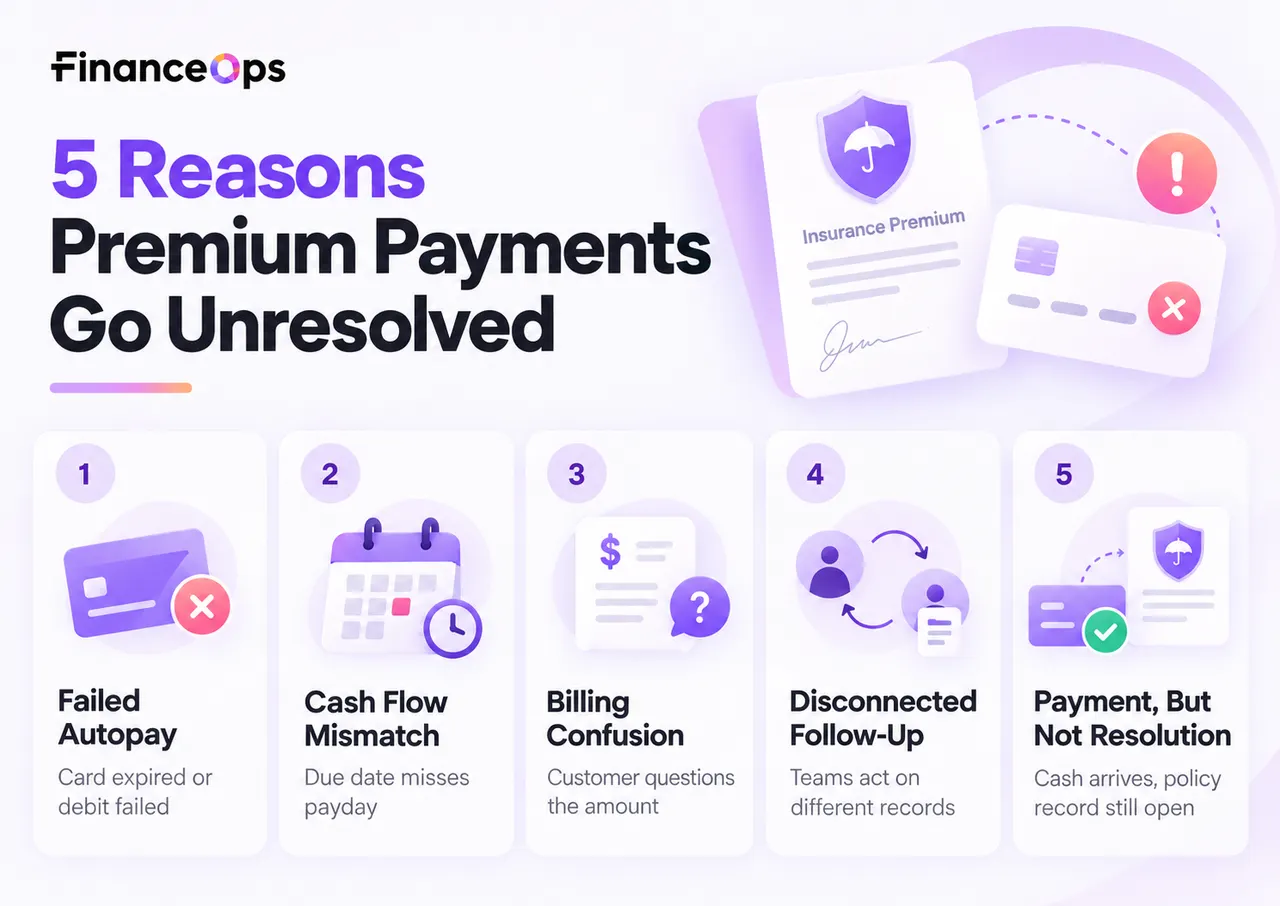
These are five operational failure modes, not a statistically ranked list of U.S. policy-lapse causes.
1. Autopay was authorized, but the transaction failed
Expired cards, insufficient funds, bank-account changes, and authorization exceptions can interrupt recurring premiums. Customers may reasonably believe a scheduled payment went through until they check their account or receive a useful notification.
A decline code requires more than another payment request. The insurer should check the processor's status, the actual premium due, the payment method, and whether another debit or alternative is authorized.
CFPB guidance on automatic bank payments explains the role of authorization and the risks of insufficient funds. A scheduled debit is not proof that funds settled.
2. The payment date conflicts with available cash
A customer paid on the fifteenth of the month may struggle with a debit scheduled for the tenth. They may intend to maintain coverage but lack available funds when the premium is attempted.
The appropriate response depends on what the policy and insurer allow. Some programs can offer approved installment options or alternate methods. Others have fixed contractual dates or additional legal requirements.
A payment plan must be permitted, understood, and followed through. Offering a new date does not itself extend a statutory grace period or guarantee coverage.
3. The customer questions a premium that changed
A renewal, endorsement, rating adjustment, or coverage change alters the invoice. The customer expected $150 but sees $195 and asks why.
If the question remains unanswered, collections may continue reminding the customer about a balance they do not understand. A dispute is a servicing issue that should be resolved or appropriately reviewed before continuing an unsuitable treatment.
The North Carolina enforcement case is relevant here because it documents incorrect charges and rate-notification failures, not because it proves a particular policy-lapse pattern.
4. The insurer contacts the customer without the latest context
The processor has a failed-payment event. Customer service has a card-update request. Collections has yesterday's outstanding balance. The customer has already answered a reminder, but that response is not visible to the next team.
More contact does not fix an information gap. It can compound the problem by asking a customer to repeat their explanation or pay an amount that has since changed.
5. Cash arrives but the policy record remains unresolved
A payment may be initiated but not settled. It may settle but remain unapplied because a policy reference is missing. Or the funds may arrive after a notice or coverage-related deadline.
These events must remain distinct in the operating system:
| Event | What it establishes | What it does not establish |
|---|---|---|
| Autopay authorized | Permission for the relevant payment activity | The debit succeeded |
| Payment initiated | A transaction was attempted | The money settled |
| Payment settled | Funds were received through the processor | The correct policy was credited |
| Payment applied | The ledger reflects the correct obligation | Coverage was automatically reinstated |
| Policy status confirmed | The authoritative policy system has a status | That every upstream exception has been resolved |
These five scenarios share one operational weakness: the insurer may have the payment data, customer history, and servicing information, but not a connected process to act on them before the issue escalates.
FinanceOps Agentic AI helps close that gap by connecting payment intelligence, approved policyholder communication, automated recovery, and reconciliation, while keeping coverage decisions under the insurer's control.
For a deeper technical analysis of these transaction states, read How AI Agents Improve Insurance Payment Recovery Workflows. For the wider finance operating model, see Insurance Receivables: The 2027 CFO Revenue Operations Guide.
U.S. compliance: A failed payment is not a cancellation instruction
Policy lapse, cancellation, nonrenewal, and reinstatement are distinct legal and servicing concepts. The exact rules depend on insurance line, jurisdiction, policy language, customer eligibility, and applicable notices.
Grace periods are product-specific
HealthCare.gov explains that certain Marketplace health-plan enrollees using advance premium tax credits, after paying at least one full month's premium during the benefit year, generally have a three-month grace period. All owed premiums must be paid to avoid loss of coverage; subsequent payments do not automatically restart the grace period, and termination may be retroactive under the applicable conditions.
That is not a universal 90-day rule for auto, homeowners, life, or every health-insurance policy.
Cancellation notices and policy authority remain with the insurer
The NAIC's consumer guide to homeowners insurance explains cancellation and nonrenewal as different events and notes that relevant notice requirements vary by state. NAIC model guidance does not automatically supersede state law.
Payment settlement should be communicated to authorized policy administration, but an AI system must not infer reinstatement from a processor success message.
Payment authorization and communications need their own controls
For recurring bank debits, authorization, revocation, and payment-network restrictions matter. The CFPB explains how customers can stop automatic payments.
Automated calls and texts also require case-specific review of applicable TCPA, FCC, privacy, and state requirements. FinanceOps cannot guarantee compliance through a single toggle. Insurers should configure approved contact windows, permitted channels, dispute holds, identity checks, and human approvals.
The operating rule is simple: an agent may execute an approved task; it must not invent insurance coverage authority.
How FinanceOps Agentic AI connects the seven capabilities
An insurer does not need another isolated reminder tool. It needs a decision path that can distinguish a solvable premium-payment issue from a case requiring regulated policy servicing.
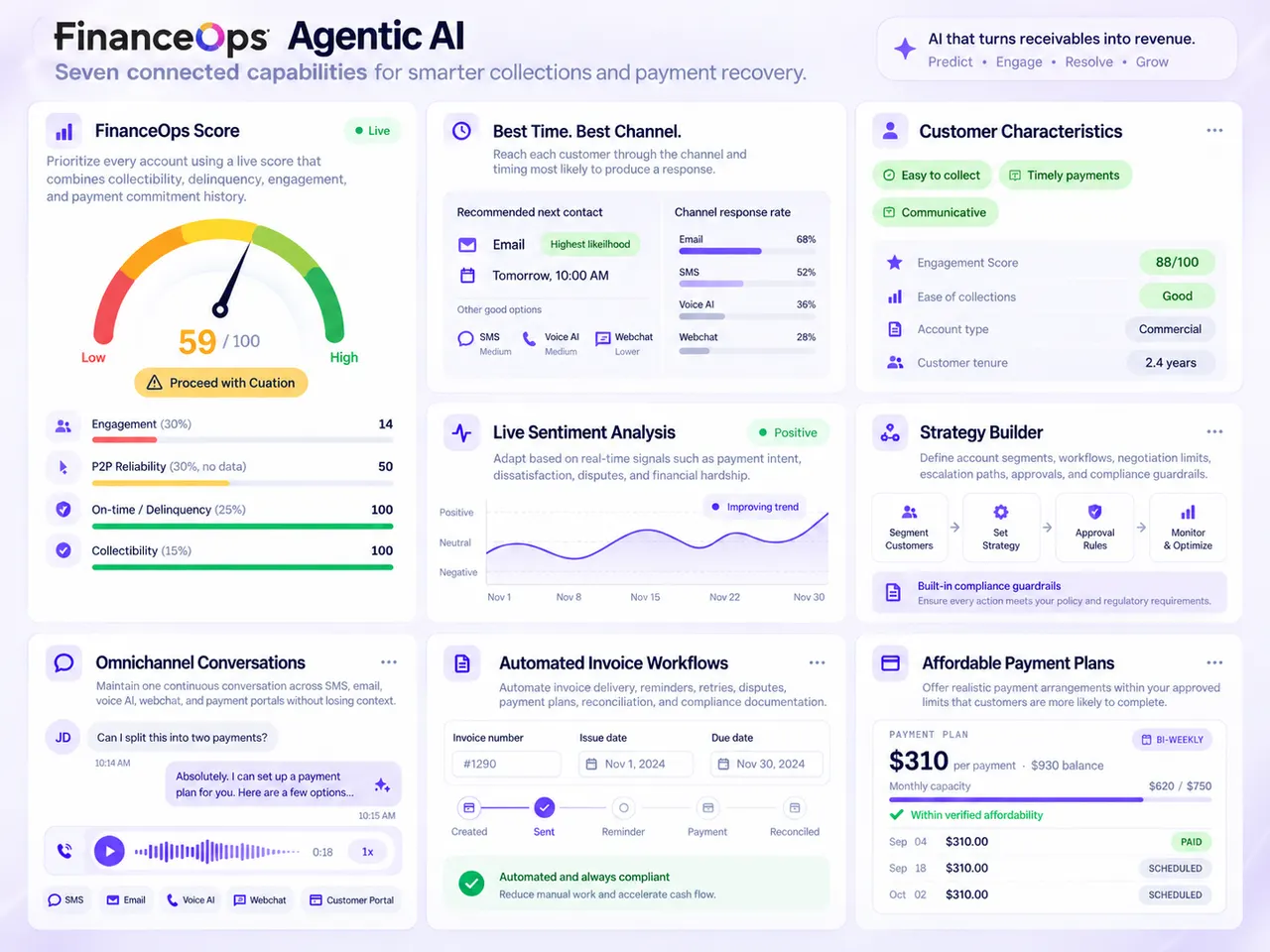
| FinanceOps Agentic AI capability | Role in premium and policyholder servicing |
|---|---|
| Best Time, Channel, and Person to Contact | Guide appropriate outreach based on permitted channels and engagement context |
| Live Sentiment Analysis | Identify possible confusion, hardship, dissatisfaction, or payment intent without treating inference as fact |
| Two-Way Omnichannel Communication | Preserve relevant policyholder conversations across configured channels |
| User-Controlled Strategy Builder | Apply insurer-approved contact, payment, restriction, and escalation rules |
| Flexible Payment Plans | Support permitted arrangements where the policy and carrier allow them |
| Automated Invoice Lifecycle | Connect premium billing, account adjustments, payment events, and reconciliation |
| FinanceOps Score | Support prioritization through collectibility, delinquency, engagement, and promise-to-pay signals |
FinanceOps Autopilot supports eligible first-party follow-up; Strategy Builder defines permitted actions; and Copilot supports authorized staff on cases that need judgment. Agentic Payments helps connect accepted payment options with transaction status, subject to integration.
These features support collections and servicing workflows, not underwriting, adjudication of claims, or automatic cancellation or reinstatement.
For security, regulatory oversight, and operational controls, review FinanceOps Compliance.
A single policyholder journey that tests the system
Imagine an illustrative $180 monthly premium. An autopay charge fails because the saved card has expired.
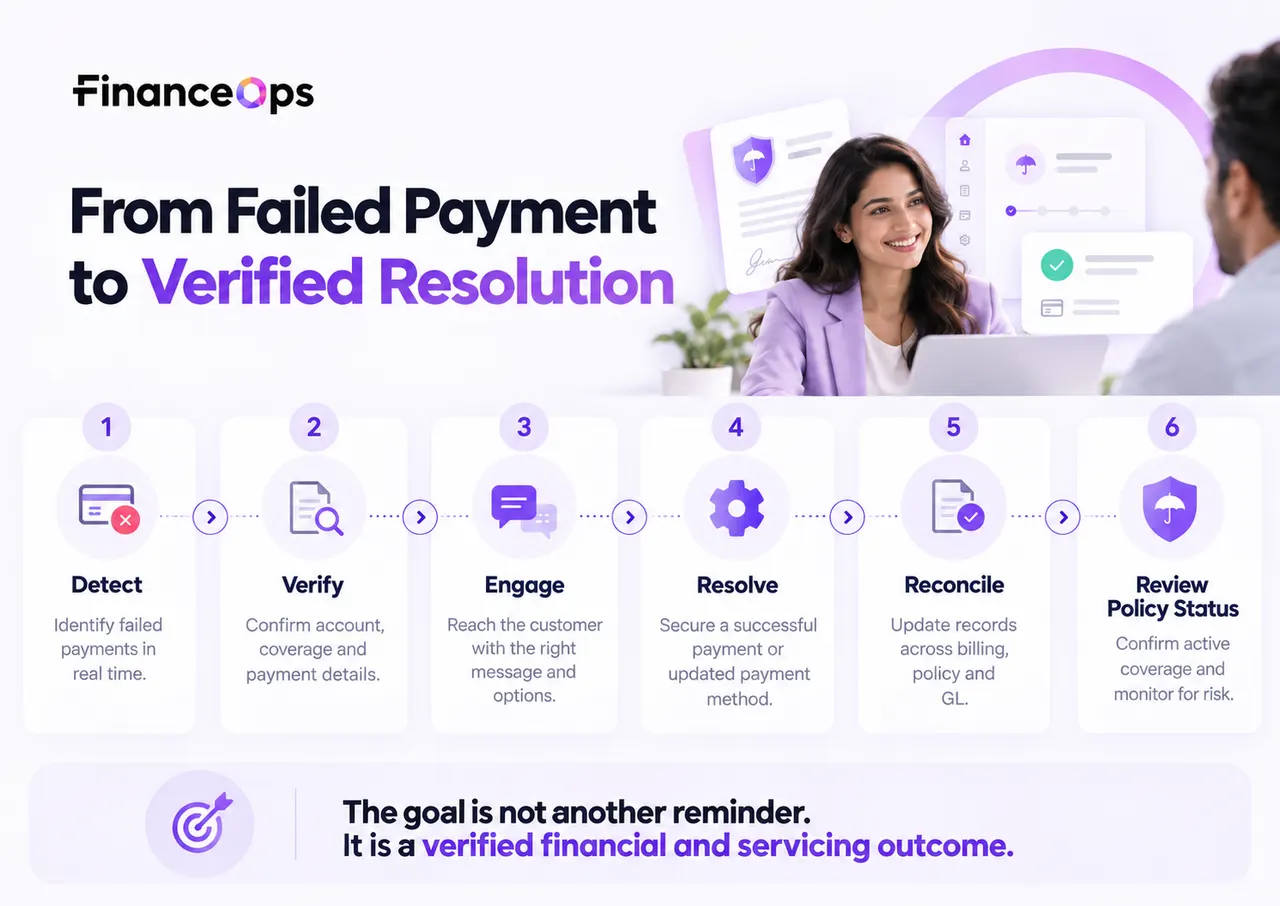
- Detect: The payment processor sends a failure event and available reason information.
- Verify: The system checks the current bill, payment state, relevant permissions, policy status, and any existing servicing hold.
- Engage: An approved message offers a route to update the method or contact support.
- Resolve: The customer chooses an authorized payment option. A billing objection or hardship disclosure takes the configured escalation path.
- Reconcile: The insurer confirms settlement and application to the correct policy account.
- Review policy status: The authoritative servicing team or policy administration process determines any coverage implications.
The test is not whether the AI initiated contact quickly. It is whether the customer, money, and policy record end in a consistent, explainable state.
What insurance CFOs should measure
| KPI | Decision it supports |
|---|---|
| Eligible failed-premium resolution rate | Are payment obstacles actually resolved? |
| Net applied premium cash | Did verified receipts reach the right policy after relevant reversals? |
| Time to close payment exceptions | How long do failed, returned, and unmatched events remain open? |
| Unapplied cash rate | Where is reconciliation creating friction? |
| Payment arrangement completion | Do permitted commitments translate into applied payments? |
| Repeat-contact and complaint rates | Is servicing creating avoidable customer frustration? |
| Policy-status mismatch rate | Do payment and coverage records remain consistent? |
| Cost per resolved eligible account | Does the workflow improve overall operating economics? |
Do not infer “policies saved” from payment recovery alone. To establish a genuine lapse-prevention effect, an insurer needs authoritative policy-status outcomes, a clear baseline, comparable cohorts, and controls for other causes of lapse.
For an operational CFO measurement framework, see AI Collections ROI: Measure Cash, Cost, and Customer Impact.
The issue is not always willingness to pay
A policyholder who intends to stay insured still needs accurate billing, a working payment method, timely communication, and clear servicing options.
Not every policy lapse can be prevented. Financial hardship, contractual obligations, and regulatory requirements are real. But some payment-related problems may be resolved earlier if insurers connect transaction events with the appropriate account context and support process.
Better insurance recovery is not simply another reminder before a deadline. It is making sure the right problem reaches the right permitted resolution path while there is still time to act.
Key takeaways for insurance leaders
- Separate intent from outcome. Autopay, promises, settlement, application, and policy status require different evidence.
- Treat billing and servicing exceptions as first-class work. A disputed amount or unapplied payment cannot be solved by increasing reminder frequency.
- Keep AI accountable to insurer rules. Use Agentic AI to execute permitted customer support and recovery workflows, with coverage authority and sensitive decisions retained by authorized personnel.