
A credit union can improve its cure rate and still lose member confidence. One loan gets paid, but the member receives an unnecessary reminder after payment, repeats a dispute to three employees, or learns that a payment arrangement was never reflected in servicing. The recovery dashboard looks positive. The member experience does not.
Reducing delinquency without losing member trust requires two measurements: verified account resolution and the quality of the path taken to get there. Better collections cannot be judged by the number of messages or promises to pay.
This practical guide is for credit union CFOs, lending operations, and collections leaders evaluating how to balance recovery, cost, member support, and policy controls. For the introductory case for early intervention, see Why Credit Unions Need Early, Intelligent Collections. Here we focus on operating strategy, customer evidence, and measurable outcomes.
A recovery result can hide an experience problem
The NCUA's Q2 2026 system results reported an aggregate credit-union delinquency rate of 96 basis points (0.96%), 6 basis points above the prior year. This is a systemwide result, not the experience of every credit union or loan type.
A credit union that increases collections can still have problems if its teams repeatedly contact members whose payments have already posted, leave disputes unresolved, or give inconsistent instructions across channels.
A member-first approach must answer two questions together: Did the account move toward verified resolution? And was the communication accurate, proportionate, and appropriate?
LAFCU and SkyOne: Two different dimensions of performance
LAFCU: Recovery and delinquency
The published LAFCU case study reports more than $1 million collected and a 65% reduction in delinquency, according to its case-study reporting.
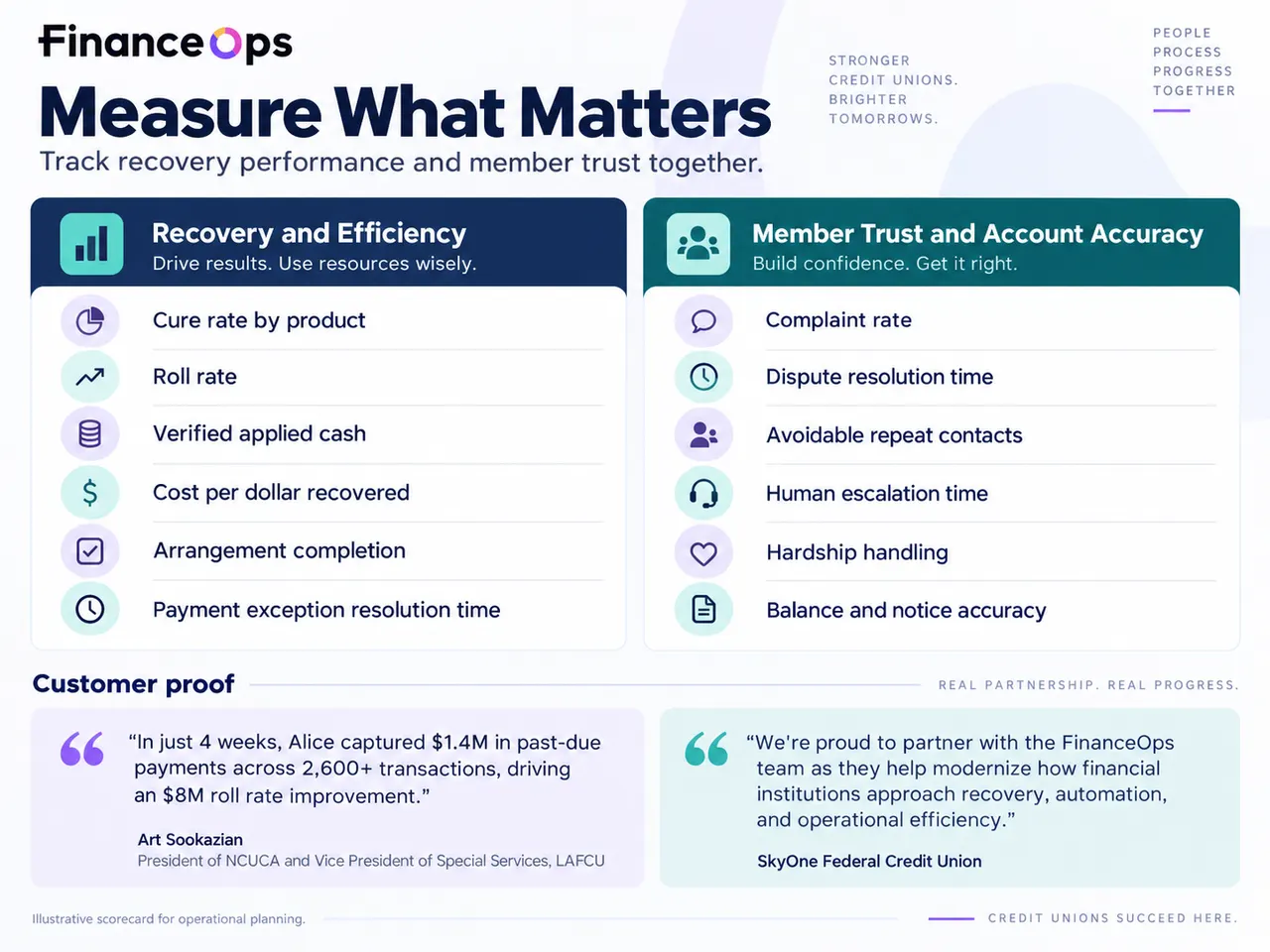
“In just 4 weeks, Alice captured $1.4M in past-due payments across 2,600+ transactions, driving an $8M roll rate improvement.”
— Art Sookazian, President of NCUCA and Vice President of Special Services, LAFCU, in a FinanceOps-published testimonial.
The testimonial's four-week figures and the case study's summary reflect distinct reporting descriptions. Do not combine them into a universal performance estimate or claim that the numbers prove an improvement in member satisfaction.
What leaders should investigate: Which loan segments improved? How was roll-rate improvement calculated? What happened to payments that were reversed? Did escalation and complaint rates change?
SkyOne: Throughput and collection costs
The published SkyOne case study reports eight times more payments processed and a 90% reduction in operating collection costs in its deployment.
“We're proud to partner with the FinanceOps team as they help modernize how financial institutions approach recovery, automation, and operational efficiency.”
— SkyOne Federal Credit Union, public partnership statement.
These figures address throughput and cost, not a measured increase in member trust. A bank or credit union evaluating the results should ask about portfolio scope, baseline, treatment costs, exception rates, and member outcomes.
The lesson: Real case studies support a business hypothesis; they do not replace an institution's own baseline and controlled pilot.
The dual scorecard: Cash performance and member experience
| Recovery and efficiency | Member treatment and account accuracy | Diagnostic question |
|---|---|---|
| Cure rate by product and days-past-due cohort | Complaint rate per contacted accounts | Did cures improve while complaints rose? |
| Roll rate to later delinquency | Dispute resolution time | Were unresolved disputes moved forward? |
| Verified applied cash and kept promises | Avoidable repeat-contact rate | Were paid members contacted again? |
| Cost per dollar recovered | Human escalation time and completion | Did lower cost create an unsupported queue? |
| Arrangement completion | Hardship and assistance handling against policy | Were arrangements appropriate and sustained? |
| Payment exception resolution time | Balance and notice accuracy | Did faster operations preserve correct account data? |
Define every denominator, time window, and account cohort. A cure rate is not the same as gross dollars collected. Complaint rates should be normalized by relevant contacted accounts, with consistent complaint definitions.
A hypothetical example: Better cures, worse experience
Assume 1,000 auto-loan accounts start in the same delinquency bucket. In an initial cohort, 320 cure and 18 complaints are recorded among 800 contacted accounts. In a comparable later cohort, 390 cure, but 40 complaints arise among 820 contacted accounts.
The cure rate rises from 32% to 39%. Complaints per 100 contacted accounts increase from 2.25 to approximately 4.88. Neither change proves causation; product mix, seasonality, and collections policies must also be considered. Together, the numbers demand investigation, not a victory announcement.
Delinquency-stage operating playbook
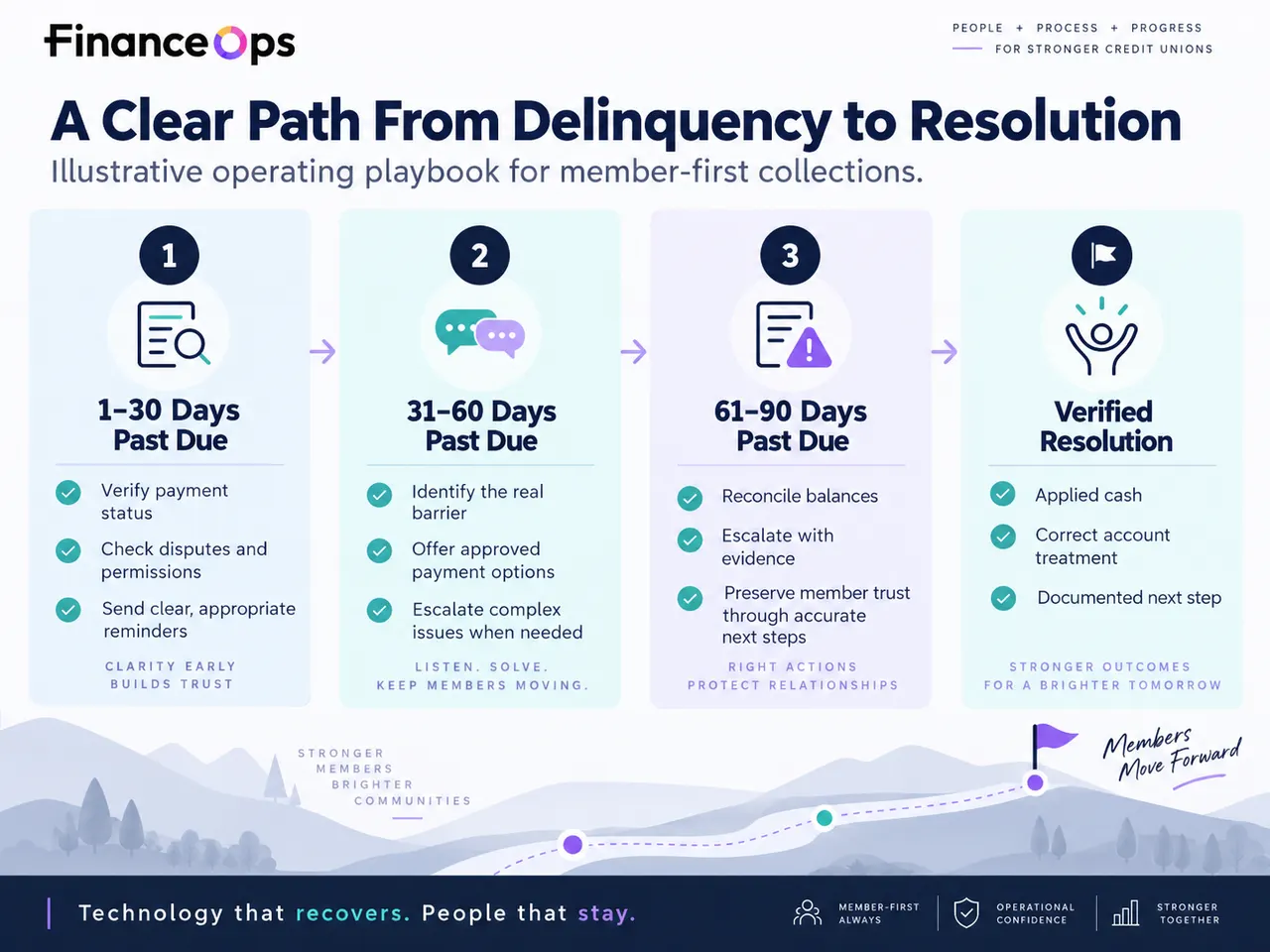
The following 1–30, 31–60, and 61–90 day bands are illustrative operating segments, not universal legal thresholds. Each credit union must configure decisions by product, member status, account restrictions, and applicable rules.
1–30 days past due: Verify and resolve simple issues
Check recent payments, unapplied cash, disputes, communication permissions, and existing arrangements before outreach. For eligible accounts, provide a clear reminder and practical servicing path. If the member says a payment was made, investigate rather than repeat the demand.
Measures: Early cure, accurate payment posting, first appropriate action, repeat contacts, member complaints.
31–60 days past due: Understand the unresolved obstacle
A second reminder should not substitute for finding out whether the issue is a failed payment method, disputed amount, affordability barrier, or incomplete member request. Offer only approved arrangements and route complex or sensitive cases to employees with conversation context.
Measures: Kept promises, approved arrangement completion, dispute-resolution time, roll rates, escalation effectiveness.
61–90 days past due: Escalate with evidence
As delinquency advances, a credit union may use more involved staff workflows or external specialists. Before any adverse or third-party action, reconcile balances, verify existing protections and notices, and document the decision owner.
Measures: Net applied cash, cure and roll rate, cost per resolution, complaints, correct exception handling.
Common rules for every stage
Identity checks, dispute and fraud handling, bankruptcy-related restrictions, consent and contact preferences, payment authorization, and member requests for human help must override engagement optimization. AI sentiment signals should not be treated as proof of a member's financial means. For practical outreach wording, review the credit union call-script template and the credit union SMS template pack. These resources require adaptation to each credit union's approved policies.
How FinanceOps supports outcomes without replacing member judgment
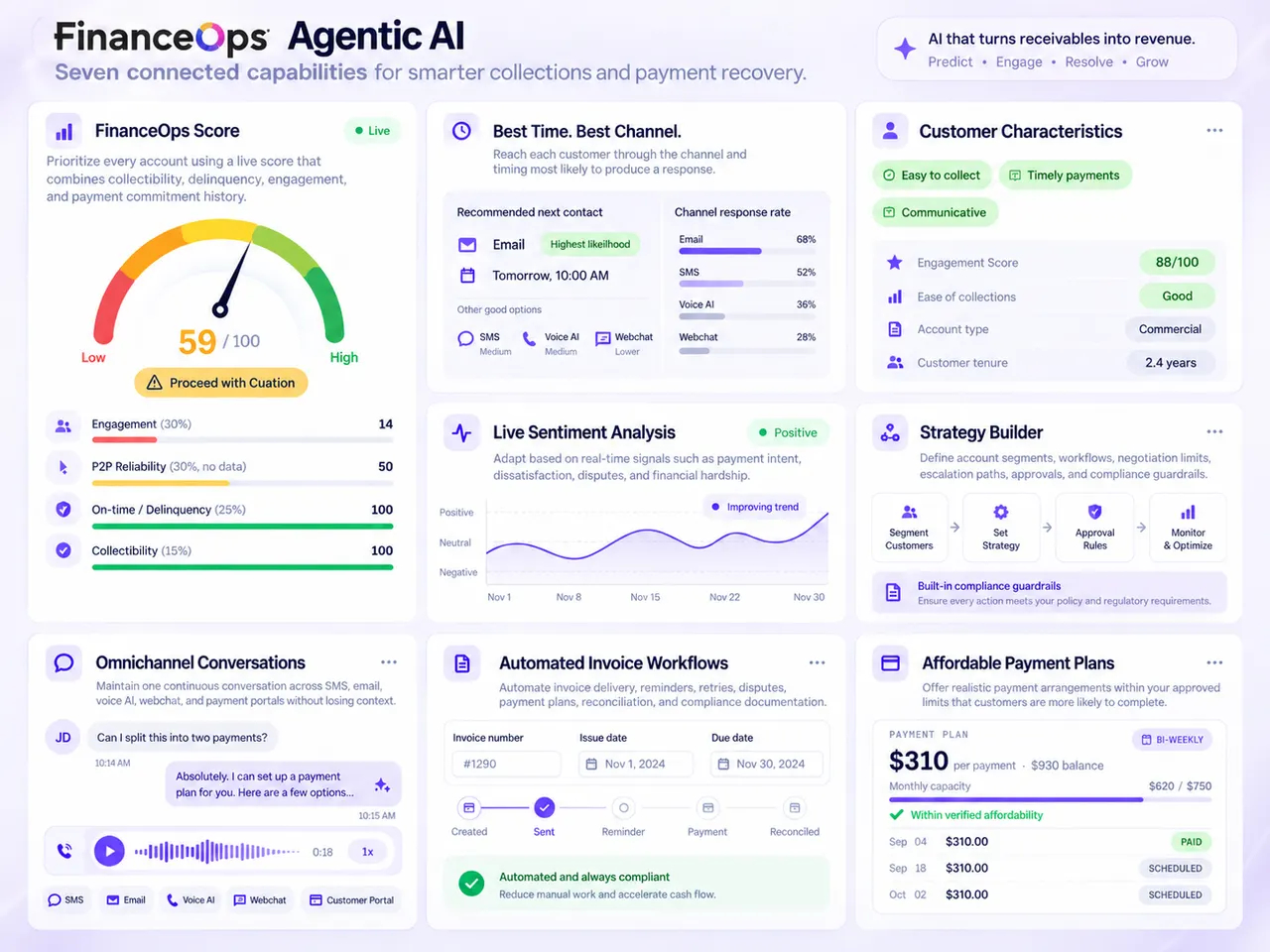
| FinanceOps capability | Operating role | What a CFO should validate |
|---|---|---|
| FinanceOps Score | Prioritize eligible accounts using collectibility, delinquency, engagement, and payment-commitment signals | Cure and roll performance by segment |
| Best Time, Channel, Person | Select permitted outreach timing and channels | Contact effectiveness and avoidable repetition |
| Live Sentiment Analysis | Surface possible confusion, complaint, or hardship signals | Accuracy, escalation, and staff review |
| Two-Way Omnichannel | Continue a member conversation across approved channels | Repeated explanations and resolution time |
| Strategy Builder | Apply approval limits, account restrictions, and escalation rules | Auditable policy adherence and exception holds |
| Flexible Payment Plans | Record and track approved member arrangements | Kept promises and applied payments |
| Automated Invoice / Account Workflows | Align notices, amounts, transactions, and reconciliation | Posting accuracy and false follow-up |
FinanceOps Autopilot can handle eligible routine first-party engagement. Copilot supports human agents on accounts needing judgment. Strategy Builder governs the decisions and escalation boundaries. Explore the credit union-specific solution or Banks & Credit Unions overview to understand the deployment approach.
Regulatory controls are part of the scorecard
The CFPB's Regulation F overview implements the FDCPA for covered debt collectors. A credit union collecting its own loans is not automatically subject to identical provisions as an unaffiliated third-party collector; other federal and state obligations can apply. Counsel should assess the lender's role, vendor activities, product, and jurisdiction.
Before automation takes any action, the platform should verify the account trigger, communication permission, current balance, dispute or protected status, and permitted next step. Keep human escalation for fraud, hardship, bankruptcy, sensitive complaints, and similar cases.
Pilot the strategy with real account exceptions
Define one eligible loan product and delinquency cohort. Measure baseline cure and roll rates, net applied cash, effort per resolution, complaints, disputes, payment-posting accuracy, and repeat contacts. Compare the pilot with a credible control or matched baseline; don't equate more messages with more success.
Test late-posted payments, ACH returns, disputes, active promises-to-pay, hardship, member requests for a person, and restricted-contact accounts. For each scenario, inspect the source-of-truth record, allowed action, message suppression, staff routing, and audit evidence.
For procurement detail, use Enterprise AI Collections: An Evidence Checklist. For the financial model, read AI Collections ROI: Measure Cash, Cost, and Customer Impact.
Trust should be measured, not assumed
Credit unions do not have to choose between delinquency reduction and member relationships. But a program cannot claim success solely because cure rates, payment throughput, or cost metrics improve.
Strong first-party collections means verified recoveries, accurate account treatment, appropriate assistance, and fewer avoidable member frustrations. Evaluate those outcomes together, then configure technology around the results.
See how FinanceOps brings account intelligence, approved engagement, servicing, and payment resolution together for credit unions.