
A missed payment is a signal to understand, not a reason to assume the worst. The earlier a credit union responds with the right support, the more options it may have to resolve the account and preserve the member relationship.
Why Early Collections Matters to Credit Unions
Delinquency is not only a balance-management issue. It can also be an early sign that a member needs help understanding a payment, fixing a billing problem, or finding an affordable way to bring an account current.
The latest NCUA first-quarter 2026 system performance data puts the delinquency rate at federally insured credit unions at 85 basis points, up 5 basis points from a year earlier. That is a systemwide figure. It does not describe every credit union, loan product, or member segment, but it underscores why leaders need timely, account-level visibility.
Waiting for an account to age into a later bucket can narrow the available options. Contact information may be stale. A small servicing issue may have become a missed payment. A member who would have responded to a clear reminder may now need a more involved conversation.
Early-stage delinquency begins after an account becomes past due, though the exact window varies by product and policy. Early collections is not about contacting people before a payment is due without a valid basis or permission. It is about recognizing a missed payment or other permitted servicing trigger promptly, understanding the account context, and choosing an appropriate next step.
The Challenge: Acting Early Without Losing the Member Context
Credit unions have a relationship with the member that extends beyond one loan. A member may have a checking account, auto loan, credit card, mortgage, or other products with the institution. A collection interaction that ignores the broader context can feel inconsistent or impersonal.
At the same time, teams often work across core systems, servicing tools, spreadsheets, digital channels, and manual queues. That can make it difficult to answer basic operational questions:
- Which accounts need attention today?
- Has the member already contacted the credit union?
- Is there an open dispute, payment arrangement, or recent payment that has not posted?
- Which communication channels are permitted and preferred?
- Does this situation need an employee’s judgment?
Without reliable answers, early outreach can become repetitive, mistimed, or disconnected from the member’s actual situation. A stronger collections data management approach can help teams work from a more complete and current account picture.

What Member-Focused Early Intervention Looks Like
A useful early-collections process starts with an operational signal, then checks context before taking action.
1. Identify a valid trigger
The trigger may be a missed payment, a returned payment, a failed recurring payment, or a member request for help. Credit unions should define triggers by product and policy, including when outreach is appropriate and when it must stop.
2. Check the account context
Before contacting a member, check for recent payments, active disputes, existing arrangements, prior conversations, communication preferences, and other relevant servicing information. Use only information the organization is authorized to access for the task.
3. Choose a suitable next step
The right action may be a clear payment reminder, an explanation of available payment methods, a servicing response, or a conversation about an arrangement the credit union is authorized to offer. A message should make it easy for the member to understand what happened and how to get help.
4. Make follow-up consistent
If the member does not respond, follow-up should reflect the account status and applicable contact rules. It should not simply repeat the same message on every channel. A payment, reply, dispute, opt-out, or request for an employee should change what happens next.
5. Route sensitive situations to a person
Disputes, complaints, suspected fraud, hardship requests, bankruptcy notices, identity concerns, and other exceptions may require employee review. Employees should receive the conversation history and account context so the member does not have to start over.
For a practical companion, use the gated collections call-script template for credit unions. It covers early reminders, hardship conversations, payment negotiations, broken commitments, and escalation.
What Should Credit Union Collections Software Support?
The right platform should make it easier to act consistently and see what happened. During an evaluation, leaders can ask:
| Capability | Question for the credit union |
|---|---|
| Current account context | Can staff see payment status, recent activity, arrangements, and open issues before outreach? |
| Configurable policies | Can workflows reflect different products, stages, contact permissions, and escalation rules? |
| Servicing and collections | Can the process resolve routine questions as well as support appropriate recovery actions? |
| Two-way communication | Can a member respond, ask for help, or request an employee without entering a disconnected process? |
| Human escalation | Do employees receive the reason for escalation and the conversation history? |
| Audit trail | Can the credit union reconstruct the trigger, decision, communication, response, and outcome? |
| Outcome reporting | Can leaders track recovery alongside complaints, repeat contacts, kept promises, and member experience? |
For a closer look at how governed AI workflows differ from fixed rules-based tools, see Agentic AI Collections Software vs. Traditional Platforms.
Explore FinanceOps’ solutions for banks and credit unions.
Where AI Can Help, and Where People Should Stay Involved
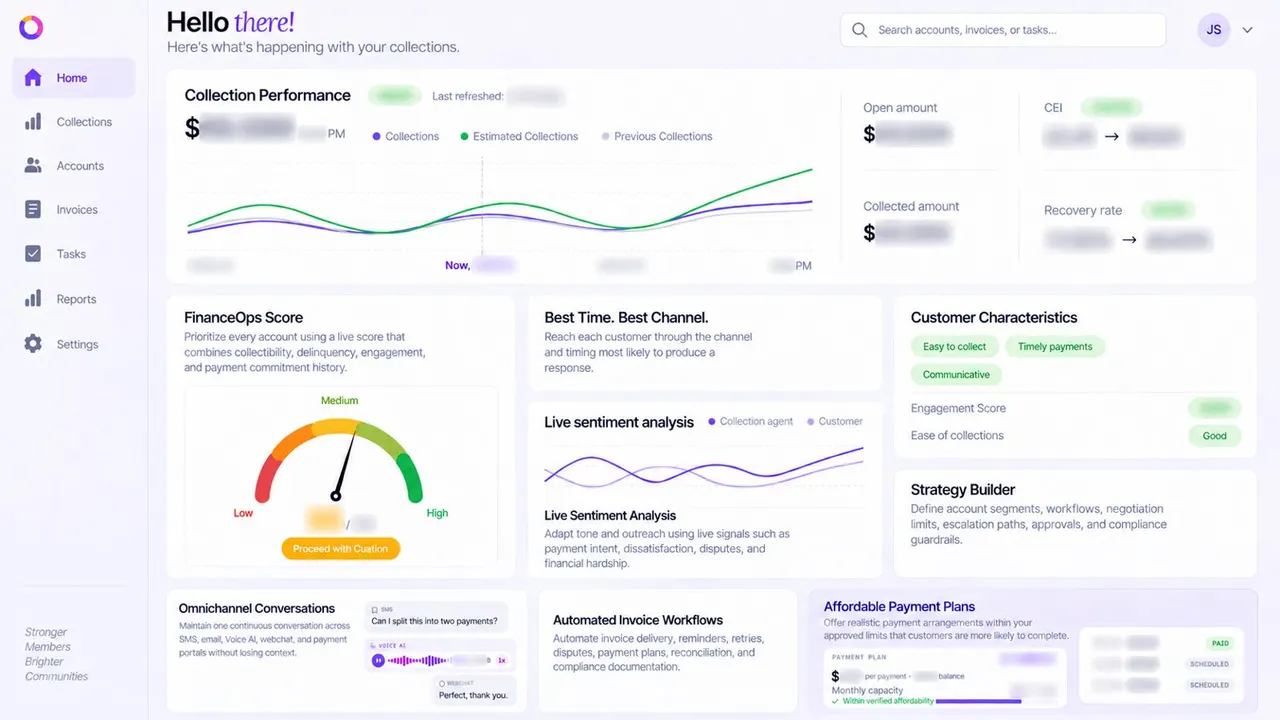
AI can help teams prioritize accounts, select an approved next step, manage routine two-way servicing and collections conversations, and update workflows when a member responds or makes a payment. For a broader introduction, see What Is an AI Payment Collection Agent?.
Autopilot supports routine collections activity, while Copilot supports employees on accounts that need a person. Credit unions can configure how those workflows operate through Strategy Builder.
But the model is only one part of the system. Credit unions also need reliable data, clear authority limits, tested workflows, access controls, monitoring, and a way to pause or route activity when conditions change. For a closer look at the end-to-end workflow, read How Does Autonomous Collections Software Actually Work?.
A practical control design should specify:
- Which account events permit an action
- Which messages and payment options are approved
- Which channels and contact windows are available
- What the system must check before acting
- Which situations require employee review
- How member responses and payment status update the workflow
- How exceptions and outcomes are logged and reviewed
For example, if a member disputes the balance, the workflow should stop routine collection steps and route the issue according to policy. If a member asks for an employee, that request should follow a defined path. If a payment posts, the account status and future outreach should update accordingly.
Compliance requirements depend on the credit union’s role, the account, the communication method, and applicable law. The CFPB’s Regulation F overview explains that Regulation F implements the FDCPA for debt collectors as defined by the statute. Credit unions should have counsel determine which requirements apply to their own first-party activity, vendors, and specific communications. This article is operational guidance, not legal advice.
Measure Recovery and Member Experience Together
A collections program should not be judged by dollars recovered alone. A useful measurement set can include:
- Cure rate by product and delinquency stage
- Roll rate from one delinquency stage to the next
- Promise-to-pay rate and kept-promise rate
- Time from trigger to first appropriate action
- Payment posting and reconciliation accuracy
- Repeat contact rate
- Complaints and disputes
- Requests for human assistance
- Opt-outs and channel delivery failures
- Outcomes across relevant account segments
FinanceOps’ gated LAFCU case study reports more than $1 million collected and a 65% reduction in delinquency for that institution. The full case study requires an access request. Treat those figures as one institution’s reported experience, not a forecast for every credit union.

These measures help leaders identify whether earlier action is resolving accounts, creating unnecessary contact, or shifting work from one team to another. They also create a basis for adjusting policies and workflows using observed outcomes rather than assumptions.
A Practical First Step for Credit Union Leaders
Choose one loan product and one early-delinquency segment. Map the current path from the first missed payment through the next employee handoff. Identify where account context is missing, where follow-up is delayed, and which member situations should go directly to staff.
Then establish a baseline. Track the current cure rate, roll rate, response rate, time to first action, complaint rate, and employee effort. A focused review can show whether better-timed, better-informed servicing and collections would help before the credit union expands the workflow.