
Modern payment infrastructure can authorize transactions instantly, support multiple payment methods, and provide customers with seamless digital payment experiences. Banks, credit unions, fintech lenders, and large enterprises have invested heavily in processors, payment gateways, servicing platforms, and financial systems. However, the most challenging payment problems often begin after the transaction fails.
Key Takeaways
AI payment recovery platforms help enterprises move from reactive payment handling to proactive recovery operations.
- Payment intelligence is the foundation of recovery: A platform must understand why payments fail by analyzing transaction data, customer history, and account context instead of treating every failure the same.
- AI decision-making improves recovery efficiency: The platform should determine the most appropriate next action, whether that is retrying a payment, requesting updated payment information, engaging the customer, or escalating to a human team.
- Agentic execution closes the gap between insight and action: Enterprise teams need AI that can execute approved workflows instead of only providing recommendations.
- Integration determines enterprise readiness: A recovery platform must connect with existing payment processors, banking systems, servicing platforms, CRMs, ERPs, and collections systems.
- Governance and measurement are critical: Financial organizations need controlled AI execution with auditability, compliance visibility, and measurable recovery impact.
What Is an AI Payment Recovery Platform?
An AI payment recovery platform is a technology layer that helps organizations recover failed and unresolved payments by combining payment intelligence, customer context, AI decision-making, workflow execution, and outcome measurement.
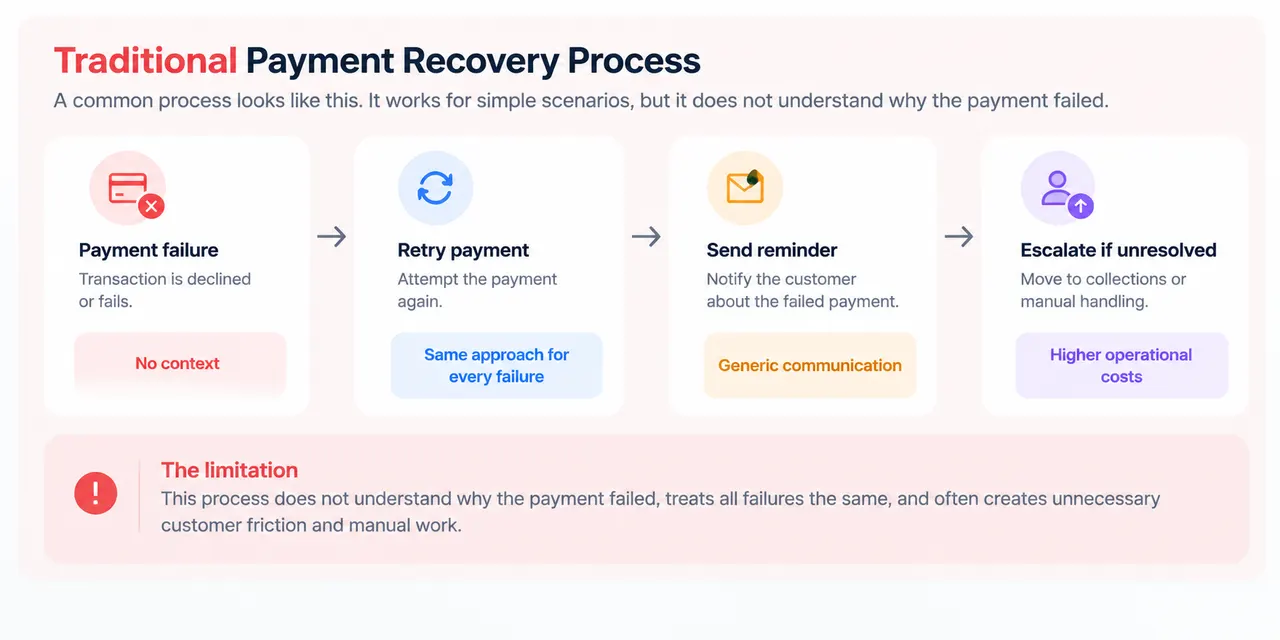
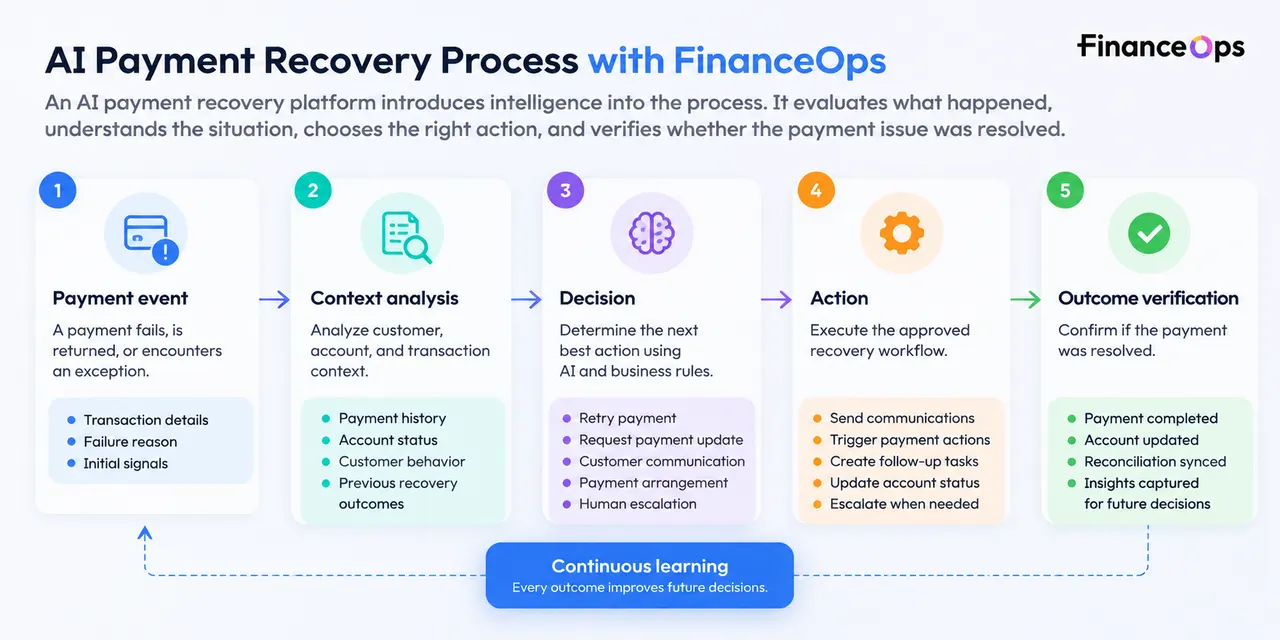
Understanding Payment Events: The Foundation of Intelligent Recovery
A payment event is not only a failed transaction. It is a combination of signals that explain what happened, why it happened, and what should happen next. For example, a failed payment event may include:
- Transaction status
- Payment method
- Failure reason
- Customer payment history
- Account information
- Previous recovery attempts
Understanding these signals allows payment teams to move from reactive processing to proactive recovery.
Payment History: Understanding Previous Customer Behavior
Payment history provides insight into how an account behaves over time.
It shows whether a customer typically pays on time, whether previous failures were resolved successfully, and whether the account has experienced repeated payment issues.
For example, a customer who has made 24 successful payments and suddenly experiences a card expiry issue should not follow the same recovery path as an account with repeated missed payments.
FinanceOps Agentic Payments uses payment history as part of its decision-making process to determine the appropriate recovery strategy.
Customer Context: Understanding the Relationship Behind the Payment
Payment recovery is not only a transaction problem. It is a customer relationship problem. Customer context includes previous conversations, payment commitments, account status, and engagement patterns.
Understanding this context allows AI to support more relevant recovery actions instead of sending generic payment reminders.
Transaction Context: Understanding the Payment Failure
Transaction context explains what happened during the payment attempt.
Examples include:
- Card authorization failure
- ACH return reason
- Payment timing
- Previous retry attempts
This information helps determine whether the issue requires another payment attempt, customer action, servicing intervention, or escalation.
Capabilities to Evaluate in an AI Payment Recovery Platform
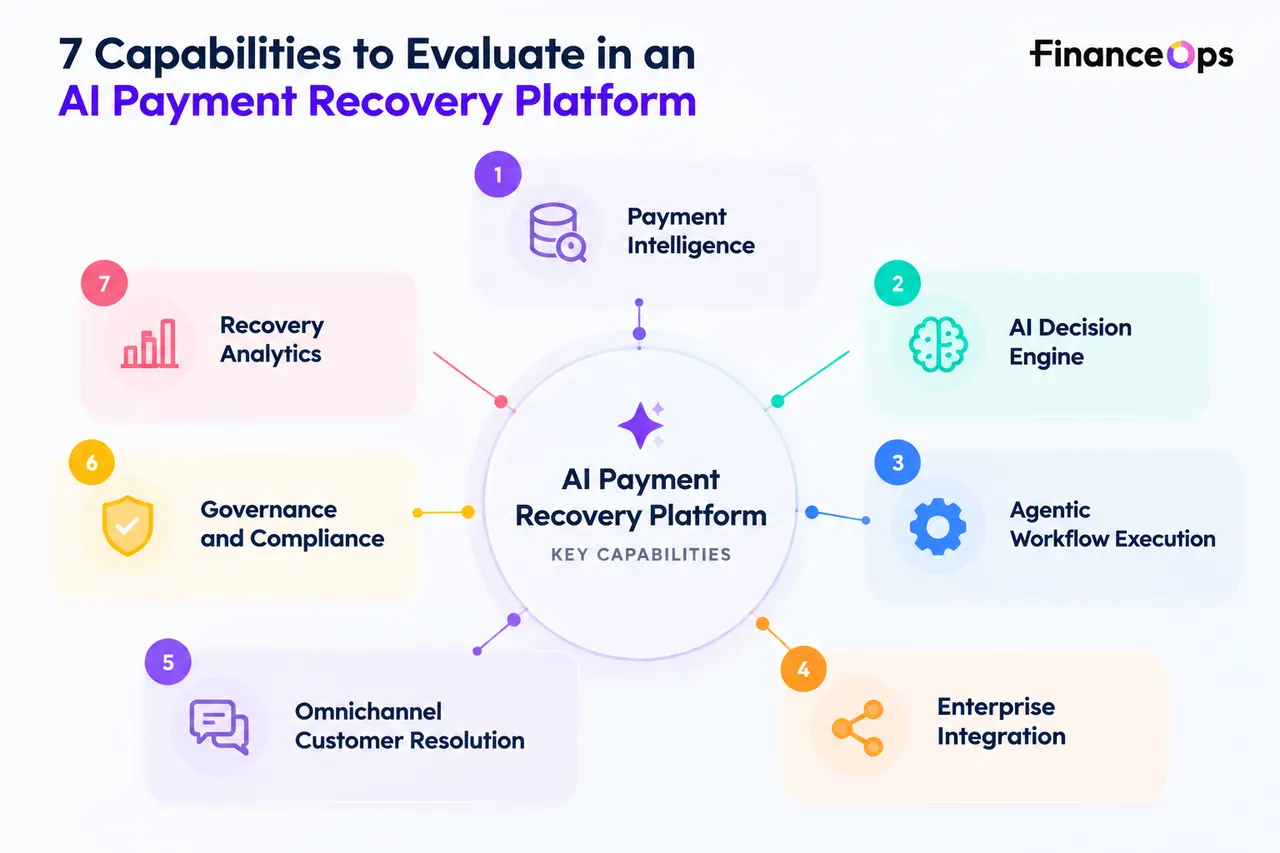
1. Payment Intelligence: Can the Platform Understand Why Payments Fail?
The first question enterprise teams should ask is:
Does the platform only identify payment failures, or does it understand the reason behind them?
A failed payment status alone is not enough information to determine the correct recovery action. An intelligent platform should analyze:
Transaction Data
Transaction data explains the payment event itself, including payment method, authorization response, failure reason, and timing.
Customer History
Customer history shows previous payment behavior, successful payments, missed payments, and previous recovery outcomes.
Account Context
Account context provides information about outstanding balances, repayment schedules, servicing status, and account activity.
FinanceOps Agentic Payments combines these signals to understand recovery opportunities instead of treating every payment failure as identical.
2. AI Decision Engine: Can It Determine the Next Best Action?
Payment recovery is not about contacting every customer. It is about selecting the action most likely to resolve the payment issue.
FinanceOps Agentic Payments evaluates payment signals, customer behavior, account information, and business rules to determine the appropriate next step.
Payment Retry
Some payment failures are temporary. The platform evaluates transaction history and previous attempts to determine whether retrying the payment is likely to succeed.
Payment Update Request
Some failures happen because payment information needs to be updated. Examples include expired cards or outdated payment methods. The platform can identify these situations and guide the appropriate payment update workflow.
Customer Communication
Customer engagement works best when communication is based on context. FinanceOps Agentic Payments uses available account and payment information to support relevant customer conversations.
Payment Arrangement
Some customers require additional flexibility. The platform can identify situations where structured payment options may improve recovery outcomes.
Human Escalation
Not every case should be automated. Complex situations, disputes, and exceptions can be routed to human teams with the relevant context already available.
The objective is not maximum automation. The objective is better recovery decisions.
3. Agentic Workflow Execution: Can AI Take Action?
Many AI platforms provide recommendations. Enterprise teams need execution. FinanceOps Agentic Payments supports approved workflows that allow AI to move from analysis into action. This includes:
Customer Communication Execution
The platform can support recovery conversations across approved channels while maintaining customer context.
Payment Workflow Execution
Approved payment actions can be initiated based on defined business rules.
Follow-Up Management
Recovery often requires multiple steps. The platform tracks commitments and follow-up activities to prevent accounts from being lost in manual processes.
Exception Handling
When a situation requires human judgment, the platform escalates appropriately. Agentic execution means AI does not simply suggest what should happen. It helps make the recovery process happen.
4. Enterprise Integration: Does It Work With Existing Systems?
Enterprise payment environments are complex. Organizations already operate multiple systems, including:
- Payment gateways
- Banking systems
- Loan servicing platforms
- CRM systems
- ERP systems
- Collections platforms
A recovery platform should not create another isolated system. FinanceOps Agentic Payments acts as an intelligence layer across existing infrastructure, connecting payment activity, customer information, servicing workflows, collections actions, and reconciliation processes.
The goal is improving intelligence without requiring a complete technology replacement.
5. Omnichannel Customer Resolution: Does It Maintain Context?
Payment recovery often requires multiple customer interactions. A customer may receive an SMS, respond through email, speak with a voice agent, and complete payment through a digital portal.
The challenge is maintaining context across these interactions. FinanceOps Agentic Payments supports:
- SMS communication
- Email engagement
- Voice AI conversations
- Webchat interactions
- Digital payment experiences
Customers do not have to repeat information because the platform maintains conversation context throughout the recovery journey.
6. Governance and Compliance: Can Enterprises Trust AI Decisions?
Financial organizations need control before deploying AI. An enterprise AI payment recovery platform should provide:
- Policy Controls: Organizations define what actions AI can perform and where approval is required.
- Audit Visibility: Teams can review decisions, actions, and outcomes.
- Human Oversight: Complex situations can be escalated to appropriate teams.
- Compliance Support: Recovery workflows operate within established regulatory requirements.
FinanceOps Agentic Payments is designed around governed execution so organizations can scale AI responsibly.
7. Recovery Analytics: Can CFOs Measure ROI?
AI adoption must connect to financial outcomes. Enterprise teams should evaluate whether the platform measures:
- Recovery improvement
- Resolution speed
- Manual workload reduction
- Operational efficiency
- Reconciliation accuracy
The purpose of AI is not increasing activity. The purpose is improving recovered revenue and creating better visibility into financial performance.
| Capability to Evaluate | What It Means | Why It Matters for Enterprise Payment Teams |
|---|---|---|
| Payment Intelligence | Understands why a payment failed by analyzing transaction data, payment history, customer behavior, and account context. | Helps teams move beyond identifying failures and determine the most effective recovery approach. |
| AI Decision Engine | Evaluates payment signals and business rules to determine the next best action, such as retrying payment, requesting updated payment details, engaging customers, or escalating cases. | Ensures every account receives the right recovery strategy instead of a one-size-fits-all workflow. |
| Agentic Workflow Execution | Moves AI from recommendations to execution by supporting approved recovery actions, customer communication, follow-ups, and exception handling. | Reduces manual effort while allowing teams to maintain control over automated processes. |
| Enterprise Integration | Connects with existing payment processors, banking systems, loan servicing platforms, CRMs, ERPs, and collections platforms. | Enables organizations to improve recovery intelligence without replacing their existing technology infrastructure. |
| Omnichannel Customer Resolution | Maintains context across SMS, email, Voice AI, webchat, and digital payment experiences. | Creates consistent customer experiences and prevents customers from repeating information across channels. |
| Governance & Compliance | Provides policy controls, audit visibility, human oversight, and compliance support for AI-driven recovery decisions. | Allows financial organizations to scale AI while maintaining accountability and operational control. |
| Recovery Analytics | Measures recovery improvement, resolution speed, operational efficiency, manual workload reduction, and reconciliation accuracy. | Helps CFOs and payment leaders understand the measurable financial impact of AI adoption. |
Why Agentic Payments Are Becoming the Future of Payment Recovery
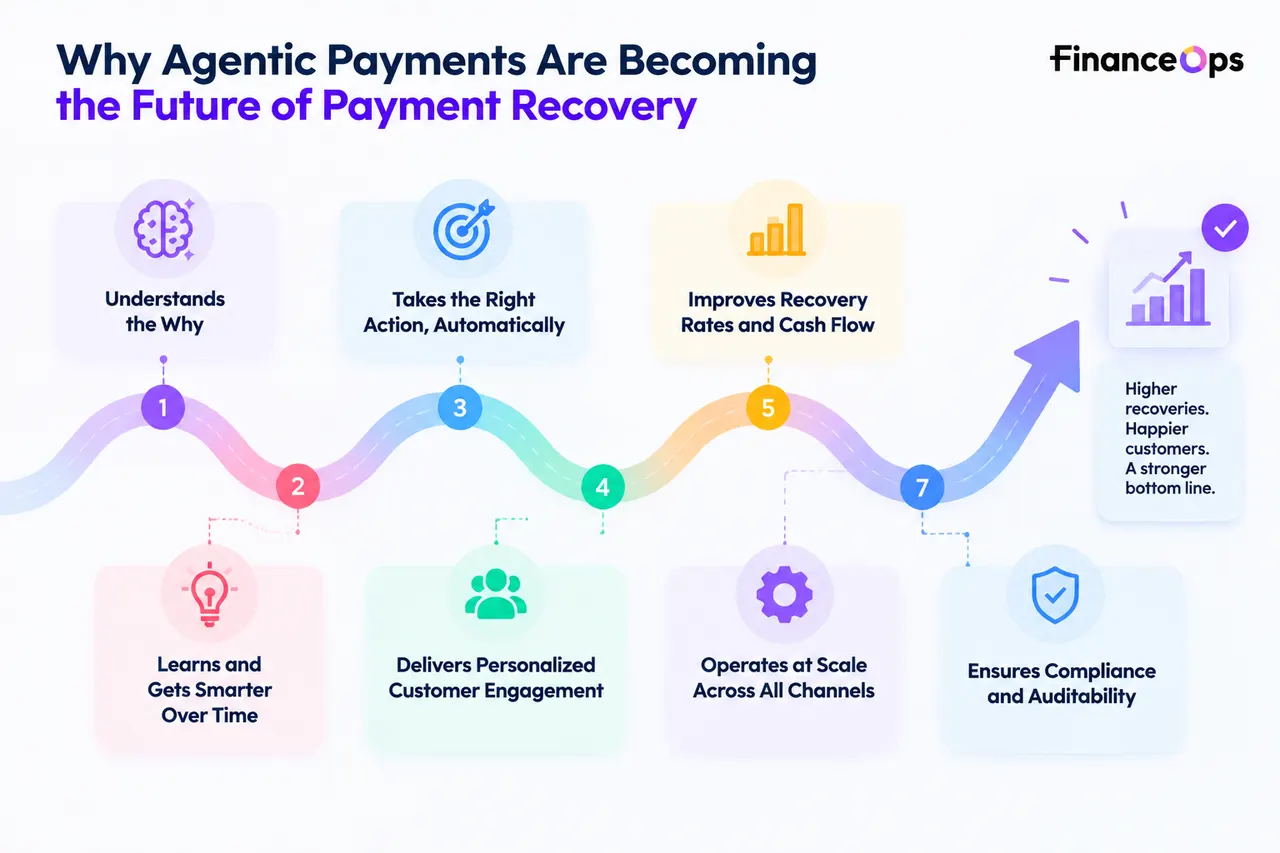
Traditional automation follows rules. Agentic Payments understand objectives. The difference is the ability to analyze context, make decisions, execute actions, and verify outcomes.
This creates a continuous recovery cycle where every payment event improves future decisions.
How FinanceOps Agentic Payments Enables Intelligent Payment Recovery
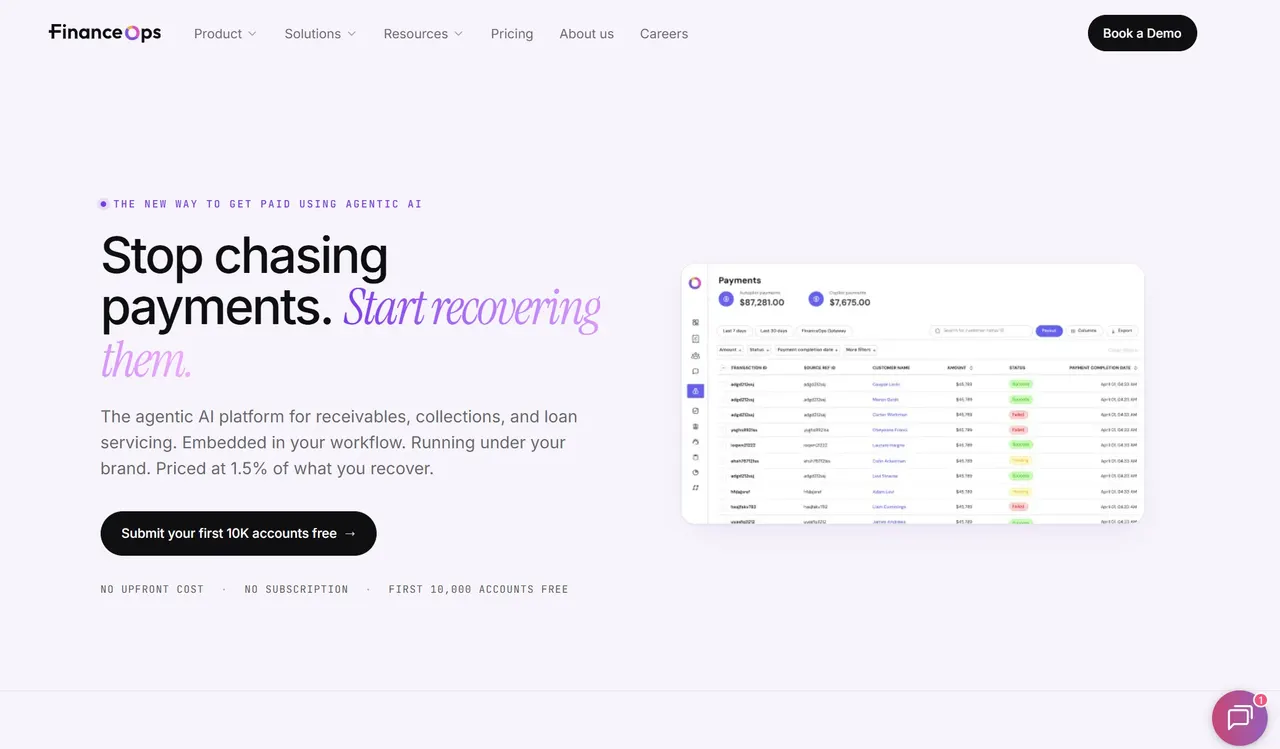
FinanceOps Agentic Payments creates a connected operating layer across:
- Payment events
- Customer communication
- Servicing workflows
- Collections actions
- Payment execution
- Reconciliation
By connecting these areas, financial institutions can improve payment visibility, automate controlled recovery workflows, reduce manual exception handling, and create measurable recovery outcomes.
FinanceOps Agentic Payments helps enterprise teams move from fragmented payment recovery processes to an intelligent operating model.
Learn more: https://financeops.ai/products/agentic-payments
The right AI payment recovery platform should understand payment events, make intelligent decisions, execute approved workflows, maintain governance, and improve measurable outcomes.