A utility customer agrees to pay $80 on the fifteenth of every month. Customer service records the arrangement and closes the call. Two weeks later, a payment is returned. The payment processor knows. Billing may still show the installment as pending. Collections is working from yesterday's balance. The customer receives another reminder, with no explanation of what went wrong.
The arrangement was approved. The account was not resolved.
That is the gap utility revenue teams need to close. A payment arrangement is not a payment. Its success depends on whether the agreement is recorded accurately, each installment can be made, payment status reaches the right systems, and exceptions trigger an appropriate next action.
This article explains why utility payment arrangements break down after approval, how electric, gas, water, and municipal utilities can connect servicing with collections and reconciliation, and how to evaluate the resulting financial impact.
Why do utility payment arrangements fail?
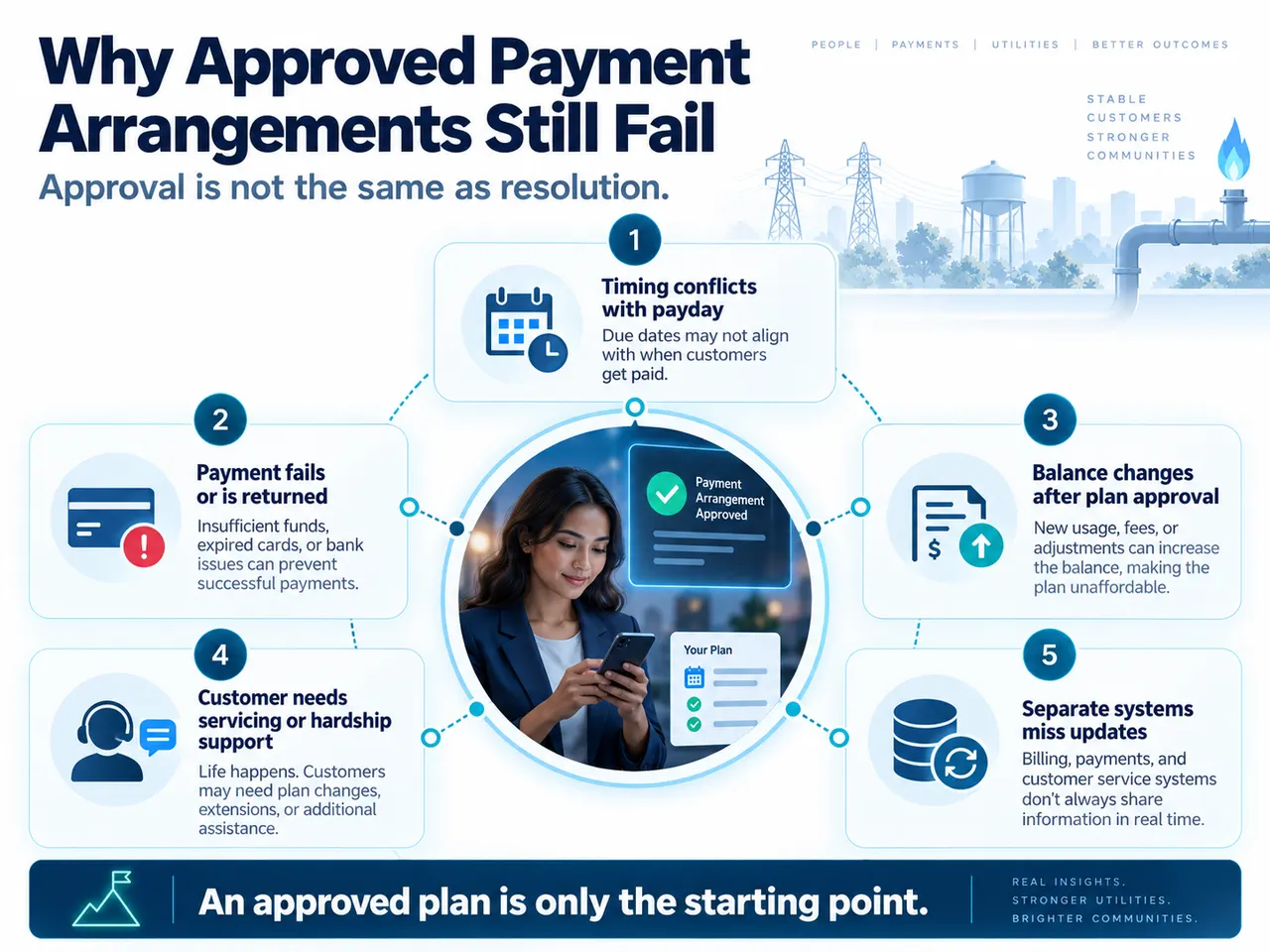
An approved utility payment arrangement may fail because the installment date does not match household cash flow, a payment method fails or authorization changes, the account balance is adjusted, the customer needs assistance, the payment posts late or to the wrong account, or separate teams act on inconsistent records.
Five stages must work together: agreement → installment due → payment outcome → account application → next approved action. Failure at any stage can leave the account open even when a customer is trying to resolve it.
A useful public research signal comes from the CFPB's Consumer Insights on Paying Bills: in the study, 50% of respondents identified bills coming due before payday as an important reason for not paying on time. The findings cover consumer bill-payment challenges, not the failure rate of utility installment arrangements. They reinforce why payment timing deserves attention. The CFPB also found that suggesting a change of due date could help some consumers align bills with income.
1. Approval does not prove the plan is affordable
A customer may accept a proposed installment in order to address an overdue bill, even when the schedule conflicts with their income timing or essential expenses.
A $480 arrears balance divided into six $80 installments looks straightforward. But if payments fall three days before payday, the agreement may be difficult to keep.
What the utility should verify: applicable eligibility and assistance rules, the proposed amount and schedule, customer authorization, and whether a permitted alternative date or plan is available. Neither an AI sentiment score nor a recorded verbal agreement proves affordability.
For a practical customer-facing example of flexible payment arrangements, see DC Water's Flexible Payment Plans. Specific terms differ by provider and jurisdiction.
2. A payment attempt can fail after the conversation ends
An installment can be scheduled but declined, returned, reversed, or left pending. The underlying reason matters.
| Event | What it establishes | Appropriate operational check |
|---|---|---|
| Scheduled installment | A future attempt is planned | Confirm authorization, date, amount, and method |
| Payment initiated | An attempt started | Do not treat it as settled cash |
| Card decline or bank return | A payment did not complete | Review reason, restrictions, and approved next options |
| Settled payment | Processor reports received funds | Confirm correct account application |
| Refunded or reversed payment | Previously reported funds changed | Reopen the relevant exception and update treatment |
The CFPB explains automatic bank-account payments as authorized recurring withdrawals. Authorization, notices, and the ability to stop payments matter; utility payment programs must follow applicable payment and consumer requirements rather than assuming every retry is allowed.
A failed ACH debit may call for updated information or a permitted alternative payment method. A disputed balance may require staff review. More retries are not a substitute for knowing the reason.
3. Billing updates can invalidate an approved arrangement
Utilities regularly apply new charges, adjustments, assistance credits, corrected meter readings, and payment allocations.
An agreement created against one balance should not continue blindly if the authoritative account has changed. A billing correction may alter the installment schedule; a confirmed payment may satisfy an installment that collections still shows as unpaid.
The operating requirement is a reconciled account state, not simply a sequence of reminders. The billing/CIS, processor, collections platform, and finance ledger need a documented source of truth and update contract.
Test what happens when payment events arrive late, twice, or out of order. Require explicit exception handling when a record cannot be matched.
4. Customers need servicing, not always another collection message
A customer who says, “That payment already came out of my bank account,” needs a payment investigation. A customer who says, “I can't make this installment,” may need an approved arrangement or assistance referral. A customer who disputes the bill needs the correct review path.
Treating each as a missed-payment event creates avoidable work and can harm trust.
A connected workflow should preserve the customer's explanation across channels, verify identity before sharing account details, apply communication permissions, and route the case when authorization or facts are unclear.
5. Separate teams can unknowingly undo each other's work
Customer service approves an arrangement. Collections follows a delinquency queue. Payment operations identifies the return. Finance handles unapplied cash. If those updates are disconnected, the customer may receive contradictory instructions.
The customer sees one utility. Internally, the account is moving through several systems.
The solution is not necessarily to replace every system. It is to connect the information and decision points that control the next action.
What an effective utility arrangement workflow looks like
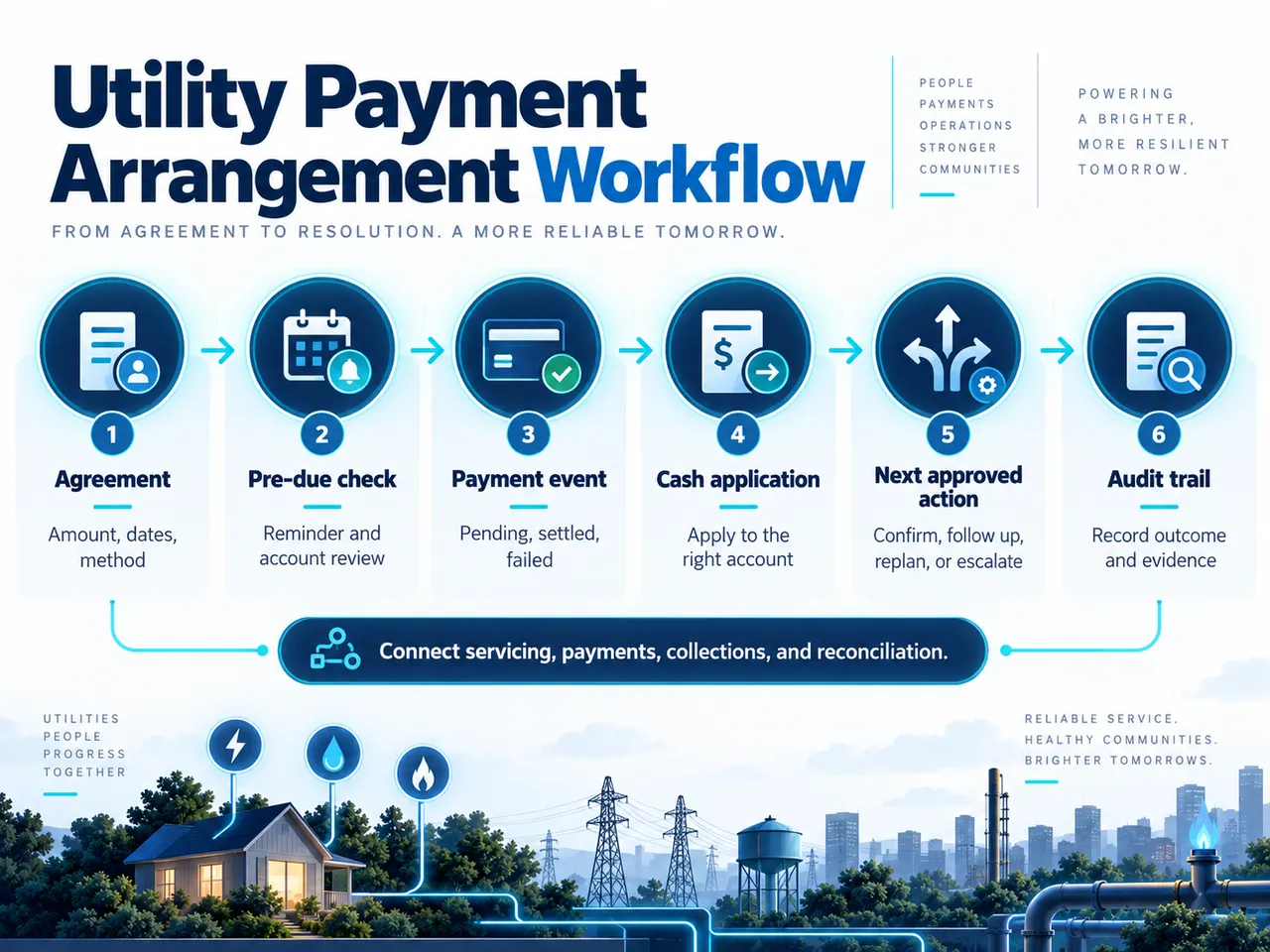
| Stage | Record or decision | Failure control |
|---|---|---|
| 1. Agreement | Approved balance, installment amount, frequency, due dates, method, authority | Validate eligibility, restrictions, and customer confirmation |
| 2. Pre-due servicing | Accurate reminder and account context | Check current status and approved contact channel |
| 3. Payment event | Pending, settled, failed, returned, refunded | Process events idempotently, including late updates |
| 4. Cash application | Payment allocated to correct account and obligation | Flag missing references or ledger mismatch |
| 5. Next action | Confirm, follow up, replan, hold, or escalate | Apply Strategy Builder policies and assistance protections |
| 6. Evidence | Outcome, timestamp, status changes, reviewer if any | Preserve audit and reporting data |
This is an illustrative operational model, not a claim that every utility uses the same ledger states.
How FinanceOps Agentic AI connects the lifecycle
FinanceOps supports first-party collections and customer servicing around existing billing and payment systems, subject to integration and approved workflow configuration.
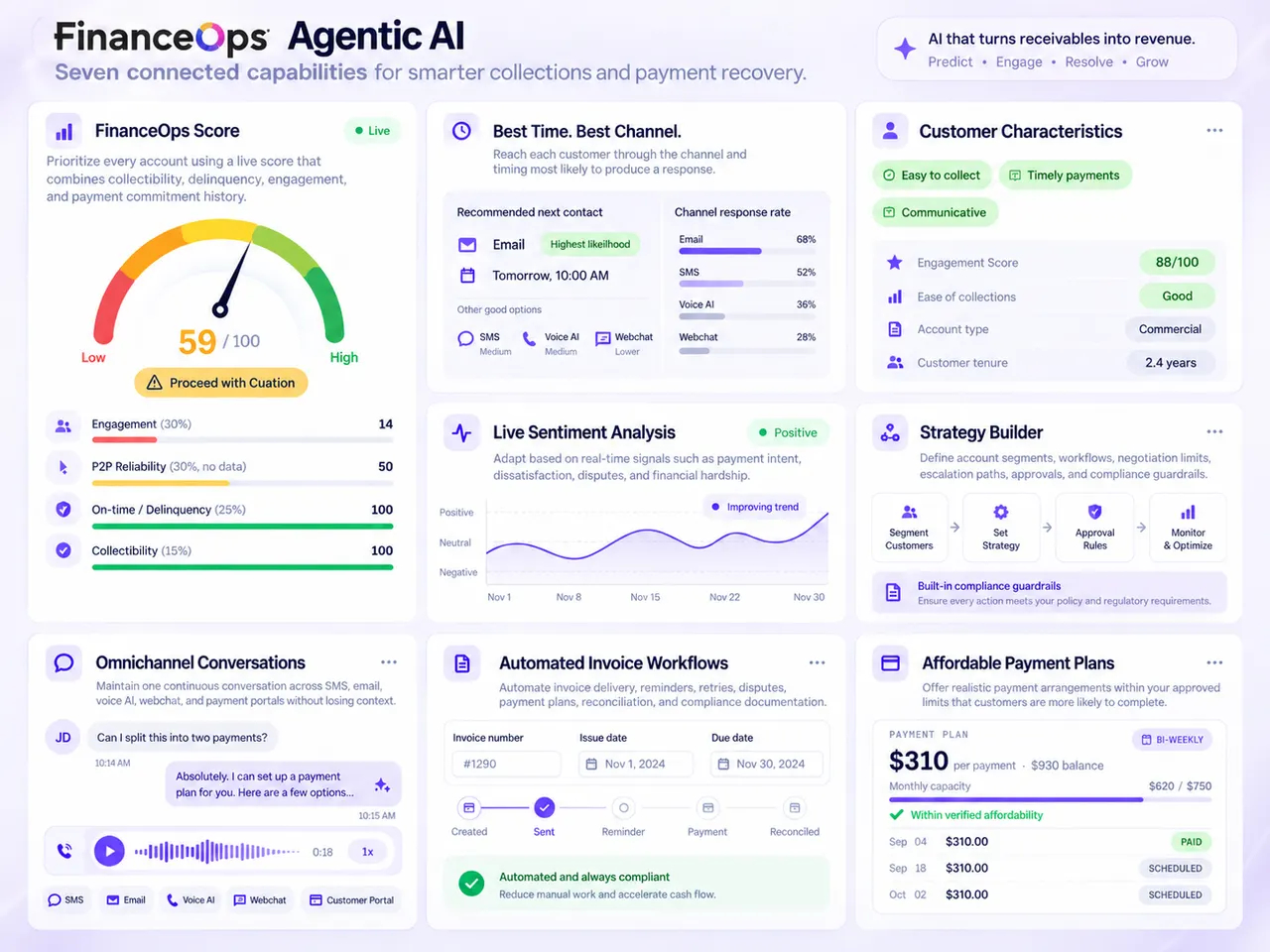
Flexible Payment Plans: Make the agreement operational
Track permitted installment amounts, schedules, and customer commitments. The meaningful outcome is not that a plan was accepted; it is whether each installment is verified and the account progresses toward resolution.
Agentic Payments: Follow the transaction through
Connect payment options, failed-payment handling, and transaction status to customer follow-up. Verified settlement and application records determine whether collections should continue.
Strategy Builder: Apply the utility's rules
Configure eligible outreach, arrangement limits, assistance referrals, escalation paths, and restrictions. Service disconnection and statutory customer protections remain under the utility's authorized decision processes, not autonomous AI discretion.
Two-Way Omnichannel and Sentiment Signals: Understand the response
Help customers ask questions, explain payment issues, and request support across configured channels. Sentiment or intent signals can suggest an issue to examine, not prove ability to pay or regulatory compliance.
FinanceOps Score: Prioritize the right work
Use collectibility, delinquency, engagement, and promise-to-pay history to support account prioritization. A high score should not override a dispute, a payment update, or a protected account status.
Automated Invoice Lifecycle: Keep account records connected
Align billing notices, due dates, payment status, and account updates through supported integrations. Staff should see unmatched payments and stale data before automated outreach depends on them.
Best Time, Channel, and Person: Use outreach purposefully
Guide permitted contact timing and channel selection with account context and engagement signals, rather than contacting every arrangement the same way.
The common thread is a verified next step. When a customer makes a payment, changes an arrangement, or raises an exception, the account workflow should respond to the new information instead of running a fixed sequence.
Utility-specific controls must come before automation
Electric, gas, water, and municipal service providers operate under different state, provincial, local, and tariff requirements. Residential versus commercial accounts can carry different treatment restrictions. Protections may address hardship, seasonal disconnection, medical needs, notice periods, assistance programs, and disputes.
A collections platform should therefore demonstrate:
- Per-service-area and customer-class rules.
- Clear separation between billing/collections actions and service-status authority.
- Holds and staff review for protected or disputed situations.
- Contact permissions and channel restrictions.
- Current account and payment records before outreach.
- An auditable explanation of the policy and action selected.
Do not interpret generalized AI compliance claims as evidence that a deployment meets the utility's legal obligations.
What the utility CFO should measure
A payment arrangement is successful only when it leads to verified, applied cash or another correctly documented resolution.
Use measures that distinguish promises from financial outcomes:
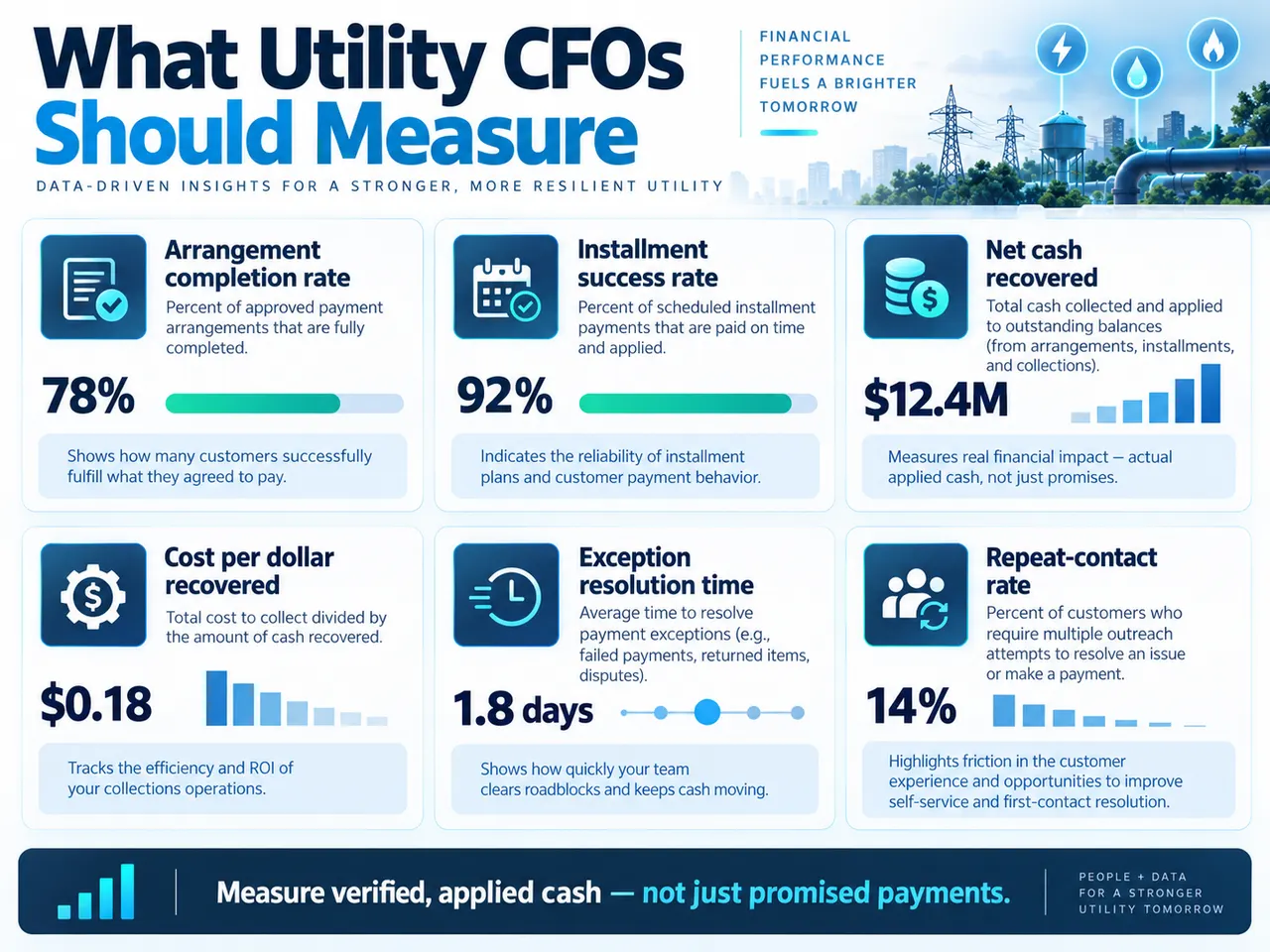
| KPI | Calculation or question |
|---|---|
| Arrangement completion rate | Arrangements fully completed / eligible arrangements reaching a measurable end |
| Installment success rate | Confirmed applied installments / installments due in the cohort |
| Net cash recovered | Applied receipts less relevant reversals, refunds, and treatment costs |
| Cost per dollar recovered | Full collection and servicing cost / eligible verified recovery |
| Exception resolution time | Median time from failed or unmatched payment to verified resolution |
| Repeat-contact rate | Unnecessary follow-up after status changes or customer explanations |
| Customer impact | Complaints, hardship-routing performance, and blocked actions |
Define denominator, measurement window, customer cohort, and return handling before evaluating a pilot.
A CFO example: Why recovered cash alone is insufficient
Consider a hypothetical utility portfolio with 2,000 active arrangements and monthly installments averaging $90.
The scheduled amount is $180,000. If 1,600 installments settle and are correctly applied, verified installment cash is $144,000, before any subsequent reversals. The remaining $36,000 is not automatically lost revenue; it represents installments not verified as applied at the measurement point and may include pending payments, missed attempts, adjustments, or exceptions.
A useful improvement project diagnoses those remaining states rather than reporting the whole amount as defaulted.
How to test a connected payment-arrangement platform
Before a full rollout, ask the vendor to demonstrate these five cases using test accounts:
- An installment is authorized but returned two days later.
- A customer pays through another channel before the scheduled debit.
- A bill adjustment changes the amount due after plan approval.
- A customer requests hardship assistance while a reminder is queued.
- A settled payment cannot be allocated to the correct account.
For each scenario, inspect the authoritative balance, the permitted next action, the communication sent or held, the exception owner, and the final recorded outcome.
Compare a limited eligible pilot with a suitable baseline. Test whether improved recovery comes from better arrangements, fewer failed-payment handoffs, or faster exception resolution—not merely a higher reminder count.
For procurement and deployment controls, use the existing Utility Collections Software Buyer Guide. For the broader operating model, see AI Collections for Utilities: Connect Billing to Recovery.
Conclusion: A payment plan is a beginning, not a result
Getting a customer to agree to a payment arrangement is progress. It is not proof that the arrears will be collected.
The work that follows—accurate installment tracking, permitted customer support, payment verification, cash application, and exception handling—determines whether the account actually moves toward resolution.
Utilities do not need another reminder for every missed installment. They need to know why the arrangement went off track and what action is appropriate next.
FinanceOps Agentic AI connects payment plans, collections, servicing, and reconciliation around that decision.