
Blog
What Is a Collection Agent? And How AI Is Changing It
Jul 17, 2026


Blog summary:
Most content on this topic treats "collection agent" as a single role. It isn't. First-party collectors, third-party agencies, and debt buyers operate under different legal exposure and different economic incentives, and conflating them produces bad compliance decisions.
The CFPB has been explicit that AI systems used in collections are held to the exact same FDCPA, Regulation F, TCPA, and UDAAP standards as human agents. There is no automation carve-out, and disparate impact testing is now an expected control, not an optional one.
The 93% AI adoption figure TransUnion reports for 2025 is technically accurate and functionally misleading unless you separate scoring and NLP automation from genuinely agentic systems, a distinction the industry has been sloppy about on purpose.
Federal Reserve data puts credit card delinquency at 13.1% in Q1 2026, a 16-year high, while CFPB complaint volume nearly doubled year over year, evidence that the collections function is under more legal and volume pressure simultaneously, not sequentially.
FinanceOps Agentic AI is built specifically for the fourth, genuinely agentic category in the framework below, with governance as the answer to the CFPB's no-exemption standard, not a bolt-on compliance feature.
What Is a Collection Agent? And How AI Is Changing Collections

For decades, a collection agent meant a person making calls, negotiating payments, and documenting outcomes. That definition is changing. AI systems can now perform many of the same functions, deciding who to contact, when to engage, what options to offer, and how disputes are resolved.
That shift matters because a collection agent, human or AI, is any professional or system responsible for recovering unpaid debt on a creditor's behalf. It's the point of contact between creditor and debtor, working to resolve delinquency before, during, and after legal escalation. Most explainer content stops there and treats "collection agent" as one role. It isn't. First-party collectors, third-party agencies, and debt buyers carry different legal exposure and different economic incentives, and the AI system built for one shouldn't run the same playbook as the AI system built for another.
What a Collection Agent Actually Does
Across the industry, the core responsibilities are consistent whether the agent is human or automated:
Initiating contact through phone, email, letter, or SMS
Validating and disclosing the debt (a statutory requirement, not a best practice)
Negotiating repayment plans or settlements
Recording every collection effort, including contact history, responses, and agreements
Escalating to legal action, repossession, or service suspension when repayment fails
Reporting satisfied or delinquent debts to credit bureaus
Operating within federal, state, and provincial compliance boundaries
The CFPB has been explicit that an AI system performing these functions is a collection agent for legal purposes, full stop. There's no automation carve out. That single fact should shape how any collections leader evaluates an AI vendor, and it's the thread running through everything below.
First-Party, Third-Party, and Debt Buyer Are Not Interchangeable Labels

This distinction usually gets treated as taxonomy trivia. It's actually an incentive-alignment problem:
First-party collectors: Operates under the original creditor's name, typically engaging accounts 30 to 60 days past due while the customer relationship is still active. The incentive is retention-adjacent (the creditor still wants that customer next year), which pushes tone toward service orientation.
Third-party collection agencies: Gets engaged after internal recovery fails, typically 60 to 180 days past due, paid on contingency (usually 20 to 50% of the amount recovered, with 10 to 15% higher commissions past 180 days). There's no relationship to protect. The incentive is pure recovery maximization within legal bounds, precisely why the FDCPA exists to constrain third-party conduct specifically.
Debt buyers: Purchases delinquent debt outright, often for pennies on the dollar, and pursue recovery for their own account. Their cost basis is so low that even a modest recovery rate is profitable, which is the economic reason debt-buyer conduct draws disproportionate regulatory attention.
An AI system built for first-party servicing and one built for third-party or debt-buyer recovery shouldn't run identical logic. Vendors selling one undifferentiated "AI collections" product across all three are optimizing for their own simplicity, not for the incentive structure their client actually operates under.
Traditional Automation vs. Agentic AI
The industry has been sloppy, sometimes deliberately, about the difference between "automation" and "agentic AI." Here's the practical distinction:
Traditional Automation | Agentic AI | |
Decision making | Human-defined rules | AI reasoning within guardrails |
Outreach | Scheduled campaigns | Dynamic next-best action |
Payment plans | Fixed options | Affordability-based |
Disputes | Manual routing | Intelligent resolution |
Compliance | After-action review | Built-in governance |
That progression, human collector to rules engine to predictive AI to agentic AI, is the real evolution underway, and most of what gets marketed as "AI collections" today still lives in the middle two stages.
The Regulatory Architecture
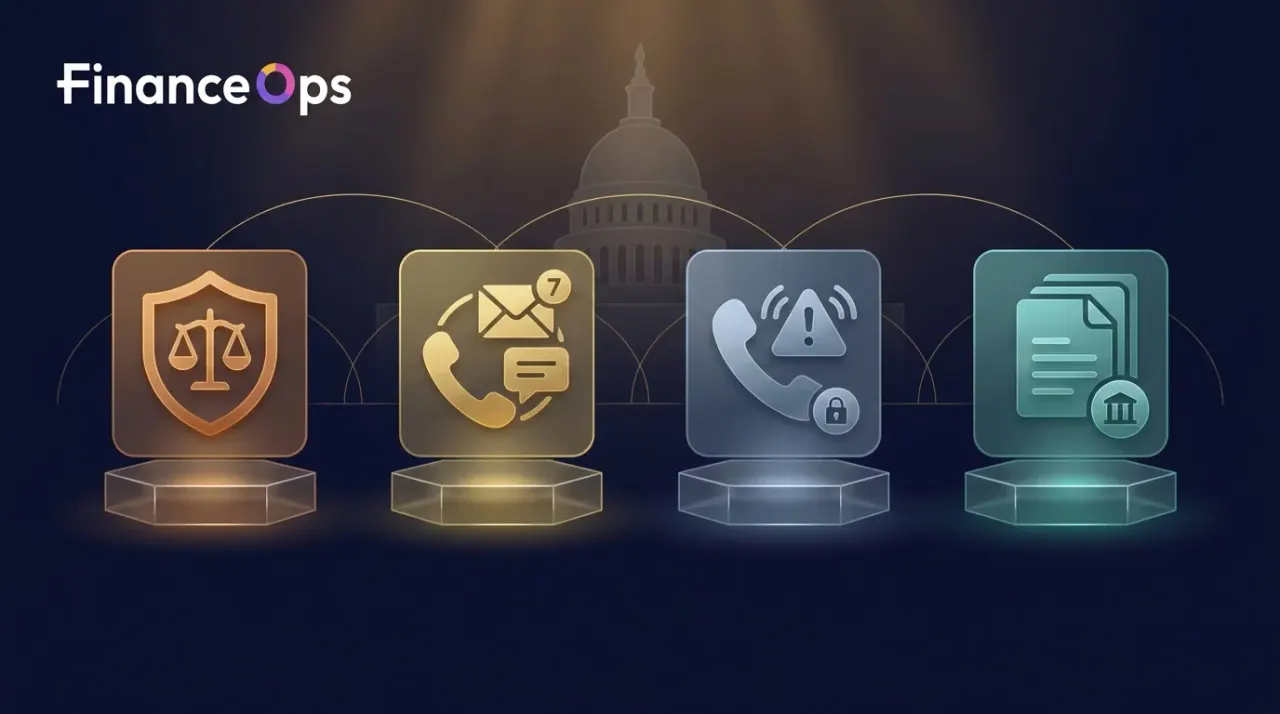
The federal statutes governing collection activity in the U.S.:
The FDCPA (15 U.S.C. §§1692 to 1692p) governs third-party collectors specifically, prohibiting harassment, false or deceptive representation, and unfair practices, and establishing a private right of action. A consumer can sue directly, not just file a complaint.
Regulation F, the CFPB's implementing rule, modernized permissible contact channels to include email and text, and codified the "7-in-7" guidance (no more than seven calls within seven days, per debt, per consumer) as a compliance safe harbor rather than a hard cap. Exceeding it isn't automatically a violation; staying within it provides a rebuttable presumption of compliance.
The TCPA (47 U.S.C. §227) governs autodialed and prerecorded communications, requiring prior express consent, with penalties of $500 to $1,500 per violation (trebled if willful), calculated per call or text, not per campaign. At volume, that math should drive architecture decisions, not general compliance sentiment.
The FCRA governs how debts are furnished to credit bureaus.
Under the CFPB's larger participant rule, any firm generating more than $10 million in annual receipts from consumer debt collection falls under direct CFPB supervisory authority, roughly 175 collectors, accounting for over 60% of the industry's annual receipts.
State law is where complexity is accelerating fastest, precisely as federal enforcement activity has cooled. Virginia's Medical Debt Protection Act (effective July 2026) caps interest on medical debt; Maryland and Maine have banned medical debt from credit reports entirely; New York City's SHIELD Rule (effective September 1, 2026) caps collectors at three contact attempts in seven days across all channels combined and imposes a 60-day freeze once a debt is disputed, both stricter than the federal safe harbor. In 2025, all 50 states introduced AI-specific legislation for the first time, with 145 bills enacted; by March 2026, over 1,500 more were pending across 45 states. Building a national AI-driven collections operation on 2025 compliance assumptions is already out of date.
Canada adds one wrinkle worth knowing: federally regulated institutions (banks, federal credit unions) fall under the Financial Consumer Agency of Canada, but the moment a debt is sold to a collection agency, FCAC jurisdiction ends and provincial or territorial law takes over instead. A collections operation compliant at origination can become non-compliant the instant the receivable changes hands, purely a function of who now owns it.
There Is No Regulatory Exemption for Automation
This is the single most consequential fact in the entire topic, stated plainly by the regulator itself: the CFPB holds AI systems used in collections to the exact same FDCPA, Regulation F, TCPA, and UDAAP standards as human agents. Organizations are expected to:
Document AI decision-making
Test for disparate impact (verifying the system isn't producing systematically worse outcomes for a protected class, even without discriminatory intent)
Maintain audit trails for every consumer-facing AI interaction
Disparate impact liability under UDAAP requires only a discriminatory effect, a harder standard to defend against than most AI vendors' compliance messaging implies. Other regulators are converging on the same position:
The NCUA has appointed a Chief AI Officer and built an AI Compliance Plan aligned with the NIST AI Risk Management Framework as a formal 2026 supervisory priority
Utah's SB 226 explicitly states that using AI is not a defense against a consumer protection violation
Colorado's algorithmic discrimination statute targets AI systems used in "consequential decisions," language broad enough to plausibly cover collections scoring and treatment-strategy selection
Underneath all of it sits a more prosaic problem most vendors don't want to discuss: Cornerstone Advisors' Data EQ study of 124 banks and credit unions found an average data-readiness score of 241 out of 500, with stronger data readiness correlating directly to AI adoption success. An agentic system reasoning over fragmented, poorly structured account data isn't agentic in any meaningful sense. It's automation wearing a better label, and it's harder to audit when it produces the exact disparate-impact or validation-notice failure CFPB examiners have already found in the field.
The Pressure Is Structural, Not Cyclical
Federal Reserve Bank of New York, Q1 2026 household debt report:
Total U.S. household debt sits at $18.8 trillion, with aggregate delinquency at 4.8%
Credit card delinquency is at 13.1%, a 16-year high
Student loan 90-plus day delinquency is at 10.3%, the highest since 2020, with roughly 2.6 million borrowers 120-plus days past due transferred to the Department of Education's Default Resolution Group
The report describes a "K-shaped" pattern: higher-income households stable, lower- and middle-income households showing concentrated deterioration
That's not a delinquency spike that resolves with a rate cut. It's a bifurcation in who can service debt at all, meaning accounts entering collection pipelines over the next several quarters skew structurally harder to recover, not just more numerous. CFPB complaint data tells the same story from the consumer side:
Approximately 207,800 debt collection complaints in 2024, nearly double 2023's roughly 109,900
45% concerned a debt the consumer says they don't owe, the top complaint category every year since 2013
Rising complaints alongside rising delinquency aren't two problems. It's the same underlying failure, whether outreach can correctly distinguish a resolvable account from a disputed one, showing up on both sides of the ledger at once.
Canada shows the same structural strain:
Household debt at $3.21 trillion (over $78,000 per capita)
A debt-to-disposable-income ratio of 174.9% in 2026
An industry generating an estimated $955.7 million in 2026 even as the number of active agencies contracts at a 3.0% CAGR since 2021
Consolidation is happening exactly as volume rises.
The 93% Adoption Statistic Is True and Also Not the Point
TransUnion's seventh annual Debt Collection Industry Report puts AI and machine learning adoption in debt collection at 93% in 2025, up from 49% in 2023. Taken at face value, that implies the industry has largely solved AI collections. It hasn't. The number blends four distinct capabilities marketed under one banner:
Machine-learning models estimating repayment probability: statistical scoring, not decision-making
NLP for reading and drafting consumer-facing messages: better templating, not judgment
Predictive analytics for account ranking and segmentation: prioritization logic, still rules downstream of the score
Agentic systems that observe an account, decide the correct action, and execute it with reduced human involvement: the only category actually doing what "collection agent" implies
Adoption of that fourth category, specifically, is far lower and far more telling: 17% of credit unions are investing in agentic AI, more than double the 7% of banks. Only 16% of financial institutions overall report having an enterprise-wide AI roadmap, against 67% claiming some form of AI implementation. That gap, implementation without a roadmap, is the more honest headline than the adoption percentage.
Performance data that holds up under scrutiny is narrower than the marketing around it: McKinsey has documented 10 to 15% recovery-rate improvements and 30 to 40% collections-efficiency gains from AI and analytics-driven collections. One North American bank reportedly saved an estimated $25 million on a $1 billion portfolio via machine-learning self-cure models. Vendor-reported figures, including Symend's claimed 10% recovery lift, should be read as directional marketing claims, not independent findings.
Where FinanceOps Agentic AI Fits
This is the test we apply to our own platform before applying it to anyone else's: does the system observe, decide, and act, or does it just score, message, or segment faster than before?

FinanceOps Agentic AI is built for that fourth category specifically. Six capabilities implement the distinction rather than just claiming it:
Best Time, Best Channel, Best Person to Contact: replaces fixed-cadence outreach with a live prediction of when, where, and who to contact for the highest response probability, driving measurable right-party contact rate improvement instead of a scoring layer bolted onto an unchanged reminder schedule.
Live Sentiment Analysis: reads tone, hardship cues, and compliance risk in real time and adjusts approach accordingly. That's the functional difference between a dispute getting routed correctly and a dispute becoming the exact "attempts to collect debt not owed" complaint the CFPB has tracked as its top category since 2013.
Two-Way, Omnichannel, Multilingual Communication: maintains full context across SMS, email, Voice AI, webchat, and portals in the customer's preferred language, addressing the "written notification" complaint category directly rather than assuming English satisfies disclosure for every consumer.
User-Controlled Strategy Builder: the structural answer to the CFPB's no-exemption standard. Compliance limits, escalation rules, and negotiation guardrails under FDCPA, TCPA, and applicable state or provincial law are defined by your team and enforced automatically. The AI can't override them, and every action is logged for the audit trail regulators now expect by default.
Affordability-Based Flexible Payment Plans: replace a single fixed demand with a schedule sized to documented repayment capacity, which matters given the K-shaped delinquency pattern described below. A uniform demand structurally fails a growing share of accounts entering collection right now.
Automated Invoice Management: runs reminder, retry, reconciliation, and dispute-routing end to end, with every action timestamped, closing the documentation gap CFPB examiners have already cited against collectors who failed to provide required validation notices.
The governance layer isn't a feature comparison line item. It's the only thing separating a genuinely agentic collection agent from a data-readiness liability wearing a modern label.
The Collection Agent Evolution
Human Collector
↓
Rules Engine
↓
Predictive AI
↓
Agentic AI (FinanceOps operates here)
Most vendors selling "AI collections" today are still one or two steps up that ladder. The question worth asking any vendor isn't whether they use AI. It's which rung they're actually standing on.
See It in Practice
If your collections team is evaluating AI, the question is no longer whether AI can automate collections. The question is whether the system can make decisions, execute actions, and remain compliant at scale.
Talk to FinanceOps Agentic AI experts to see how AI operates as a governed collection agent across your portfolio.
FAQs
What is a collection agent?
A collection agent is a professional or automated system responsible for recovering unpaid debts on behalf of a creditor, acting as the point of contact between creditor and debtor and working to resolve delinquencies before, during, and after legal escalation.
What is the difference between a first-party and a third-party collector?
A first-party collector operates under the original creditor's name, typically engaging an account 30 to 60 days past due while the customer relationship is still active. A third-party collection agency is engaged after internal recovery fails, typically 60 to 180 days past due, and is paid on contingency, usually 20 to 50% of the amount recovered.
What is a debt buyer?
A debt buyer purchases delinquent debt outright from the original creditor, often for pennies on the dollar, and pursues recovery for its own account rather than on behalf of the original creditor, an incentive structure that draws disproportionate regulatory attention.
Is it legal for AI to collect debt?
Yes, but the CFPB holds AI systems used in collections to the exact same FDCPA, Regulation F, TCPA, and UDAAP standards as human collection agents, including disparate impact testing, with no regulatory exemption for automation.
Does the FDCPA apply to AI-driven collection agents?
Yes. The FDCPA, along with Regulation F and the TCPA, applies to AI-driven collection activity exactly as it does to human agents, and organizations are expected to document AI decision-making and maintain audit trails for every consumer-facing AI interaction.
How is AI actually changing debt collection?
Reported AI adoption reached 93% in 2025 per TransUnion, but that figure blends four distinct capabilities: repayment scoring, NLP messaging, predictive segmentation, and genuinely agentic action. Only the last of those represents a system actually deciding rather than executing a rule.
Do collection agents have to validate a debt before collecting it? Yes. Validating and disclosing the debt is a statutory requirement in both the United States and Canada, and CFPB examiners have specifically documented cases of student loan debt collectors failing to provide these required validation notices.
Blog summary:
Most content on this topic treats "collection agent" as a single role. It isn't. First-party collectors, third-party agencies, and debt buyers operate under different legal exposure and different economic incentives, and conflating them produces bad compliance decisions.
The CFPB has been explicit that AI systems used in collections are held to the exact same FDCPA, Regulation F, TCPA, and UDAAP standards as human agents. There is no automation carve-out, and disparate impact testing is now an expected control, not an optional one.
The 93% AI adoption figure TransUnion reports for 2025 is technically accurate and functionally misleading unless you separate scoring and NLP automation from genuinely agentic systems, a distinction the industry has been sloppy about on purpose.
Federal Reserve data puts credit card delinquency at 13.1% in Q1 2026, a 16-year high, while CFPB complaint volume nearly doubled year over year, evidence that the collections function is under more legal and volume pressure simultaneously, not sequentially.
FinanceOps Agentic AI is built specifically for the fourth, genuinely agentic category in the framework below, with governance as the answer to the CFPB's no-exemption standard, not a bolt-on compliance feature.
What Is a Collection Agent? And How AI Is Changing Collections

For decades, a collection agent meant a person making calls, negotiating payments, and documenting outcomes. That definition is changing. AI systems can now perform many of the same functions, deciding who to contact, when to engage, what options to offer, and how disputes are resolved.
That shift matters because a collection agent, human or AI, is any professional or system responsible for recovering unpaid debt on a creditor's behalf. It's the point of contact between creditor and debtor, working to resolve delinquency before, during, and after legal escalation. Most explainer content stops there and treats "collection agent" as one role. It isn't. First-party collectors, third-party agencies, and debt buyers carry different legal exposure and different economic incentives, and the AI system built for one shouldn't run the same playbook as the AI system built for another.
What a Collection Agent Actually Does
Across the industry, the core responsibilities are consistent whether the agent is human or automated:
Initiating contact through phone, email, letter, or SMS
Validating and disclosing the debt (a statutory requirement, not a best practice)
Negotiating repayment plans or settlements
Recording every collection effort, including contact history, responses, and agreements
Escalating to legal action, repossession, or service suspension when repayment fails
Reporting satisfied or delinquent debts to credit bureaus
Operating within federal, state, and provincial compliance boundaries
The CFPB has been explicit that an AI system performing these functions is a collection agent for legal purposes, full stop. There's no automation carve out. That single fact should shape how any collections leader evaluates an AI vendor, and it's the thread running through everything below.
First-Party, Third-Party, and Debt Buyer Are Not Interchangeable Labels

This distinction usually gets treated as taxonomy trivia. It's actually an incentive-alignment problem:
First-party collectors: Operates under the original creditor's name, typically engaging accounts 30 to 60 days past due while the customer relationship is still active. The incentive is retention-adjacent (the creditor still wants that customer next year), which pushes tone toward service orientation.
Third-party collection agencies: Gets engaged after internal recovery fails, typically 60 to 180 days past due, paid on contingency (usually 20 to 50% of the amount recovered, with 10 to 15% higher commissions past 180 days). There's no relationship to protect. The incentive is pure recovery maximization within legal bounds, precisely why the FDCPA exists to constrain third-party conduct specifically.
Debt buyers: Purchases delinquent debt outright, often for pennies on the dollar, and pursue recovery for their own account. Their cost basis is so low that even a modest recovery rate is profitable, which is the economic reason debt-buyer conduct draws disproportionate regulatory attention.
An AI system built for first-party servicing and one built for third-party or debt-buyer recovery shouldn't run identical logic. Vendors selling one undifferentiated "AI collections" product across all three are optimizing for their own simplicity, not for the incentive structure their client actually operates under.
Traditional Automation vs. Agentic AI
The industry has been sloppy, sometimes deliberately, about the difference between "automation" and "agentic AI." Here's the practical distinction:
Traditional Automation | Agentic AI | |
Decision making | Human-defined rules | AI reasoning within guardrails |
Outreach | Scheduled campaigns | Dynamic next-best action |
Payment plans | Fixed options | Affordability-based |
Disputes | Manual routing | Intelligent resolution |
Compliance | After-action review | Built-in governance |
That progression, human collector to rules engine to predictive AI to agentic AI, is the real evolution underway, and most of what gets marketed as "AI collections" today still lives in the middle two stages.
The Regulatory Architecture

The federal statutes governing collection activity in the U.S.:
The FDCPA (15 U.S.C. §§1692 to 1692p) governs third-party collectors specifically, prohibiting harassment, false or deceptive representation, and unfair practices, and establishing a private right of action. A consumer can sue directly, not just file a complaint.
Regulation F, the CFPB's implementing rule, modernized permissible contact channels to include email and text, and codified the "7-in-7" guidance (no more than seven calls within seven days, per debt, per consumer) as a compliance safe harbor rather than a hard cap. Exceeding it isn't automatically a violation; staying within it provides a rebuttable presumption of compliance.
The TCPA (47 U.S.C. §227) governs autodialed and prerecorded communications, requiring prior express consent, with penalties of $500 to $1,500 per violation (trebled if willful), calculated per call or text, not per campaign. At volume, that math should drive architecture decisions, not general compliance sentiment.
The FCRA governs how debts are furnished to credit bureaus.
Under the CFPB's larger participant rule, any firm generating more than $10 million in annual receipts from consumer debt collection falls under direct CFPB supervisory authority, roughly 175 collectors, accounting for over 60% of the industry's annual receipts.
State law is where complexity is accelerating fastest, precisely as federal enforcement activity has cooled. Virginia's Medical Debt Protection Act (effective July 2026) caps interest on medical debt; Maryland and Maine have banned medical debt from credit reports entirely; New York City's SHIELD Rule (effective September 1, 2026) caps collectors at three contact attempts in seven days across all channels combined and imposes a 60-day freeze once a debt is disputed, both stricter than the federal safe harbor. In 2025, all 50 states introduced AI-specific legislation for the first time, with 145 bills enacted; by March 2026, over 1,500 more were pending across 45 states. Building a national AI-driven collections operation on 2025 compliance assumptions is already out of date.
Canada adds one wrinkle worth knowing: federally regulated institutions (banks, federal credit unions) fall under the Financial Consumer Agency of Canada, but the moment a debt is sold to a collection agency, FCAC jurisdiction ends and provincial or territorial law takes over instead. A collections operation compliant at origination can become non-compliant the instant the receivable changes hands, purely a function of who now owns it.
There Is No Regulatory Exemption for Automation
This is the single most consequential fact in the entire topic, stated plainly by the regulator itself: the CFPB holds AI systems used in collections to the exact same FDCPA, Regulation F, TCPA, and UDAAP standards as human agents. Organizations are expected to:
Document AI decision-making
Test for disparate impact (verifying the system isn't producing systematically worse outcomes for a protected class, even without discriminatory intent)
Maintain audit trails for every consumer-facing AI interaction
Disparate impact liability under UDAAP requires only a discriminatory effect, a harder standard to defend against than most AI vendors' compliance messaging implies. Other regulators are converging on the same position:
The NCUA has appointed a Chief AI Officer and built an AI Compliance Plan aligned with the NIST AI Risk Management Framework as a formal 2026 supervisory priority
Utah's SB 226 explicitly states that using AI is not a defense against a consumer protection violation
Colorado's algorithmic discrimination statute targets AI systems used in "consequential decisions," language broad enough to plausibly cover collections scoring and treatment-strategy selection
Underneath all of it sits a more prosaic problem most vendors don't want to discuss: Cornerstone Advisors' Data EQ study of 124 banks and credit unions found an average data-readiness score of 241 out of 500, with stronger data readiness correlating directly to AI adoption success. An agentic system reasoning over fragmented, poorly structured account data isn't agentic in any meaningful sense. It's automation wearing a better label, and it's harder to audit when it produces the exact disparate-impact or validation-notice failure CFPB examiners have already found in the field.
The Pressure Is Structural, Not Cyclical
Federal Reserve Bank of New York, Q1 2026 household debt report:
Total U.S. household debt sits at $18.8 trillion, with aggregate delinquency at 4.8%
Credit card delinquency is at 13.1%, a 16-year high
Student loan 90-plus day delinquency is at 10.3%, the highest since 2020, with roughly 2.6 million borrowers 120-plus days past due transferred to the Department of Education's Default Resolution Group
The report describes a "K-shaped" pattern: higher-income households stable, lower- and middle-income households showing concentrated deterioration
That's not a delinquency spike that resolves with a rate cut. It's a bifurcation in who can service debt at all, meaning accounts entering collection pipelines over the next several quarters skew structurally harder to recover, not just more numerous. CFPB complaint data tells the same story from the consumer side:
Approximately 207,800 debt collection complaints in 2024, nearly double 2023's roughly 109,900
45% concerned a debt the consumer says they don't owe, the top complaint category every year since 2013
Rising complaints alongside rising delinquency aren't two problems. It's the same underlying failure, whether outreach can correctly distinguish a resolvable account from a disputed one, showing up on both sides of the ledger at once.
Canada shows the same structural strain:
Household debt at $3.21 trillion (over $78,000 per capita)
A debt-to-disposable-income ratio of 174.9% in 2026
An industry generating an estimated $955.7 million in 2026 even as the number of active agencies contracts at a 3.0% CAGR since 2021
Consolidation is happening exactly as volume rises.
The 93% Adoption Statistic Is True and Also Not the Point
TransUnion's seventh annual Debt Collection Industry Report puts AI and machine learning adoption in debt collection at 93% in 2025, up from 49% in 2023. Taken at face value, that implies the industry has largely solved AI collections. It hasn't. The number blends four distinct capabilities marketed under one banner:
Machine-learning models estimating repayment probability: statistical scoring, not decision-making
NLP for reading and drafting consumer-facing messages: better templating, not judgment
Predictive analytics for account ranking and segmentation: prioritization logic, still rules downstream of the score
Agentic systems that observe an account, decide the correct action, and execute it with reduced human involvement: the only category actually doing what "collection agent" implies
Adoption of that fourth category, specifically, is far lower and far more telling: 17% of credit unions are investing in agentic AI, more than double the 7% of banks. Only 16% of financial institutions overall report having an enterprise-wide AI roadmap, against 67% claiming some form of AI implementation. That gap, implementation without a roadmap, is the more honest headline than the adoption percentage.
Performance data that holds up under scrutiny is narrower than the marketing around it: McKinsey has documented 10 to 15% recovery-rate improvements and 30 to 40% collections-efficiency gains from AI and analytics-driven collections. One North American bank reportedly saved an estimated $25 million on a $1 billion portfolio via machine-learning self-cure models. Vendor-reported figures, including Symend's claimed 10% recovery lift, should be read as directional marketing claims, not independent findings.
Where FinanceOps Agentic AI Fits

This is the test we apply to our own platform before applying it to anyone else's: does the system observe, decide, and act, or does it just score, message, or segment faster than before?

FinanceOps Agentic AI is built for that fourth category specifically. Six capabilities implement the distinction rather than just claiming it:
Best Time, Best Channel, Best Person to Contact: replaces fixed-cadence outreach with a live prediction of when, where, and who to contact for the highest response probability, driving measurable right-party contact rate improvement instead of a scoring layer bolted onto an unchanged reminder schedule.
Live Sentiment Analysis: reads tone, hardship cues, and compliance risk in real time and adjusts approach accordingly. That's the functional difference between a dispute getting routed correctly and a dispute becoming the exact "attempts to collect debt not owed" complaint the CFPB has tracked as its top category since 2013.
Two-Way, Omnichannel, Multilingual Communication: maintains full context across SMS, email, Voice AI, webchat, and portals in the customer's preferred language, addressing the "written notification" complaint category directly rather than assuming English satisfies disclosure for every consumer.
User-Controlled Strategy Builder: the structural answer to the CFPB's no-exemption standard. Compliance limits, escalation rules, and negotiation guardrails under FDCPA, TCPA, and applicable state or provincial law are defined by your team and enforced automatically. The AI can't override them, and every action is logged for the audit trail regulators now expect by default.
Affordability-Based Flexible Payment Plans: replace a single fixed demand with a schedule sized to documented repayment capacity, which matters given the K-shaped delinquency pattern described below. A uniform demand structurally fails a growing share of accounts entering collection right now.
Automated Invoice Management: runs reminder, retry, reconciliation, and dispute-routing end to end, with every action timestamped, closing the documentation gap CFPB examiners have already cited against collectors who failed to provide required validation notices.
The governance layer isn't a feature comparison line item. It's the only thing separating a genuinely agentic collection agent from a data-readiness liability wearing a modern label.
The Collection Agent Evolution
Human Collector
↓
Rules Engine
↓
Predictive AI
↓
Agentic AI (FinanceOps operates here)
Most vendors selling "AI collections" today are still one or two steps up that ladder. The question worth asking any vendor isn't whether they use AI. It's which rung they're actually standing on.
See It in Practice
If your collections team is evaluating AI, the question is no longer whether AI can automate collections. The question is whether the system can make decisions, execute actions, and remain compliant at scale.
Talk to FinanceOps Agentic AI experts to see how AI operates as a governed collection agent across your portfolio.
FAQs
What is a collection agent?
A collection agent is a professional or automated system responsible for recovering unpaid debts on behalf of a creditor, acting as the point of contact between creditor and debtor and working to resolve delinquencies before, during, and after legal escalation.
What is the difference between a first-party and a third-party collector?
A first-party collector operates under the original creditor's name, typically engaging an account 30 to 60 days past due while the customer relationship is still active. A third-party collection agency is engaged after internal recovery fails, typically 60 to 180 days past due, and is paid on contingency, usually 20 to 50% of the amount recovered.
What is a debt buyer?
A debt buyer purchases delinquent debt outright from the original creditor, often for pennies on the dollar, and pursues recovery for its own account rather than on behalf of the original creditor, an incentive structure that draws disproportionate regulatory attention.
Is it legal for AI to collect debt?
Yes, but the CFPB holds AI systems used in collections to the exact same FDCPA, Regulation F, TCPA, and UDAAP standards as human collection agents, including disparate impact testing, with no regulatory exemption for automation.
Does the FDCPA apply to AI-driven collection agents?
Yes. The FDCPA, along with Regulation F and the TCPA, applies to AI-driven collection activity exactly as it does to human agents, and organizations are expected to document AI decision-making and maintain audit trails for every consumer-facing AI interaction.
How is AI actually changing debt collection?
Reported AI adoption reached 93% in 2025 per TransUnion, but that figure blends four distinct capabilities: repayment scoring, NLP messaging, predictive segmentation, and genuinely agentic action. Only the last of those represents a system actually deciding rather than executing a rule.
Do collection agents have to validate a debt before collecting it? Yes. Validating and disclosing the debt is a statutory requirement in both the United States and Canada, and CFPB examiners have specifically documented cases of student loan debt collectors failing to provide these required validation notices.
7 minutes
Posted by
Arpita Mahato
Content Writer
Other Blogs
View other blogs
Stay Updated with Us
Enter your email below and subscribe to our weekly newsletter
Instant Access
Boost Productivity
Easy Setup

Transform Your Financial Processes
Join thousands of businesses already saving time and money with FinanceOps

Transform Your Financial Processes
Join thousands of businesses already saving time and money with FinanceOps

Transform Your Financial Processes


