
COLLECTION OPERATIONS
A validation request is more than a letter to process. It tests whether a collections operation can identify the account, apply the right control, retrieve reliable records, respond on time, and document what happened.
For collection leaders, the challenge is coordinating those steps across queues, channels, account systems, and teams. For CFOs, the issue is whether dispute handling creates avoidable rework, delays resolution, or exposes the organization to control failures.
This playbook explains how to build a consistent validation-request workflow, what to measure, and where legal scope must be confirmed.
Start with the right legal scope
The Fair Debt Collection Practices Act (FDCPA) and Regulation F generally govern covered debt collectors collecting consumer debts. The FDCPA generally does not cover an original creditor collecting its own debt, and it does not cover business debts. State laws may impose similar or broader requirements, and exceptions can apply. The CFPB provides a helpful overview of FDCPA coverage. Confirm the rules for your organization, account type, and collection role with qualified counsel.
For covered debt collectors, Regulation F requires validation information in the initial communication, within five days of it, or orally during it. The validation period generally ends 30 days after the consumer receives or is assumed to receive the information. A written dispute submitted within that period requires the collector to pause collection of the debt, or the disputed portion, until it sends verification or a copy of a judgment. Requests for original-creditor information have their own requirements.
See the CFPB’s Regulation F validation notice rule and dispute handling rule.
These requirements do not mean every creditor or servicing team follows the same workflow. Institutions should map applicable federal, state, contractual, and internal requirements to each account type and business role.
For more on governing automated collections, see our guides to AI support for FDCPA compliance, AI collections governance for banks, and Texas debt collection laws.
Where workflows break
A dispute can enter through a letter, email, phone call, portal, or third-party representative. If each route creates a separate queue, teams can miss the account relationship or apply controls inconsistently.
Common pressure points include:
- A dispute is received but not matched promptly to the correct account.
- The hold applies to the wrong balance or fails to suppress scheduled outreach.
- Account records are spread across servicing, payment, and document systems.
- A response is prepared, but delivery and follow-up are not recorded with the case.
- The dispute is resolved, but the account does not move cleanly back to the right treatment path.
- Credit reporting activity is treated as identical to collection activity, although separate rules may apply.
The operational goal is a traceable case from intake to disposition, with a clear owner and a controlled next action at every stage.

Build a controlled workflow
1. Capture and match the request
Record the received date, channel, account identifiers, sender, and the specific debt or portion being disputed. Match the request against customer and account records, and route uncertain matches for human review. Preserve the original request and its attachments in the case history.
2. Determine coverage and timing
Use the organization’s approved policy to identify the account type, creditor or collector role, applicable rule set, validation-period status, and response deadlines. When the legal scope is unclear, route the case to compliance or counsel rather than relying on a generic rule.
3. Apply the appropriate control
Where a hold is required, scope it to the debt or disputed portion as applicable. Suppress collection actions that conflict with the hold across the relevant channels and queues. Record the rule or policy that triggered the control, when it took effect, and who approved any exception.
A control should travel with the account. A note in one team’s queue is not enough if another system can still launch a call, letter, text, or automated treatment.

4. Retrieve and review account information
Bring together the records needed to investigate the specific issue, such as account ownership, balance and itemization, payment history, adjustments, prior communications, and relevant servicing events. Track what was reviewed, what remains missing, and who is responsible for the next step.
The response should reflect the applicable requirements and the actual account record. Avoid sending a generic package that does not address the dispute or includes information that has not been verified.
5. Respond and preserve evidence
Use approved templates and channels, with required content reviewed for the applicable rule set. Store the response, supporting records, delivery status, and any follow-up in the case history. Escalate incomplete evidence, returned communications, identity concerns, and non-standard requests to the right reviewer.

6. Resume or redirect activity deliberately
Do not let a case leave a hold simply because a response was drafted. Define the event that permits the next action under the applicable requirements and policy, record that event, and release the hold through a controlled step.
Then route the account to the appropriate servicing or collections treatment. Credit reporting should be governed through its own controls. Regulation F includes separate furnishing requirements, including steps a covered debt collector must take before furnishing information about a debt to a consumer reporting agency. See the CFPB’s rule on furnishing information.
Give leaders operational visibility
A dashboard should help managers find cases that need attention, not just count incoming disputes. Useful measures include:
- Time from receipt to account match and triage
- Requests awaiting evidence, review, or response
- Holds applied within the organization’s required timeframe
- Cases with outreach attempted while a hold was active
- Response turnaround and delivery status
- Repeat disputes, reopened cases, and unresolved account mismatches
- Manual touches and handoffs per case
- Time from resolution to a documented next action
Segment these measures by portfolio, channel, dispute type, and business unit. Establish targets from your own requirements and baseline performance. Avoid treating an external benchmark as a universal standard unless the underlying population and definitions match your operation.
For CFOs, this view connects control quality to operating cost: repeated research, duplicate handling, aged exceptions, and delayed resolution all consume staff capacity. The value is in seeing where work accumulates and correcting the process, not in assuming every dispute can be automated.

FinanceOps Agentic AI brings first-party servicing and collections workflows into one operating platform. It supports configurable collection strategies, autonomous and AI-assisted outreach, two-way customer communication, flexible payment plans, exception handling, and portfolio visibility.
With Strategy Builder, collections and compliance teams can define treatment logic such as cadence, tone, segmentation, and escalation. Autopilot can execute configured workflows across eligible accounts, while teams retain control over policies, permissions, and review points. Confirm the integrations, allowed actions, recordkeeping, and human-review gates for your own deployment. FinanceOps does not determine which laws apply or replace legal advice.
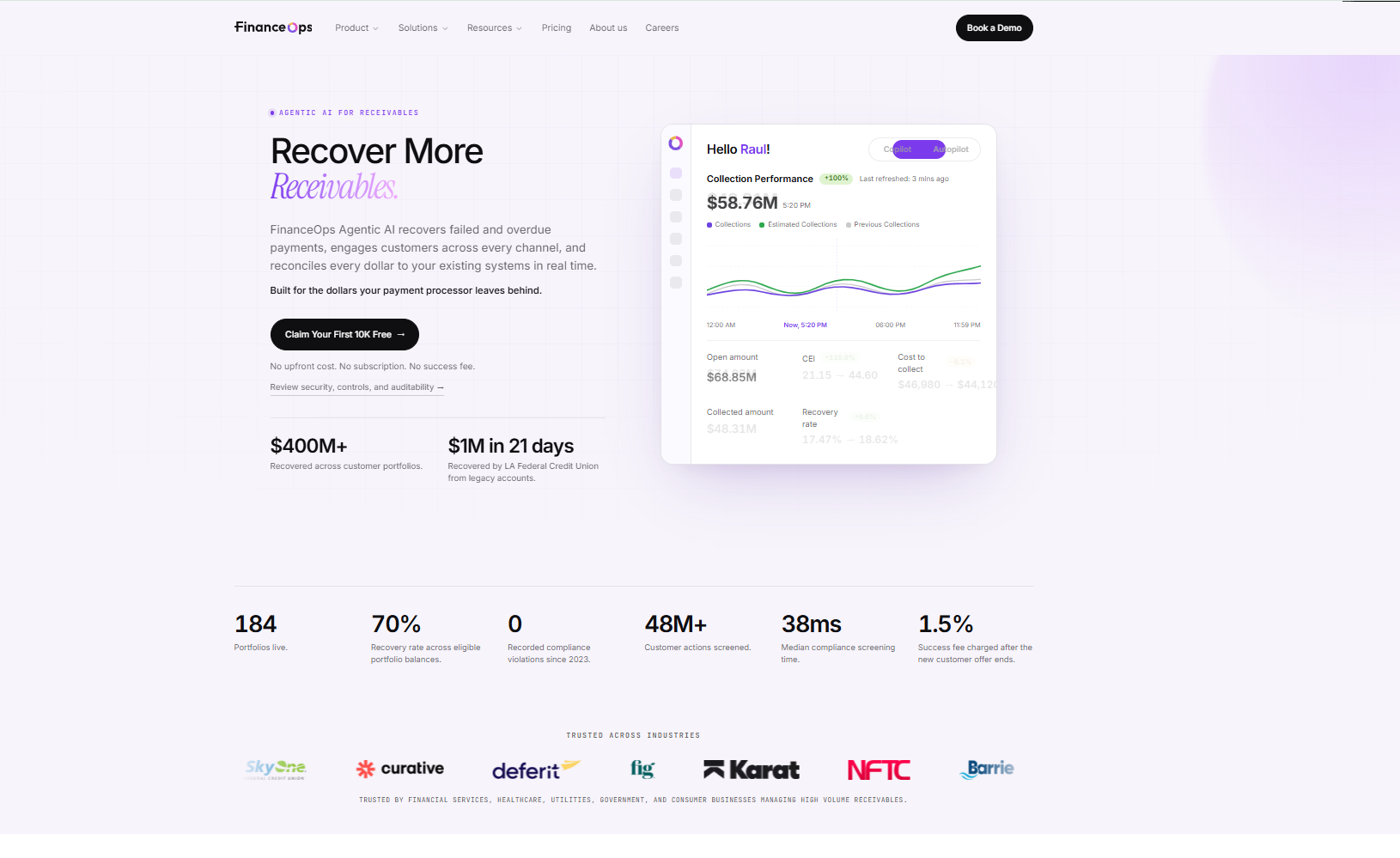
FinanceOps reports the portfolio-level recovery total shown below as of October 2026. It is a company-wide aggregate, not a projection or a guaranteed outcome for any individual account or portfolio.
A control only works when it follows the account, the channel, and the next action.
— Yogesh Jeswani, CTO & Co-founder, FinanceOps