
Healthcare collections software should help providers resolve unpaid patient balances by connecting billing records, patient conversations, approved payment options, and staff review. For a 2027 purchase, evaluate whether the software completes that work accurately, protects sensitive information, and produces results your revenue-cycle team can verify.
Imagine a patient receiving a reminder for $420 after an insurer reprocessed the claim. The patient asks why the amount changed. A useful platform retrieves the current record or routes the question to its owner. A weak workflow repeats the original demand.
That is the buying decision: can the proposed system handle the account after the patient replies?
This guide is for hospital revenue-cycle leaders, patient financial services teams, IT, privacy officers, and procurement. It covers patient-balance customer support and collections, rather than clinical decision-making or a complete replacement for claims management.
Start With the Problem You Need to Solve
Choose a specific initial use case: post-insurance patient balances, self-pay follow-up, failed installments, or unresolved billing inquiries. Record the locations, account volumes, balance ranges, languages, channels, and staff responsibilities involved.
The scale matters. The Centers for Medicare & Medicaid Services NHE fact sheet, updated in June 2026, reports $1,634.7 billion in U.S. hospital expenditures for 2024. That is spending across payers, not unpaid patient bills or a 2027 collections forecast.
Your own portfolio is the buying baseline. Separate patient responsibility from amounts still awaiting payer review, corrections, or approved assistance decisions. Decide which accounts are eligible for outreach and which need another workflow first.
For operational context, read AI Patient Collections Software. This buyer guide turns that workflow into requirements you can put in a purchasing decision.
What Evidence Should Buyers Request?
Give each requirement an owner, a test, and an acceptance decision. A feature marked “available” tells you little about how it works in your environment.
| Evaluation area | Evidence to request | Account test |
|---|---|---|
| Balance accuracy | Data mapping and update rules | A claim adjustment changes patient responsibility |
| Patient identity | Identity and authorized-party workflow | A caller is a caregiver rather than the patient |
| Billing questions | Approved knowledge and escalation paths | A patient challenges a duplicate charge |
| Financial assistance | Policy routing, status handling, and ownership | An assistance request is awaiting review |
| Payment integrity | Transaction states and duplicate prevention | A payment request times out |
| Staff handoff | Assigned queue, context, and completion tracking | A specialist must resolve an exception |
| Privacy and security | Applicable BAA, access controls, data flow, and security evidence | A user attempts access outside their role |
| Operating results | Reproducible reports and cost definitions | Finance traces reported recovery to applied payments |
Treat critical requirements as gates. A strong score for outreach volume should not compensate for an unresolved privacy or payment-control failure. Rank acceptable options on usability, deployment effort, cost, and measured outcomes after those gates are satisfied.
Can It Explain the Right Patient Balance?
A patient can have several encounters, statements, adjustments, and payments. The integration must identify the patient, responsible party, encounter or billing account, obligation, and transaction without collapsing distinct records into one balance.
Ask which system is authoritative for patient responsibility. Specify how claim reprocessing, contractual adjustments, credits, refunds, and partial payments reach the collections workflow. Keep accounting corrections with authorized staff.
Daily files and event-driven integrations create different freshness expectations. Document update frequency and the handling of duplicate files, out-of-order events, and unavailable systems. If the balance cannot be confirmed, the workflow needs an exception path.
Have the provider demonstrate a payment arriving just before a scheduled reminder. Inspect whether the system rechecks eligibility and updates the outreach queue. “We integrate with your billing system” is the start of the discussion, not the acceptance test.
How Does It Handle Patients Who Need Help?
Patient communication should make it easy to identify the bill, ask a question, and reach a person. Test language preferences, channel changes, authorized representatives, and requests for a callback.
A billing explanation must use approved account information. The system should acknowledge missing information and route the case rather than invent an insurance answer. Clinical questions belong with qualified healthcare professionals.
For hospital organizations subject to Section 501(r), the IRS requires reasonable efforts to determine financial-assistance eligibility before extraordinary collection actions. This requirement has a specific scope; it is not a universal ban on routine patient billing.
Ask how applicable assistance rules, requests, decisions, and escalation restrictions are recorded. Require a named hospital owner for eligibility decisions and a demonstrated process for updating account treatment when the status changes. Have the organization's policy and legal teams approve the configuration.
For conversation continuity, explore Omnichannel Healthcare Collections AI. During evaluation, test whether the staff member receiving a handoff can see the issue, relevant history, and promised next step.

What Should the Privacy Review Cover?
Map sensitive information through imports, conversations, transcripts, prompts, logs, analytics, support access, and subprocessors. A data-flow diagram should show where information is stored, why each service receives it, and how it is removed.
HHS cloud-computing guidance explains that a cloud provider creating, receiving, maintaining, or transmitting ePHI on behalf of a covered entity or business associate is a business associate, including certain encrypted-data arrangements. Establish applicable BAAs and responsibilities before moving production information.
Use the HHS minimum-necessary guidance to inform access design for uses and disclosures to which the standard applies. Billing support should not automatically receive an entire clinical record.
Request evidence of role-based access, tenant isolation, audit logs, security testing, incident handling, backup recovery, and contractual retention and deletion. Clarify whether data can be used for model training and which downstream providers process it. These are purchasing controls to evaluate, not a claim that every item is a separate legal mandate.
A certification or audit report has a scope and a period. Review both, along with exceptions and customer responsibilities. A badge does not establish that your proposed workflow meets every applicable obligation.
Will Payment Workflows Survive Exceptions?
Payment initiation, authorization, settlement, and application are different events. Ask how each appears in the account record and what happens after a failure, return, refund, or reversal.
A timeout does not prove a payment failed. Require a status check and stable transaction identifiers before repeating an action. Demonstrate duplicate prevention and reconciliation between the payment record and the billing account.
For installment plans, inspect approved terms, authorization, schedule changes, missed payments, and cancellation handling. The software should not infer a patient's ability to pay from sentiment or silently change agreed terms.
Use approved or synthetic accounts for prelaunch tests. Inspect the logs and resulting records, not just the message shown to the patient. Review Agentic Payments against those tests.
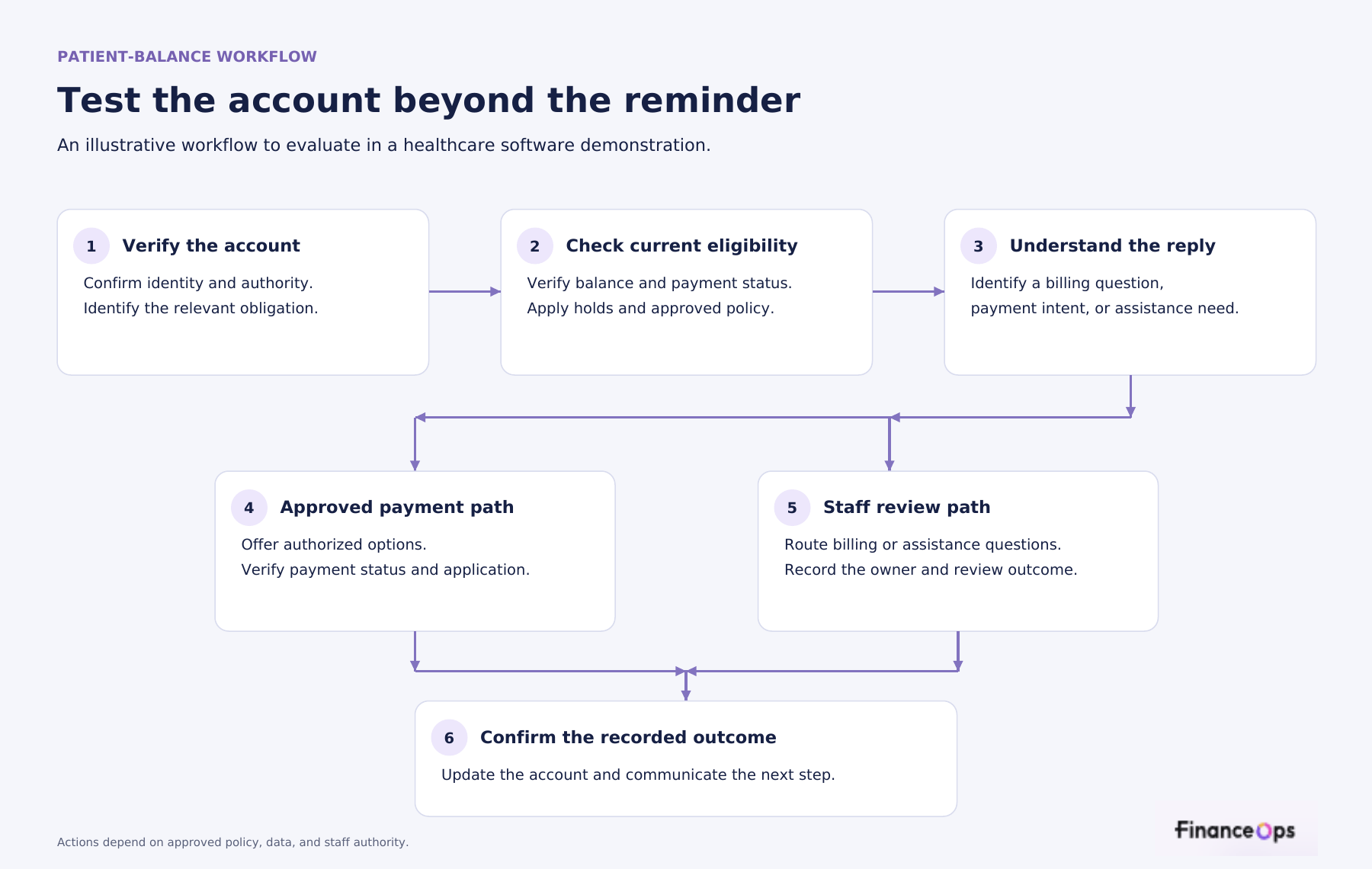
How Should You Evaluate FinanceOps?
Evaluate FinanceOps for Healthcare as a customer support and collections workflow around eligible patient balances. Map the proposed deployment to billing explanations, balance follow-up, payment-plan support, failed-payment resolution, and staff escalation.
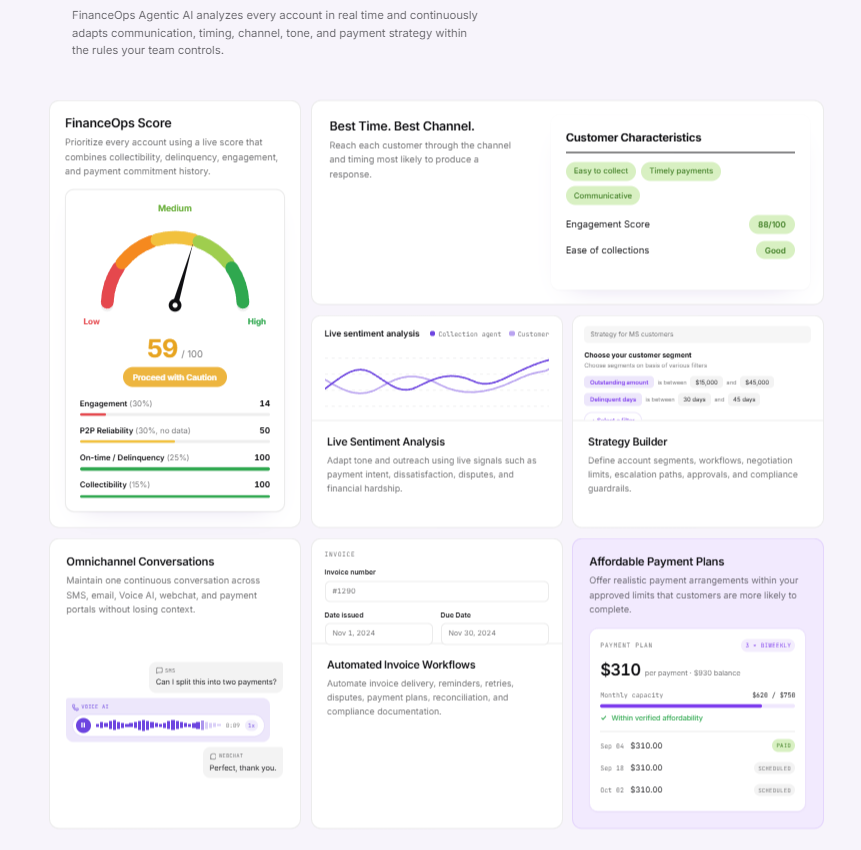
Review Autopilot for approved automated work and Copilot for staff-assisted handling. Use Strategy Builder to examine configured rules, review requirements, and escalation paths.
Then test invoice workflows and Dashboards against your payment and reporting definitions. Confirm supported integrations, data availability, languages, channels, and actions in the agreed scope.
The hospital retains responsibility for its policies, assistance determinations, authorized corrections, and clinical decisions. Ask the demonstration team to show both an ordinary account and an exception requiring staff review.
What Can the Enamel Case Study Tell You?
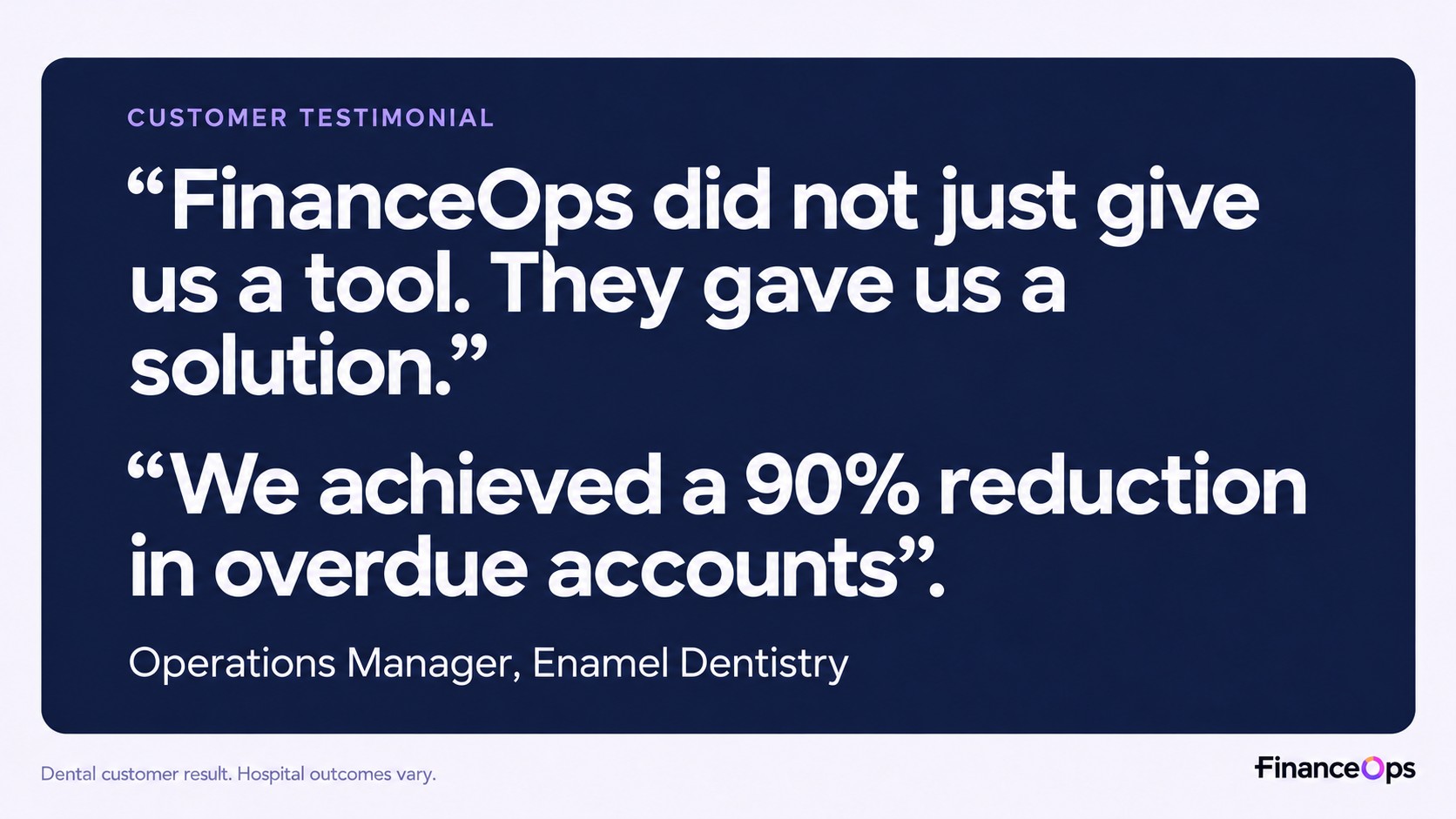
The published Enamel Dentistry case study reports a 90% reduction in seriously overdue accounts. It is dental customer evidence, not a hospital recovery guarantee.
Use it to ask useful reference questions: which accounts were included, what staff work remained, how results were measured, and how payment questions were resolved. Ask for the full case study rather than treating a headline as your forecast.
A hospital's payer mix, account complexity, assistance policies, and integration needs can differ substantially. Validate the relevant workflow with your own pilot.
How Do You Compare Cost and Pilot Results?
Compare the same scope across proposals. Include software or recovery fees, implementation, integrations, communication costs, payment processing, security review, support, and retained staff work. Define the fee base and how refunds, reversals, assistance adjustments, and already-scheduled payments are treated.
Review FinanceOps pricing with the proposed scope. Do not compare a headline success fee with another option's total operating cost.
Before launch, agree the eligible population, exclusions, comparison group or documented baseline, observation period, and acceptance thresholds. Track cash received and applied separately from promises, credits, and write-offs.
Also measure incorrect-balance contacts, repeat billing inquiries, unresolved handoffs, complaints, assistance-routing completion, manual touches, and kept installments. Released staff hours create capacity; they become cash savings only if spending decreases or a documented expense is avoided.
Use a bounded rollout with named owners. IT signs off integration behavior; privacy and security approve data handling; patient financial services approve account treatment; finance validates the results. Agree pause conditions, configuration-change review, record export, and completion of open cases before expansion.
For the calculation method, read AI Collections ROI. Choose the platform whose results your team can explain and reproduce.