
Move recurring patient-balance follow-up off the front desk when it interrupts scheduling or keeps getting postponed. Give routine outreach dedicated capacity, while practice staff retain responsibility for insurance questions, disputed balances, and patient support.
Key takeaways
- Define the work before approving the hire. Patient calls, claim investigation, and payment reconciliation require different skills.
- Check patient responsibility before outreach. Unresolved insurance or posting issues can create avoidable calls and repeated work.
- Compare three operating models. Protected front-desk time, centralized billing, and managed first-party follow-up each fit different workloads.
- Assign the decisions that follow each conversation. A recorded dispute or callback request still needs someone responsible for resolving it.
- Measure performance across the group. Assess verified payments, scheduling service, patient experience, and total employee effort.
What another AR hire needs to solve
The American Dental Association’s Patient Service Coordinator program includes appointment management, insurance verification, claims, billing, and payment collection. These responsibilities can legitimately sit within one front-office role. The staffing question is whether employees have enough time, coverage, and authority to complete them reliably.
For a dental group, a request for another patient accounts receivable (AR) employee deserves a closer look.
One location may have accurate patient balances awaiting contact. Another may have unresolved insurance claims. A third may be handling calls about payments that were received but posted to a different account.
Those offices need different kinds of help.
Additional calling capacity can address a queue of verified balances. Claim investigation requires billing expertise. Payment-allocation problems need reconciliation. A broad job description that combines all three can leave the new employee managing the same competing priorities as the existing team.
Before deciding who to hire, establish which work is accumulating and what authority someone needs to finish it.
What the U.S. staffing data tells us
In the ADA Health Policy Institute’s Q3 2026 survey, 40.7% of responding owner dentists reported adding staff since the beginning of the year.
This is broad hiring context, not a measure of patient AR hiring or scheduling disruption. Use your group’s call and workload records to establish whether collection work competes with reception duties.
Find the work behind the hiring request
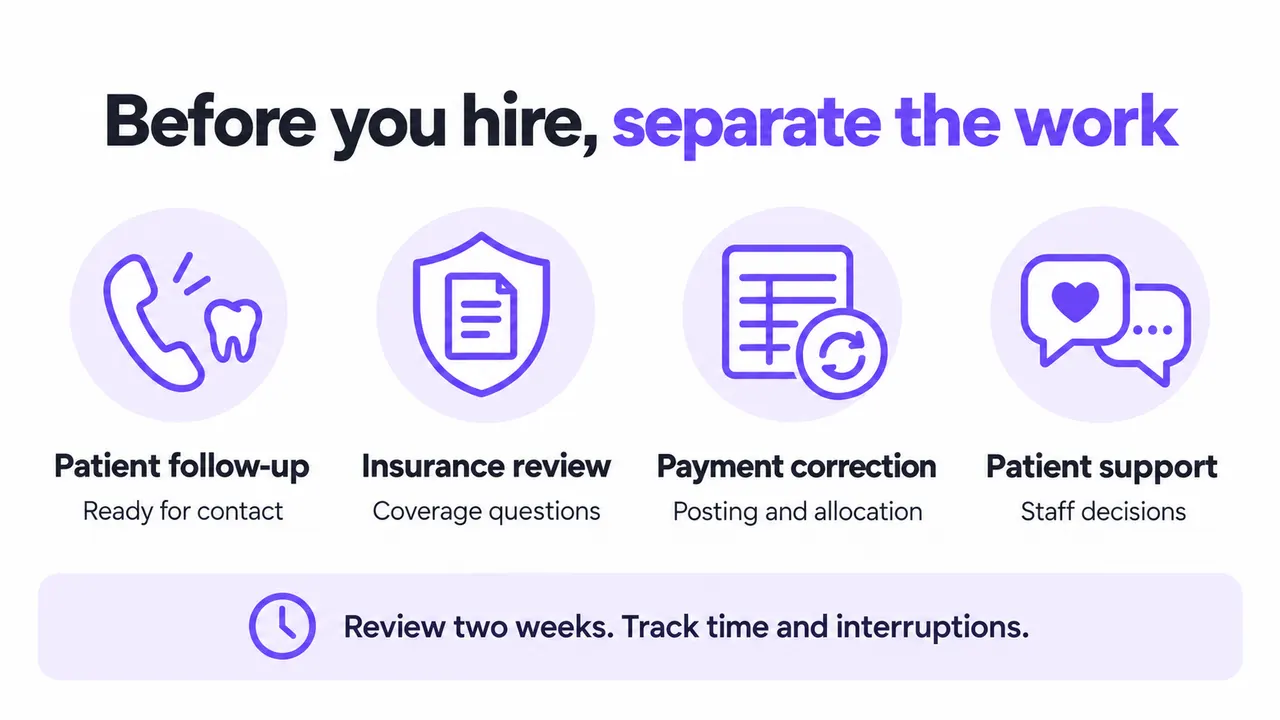
Review two representative weeks across locations. Include preparation, unsuccessful attempts, return calls, documentation, and account investigation.
Separate balances ready for patient contact from those awaiting insurance review or payment correction. Identify support requests that need employee judgment.
If investigation consumes most of the time, another caller will still depend on billing. If accurate balances go untouched, dedicated follow-up addresses a clearer capacity gap.
Record when follow-up happens and where it is interrupted or postponed. Work that fits into a weekly total may still clash with morning check-in or lunch coverage.
Compare those periods with scheduling-call answer rates, callback completion, and check-in waits. Review phone routing and staffing coverage as other possible explanations.
Check what the patient actually owes
Dedicated follow-up inherits the quality of the accounts it receives.
Before outreach, check who is responsible, what is currently due, and whether contact is permitted. Account for payments, credits, adjustments, existing arrangements, and open reviews that affect the balance.
A claim denial needs review before it becomes a patient payment request. Self-pay accounts may follow a different process because insurer adjudication is not relevant to every balance. Our blog on dental accounts receivable explains the distinction.
With overnight updates, a patient who paid that morning may still appear overdue. Give the team a way to check reported payments or route them for investigation before repeating the request. Confirm payment only when records support it.
Compare three follow-up models
Use the volume of accounts ready for contact, the investigation they generate, and available supervision to compare the options.
| Model | When it may fit | What it requires |
|---|---|---|
| Protected front-desk follow-up | The queue fits within reserved time and reception has dependable coverage. | Private calling time, backup coverage, consistent notes, and an escalation owner. |
| Centralized in-house billing | Several locations share enough recurring work to support dedicated staff. | Location-level records, training, absence coverage, and clear authority limits. |
| Managed first-party follow-up | Verified balances need consistent outreach while practice staff retain complex decisions. | Agreed account eligibility, current data, approved conversations, transparent fees, and exception handling. |
Before choosing a model, ask each location to show how it would cover the same eligible account queue during a busy week and an employee absence. Include the return calls and exceptions the proposed arrangement would generate.
Keep protected front-desk follow-up when reserved time and backup coverage let the team finish the queue without weakening patient-facing service. Compare centralization and managed follow-up when that coverage is unreliable or shared demand warrants dedicated capacity.
Managed first-party follow-up means outreach on the practice’s behalf. Confirm the requirements that apply to the provider’s actual activities and arrangement.
Give each patient response a next step
Agree where unresolved conversations go before launch. A patient asking for a payment link, questioning coverage, or reporting reduced income needs a different next step in each case.
| Patient response | Appropriate next step | Responsible owner |
|---|---|---|
| “I thought insurance covered this.” | Review coverage-related account information and pause routine follow-up on the disputed portion. | Billing or insurance specialist |
| “I paid at another location.” | Check the receipt, posting, and allocation before repeating the request. | Reconciliation team |
| “My hours were cut. I cannot pay this now.” | Acknowledge the income change and offer a choice of authorized options, human support, or another time. | Authorized financial coordinator |
| “There was a problem with my treatment.” | Route the care concern through the practice’s clinical process. | Clinical lead or practice manager |
| “You have the wrong person.” | Avoid account disclosure, stop that contact path, and investigate the record. | Patient administration team |
Give each receiving team a response target and make overdue reviews visible to a supervisor. An expired target should not restart payment reminders while the issue remains unresolved.
The handoff should explain what the patient asked, what was checked, which actions were attempted, and what still needs a decision. Include the responsible owner and any active contact restriction.
That record matters to both sides of the conversation. The employee can pick up the work, and the patient has less reason to repeat an explanation they already gave.
Where Voice AI can take work off the desk
Voice AI can handle defined routine conversations when it has current account information, permission to take the relevant action, and a reliable route to staff.

For example, a patient asking for a payment link needs delivery through the approved channel and a recorded delivery result. A promise to pay Friday needs an amount, a date, and a later payment check. Neither outcome should be reported as cash collected.
An insurance question or a disputed amount needs a different route. The practice should define when outreach pauses and which employee can review the issue. Adjustments or concessions outside the agent’s authority stay with that employee.
Ask to see the difficult cases
During a demonstration, ask what happens when payment records are unavailable, an account match is uncertain, or a transfer fails. Look at the resulting record and who is responsible for the next step.
A transfer request is only an attempt until the system confirms connection. If it fails, the approved fallback should keep the issue assigned rather than send the patient back into routine reminders.
Leave room for the patient to choose
A patient who says their hours have been cut may want to explore available arrangements, speak with an employee, or discuss the account another time.
Acknowledge the income change and ask which option they prefer. Continue within practice policy and account permissions, without repeated pressure to pay or suggestions to borrow or sacrifice essentials.
Acute distress needs a separate response: stop payment discussion and follow the approved support process. Test these situations before launch so the team knows how the workflow handles them.
Check how patient information is handled
HHS recognizes debt collection as a payment activity under HIPAA. Covered entities can use collection services through an appropriate business-associate arrangement, with relevant disclosures subject to business-associate and minimum-necessary requirements.
For a covered dental group, agree the applicable business associate agreement and who can access patient information. Review subcontractors, recordings, transcripts, retention, deletion, and approved payment channels.
Keep access tied to the task; routine follow-up should not require unrestricted clinical records.
Measure what changes across the group
Start a pilot with a defined set of accounts and a comparable baseline or comparison group. Account for balance age, amount, insurance status, and placement timing so differences in the accounts do not become unexplained performance gains.
| Measure | What it should establish |
|---|---|
| Front-desk effort | Total time spent reviewing accounts, contacting patients, documenting outcomes, and handling return calls. |
| Scheduling service | Answer rates, completed callbacks, and check-in waits during affected periods, using consistent definitions. |
| Verified patient payments | Cash received and correctly applied to the placed accounts within an agreed attribution window, adjusted for reversals. |
| Exception effort | Investigation and review time retained by billing and practice managers. |
| Patient experience | Complaints, wrong-party contacts, and repeated requests after payment, with both counts and rates reported. |
| Total operating cost | Fees, internal labor, processing, integration, training, and oversight. |
Agree measurement rules before the pilot:
- Scheduling: Answered scheduling calls divided by offered scheduling calls, with consistent treatment of abandoned calls.
- Payments: Compare accounts over the same follow-up window.
- Resolution: Distinguish payment and approved adjustment from referral for investigation before calculating staff minutes per resolution.
Count work wherever it moves. If reception saves ten hours but billing spends ten additional hours investigating incomplete handoffs, total employee effort has not decreased.
Identify how released time is used. More reliable scheduling coverage, reduced overtime, or an avoided planned expense can support the business case. Freed hours alone do not establish payroll savings or additional appointment revenue.
How FinanceOps supports dental groups
FinanceOps supports patient-balance follow-up in the practice’s name through voice, SMS, and email, with approved payment options and human escalation. Its dental offering includes native Open Dental integration; requirements for other practice-management systems should be confirmed during scoping.
The collections offer starts at a 1.5% success fee plus $1 per recovered payment, subject to agreed scope and terms. Include payment-processing costs and retained employee effort when comparing the total cost.
Bring examples from your own account queue to the evaluation. Ask how a reported payment is checked, where an insurance question goes, and what an employee receives after a failed handoff.
Results from Enamel Dentistry
Enamel Dentistry, an Austin-based FinanceOps client, had patient balances of roughly $100 to $250 that remained overdue for more than 120 days. Its published case study describes the difficulty of making dedicated manual follow-up economical for these smaller balances.
The practice used FinanceOps Autopilot to coordinate account prioritization, reminders, payment options, and continued follow-up. The case study reports:
- 90% reduction in accounts more than 120 days overdue.
- $100,000 recovered over 18 months.
We were drowning in delinquent accounts with no good way to handle them. FinanceOps didn’t just give us a tool, they gave us a solution. The results speak for themselves, 90% reduction in overdue accounts and improved ROI that have completely changed our collections process. We’re now able to focus on delivering care, not chasing payments.
— Operations Manager, Enamel Dentistry
These results describe Enamel’s deployment. The case study does not quantify scheduling improvements, front-desk hours saved, or an avoided hire. Dental groups assessing their own staffing needs should measure those outcomes separately.
Read the Enamel Dentistry case study →
Make the hiring brief more precise
Use the workload review to write a specific recommendation: which accounts will move, who will contact patients, which decisions stay with the practice, and how the group will judge the result.
If dedicated follow-up frees desk time but leaves insurance investigations unresolved, that remaining need belongs in the hiring brief. The next role may be an insurance specialist, a reconciliation employee, a financial coordinator, or additional scheduling support.
A role built around that remaining work gives the employee a clearer responsibility and gives the group a concrete reason for the investment.