
Collectors’ Brain guides AI collections through four connected steps: bring the account into focus, apply your rules, carry out a permitted step, and confirm and record the result. This guide follows that workflow from available account information to an authorized action or human review.
For the product introduction, read AI Collections With Context: Meet Collectors Brain. Available workflows depend on connected systems, enabled channels and approved configuration.
Key takeaways
Context before contact: Account records, previous conversations and approved knowledge help establish the next step.
Your rules govern actions: Configured policies define contact permissions, approved options and review routes.
Voice AI carries the conversation: Enabled channels use available account context and approved guidance.
People handle exceptions: Disputes, hardship requests and uncertain records follow configured review paths.
Measure confirmed results: Keep commitments and payment attempts separate from recovered cash.
Why do collections teams need more context before following up?
A customer promised to pay on Friday. Another disputed an invoice yesterday. A third says the payment has already been made. All three accounts show an overdue balance. Each needs a different next step.
Intuit QuickBooks’ 2026 Small Business Late Payments Report found that 59% of surveyed US small businesses had invoices overdue by 30 days or more, compared with 47% the previous year. This finding describes US small businesses, rather than every lending or healthcare portfolio.
For collectors, working overdue accounts means checking what happened, understanding the customer’s response and finding an appropriate way forward. When information sits across separate systems, the collector must reconstruct the account before making a call. An automated reminder can also overlook an active commitment or an unresolved billing concern.
What information guides the workflow?
The workflow brings together the evidence needed to answer three questions:
- What is happening with this account?
- What action does our policy permit?
- Does a person need to review the case?
| Information | What it contributes |
|---|---|
| Account records | Recorded balances, invoices, payment history and account status |
| Customer conversations | Previous replies, questions, disputes and commitments |
| Approved business knowledge | Documents, answers and policies relevant to the interaction |
| Configured workflows | Contact rules, available options, action limits and review routes |
How does Collectors’ Brain guide the next action?
Follow the four stages below to see what evidence each step uses, what controls apply and what result should be recorded.
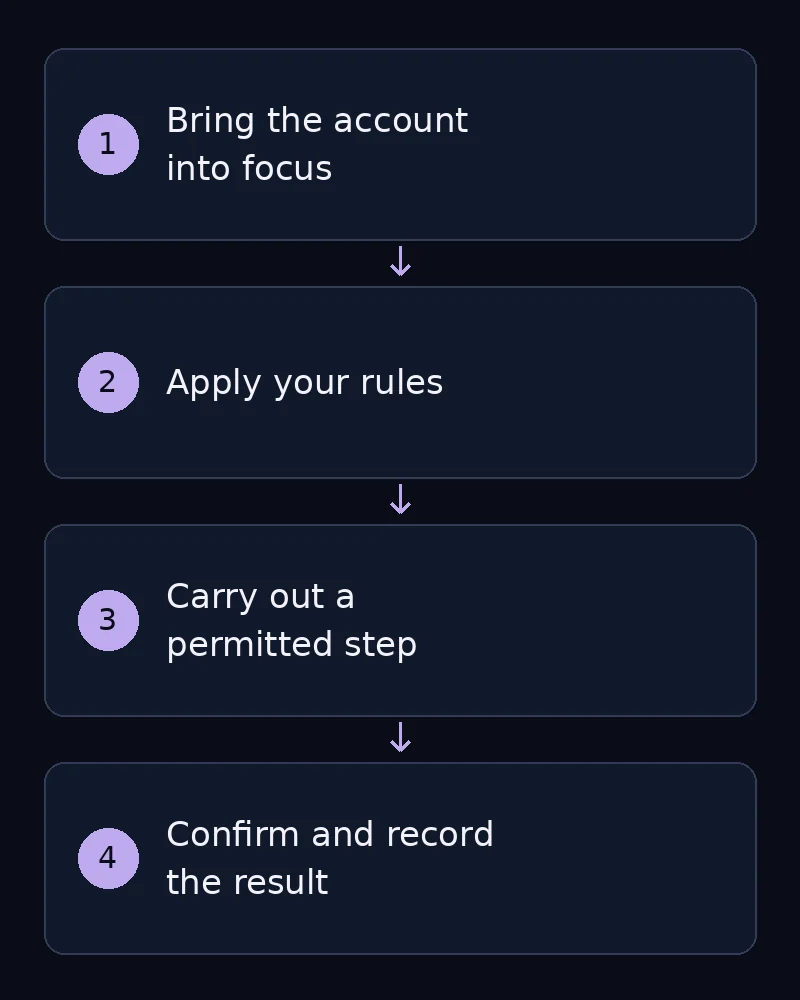
1. Bring the account into focus
Start with relevant account information: the recorded balance, available payment data, previous interactions and approved guidance. Freshness matters. Yesterday’s payment file may not explain a transfer reported this morning. Missing or conflicting information should remain visible.
For a deeper look, explore account context before contact.
2. Apply your rules
Your organization defines permitted actions, including contact timing, approved payment options, offer limits, stop conditions and approval requirements. Strategy Builder supports the configuration of those workflows and review routes.
3. Carry out a permitted step
Depending on the enabled workflow, the AI collector can answer a question using approved knowledge, record a commitment, initiate an approved payment flow or route an exception. Requests outside the permitted options follow the configured review process.
4. Confirm and record the result
An attempted action and a completed action are different states. Sending a payment link does not mean payment was made. A customer’s promise does not establish recovered cash. The account history should show the result confirmed by the connected system.
Our guide to keeping payment commitments separate from recovered cash explains how to track those distinctions.
What changes when a conversation adds new information?
After the required identity checks, a customer says: “I can pay part of the balance, but I need to understand the available options.”
The workflow checks the account and approved arrangements before discussing an option. A request beyond its limits goes to review. Any commitment recorded during the conversation remains distinct from a confirmed payment.
If the next follow-up uses SMS or email, the recorded conversation should inform that step. Test whether the workflow preserves the agreed amount, date and unresolved questions across enabled channels.
Use our Voice AI pilot checklist to test routine conversations, unclear records and failed actions.
When should Collectors’ Brain bring in your team?
Human review is part of the operating design. An AI collector supports defined routine work while people remain responsible for policies, approvals and cases requiring judgment.
- Disputes: A customer challenges a charge, invoice or balance.
- Hardship requests: A customer asks for support requiring specialist handling.
- Uncertain records: Payment information is missing, conflicting or out of date.
- Requests outside approved options: An arrangement requires additional authority.
- Unanswered questions: Available knowledge does not support a reliable response.
A useful handoff includes what the customer said, what the records show, what action was attempted and why review is needed. Collectors can then focus on the unresolved decision.
Read more about where human review fits in AI collections and review the FinanceOps security and compliance information.
What happens when a customer says, “I already paid”?
The following illustrates a configured workflow; exact handling depends on the deployment.
A customer reports paying that morning. The latest available record does not show the transaction. The AI collector should distinguish the customer’s statement from a confirmed payment, explain that confirmation is needed and follow the approved review process.
If the workflow permits a temporary outreach pause, that pause should have a recorded reason and review condition. Once the authoritative record confirms the applicable status, the account can move to the appropriate next stage.
| Account moment | Appropriate handling |
|---|---|
| Customer reports a payment | Record the statement and check available payment information |
| Records are stale or unclear | Explain the uncertainty and follow the review route |
| Applicable payment status is confirmed | Apply the corresponding account update |
| Confirmation remains unavailable | Keep the issue unresolved with a clear review owner |
What should your team review before changing the workflow?
When a resolved case reveals a gap, record the evidence and proposed correction. Identify whether the change affects approved knowledge, action limits or review routing. Test the revised handling, approve the change and monitor the result.
For example, repeated billing questions may call for a clearer approved explanation. They do not justify automatically expanding the agent’s permissions. Reviewed outcomes can inform controlled updates; conversations should not be assumed to retrain production behavior.
How does this fit different collection environments?
The account context, approved options and review process should reflect your industry.
- Credit unions: Review member payment commitments, approved arrangements and sensitive cases while preserving relationship context.
- Banks: Evaluate account handling against institutional policies, action limits and review ownership.
- Healthcare: Distinguish patient payment follow-up from billing questions requiring staff review.
- Dental practices: Keep patient-balance questions and insurance-related issues on their appropriate handling paths.
- Small businesses: Connect invoice history, replies and next actions without repeatedly reconstructing the same account.
- Utilities: Configure arrears follow-up and specialist review around the organization’s applicable policies.
These are evaluation scenarios, not a claim that every workflow is enabled by default.
How does FinanceOps pricing compare with collection agency fees?
How much of every recovered dollar does your business keep? A percentage-based collection fee can make a substantial difference to that answer.
According to CO— by the U.S. Chamber of Commerce, collection agencies often charge 25–50% of the amount recovered, with older or more difficult accounts generally carrying higher fees. The comparison below uses illustrative agency rates of 25% and 30%; actual fees and service scope vary.
FinanceOps Autopilot starts at 1.5% of eligible cash recovered, plus $1 per recovered payment. Collections operate under your brand, with approved workflows guiding follow-up and human review.
The difference on $100,000 recovered
Assume each option recovers the same $100,000, and FinanceOps records 500 recovered payments:
- Agency at 25%: $25,000 collection fee; $75,000 remains before other costs.
- Agency at 30%: $30,000 collection fee; $70,000 remains before other costs.
- FinanceOps base pricing: $1,500 success fee + $500 in payment fees = $2,000; $98,000 remains before separately applicable charges.
That is an illustrative $23,000–$28,000 difference in base collection fees on the same recovered cash. It assumes no increase in recovery and does not establish equivalent service scope or portfolio performance.
Confirm payment processing, Voice AI, optional services and eligibility in your agreement. Copilot pricing is confirmed with sales. Compare total cost and confirmed recoveries on similar accounts.
Put your own numbers to work: explore the pricing breakdown below to see what the model could mean for your portfolio.
How should you measure the value of AI collections?
Start with a defined account group, measurement period and matched baseline.
| Measure | What to examine |
|---|---|
| Confirmed recovered cash | Eligible money actually recovered during the period |
| Time to payment | Time from account placement to confirmed payment |
| Collector effort | Time spent on routine handling and exceptions |
| Review quality | Whether cases reach the right owner with usable context |
| Handling accuracy | Whether actions reflect payment status and approved rules |
| Cost to collect | Applicable fees and internal effort relative to recovery |
Compare similar account populations. Record unresolved cases and incorrect actions alongside efficiency measures. Calls completed and messages sent explain activity; confirmed recovery and handling quality establish whether the workflow helped.
For practical measurement guidance, explore payment confirmation and collection economics.