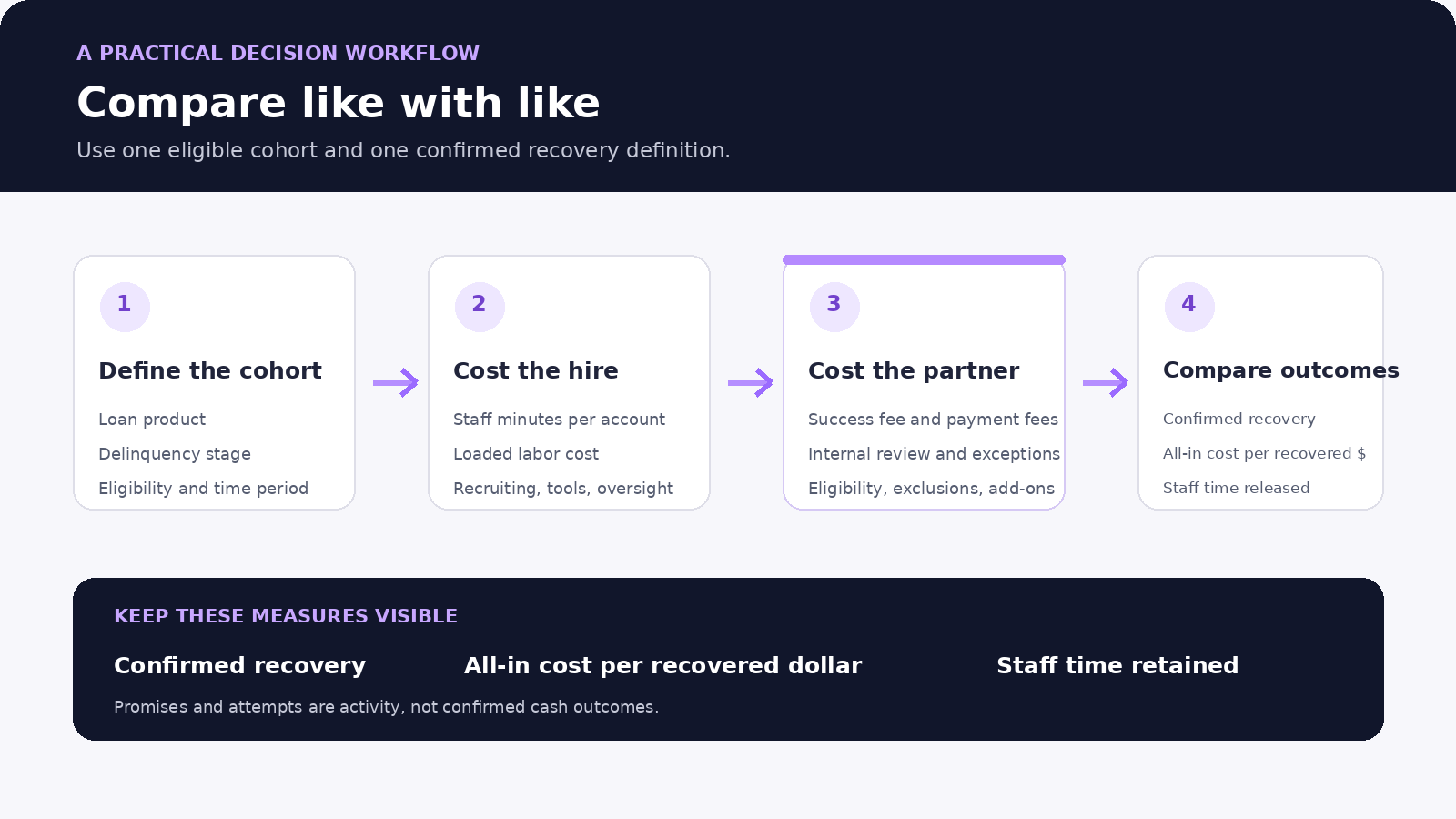
A growing loan book creates a practical choice: add collection capacity to payroll, or pay a partner when eligible balances are recovered. The fair comparison counts the same accounts, staff effort, confirmed recoveries, and all-in fees on both sides.
What should fintech lenders compare before hiring or outsourcing collections?
A hire adds capacity you can direct and develop, but the full cost includes compensation, recruiting, training, supervision, systems, and time spent on exceptions. A success-fee partner ties some cost to recovery, but its economics depend on eligible accounts, fee definitions, payment counts, internal review, and the work your team still owns.
There is no universal break-even point. A model is useful only when both options use the same portfolio, time period, and definition of “recovered.” Count funds confirmed in the relevant account or ledger. A payment promise, initiated transaction, or message sent is not a recovered balance.
This is a different question from how many people a queue needs. For workload planning, see How Should Fintech Lenders Plan Collections Capacity?. For account-level routing, see How Can U.S. Fintech Lenders Triage Early-Stage Collections?.
What costs belong in an in-house collections model?
Start with the labor used for the selected cohort, then add the costs required to make that capacity productive and accountable.
| Cost area | What to include |
|---|---|
| Compensation | Salary or hourly wages, payroll taxes, benefits, and incentives |
| Recruiting and ramp | Recruiting time, onboarding, training, and time before a new hire reaches expected productivity |
| Operating support | Manager and quality-review time, systems, communications, and reporting |
| Account work | Research, outreach, replies, payment follow-up, documentation, and rework |
| Exceptions | Staff time for disputes, hardship requests, payment questions, and cases outside the routine workflow |
The U.S. Bureau of Labor Statistics reports a median annual wage of $47,030 for bill and account collectors in May 2025, equivalent to $22.61 an hour. This is a broad occupational benchmark, not a fintech-specific wage or the full cost of an employee. BLS data for private industry in June 2026 show wages and salaries were 70.0% of total employer compensation on average. That broad ratio can help illustrate a loaded-cost proxy, but it is not a collector-specific benefits rate. See the BLS occupation data and BLS compensation data.
For a decision, replace public benchmarks with your actual pay, benefits, recruiting, software, management, and productive-hour data. Avoid counting all paid hours as collections capacity. Training, meetings, leave, and other responsibilities reduce the time available for account work.
What does a success-fee partner really cost?
The headline rate is only one input. Confirm how the agreement defines eligible accounts and recovered amounts, when a recovery is attributed, how partial or reversed payments are treated, whether payment-level fees apply, and what internal review remains with your staff.
A practical model is:
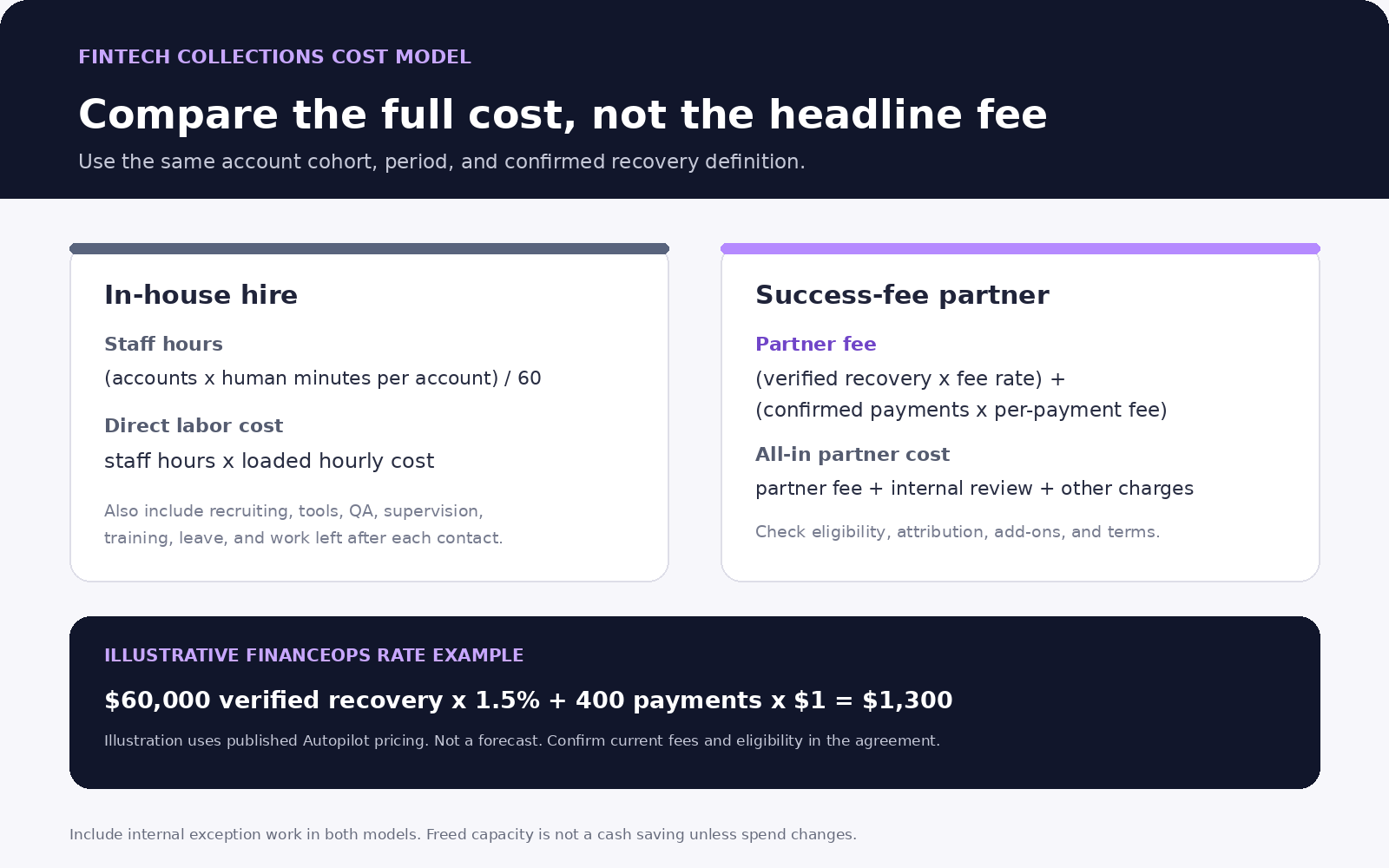
Partner cost = (eligible confirmed recovery × success-fee rate) + (counted payments × per-payment fee) + internal review cost + applicable platform or add-on charges
Then calculate:
Cost per confirmed recovery = total cost ÷ confirmed recovered dollars
Use the same recovery definition for every option. If the partner reports contact activity but your ledger shows no settled or posted payment, keep those events separate.
How do the two models compare in an illustrative scenario?
The following example uses hypothetical portfolio and workload assumptions. It is not an industry average, a FinanceOps performance claim, or a forecast.
Portfolio assumptions: 1,000 early-stage accounts with $300,000 in total balances. For illustration, the account mix produces $60,000 in confirmed recovery across 400 payments during the selected measurement period.
| Loan segment | Accounts | Starting balance | Assumed recovery rate | Confirmed recovery | Payments |
|---|---|---|---|---|---|
| BNPL | 400 | $120,000 | 25% | $30,000 | 200 |
| Personal or installment loans | 400 | $120,000 | 15% | $18,000 | 120 |
| Embedded credit | 200 | $60,000 | 20% | $12,000 | 80 |
| Total | 1,000 | $300,000 | 20% blended | $60,000 | 400 |
The recovery rates and payment counts above are scenario inputs only. Replace them with matched historical cohorts, segmented by product and delinquency stage.
In-house workload illustration
Assume the selected cohort requires an average of 12 minutes of staff work per account across the measured period:
- 1,000 accounts × 12 minutes ÷ 60 = 200 staff hours
- For illustration, use a loaded labor proxy of $32.30 per hour
- 200 hours × $32.30 = $6,460 in direct labor value
The $32.30 proxy is derived from the BLS collector wage benchmark and the broad private-industry wage share cited above. It excludes recruiting, training, management, systems, and other overhead. More importantly, $6,460 is not automatically a cash saving if the team is already salaried. It estimates labor capacity used. Call it a cash saving only if the expense actually changes.
Success-fee illustration
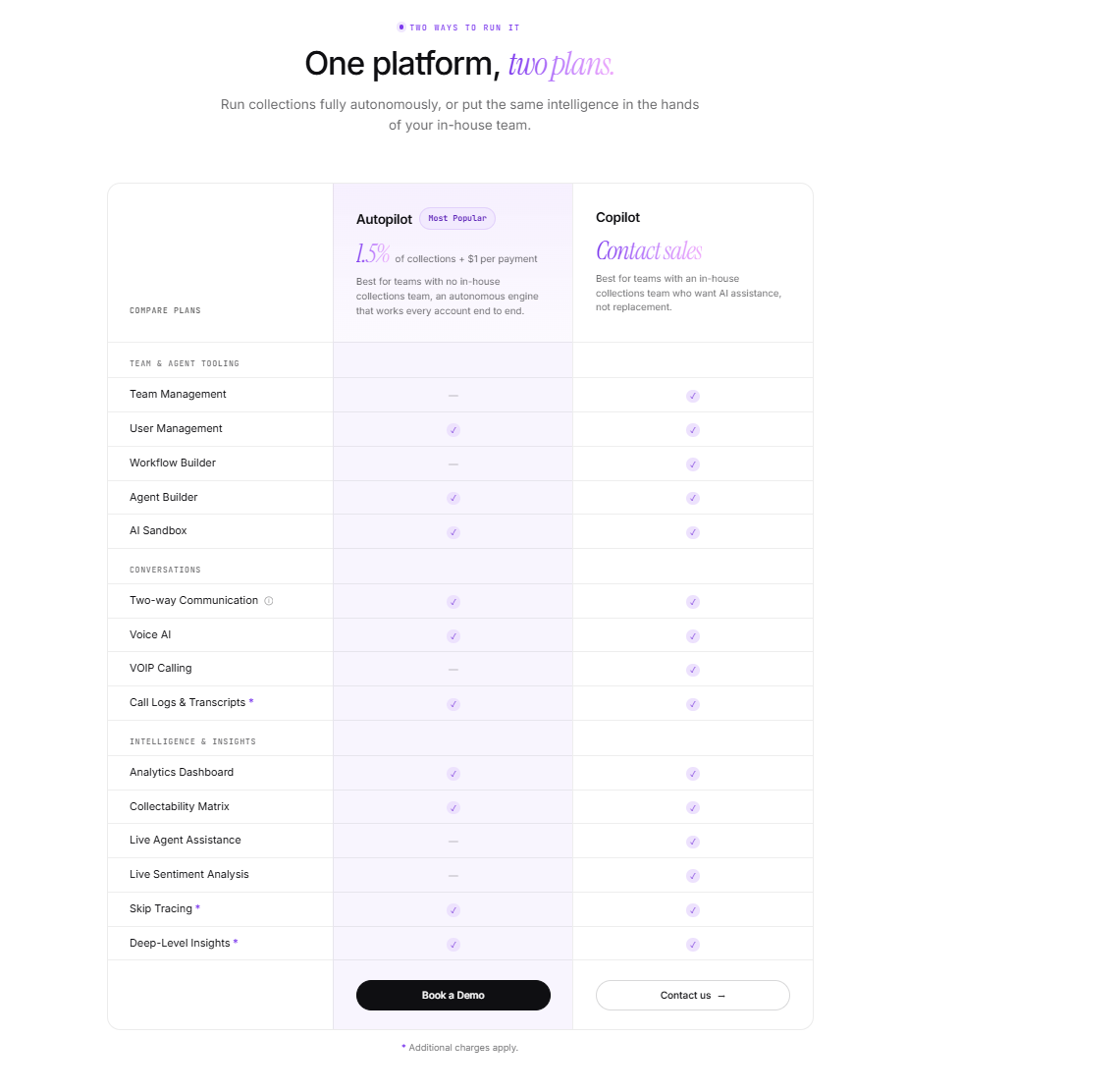
FinanceOps’ Autopilot product page currently describes pricing of 1.5% of recovered balances plus $1 per payment. Applying that published example to the hypothetical cohort:
- $60,000 × 1.5% = $900
- 400 payments × $1 = $400
- Illustrative fee = $1,300
If your team reviews 10% of accounts and spends 15 minutes on each, that adds 25 hours. At the same illustrative $32.30 loaded-cost proxy, internal review represents $807.50 in labor value. The modeled partner-side total is therefore $2,107.50, before any other applicable costs.
| Modelled item | In-house workflow | Success-fee workflow |
|---|---|---|
| Assumed staff time | 200 hours | 25 review hours |
| Illustrative labor value | $6,460 | $807.50 |
| Partner fee | Not applicable | $1,300 |
| Illustrative measured cost | $6,460 direct labor value | $2,107.50 |
This table does not prove the partner is cheaper for your business. The in-house estimate excludes several overhead costs, while the partner estimate depends on the fee schedule and assumes the stated review workload. The models also do not capture differences in recovery, customer experience, quality, risk, or the value of released staff capacity. Validate those factors using a controlled, comparable cohort. Confirm current fees, eligibility, attribution, and any offers in the FinanceOps pricing details and written agreement.
Equations for your own scenario
In-house labor value = accounts × average staff minutes per account ÷ 60 × loaded hourly labor cost
Partner-side cost = confirmed recovery × success-fee rate + counted payments × per-payment fee + internal review and exception cost
Net recovery contribution = confirmed recovery − all-in collection cost
Use the same date range, account eligibility, recovery definition, and portfolio mix for both options. A product-level model is more informative than one blended average: BNPL, installment, and embedded-credit accounts may have different payment patterns, exception rates, handling time, and approved treatments.
When can a hire make sense, and when can a partner fit?
An in-house hire may fit when collections requires sustained judgment-intensive work, the workload is predictable enough to keep the role productive, or the lender needs direct ownership of every interaction. Include the manager and systems needed to support that hire, not only base pay.
A success-fee partner may fit when early-stage volume fluctuates, routine follow-up competes with servicing or risk work, or leadership wants to test recovery economics before building a larger team. It still needs clear account eligibility, decision rights, review paths, data access, and reporting. Outsourcing the work does not outsource the lender’s responsibility for its policies and oversight.
Some lenders may choose a mixed model: keep complex decisions and exceptions with staff, while assigning clearly defined routine follow-up to a partner. The right comparison is then the cost and confirmed outcome of each segment, not an all-or-nothing headcount argument.
For a practical fintech collections workflow, explore FinanceOps for fintech lenders. Teams can review how Autopilot handles configured routine work, how the Strategy Builder defines workflows, and how Dashboards support portfolio reporting. Review the compliance overview when assessing control evidence and deployment requirements. Capabilities and workflow details depend on the agreed configuration.
Want a look at what we’re building next for collections intelligence? Join the FinanceOps Brain waitlist for product updates.
A simple decision checklist
Before approving a hire or partner model, document:
- Which accounts are eligible, and which products or delinquency stages are in scope?
- What counts as recovery: initiated, settled, posted, or another contractually defined event?
- How many staff minutes does each segment require, including follow-up and exceptions?
- Which costs are avoidable cash expense, and which represent capacity value only?
- What partner fees, payment charges, exclusions, reversals, or add-ons apply?
- Who reviews disputes, hardship requests, and other exceptions?
- Will both options be measured over the same period and with the same outcome definitions?
The decision gets clearer when the model reflects the work your team actually does. Start with one comparable cohort, record assumptions before launch, and revisit the result when product mix, account volume, or workflow changes.