Loan growth adds accounts, but account count alone does not tell you how much collections work is coming. A useful capacity plan estimates the human time each workflow requires, then compares that demand with available team hours and confirmed outcomes.
Key takeaways
- Account volume is not the same as workload. The work around each account matters.
- Automation changes capacity only when it reduces human effort or repeat work, not simply when it sends more messages.
- Measure staff time alongside verified payments, resolution, and the work that still needs human review.
Why is account volume a weak measure of collections capacity?
Two portfolios with the same number of past-due accounts can create very different workloads. One may generate routine follow-up. Another may generate more payment questions, returned payments, account research, repeat contacts, or staff review.
Counting accounts or calls alone can hide the work between them. A contact attempt may lead to a conversation, a payment promise, a payment that needs confirmation, or an issue that requires follow-up. Each outcome changes the work still ahead.
For fintech lenders, capacity planning should start with the activity the team handles and the time that activity takes. It should also account for whether the outcome was confirmed. A payment promise is not a posted payment, and a message sent is not a resolved account.
What work should a collections capacity plan include?
Count the human work across the account journey. Use the same definitions across teams and periods.
| Work to measure | Examples of activity |
|---|---|
| Account review | Checking balance, payment status, prior contact, and next action |
| Outreach and responses | Preparing contact, handling replies, and following up |
| Payment follow-through | Checking whether an attempted payment settled and was recorded |
| Review and exception work | Investigating an account question or completing a staff review |
| Records and quality work | Recording outcomes, reviewing interactions, and handing off context |
These are workload categories, not a rule for deciding which account should be automated. For an account-routing framework, see How Can U.S. Fintech Lenders Triage Early-Stage Collections?. For payment follow-through and reconciliation, read Agentic Payments: How AI Makes Payment Recovery Proactive.
How can fintech lenders estimate collections workload?
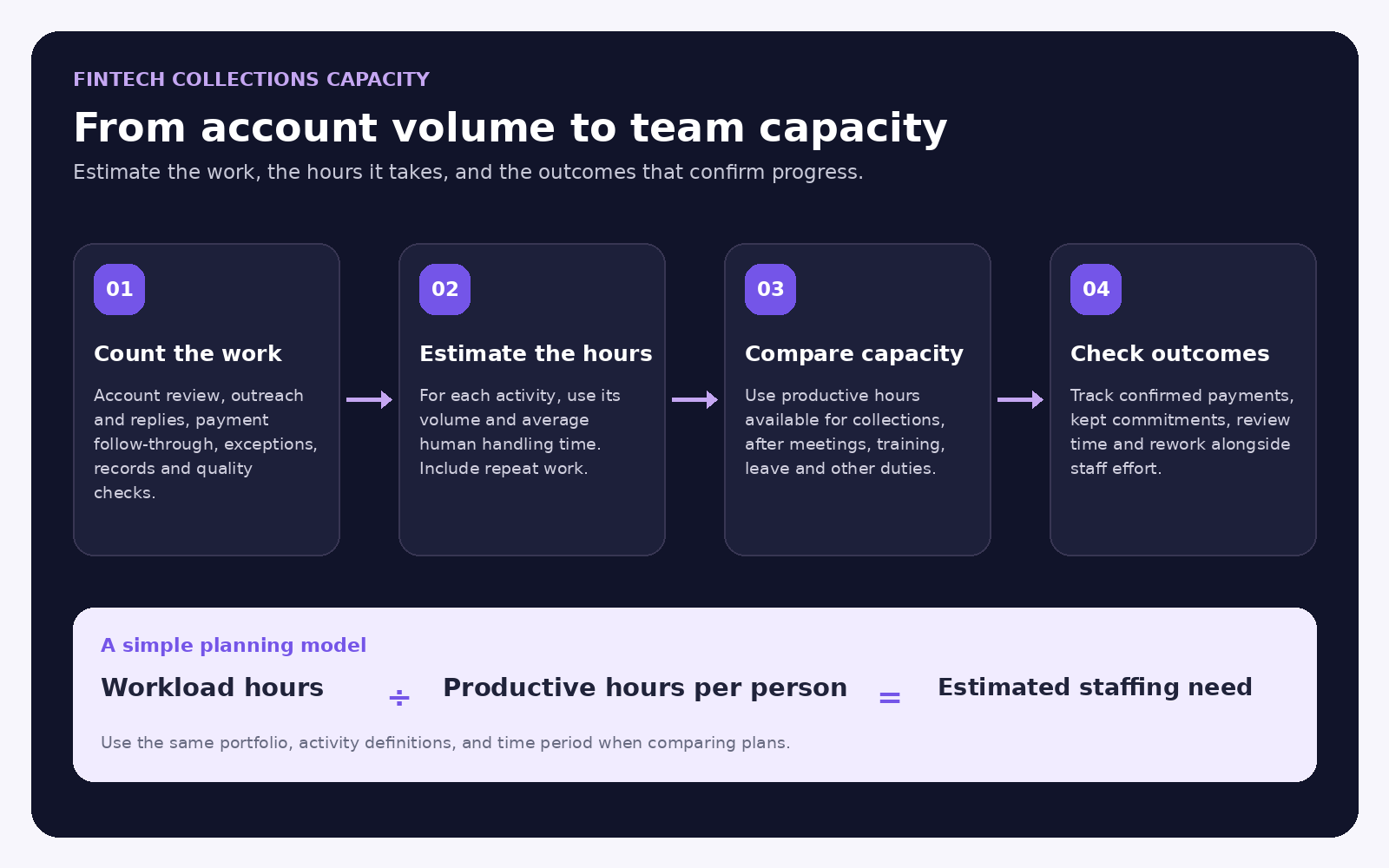
Use activity volume and the average human time each activity takes. Count repeat work too.
Estimated human workload hours = total of (activity volume × average human minutes per activity) ÷ 60
Estimated staffing capacity needed = estimated human workload hours ÷ productive hours available per person in the same period
Use your own operating data for activity volume, handling time, and available hours. Productive hours should reflect the time people can actually spend on this work after meetings, training, leave, and other assigned responsibilities. Do not treat paid hours as if every hour is available for account handling.
This is a planning model, not an industry benchmark. Define the period, portfolio, and activity types before comparing results. If a workflow changes, record what changed so the comparison remains useful.
What does a sample week translate to in staffing hours?
Here is a hypothetical week using distinct staff-handled activities. The figures illustrate the calculation. They are not industry averages.
| Staff-handled activity | Weekly volume | Average time | Workload hours |
|---|---|---|---|
| Account reviews | 300 | 2 minutes | 10.0 |
| Customer response handling | 500 | 3 minutes | 25.0 |
| Payment follow-up | 100 | 4 minutes | 6.7 |
| Exception review | 60 | 8 minutes | 8.0 |
| Total | 960 tasks | 49.7 hours |
At an illustrative 25 productive collections hours per person that week, 49.7 ÷ 25 = 1.99, or about two people’s weekly capacity. This is a workload illustration, not a staffing recommendation. Replace the volumes, handling times, and available hours with your own data. Count each staff-handled activity once, and use the same definitions when comparing periods.
How should leaders compare capacity scenarios?
Compare the current process with possible changes using the same portfolio scope and measurement period. Include staff effort, verified outcomes, and any review or rework that remains.
| Scenario | What to compare |
|---|---|
| Current workflow | Human hours, completed activities, repeat work, and confirmed payment outcomes |
| Collector-supported automation | Human time spent preparing, reviewing, correcting, or completing work after AI support |
| Approved routine automation | Work completed without staff action, exceptions routed to people, and confirmed outcomes |
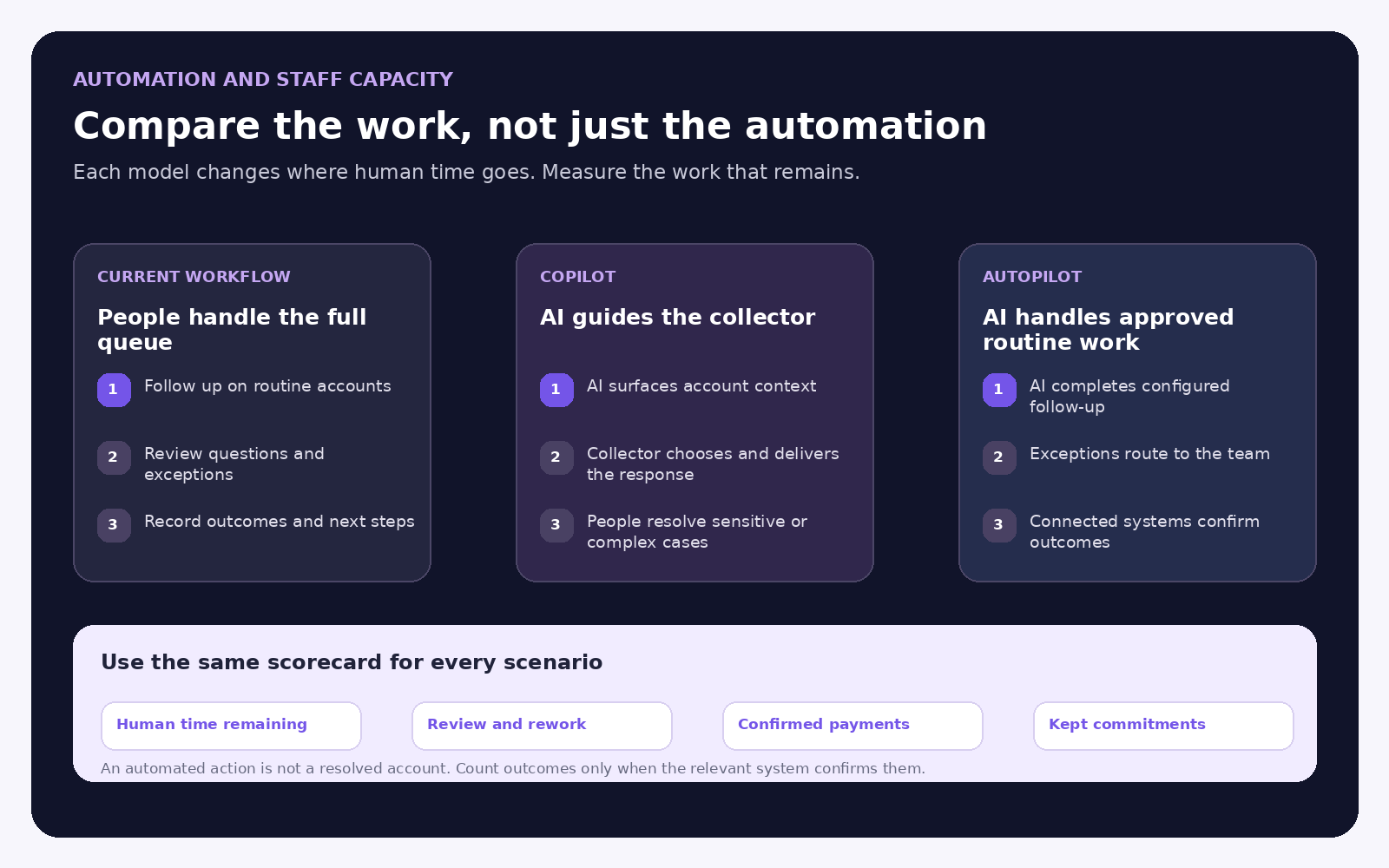
Do not count an automated activity as capacity gained just because the system initiated it. Check whether a person still had to review the result, repeat the contact, verify a payment, or update the account. Keep released staff time separate from cash savings. Time may create room for more work without reducing payroll or operating expense.
Qualitative feedback points to the same evaluation questions. A Reddit discussion about AI collection agents asked what work can realistically be automated, where collectors add value, and how exceptions are handled. G2’s broader credit and collections reviews surface interest in workflow visibility and automation, alongside concerns about integrations, reporting, implementation complexity, and system performance. These are directional signals, not fintech-specific benchmarks. Reddit discussion · G2 category reviews
Which metrics show whether collections capacity is improving?
Pair workload measures with outcome measures. Useful indicators include:
- Human minutes per resolved account
- Human review time per confirmed payment
- Repeat contacts and rework
- Staff review volume and time to complete a review
- Kept payment commitments and confirmed payments
- Cost per verified recovery
Compare like with like. Results should be separated by relevant loan product, workflow, and period. Track how each metric is defined, and avoid comparing a payment attempt in one period with a confirmed payment in another.
For portfolio reporting, FinanceOps Dashboards can help teams review activity and outcomes across agreed workflows.
How can FinanceOps support capacity planning?
FinanceOps connects configured collections work with account context, customer conversations, payment follow-up, and recorded outcomes. The lender defines the workflow and the actions that require staff review.
Strategy Builder lets teams configure approved workflows. Autopilot carries out configured routine work, while Copilot gives collectors account context and guidance. Agentic Payments connects payment follow-up with payment status and reconciliation.
For a broader view of how these capabilities apply to lending portfolios, see the FinanceOps Fintech solution page.