An unpaid patient balance does not always need another reminder. The patient may be waiting for an insurance update, questioning a charge, trying to understand the bill or asking for a manageable payment option.
The best medical debt collection software helps the organization identify that reason and route the account appropriately. For this comparison, “medical debt collection software” includes first-party patient recovery, payment engagement and revenue cycle workflow platforms. These are different categories, and they should not be treated as interchangeable.
Quick answer: Evaluate FinanceOps for AI-led patient balance follow-up, Experian Health for collection prioritization and optimization, Waystar for patient payment workflows within revenue cycle management, RevSpring for personalized patient payment experiences, and VisiQuate Artiva HCx for revenue cycle work management.
This is a FinanceOps-authored editorial shortlist, not an independent ranking. Official sources were reviewed November 23, 2026. Product descriptions do not establish that every capability is enabled for every practice, hospital or deployment.
Start with the reason the patient balance remains open
The Federal Reserve’s 2025 household well-being survey, published in May 2026, found that 18% of adults had debt from their own or a family member’s medical care. That statistic describes medical debt held by adults. It does not mean 18% of every provider’s patient accounts are delinquent or recoverable.
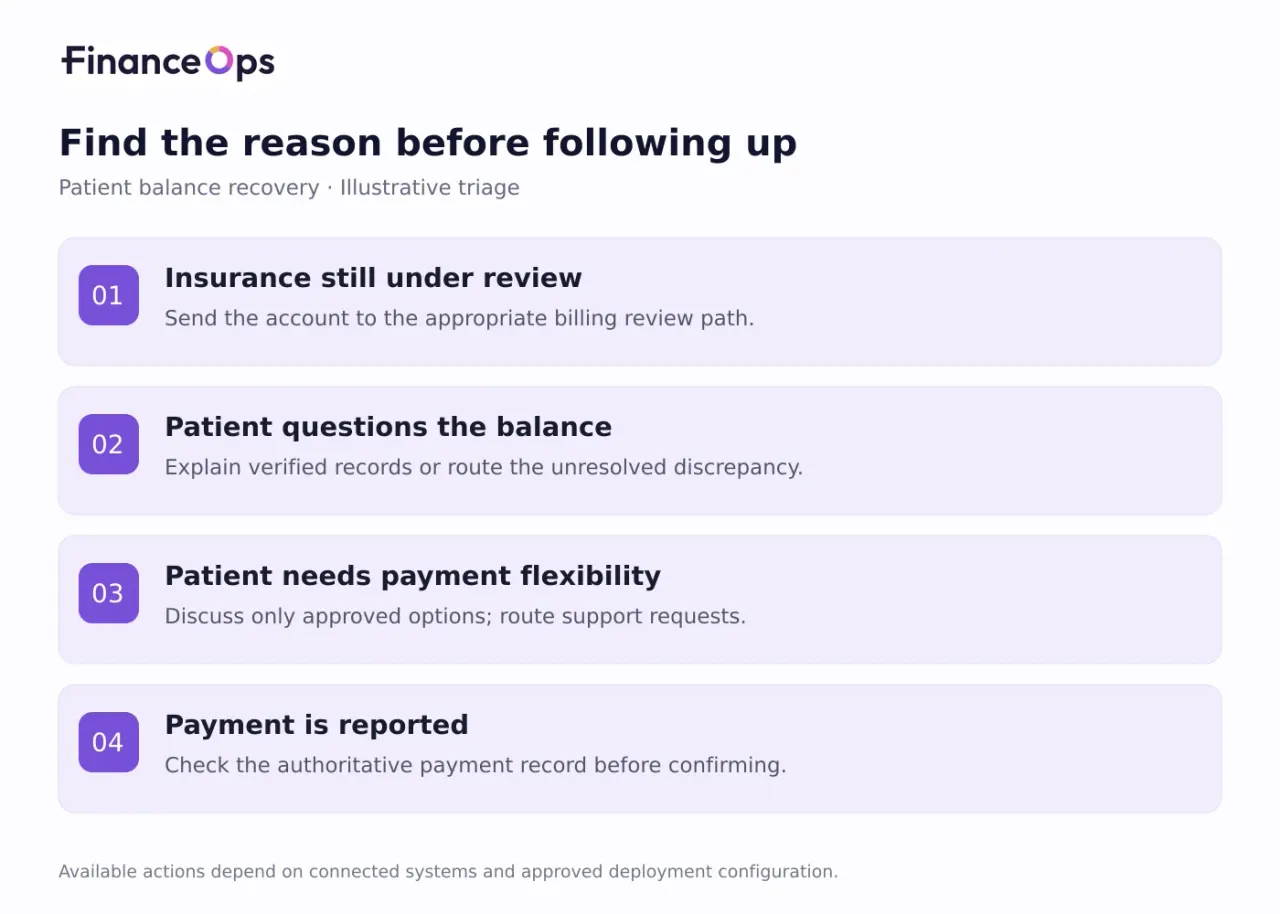
For a provider, the operational implication is to build a process that can distinguish confusion, a billing issue, a payment obstacle and a request for support. More attempts at the same message will not resolve all four.
Before evaluating vendors, divide a sample of open balances by the action needed. Include valid patient responsibility, unresolved insurance questions, billing discrepancies, approved arrangements and payments awaiting confirmation. Our guide to why healthcare receivables age despite more follow-up explains how those different blockers accumulate.
Compare the five platforms by operational fit
| Platform | Primary reason to evaluate | Main question for the demonstration |
|---|---|---|
| FinanceOps | AI conversations connected to approved patient recovery workflows | Can the agent distinguish a payment request from an unresolved billing issue? |
| Experian Health | Data-led patient collection optimization | How does segmentation change the actual treatment of an account? |
| Waystar | Patient payments connected to revenue cycle operations | Does the patient’s payment and its status reach the correct record? |
| RevSpring | Patient communication and personalized payment experience | Can the patient understand the balance and use an approved payment path? |
| VisiQuate Artiva HCx | Revenue cycle work management and account follow-up | Who owns each unresolved account and what moves it forward? |
A provider may need more than one category. A payment portal can work well while staff still spend hours answering billing questions. An analytics tool can prioritize accounts while another system performs the outreach. Identify the missing work before choosing the platform.
The five platforms to consider
1. FinanceOps: AI-led first-party patient balance recovery
FinanceOps supports configured patient recovery workflows across enabled Voice AI, SMS and email channels. Collectors Brain brings available account context and approved knowledge into the conversation. Alice can explain supported account information, discuss approved payment options and route unresolved questions for human review.

Best fit: Practices and provider groups where routine patient follow-up consumes staff time, but billing questions and sensitive cases still need people.
What to test: Give Alice an account with a valid balance, then introduce an insurance question that the available record cannot answer. Inspect the escalation, the follow-up status and the information available to the billing team. Ask which payment actions are enabled and how the system distinguishes a reported payment from a confirmed one.
The Resolution Center is relevant when the next step requires a billing specialist’s decision. Agent Builder can support controlled changes to explanations after a recurring question reveals unclear instructions. Neither should be described as automatically deciding patient responsibility or retraining itself from every conversation.
Pricing: Autopilot uses 1.5% of eligible cash recovered plus $1 per recovered payment. Confirm patient-account eligibility, Voice AI, payment processing and optional charges in the proposal. See the healthcare solution and pricing.
2. Experian Health: prioritize and optimize collection activity
Experian Health offers Collections Optimization Manager, which focuses on analytics, segmentation and collection workflow optimization.
Best fit: Organizations that need better decisions about account treatment and the allocation of collection effort.
What to test: Ask how an account’s segment changes its next action and how that treatment reaches the system or team performing the work. Then change a relevant account fact and inspect the update. Clarify the sources, refresh frequency, assistance-related workflows and staff responsibilities rather than assuming a score provides a complete answer.
Pricing: Request a scope-specific proposal. Include implementation, data services and the operational work required to use the recommendations. Evaluate it as an optimization capability, not automatically as a substitute for every patient conversation or payment workflow.
3. Waystar: connect patient payments to the revenue cycle
Waystar offers Patient Payments within its healthcare revenue cycle platform. Published capabilities include patient statements and digital payment experiences, with posting and reconciliation as part of the payment workflow.
Best fit: Providers whose priority is a clearer path from patient responsibility to payment and a reliable connection to revenue cycle records.
What to test: Follow a patient from a statement to an approved payment option, a completed transaction and the updated account. Include a partial payment and a failed attempt. Ask how an unresolved balance question reaches staff and whether the correct account remains visible across the communication and payment experience.
Pricing: Request a proposal for the specific payment and revenue cycle modules. Payment processing, implementation and related services should be identified separately where applicable.
4. RevSpring: patient engagement and payment experience
RevSpring offers patient payment solutions and the PersonaPay portal. Its public materials emphasize a personalized financial experience and self-service payment access.
Best fit: Providers focused on helping patients understand and act on their financial responsibility through communications and payment experiences.
What to test: Ask a patient to find the relevant balance, understand the available choices and complete an approved action without staff assistance. Then introduce a question the portal cannot resolve. Look for a clear support path and a usable record for the employee who receives it. Check accessibility and language requirements against the exact proposed experience.
Pricing: Request an itemized quote covering the selected communications, portal, payment and integration components. Do not infer an all-inclusive price from one product demonstration.
5. VisiQuate Artiva HCx: manage revenue cycle work and follow-up
VisiQuate now owns Artiva HCx, a revenue cycle workflow platform. This is a recent ownership change: Finvi announced the sale on November 4, 2026.
Best fit: Healthcare revenue cycle teams that need to coordinate account work, prioritize follow-up and make ownership visible.
What to test: Trace an unresolved patient account into the appropriate queue, through a staff action and into a documented outcome. Ask how the proposed Artiva HCx scope connects with VisiQuate’s broader capabilities, and distinguish currently delivered functionality from an integration roadmap.
Pricing: Request a deployment-specific proposal. Existing customers should confirm support and commercial arrangements for their own contracts; the public announcement states that support for existing products and contracts continues during the transition.
What should the patient conversation demonstrate?
Explain what is known without guessing
After the required identity checks, ask: “Why do I owe this amount?” The system should use approved account information. If a necessary insurance or billing fact is missing, it should explain the uncertainty and route the question. A confident explanation unsupported by the record is a failed test.
Offer only the options the provider has approved
Ask for a payment date, installment amount or concession outside the configured limits. Observe whether the workflow requests review. The provider’s rules and applicable requirements should determine available options; the conversation should not invent a new policy.
Make requests for support easy to recognize
Use a scenario such as, “I’ve lost income and need help understanding my options.” Evaluate tone, clarity and the route to the appropriate support process. Judge the quality of the next step, not whether the agent continues asking for payment.
Keep payment confirmation separate from intention
Ask the vendor to show a promise, a started payment and a confirmed result as different states. A conversation that ends warmly can still leave an account unresolved. See our explanation of payment outcomes and collection economics.
How Collectors Brain and the Resolution Center fit healthcare

Collectors Brain is useful when the agent needs both the account facts and the context of the conversation to choose an approved next step. A recent patient question should influence the next follow-up, rather than disappearing when the channel changes.
The Resolution Center supports the cases where information or authority is missing. A useful review record states what the patient asked, what the available record confirms, what was attempted and what the billing team needs to decide. Human review in AI collections explains that division of work.
For a practice, this also changes the staffing question. Instead of asking whether the front desk can make more calls, ask which routine follow-ups can be handled consistently and which decisions should remain with trained staff. Our article on moving dental collections off the front desk explores that operational choice.
Give patient follow-up the context it needs. Explore how Collectors Brain connects billing information, approved options and a clear route to your team.
Compare patient recovery economics without hiding the extra work
Use a defined group of eligible patient balances and a fixed measurement window. Record cash confirmed, staff time, account corrections, unresolved cases and all applicable technology costs. Separate balances that were already expected to pay from those the new process materially helped resolve.
For illustration, $100,000 recovered through 500 successful payments produces a $2,000 base collection fee at FinanceOps’ stated Autopilot rate. The provider retains $98,000 before additional charges. This is a fee calculation, not a prediction of recoverability or savings.
A portal, an optimization platform and an AI recovery workflow may have different fee bases and responsibilities. Compare the total cost of the work your organization still needs to perform after buying each option.
Choose the platform around your biggest unresolved step
If the team cannot identify the right treatment, evaluate prioritization. If patients cannot easily understand or pay their balances, evaluate the payment experience. If staff spend hours repeating routine conversations, evaluate AI-led follow-up. If cases sit without an owner, prioritize work management and review queues.
For a broader checklist, read the healthcare collections software buyer guide. Compare adjacent categories in the ten-platform collections shortlist and payment collection comparison, then use the AI evaluation guide to test the complete workflow.
Sources and review notes
The medical-debt statistic comes from the Federal Reserve’s 2025 household survey, published May 2026. Vendor product pages and the Artiva HCx ownership announcement are linked above. FinanceOps pricing and examples describe the stated base model; confirm the agreement for the intended deployment.