A failed payment and an unresolved account are not always the same problem. A bank debit may need a better retry time. An invoice may be missing a purchase order. A customer may want to pay but need an approved arrangement. Another may dispute the amount entirely.
That is why comparing payment collection platforms requires more than a list of reminder features. The right product depends on where the payment journey stops and what work is needed to continue it.
This guide compares FinanceOps, Stripe Billing, Chargebee Receivables, GoCardless Success+ and Upflow. They overlap in parts of the payment and receivables process, but they are not five identical replacements for one another.
Quick answer: Start with Stripe Billing for subscription billing and payment recovery within Stripe, GoCardless Success+ for eligible failed bank-payment retries, Chargebee Receivables or Upflow for receivables workflows, and FinanceOps for first-party AI conversations connected to approved recovery actions and human review.
FinanceOps authored this guide and is included in the comparison. The shortlist reflects use-case fit from official sources reviewed November 23, 2026. It is not a controlled performance ranking or a claim that a payment processor and a collections platform have identical responsibilities.
Identify the point where payment recovery gets stuck
Start by reviewing a sample of failed or overdue accounts. For each, record the next useful action. That might be a permitted retry, a payment-method update, an invoice correction, a conversation about approved options or specialist review.
The Federal Reserve’s 2025 household well-being survey, published in May 2026, found that 16% of adults did not pay all their bills in full in the month before the survey. For credit cards, the survey treated paying the minimum as paying that bill in full. The statistic describes household financial strain, not the failure rate of any payment platform.
For buyers, it is a reminder that technical retries will not resolve every unpaid account. Some customers need clarification or support. Some balances need correction. Read our guide to why failed payments are a CFO-level revenue problem for the broader operating implications.
Compare the five platforms by the job they perform
| Platform | Primary job to evaluate | Pricing basis to investigate | Important boundary |
|---|---|---|---|
| FinanceOps | First-party AI recovery and approved account actions | Eligible recovered cash plus recovered payment count | Confirm eligibility and additional voice, processing and service charges |
| Stripe Billing | Subscription billing and payment recovery in the Stripe environment | Billing plan and volume, with payment-processing charges separately assessed | Billing and processing do not automatically replace every collections workflow |
| Chargebee Receivables | Receivables follow-up, context and workflow management | Receivables-specific scope and commercial proposal | Confirm which functions belong to Receivables versus other Chargebee products |
| GoCardless Success+ | Intelligent retry of eligible failed bank payments | Regional plan and payment terms | Not every failure is eligible for automated retry |
| Upflow | B2B receivables workflows, insights and payments | Published plans based on annual invoiced revenue; confirm scope | Compare against the B2B workflow and integration needed |
The table does not declare any platform the cheapest. A fee applied to all billing volume and a fee applied only to eligible recovered overdue cash have different denominators.
The five platforms and their strongest use cases
1. FinanceOps: handle the conversation behind the overdue balance
FinanceOps is relevant when recovery requires an account-aware conversation and an approved next action. Alice supports enabled Voice AI, SMS and email workflows, with Collectors Brain bringing available account context and approved guidance into the interaction.

Best fit: Teams handling overdue first-party balances where customer replies regularly create manual work.
What to test: Ask the agent to explain supported account information, discuss an approved payment option, handle an unconfirmed payment and route a dispute. Inspect the result in the connected system and the information sent for review. The Resolution Center should be part of the test when a person needs to decide the next step.
The platform should be evaluated for the work it performs around recovery. Do not assume it replaces the payment processor or every component of the billing stack. Our agentic payments guide explains the connection between conversation and action.
2. Stripe Billing: subscription billing and payment recovery
Stripe offers Billing with subscription management and revenue recovery capabilities, including Smart Retries. Its feature overview describes billing functions that are especially relevant to businesses already operating in the Stripe ecosystem.

Best fit: Businesses whose primary need is to manage recurring billing and recover eligible payment failures within that environment.
What to test: Run a failed subscription payment through the configured retry and customer-notification process. Then introduce a disputed amount or a request outside standard billing rules and identify the team or system that handles it.
Pricing: Use the current Stripe Billing pricing page for the applicable plan and region, and include payment-processing charges. Keep Billing fees separate from other Stripe products when building a comparison. A processor-level fee should not be presented as the full cost of every collection activity.
3. Chargebee Receivables: receivables context and collection workflows
Chargebee offers Receivables for collection workflows, account context and follow-up. Its published capabilities include AI-related handling of customer replies and receivables work, so reducing it to scheduled reminders would be misleading.
Best fit: Finance teams that want to coordinate outstanding receivables, customer responses and collection activity.
What to test: Provide an overdue invoice and a reply saying the amount does not match the agreement. Ask how the relevant billing context is surfaced, what action is proposed and where approval is required. Inspect the resulting workflow rather than only the generated response.
Pricing: Request Receivables-specific commercial terms. Do not assume a publicly displayed subscription-billing plan includes the exact receivables functionality shown in a demo. Include integration, implementation and ongoing workflow ownership in the evaluation.
4. GoCardless Success+: retry eligible failed bank payments
GoCardless provides bank-payment services, including Success+ intelligent retries. Its support documentation specifies that retry eligibility depends on the reason a payment failed.
Best fit: Organizations whose recovery problem includes eligible failed bank payments that can be retried under the relevant authorization and scheme rules.
What to test: Compare an insufficient-funds failure with a cancelled mandate or closed account. The official eligibility guidance makes clear that not all failure types belong in the same retry path.
Pricing: Review the applicable regional plan and Success+ terms. Confirm what happens when a failure is ineligible or retries do not resolve it. A technical retry mechanism should not be treated as a substitute for resolving a disputed bill or an unsupported customer request.
5. Upflow: coordinate B2B receivables work
Upflow describes B2B receivables capabilities spanning collection workflows, insights, payments and cash application. It is relevant when the finance team needs to connect account visibility with consistent follow-up and payment handling.

Best fit: B2B teams seeking a coordinated receivables process around their existing accounting and payment environment.
What to test: Introduce an invoice missing customer approval, a promise to pay and a completed payment without clear remittance. Ask how the next owner is identified and how the account becomes reconciled. Establish what staff still need to do outside the product.
Pricing: The published pricing page describes plans based on annual invoiced revenue. Confirm the capabilities in the proposed plan and any separate payment or implementation costs. Use the same annual period and operational scope when comparing with other models.
Why payment states belong in the comparison
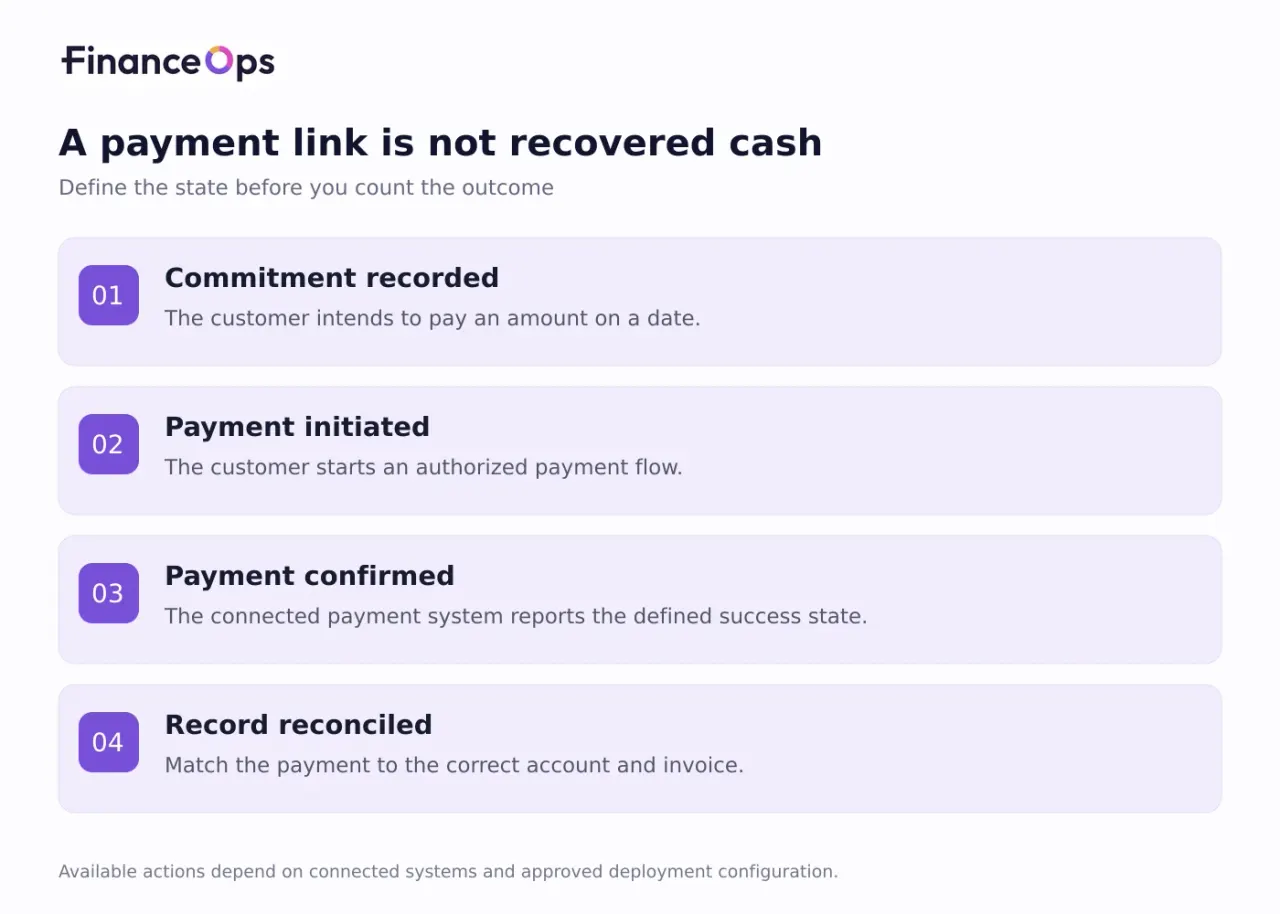
A commitment is not a transaction
The customer may intend to pay on Friday. That is useful information for follow-up, but it is not recovered cash. Record the amount, date and context without changing the payment ledger as though money arrived.
A started transaction is not always a completed payment
A customer can open a link or begin a payment flow without completing it. An API can time out while the payment system continues processing. The workflow needs a reliable way to establish status before retrying or confirming success.
A confirmed payment still needs the right account match
The money must be associated with the appropriate account, invoice and accounting record. A dashboard total that cannot be reconciled leaves finance staff with unresolved work. Our guide to payment commitments and account tracking describes these distinctions.
Where Collectors Brain, Agent Builder and human review add value

Collectors Brain is relevant when the next action depends on what the customer said and what the records show. An account with a new dispute should not receive the same treatment as one with a valid commitment due tomorrow.
The Resolution Center gives people a place to work on cases that require judgment or missing information. Agent Builder supports controlled improvements when an approved explanation is unclear or a response needs correction. The process is to propose, test and authorize a change, not to assume that every conversation automatically changes production behavior.
These capabilities should be demonstrated together. Ask the agent to stop on an unresolved issue, show the case to a staff member, and then show how a reviewed instruction improvement is tested before release. For the full model, read how Collectors Brain works.
What happens between a reply and a resolved balance? Explore how Collectors Brain guides approved actions while keeping commitments separate from confirmed payments.
Calculate retained cash with the same assumptions
At the stated FinanceOps Autopilot base rate:
Base collection fee = 0.015 × eligible recovered cash + $1 × recovered payment count.
| Illustrative recovery | Successful payments | Base collection fee | Retained before other costs |
|---|---|---|---|
| $100,000 | 200 | $1,700 | $98,300 |
| $100,000 | 500 | $2,000 | $98,000 |
| $100,000 | 1,000 | $2,500 | $97,500 |
The same recovered cash can produce a different fee when the payment count changes. Installment frequency therefore matters. These calculations exclude separately applicable Voice AI, processing and optional-service charges.
The middle example supports “retain 98% before other costs.” It does not support “save 98%.” Savings require a documented baseline, comparable service scope and all applicable costs.
For every vendor, model the fee against its actual charging basis, then add the internal work that remains. That makes the comparison useful even when products charge in different ways.
Choose the missing capability, not the most familiar logo
Keep a working billing or payment system if it performs the required job. Add or replace the component that fails to move accounts forward. A technical failure may need retry logic. A customer question may need account-aware dialogue. A dispute needs the right review process.
Use the ten-platform collections shortlist for broader operational systems. For institution-specific requirements, see the credit union comparison or medical patient balance guide. Apply the AI collections evaluation guide before signing a proposal.
Sources and review notes
Sources include the Federal Reserve household survey, official product and pricing pages linked in each profile, and GoCardless retry eligibility guidance. All fee examples are arithmetic illustrations, not forecasts or claims of equivalent vendor service scope.