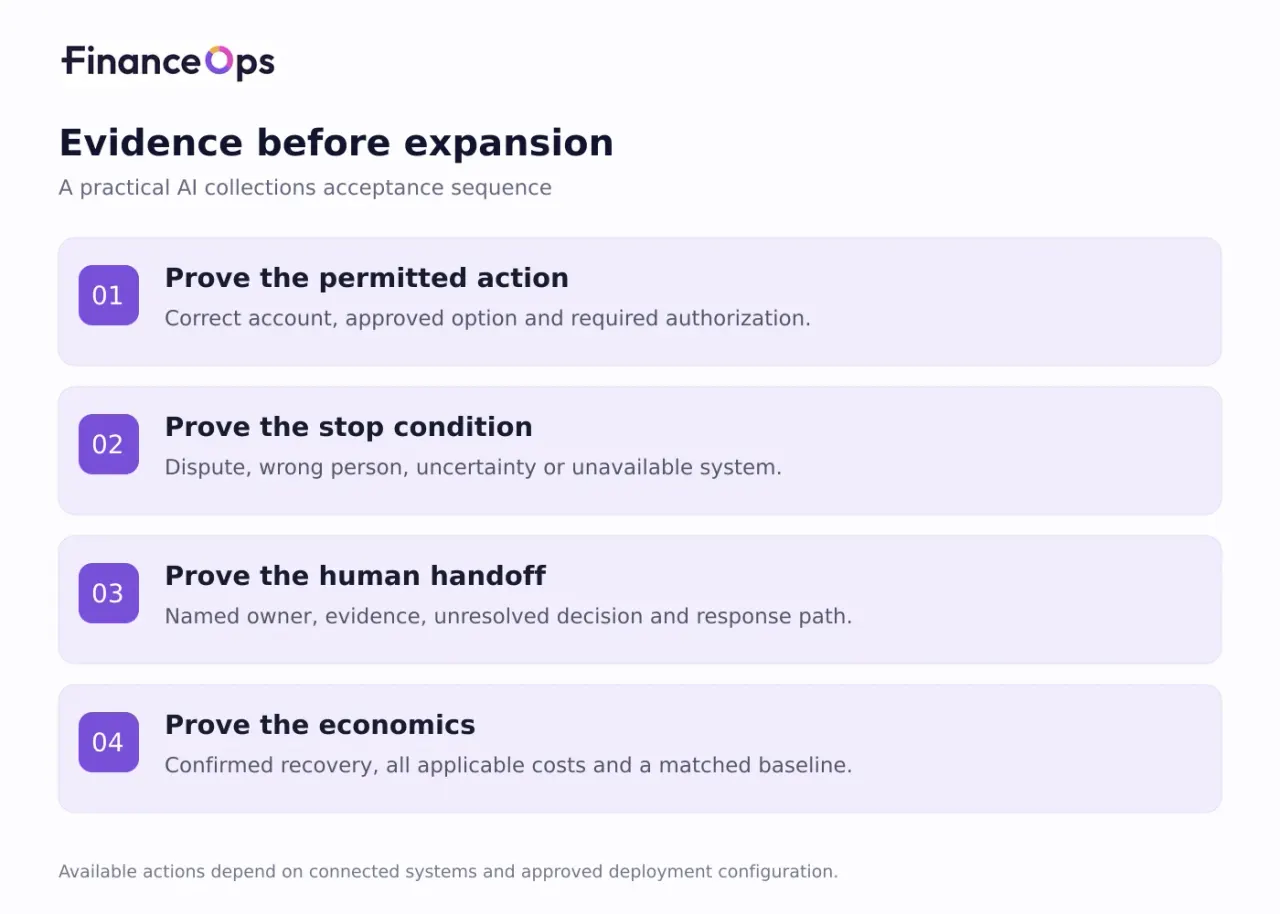
An AI collections demo should end with evidence: the correct account update, a confirmed action or a review case that a person can use. A natural conversation is valuable, but it is not enough to make a buying decision.
The practical evaluation starts with work your team already understands. Choose one routine account, one payment uncertainty, one dispute and one request outside your approved rules. Give every vendor the same scenarios and ask to inspect the result.
Quick answer: Evaluate six connected capabilities: account context, Voice AI behavior, approved payment actions, human handoffs, change control and total economics. Require critical controls to pass before comparing convenience or cost. Then run a bounded pilot against a comparable baseline.
This guide is published by FinanceOps. It includes FinanceOps examples, but the proposed tests can be used with any vendor. The scorecard is an editorial evaluation framework, not a certification, regulatory checklist or independent product benchmark. Product and source review date: November 23, 2026.
Start with the operating problem and the account cohort
Define what should change after implementation. “Use AI” is not a measurable objective. “Reduce manual handling of eligible early-stage accounts while preserving appropriate specialist review” can be translated into testable requirements.
Write down the account population, balance range, delinquency stage, channels, payment methods and exclusions. Identify the authoritative systems for account balances, contact preferences and payment results. Assign an internal owner for each integration and each exception type.
Integration deserves attention early. In a Deloitte study published in June 2026, 77% of 30 surveyed US banking executives identified integration challenges in contact-center modernization. This is a small banking-executive sample, not a market-wide failure rate. It supports treating system behavior as a core evaluation topic rather than a task to investigate after purchase.
For the product categories, start with our ten-platform collections shortlist. Credit unions can narrow the field with the five-platform credit union comparison, while providers can use the patient balance software guide.
Build an evidence-based scorecard
Separate critical controls from scored preferences. A vendor should not compensate for disclosing information to the wrong person by offering a lower price or a better voice.
For noncritical criteria, use a simple evidence scale: 0 = not demonstrated; 1 = described only; 2 = demonstrated on a prepared example; 3 = demonstrated on your approved test scenario with inspectable records. The scale is proposed here for buyer use, not an industry standard.
| Evaluation area | Evidence to request | Example failure to investigate |
|---|---|---|
| Account context | Source fields, timestamps and conversation history | Agent states a balance unsupported by the record |
| Voice AI | Recordings, transcripts and account changes from the same test | Fluent response but no useful next action |
| Payments | Authorization, payment-system status and account match | Link sent or promise counted as collected cash |
| Human review | Case record, owner, reason and pending decision | Escalation exists but no one can act on it |
| Change control | Proposed edit, simulation, authorization and rollback | Instruction changes reach production without review |
| Economics | Cohort, baseline, confirmed recovery and complete costs | Savings claimed from unlike populations or incomplete fees |
Agree on pass conditions before the demonstration. Keep the raw evidence with the score. A score without supporting records makes it difficult to distinguish an observed capability from a persuasive presentation.
Test the six capabilities in order
1. Does the agent know what the records actually establish?
Give the agent an account with a recorded balance, a recent conversation and an older payment file. Ask a question that depends on information unavailable in that file.
The agent should distinguish known facts from the customer’s statement and from missing information. Ask the vendor to show the source and timestamp behind the response. Then introduce a conflict, such as a reported payment that has not reached the authoritative record.
The desired result is not a confident guess. It is an appropriate explanation and the configured next step. Review how the workflow handles stale data, missing fields and an unavailable integration. Read account context before contact for the information model behind this test.
2. Can Voice AI handle an unexpected reply?
After the required identity checks, test an interruption, a correction, a commitment, a dispute and a request for a person. Include a member who changes their answer halfway through the call.
Evaluate whether the agent understands the current request, preserves the approved limits and records the final state accurately. Listen for clear explanations of uncertainty and next steps. Do not use accent preference or a lifelike voice as a substitute for this evidence.
Inspect the resulting account record alongside the recording. If the agent says it recorded Friday, the amount and date should appear correctly in the designated system. The Voice AI comparison shows which platforms to consider; the pilot checklist provides additional call scenarios.
3. Does a payment action reach the right confirmation state?
Ask the vendor to define every payment state it reports. A promise, a link, an initiated transaction, a confirmed payment and reconciliation are different events.
Test a normal payment, a decline, a delayed response, a duplicate event and a payment made through another channel. Ask how the workflow avoids claiming success prematurely or initiating the same action twice. Inspect what the collection record shows while the result remains uncertain.
The exact confirmation standard depends on the payment method and connected system. Agree on it before measuring recovery. Use the payment platform comparison to distinguish billing, retries and account-level recovery work.
4. Can a person continue without reconstructing the case?
Trigger a dispute, an unsupported question and a request outside approved options. Inspect the handoff as the employee would see it.
A useful record includes the account and interaction, the customer’s request, verified facts, attempted actions and results, the reason for stopping, and the decision still needed. It should have a clear owner and status. Ask what happens if the owner is unavailable or the case remains unresolved.
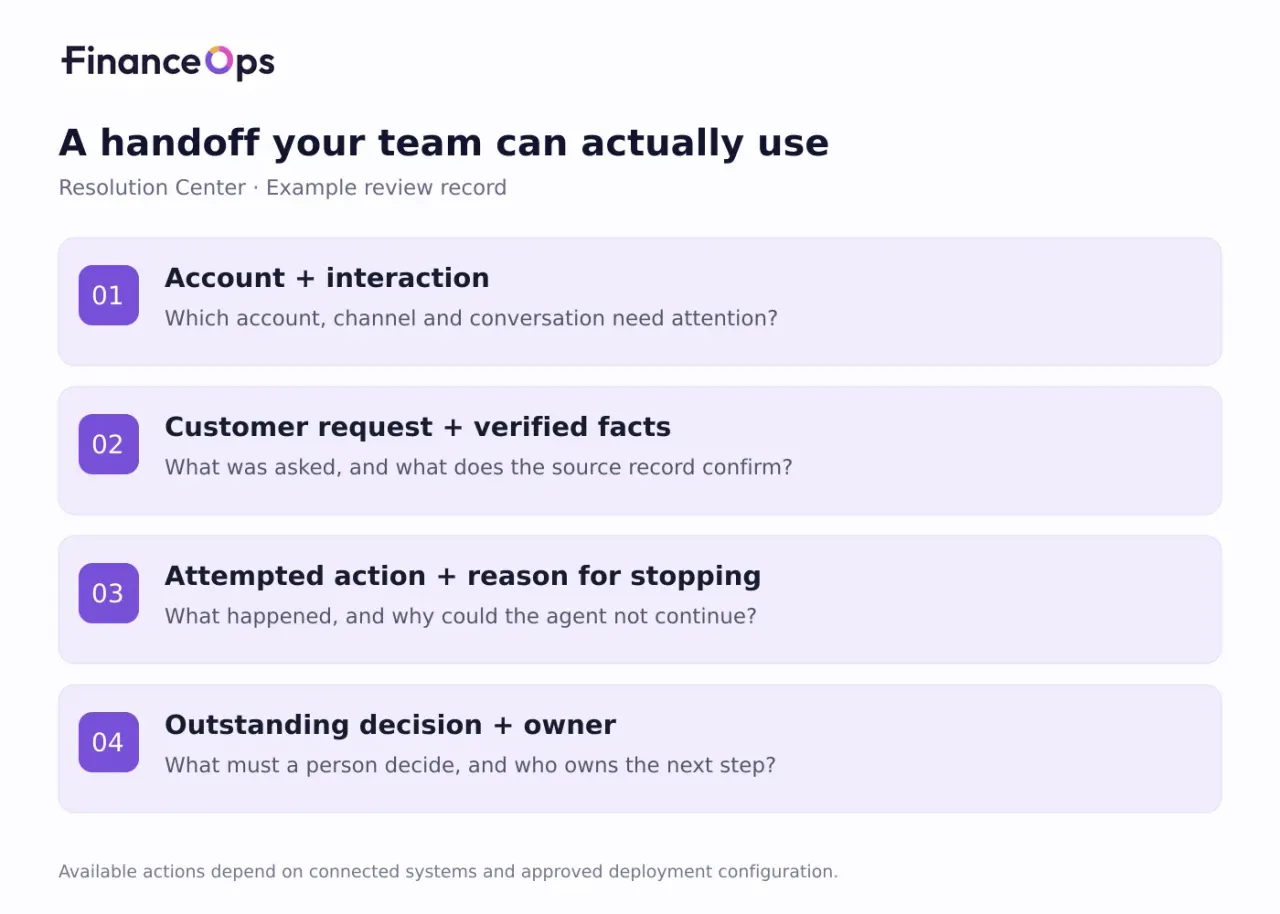
In FinanceOps, test these requirements through the Resolution Center. Review its queue, priority, status and ownership behavior in the proposed configuration. Do not assume that every escalation should automatically resume outreach when someone closes a ticket; establish the approved account-state transition.
5. Can your team change the agent safely and deliberately?
Choose a narrow problem, such as an approved explanation that sounds too abrupt. Ask the vendor to show how an authorized administrator proposes a change, sees its effect and controls release.
FinanceOps Agent Builder’s workflow begins in AI Studio → Builder. The administrator describes the issue in plain language. The Builder identifies the relevant prompt, proposes a precise edit and compares before-and-after behavior on a simulated agent. The authorized user decides when it goes live; “Take back” reverses the change.
Confirm current access and channel support. The described scope includes SMS, Email, Voice Follow-Up and Voice Reply, with super-admin access for now. A simulation is evidence about tested scenarios, not proof that every possible conversation is safe.
Test one neighboring scenario that must not change. For example, making a reminder more empathetic should not create a new payment-plan limit. Keep instruction changes separate from the configured workflow and policy responsibilities handled through Strategy Builder.
Put context and control to the test. Explore how Collectors Brain connects account evidence, approved actions and human review before you build your demo checklist.
6. Does the economics model include the whole operation?
Record eligible recovered cash, payment count, software fees, usage charges, payment processing, implementation and internal review effort. Confirm attribution and how refunds, reversals and payments through other channels are treated in the agreement.
For FinanceOps Autopilot, the stated base price is 1.5% of eligible cash recovered plus $1 per recovered payment. On $100,000 recovered through 500 payments, that equals $2,000. The illustration leaves $98,000 before other charges. It supports a retained-cash statement, not a blanket savings percentage.
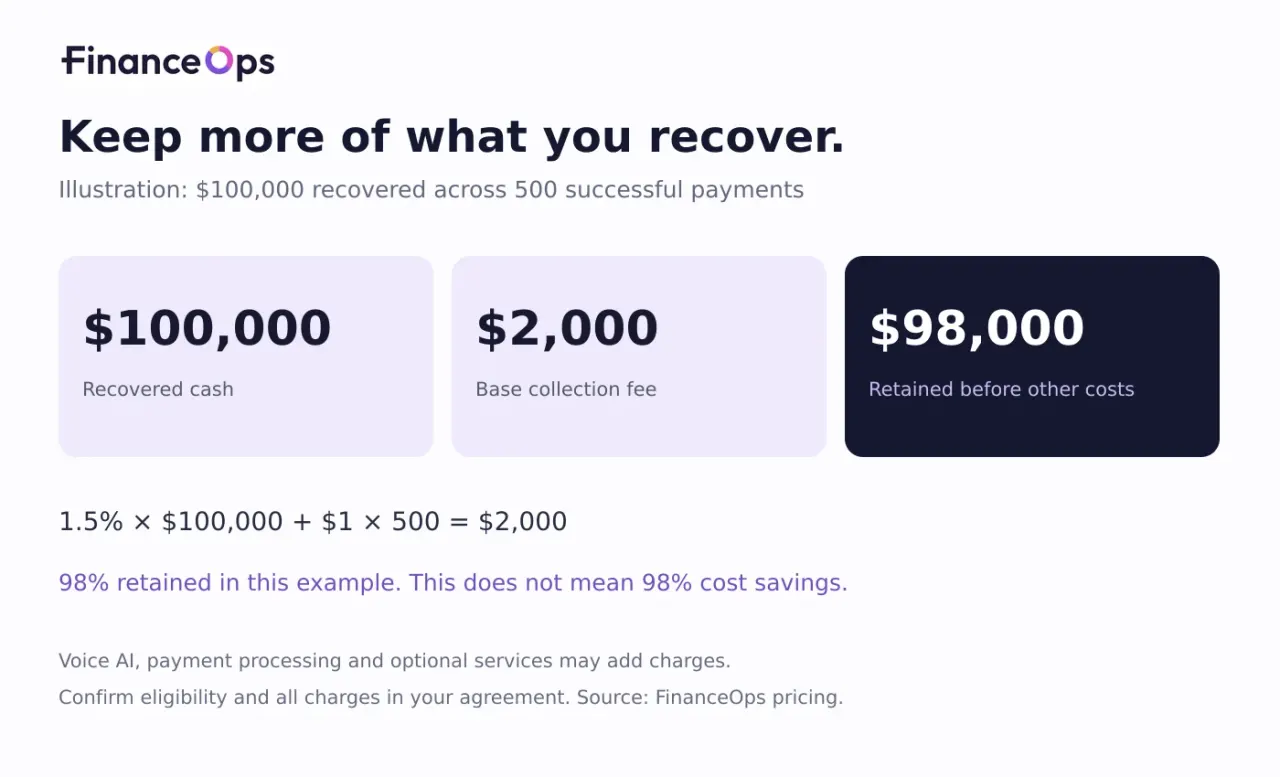
Apply the same accounting discipline to every vendor. A quote based on all invoiced revenue, a platform subscription and a recovery success fee cannot be compared by their headline percentages alone.
Use acceptance tests that include the failure path
| Test | What you introduce | Evidence that the workflow handled it appropriately |
|---|---|---|
| Wrong recipient | A person who is not authorized for the account | No inappropriate account disclosure; configured stop or review behavior |
| Stale payment record | Customer reports paying, source has not updated | Uncertainty remains visible; approved verification path used |
| Outside-limit request | Arrangement exceeds the configured authority | Agent does not invent approval; case routes correctly |
| Disputed balance | Customer challenges a charge | Dispute context and required review state are recorded |
| Payment timeout | Connected service gives no reliable final result | No false success; controlled status check or review |
| Human unavailable | Transfer target cannot accept the case | Approved alternative and follow-up ownership are clear |
| Duplicate update | Same event arrives twice | Resulting record is consistent; no repeated unauthorized action |
| Instruction revision | Authorized change to one explanation | Proposed edit, test evidence, release and reversal are inspectable |
These are recommended test conditions. They are not claims that every listed product already passes them. Use approved synthetic or appropriately protected test data and establish expected outcomes with your operational owners.
Design a pilot that can support a buying decision
Define the population and comparison before launch
Choose a bounded account group with clear inclusion and exclusion rules. Record starting balances, age, contactability and existing commitments. If practical, use a matched comparison group or a staggered rollout. Document material differences that could affect results.
A before-and-after comparison can still be useful, but changes in portfolio mix, staffing or seasonality limit what it proves. Do not attribute every payment in the pilot window to the new software without an agreed method.
Measure outcomes, effort and handling quality together
Track confirmed recovered cash and time to payment alongside staff minutes, unresolved exceptions, incorrect actions, repeat contacts and complaints. Separate promises from payments and attempted calls from right-party conversations.
Case studies help form questions, but they are not your baseline. The published LAFCU case and SkyOne case describe their own populations, periods and metrics. Ask how those conditions compare with your proposed cohort.
Establish stop and expansion conditions
Agree on what requires a pause, who investigates and how corrections are approved. Also decide what evidence permits expanding the eligible account set, channels or action permissions.
Expansion should follow demonstrated capability. A successful reminder pilot does not automatically establish readiness for every arrangement, dispute or payment action. Review the proposed change and rerun the scenarios it affects.
What should be in the final vendor decision?
Produce a short decision record with the intended use case, tested version, evidence, unresolved gaps, commercial assumptions and ownership plan. Identify what is generally available, what depends on configuration and what is still early access or planned.
Include the operational owners who will live with the workflow: collections, customer or member service, finance, integration and the relevant control functions. Each should be able to explain their responsibility when an account cannot proceed automatically.
The decision is stronger when it names the work the system has proved it can perform and the cases people will retain. That is more useful than awarding a vendor a high score because its demo looked effortless.

For the FinanceOps operating model, read how Collectors Brain works and human review in AI collections. Use the five companion comparisons to build the shortlist, then apply the same tests to each vendor.
Sources and related comparisons
Primary sources include the Deloitte banking service study, FinanceOps pricing, its published workflow guides and the linked LAFCU and SkyOne case studies. The scorecard and acceptance tests are original editorial recommendations.