Fintech lending teams rarely run out of ways to send a payment reminder. The harder problem is knowing whether a payment is actually overdue, which accounts deserve attention, which actions are permitted, and whether the money eventually reaches the ledger.
Consider a digital lender with 50,000 active loans. A customer misses an installment. The processor reports an ACH return, the servicing system still shows the original balance, and a message arrives: “My bank already took the money.” A conventional reminder sequence can continue contacting the borrower while the payment operations team investigates. AI collections software is useful only if it can connect those events and select an appropriate next step.
This buyer's guide helps fintech CFOs, COOs, Heads of Risk, and lending operations teams evaluate AI collections software for fintechs using real deployment criteria: integrations, recovery economics, communication controls, payment arrangements, data security, and a measurable pilot.
What should fintechs look for?
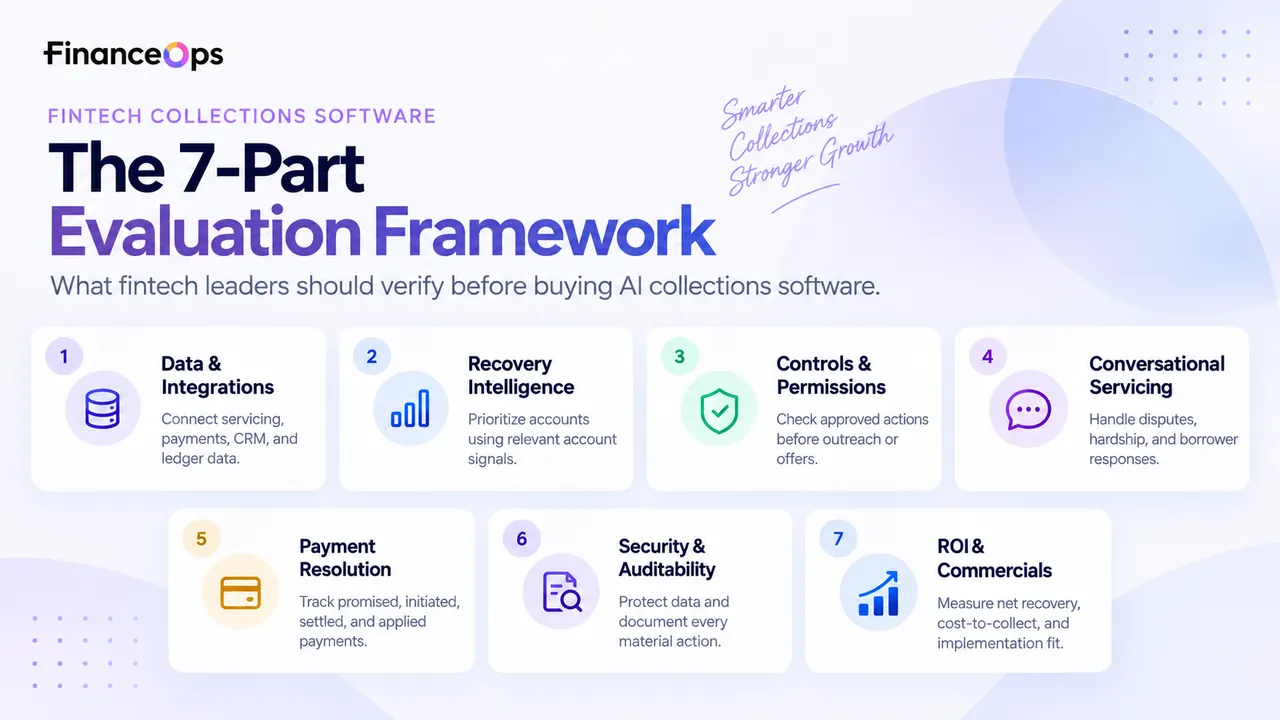
Evaluate vendors on seven capabilities:
- Account state accuracy: Can the platform distinguish overdue, pending, returned, disputed, settled, and applied payments?
- Intelligent prioritization: Does account scoring use relevant signals without misrepresenting scores as payment probabilities?
- Governed execution: Are communication permissions, treatment rules, and escalation decisions checked before actions?
- Two-way borrower servicing: Can customers dispute an amount, explain hardship, and request an approved arrangement?
- Payment follow-through: Can the platform verify commitments, returns, partial payments, and ledger reconciliation?
- Integration and observability: Can it work with the loan-management system, processor, CRM, and data pipelines with auditable failures?
- Net financial impact: Can it show incremental applied cash after software, processing, staff, and exception costs?
Do not select a vendor solely on recovery-rate claims, AI demonstrations, or the number of outbound messages it can send. Demand evidence from your own loan cohorts.
Why fintech lending needs a different evaluation framework
BNPL, consumer lending, credit products, and embedded-finance businesses differ in terms, risk models, payment schedules, and servicing obligations. A $40 missed BNPL installment may be uneconomical for repeated manual calls; a disputed personal-loan debit may need investigation before further activity.
The CFPB's Consumer Credit Trends dashboards monitor changes in U.S. consumer credit markets. Their value for fintech leaders is the reminder that lending populations and outcomes vary; broad recovery benchmarks cannot substitute for portfolio-level measurement.
Three considerations separate fintech recovery from ordinary invoice chasing:
- High transaction volume and small balances: The marginal cost of outreach, reconciliation, and exception handling matters.
- Dynamic account states: Scheduled debits, partial payments, returns, credits, disputes, and reversals must be reflected before the next action.
- Regulated customer interactions: The permitted treatment depends on the lender's role, the product, applicable law, consent, the communication channel, and customer circumstances.
For lender-specific strategy, compare this guide with FinanceOps' existing fintech collections overview, which discusses the general AI transformation rather than vendor procurement.
The seven-part AI collections software evaluation framework
1. Data and integration architecture
Start by identifying the system of record for balances and payment outcomes. If the AI works from yesterday's snapshot, intelligent wording will not prevent an incorrect reminder.
Require a system diagram showing:
| System | Data required | Failure to test |
|---|---|---|
| Loan management / core servicing | Loan ID, installments, due dates, balance, fees, holds | Balance changes while outreach is queued |
| Payment processor / bank rails | Initiated, pending, settled, returned, refunded transactions | ACH return arrives after a payment promise |
| CRM and communications | Customer identity, preferences, channel history, disputes | Opt-out recorded on one channel but missing on another |
| Accounting / ledger | Cash application, reversals, unapplied funds | Payment settles but remains unmatched |
| Identity and access | Roles, approvals, service permissions | Agent requests an action above its authority |
| Analytics / warehouse | Cohort attributes and verified outcomes | Recovery attributed to the wrong treatment |
Technical acceptance tests: Replay duplicate webhooks, out-of-order events, stale balance files, API timeouts, and mismatched loan IDs. Ask how the system handles idempotency, retries, reconciliation queues, replay, and alerting.
For file-based integrations, require a documented ingest cadence and a clear hold behavior when records are late. Real-time claims should be tied to measured end-to-end latency, not just API availability.
2. Recovery intelligence and prioritization
Ask what the platform scores and how the score is interpreted. Relevant signals may include delinquency, valid outstanding balance, payment history, meaningful customer engagement, and kept or broken arrangements.
FinanceOps Score brings together collectibility, delinquency, customer engagement, and promise-to-pay signals. It supports prioritization; it is not, by default, a credit score or a statement that an account has an X% probability of payment.
Test the model with three accounts that look identical in an aging report:
- An account with a confirmed payment arrangement due Friday.
- An account with an unresolved dispute.
- An account whose messages are bouncing.
If the platform chooses the same treatment for all three, ask what useful account context the score is actually adding. Inspect missing-data handling, score refresh triggers, cohort-level ranking quality, and performance drift.
See FinanceOps Score Explained for the signal definitions and interpretation limits.
3. Agent autonomy, permissions, and compliance controls
“Agentic” should mean the system can evaluate context, select from approved actions, execute permitted steps, observe results, and escalate exceptions. It should not mean unrestricted access to change loan terms or initiate payments.
Request a permission matrix defining what AI can read, communicate, offer, update, and escalate. Require explicit controls on payment authorization, contact windows, consent, disputes, hardship, and identity verification.
U.S. compliance claims need careful scoping. Regulation F implements the FDCPA for covered debt collectors; it is not automatically the rule governing every original lender collecting its own loans. Original creditors can still face relevant state and federal consumer-protection requirements. Channel-specific rules and product-specific servicing obligations also matter. No sentiment model or policy engine can guarantee compliance in every jurisdiction.
Ask the vendor to demonstrate an account with a disputed charge, a stop-contact request, and a mid-conversation hardship disclosure. Observe whether the action is held or routed before an impermissible follow-up is generated.
4. Conversational servicing and human assistance
A borrower saying “I can't pay today” may need a permitted plan. “That's not my account” requires a different response. “I already paid” calls for verification, not a softer demand.
Assess whether the vendor preserves context across SMS, email, voice, and portal workflows and distinguishes detected intent from verified account facts. Test multilingual conversations, ambiguous statements, opt-outs, and identity checks.
Compare two operating models:
| Mode | Best use | Human boundary |
|---|---|---|
| Autonomous workflows | Eligible routine reminders, approved arrangements, payment follow-up | Escalate exceptions, restricted actions, ambiguous facts |
| Collector assistance | Complex disputes, hardship conversations, high-value or sensitive cases | Staff confirms facts and approves material decisions |
For FinanceOps, these correspond to Autopilot and Copilot. Buyers should evaluate each separately, since product scope and commercial terms can differ.
5. Payment arrangements and account resolution
A recorded promise-to-pay is not collected revenue. A payment may be authorized but later returned or applied incorrectly.
Require states such as PROMISED → INITIATED → SETTLED → APPLIED, with separate pathways for FAILED, RETURNED, PARTIAL, DISPUTED, and REVERSED. These labels are an illustrative acceptance-test model, not a claim about any vendor's exact database schema.
A robust workflow should show: who authorized the payment method, what terms were agreed, what processor result arrived, whether the correct installment was updated, and when the next message changed.
Test insufficient funds, expired credentials, a partial installment, a payment made during an open dispute, and a returned debit after the system initially believed the promise was kept.
6. Security, auditability, and operational reliability
Ask for evidence, not a badge list. Review encryption, access boundaries, production-data handling, tenant isolation, retention, incident response, vendor subprocessors, logging, and applicable audit reports.
For AI actions, the audit trail should ideally capture the relevant account snapshot, policy version, allowed action, tool call, human approval where relevant, and resulting account state.
Operational questions matter just as much: What is the retry policy when the servicing API fails? How is an account prevented from receiving duplicate messages? Who reviews a stuck payment exception? What appears on a Grafana or equivalent operational dashboard when ingestion is delayed?
Request a recovery and escalation runbook, a test tenant, and a defined incident response owner.
7. Commercial model and financial ROI
A vendor's gross recovered-cash claim cannot establish business value on its own. Some borrowers would have paid without the new system.
Use a controlled pilot or a properly matched comparison group where practical.
Illustrative fintech portfolio, not a FinanceOps customer result:
| Measure | Existing workflow | AI-enabled workflow |
|---|---|---|
| Eligible starting balance | $2,000,000 | $2,000,000 |
| Verified, applied cash | $240,000 | $280,000 |
| Incremental applied cash | — | $40,000 |
| Total collection treatment cost | $35,000 | $28,000 |
| Net cash after treatment cost | $205,000 | $252,000 |
In this hypothetical, the difference in net recovered cash is $47,000. That is not a predicted outcome; it merely shows the correct calculation. Account assignment, starting balance, loan age, refunds, returns, and attribution windows must be comparable.
Also measure staff minutes per resolved account, cost per dollar recovered, kept arrangements, disputes, complaints, and time to reconcile.
FinanceOps pricing: what 1.5% + $1 actually means
For the stated FinanceOps Autopilot offer, pricing is 1.5% of eligible cash recovered plus a $1 flat fee per successful payment. There is no standard setup or subscription charge under this offer, and no percentage success fee on balances without eligible recovery.
Payment processing, Voice AI, tracing, and optional services may cost extra. Copilot is priced separately. Confirm the definition of eligible recovery, attribution period, reversals, integrations, and optional fees before contracting.
Illustrative fee calculation: $200,000 in eligible recovered cash across 1,000 successful payments yields $3,000 in percentage fees plus $1,000 in fixed fees, or $4,000 in Autopilot fees, before processing and extras.
That number is not comparable to a processor's merchant discount rate or a traditional agency commission without examining the different services and recovery outcomes involved.
Build or buy AI collections software?
For fintechs with strong engineering teams, building a messaging workflow can seem inexpensive. Production collections demands much more: orchestration, policy governance, retries, event handling, dispute routing, account synchronization, auditability, and ongoing quality evaluation.
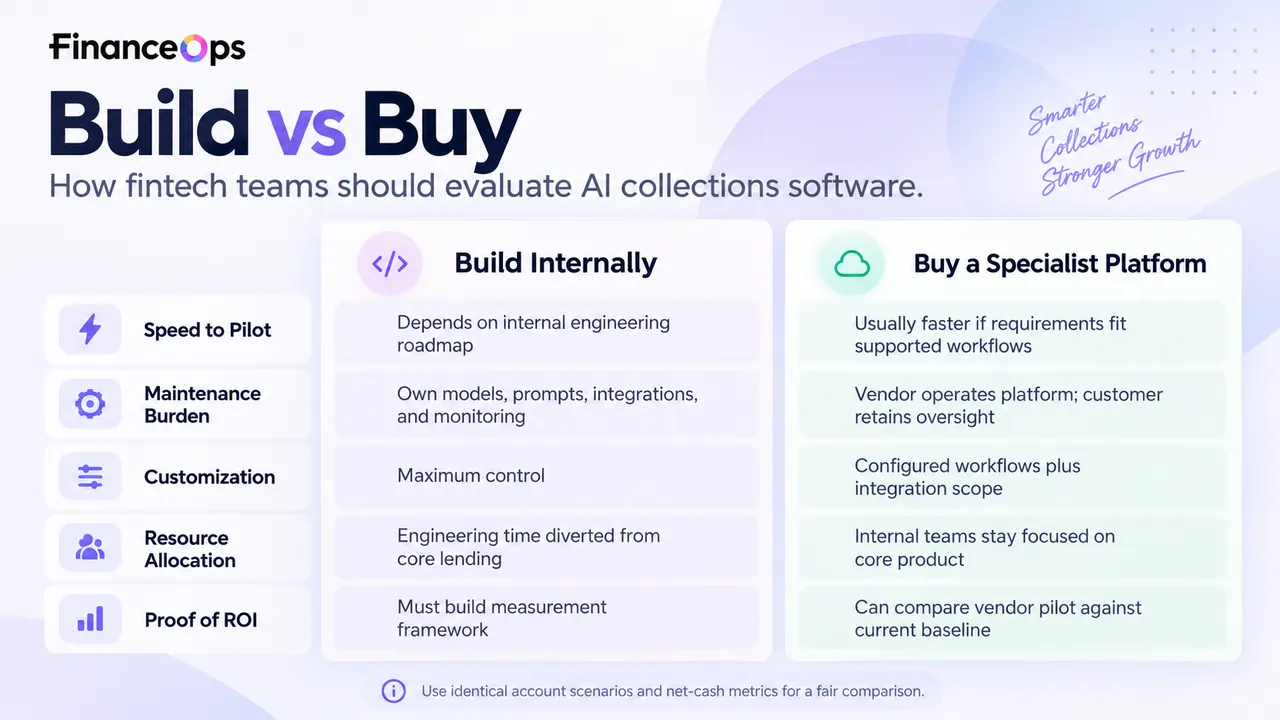
| Decision factor | Build internally | Buy a specialist platform |
|---|---|---|
| Unique lending policy and data integrations | Maximum control, but engineering ownership | Configuration plus custom integration scope |
| Time to initial pilot | Depends on existing stack and compliance review | May be faster if requirements fit supported workflows |
| Maintenance burden | Own models, prompts, monitoring, integrations and audits | Vendor operates platform; customer retains oversight obligations |
| Differentiation | Useful if recovery technology itself is strategic IP | Useful if internal resources are better spent on core lending |
| Data/control risks | Direct accountability | Contractual, security, and integration diligence required |
| Economics | Ongoing total engineering and infrastructure cost | License, success, usage, and optional service fees |
Use a build-vs-buy proof of concept, not a philosophical debate. Give both options identical account scenarios, a fixed evaluation window, and the same net-cash measurement definitions.
A 30-day fintech proof-of-value plan
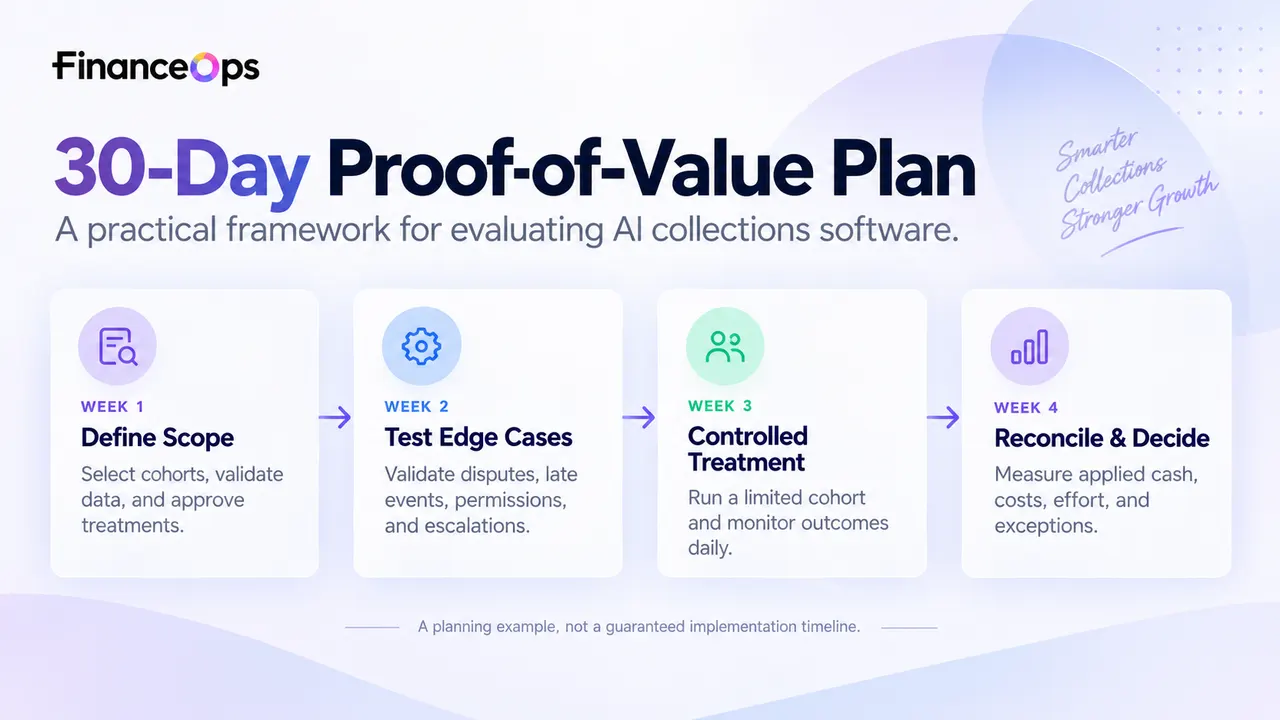
A four-week pilot is a planning example, not a guaranteed implementation timeline.
Week 1: Define scope. Select eligible loan cohorts, agree on controls, validate data fields, identify authoritative payment records, and approve permitted treatments.
Week 2: Test edge cases. Validate duplicate/late events, disputed debts, communication preferences, arrangement terms, and human escalation. Do not begin live outreach until acceptance criteria are met.
Week 3: Controlled treatment. Operate a limited eligible cohort with a comparable baseline, monitor manual interventions, observe payment outcomes, and review complaints or exceptions daily.
Week 4: Reconcile and decide. Measure applied cash net of reversals, all costs, staff effort, arrangement outcomes, time to resolve, and compliance exceptions. Document pass/fail decisions and the scope for expansion.
Vendor scorecard for procurement teams
Use a weighted scorecard and require vendors to demonstrate evidence for each rating.
| Evaluation dimension | Suggested weight |
|---|---|
| Integrations and payment-state accuracy | 20% |
| Policy controls and human oversight | 20% |
| Verified recovery and net economics | 20% |
| Borrower experience and dispute handling | 15% |
| Security, audit, and operational reliability | 15% |
| Implementation fit and commercial clarity | 10% |
A numerical vendor score is only a decision aid. A serious security, legal, or payment-accuracy failure should remain a launch blocker regardless of the weighted average.
Questions to ask in every AI collections software demo
- Show a payment that was returned after the borrower promised to pay. What happens to the next outreach?
- Show a borrower who says a charge is wrong. Which action is held, and who owns the investigation?
- Where are contact permissions checked? What happens when they change mid-conversation?
- How do your scores change after a new payment, dispute, or missing-data event?
- Which actions can AI execute without approval, and where are those permissions configured?
- How do you reconcile the payment processor, servicing system, and ledger?
- What does a failed integration look like to an operator, and how is it repaired?
- Which costs are included in the quote, and which are variable?
- How will you prove incremental net recovery against our current process?
- Can we export the decision history and relevant operational evidence?
Where FinanceOps fits the fintech stack
FinanceOps Agentic AI connects first-party collections, borrower servicing, payment follow-up, and reconciliation around the customer's approved rules and existing systems.
FinanceOps Score supports prioritization. Strategy Builder defines permitted actions. Autopilot coordinates eligible automated collections. Copilot helps human collectors handle cases that need judgment. Agentic Payments and integrations connect appropriate payment outcomes to account records, subject to deployment scope.
The best demo is not a polished chatbot conversation. It is one overdue loan followed all the way to an applied payment or properly escalated exception, with every material account change visible.
Buy the outcome, not the AI label
An AI collections platform should do more than send better reminders. It must use current account context, operate within approved boundaries, help borrowers resolve genuine issues, and confirm that promised payments actually become applied cash.
For fintech CFOs, the purchase decision is ultimately about incremental net recovery, operating leverage, governance, and borrower treatment. For COOs and risk leaders, it is about whether the workflows can be trusted at portfolio scale.