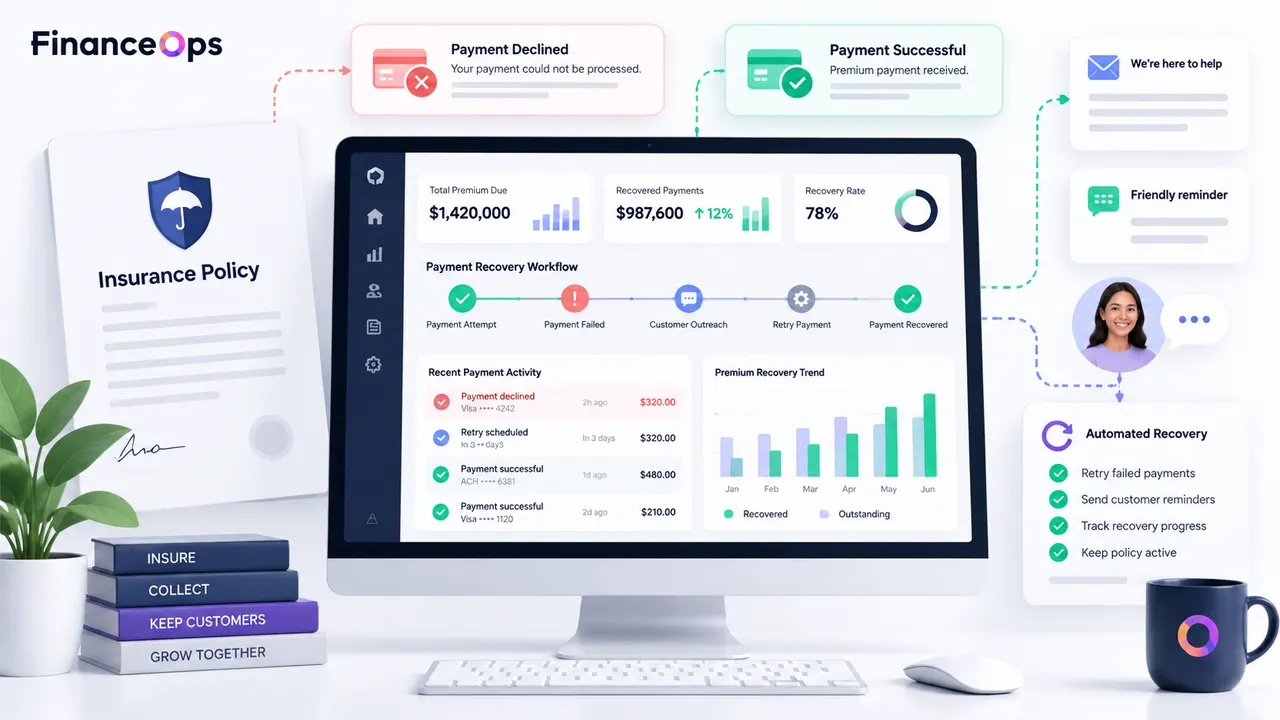
Insurance premium receivables do not become operationally complex only when a customer misses a payment. They become complex when the billing ledger, processor, policy administration system, customer service team, and finance records disagree on what is owed, what has been paid, and what action is permitted next.
For U.S. insurance CFOs and premium billing leaders, the 2027 priority is not sending more reminders. It is creating a reliable path from premium due to settled, applied cash and an accurate policy record.
Insurance receivables management is the coordinated process of billing premiums, tracking payment events, resolving exceptions, applying cash, maintaining policy-status accuracy, and documenting the result. It becomes a revenue operations problem when those responsibilities are split among systems and teams without a shared account-level workflow.
This article covers insurer premium billing and policyholder receivables, not claims adjudication, medical-provider collections, or third-party debt purchasing.
What U.S. regulatory guidance tells us
The stakes go beyond accounts receivable aging. Under HealthCare.gov's federal Marketplace guidance, the premium payment grace period is usually three months for enrollees who both use advance premium tax credits for a Marketplace plan and have paid at least one full month's premium during the benefit year. During that period, they must pay all owed premiums to avoid losing coverage. The period begins with the first unpaid month, even if later monthly premiums are paid. If the balance remains unpaid, coverage may be terminated retroactively, dating back to the first month of nonpayment under the applicable rule.
This is a specific Marketplace health insurance rule, not a universal 90-day grace period. Other Marketplace enrollees and property, casualty, life, and other insurance products may follow different state, contractual, and product-specific requirements. Carriers must verify the applicable rule and authoritative policy status before determining notices, cancellation, or reinstatement.
Likewise, the National Association of Insurance Commissioners' state insurance department directory underscores the role of state-level oversight. Notice, nonpayment, cancellation, and reinstatement rules depend on insurance line, jurisdiction, policy terms, and applicable legal requirements.
Operational implication: A payment collection engine should never treat “card declined,” “premium overdue,” “cancellation notice sent,” and “policy canceled” as the same status. They require separate records, permissions, and escalation controls.
The five handoffs creating insurance receivables friction
| Handoff | Typical exception | Business consequence |
|---|---|---|
| Policy administration → premium billing | Endorsement or renewal changes a premium but invoice data lags | Disputed balances and unnecessary outreach |
| Billing → payment processor | Payment credentials expire or debit returns | Unresolved premium and repeat processing work |
| Processor → cash application | Payment clears but references the wrong policy or installment | Unapplied cash and overstated past-due balances |
| Billing → customer service | Service representative cannot see the latest payment event | Contradictory answers and avoidable repeat contacts |
| Collections → policy servicing | An account is escalated without accurate grace-period or cancellation status | Customer harm and compliance exposure |
These are operational scenarios, not published industry incidence statistics. The point is that a workflow can fail even when each individual system works as designed.
For a detailed explanation of handling the payment-failure event itself, see How AI Agents Improve Insurance Payment Recovery Workflows. This article concentrates on the broader financial operating model rather than repeating that guide.
What insurance CFOs should measure instead of reminder volume
A useful insurance premium receivables dashboard should separate payment activity, financial outcomes, and policyholder consequences.
| Metric | Suggested definition | Why it matters |
|---|---|---|
| Premium receivables aging | Open premium amount by due-date bucket and product line | Reveals unresolved exposure |
| Settled recovery rate | Cleared, unreversed recovered premium / eligible outstanding premium | Measures cash, not promises |
| Unapplied cash rate | Cleared premium cash not allocated to the correct policy / cleared premium cash | Exposes reconciliation failures |
| Payment exception resolution time | Median hours or days from event to verified closure | Shows operational delay |
| Cost per resolved exception | Incremental servicing, payment, and operations costs / verified resolved exceptions | Exposes true servicing economics |
| Policy-status discrepancy rate | Sampled accounts with inconsistent billing and authoritative policy status / sampled accounts | Flags customer and regulatory risk |
| Repeat-contact rate | Accounts with redundant follow-ups after resolution / resolved accounts | Measures avoidable customer friction |
Accounting caveat: A delayed premium, written premium, earned premium, recognized revenue, and collected cash are different measures. Finance and actuarial teams should apply the insurer's accounting policies; recovery systems should not label every received premium as incremental revenue.
A simple scenario: why cash application matters
Suppose an insurer receives $1 million in premium receipts in a reporting period, but $40,000 remains temporarily unapplied because payment references cannot be matched to policies. The unapplied cash rate is 4%. If a new workflow correctly applies $30,000 of that existing cash, it has improved reconciliation and reduced unresolved exceptions: but it has not created $30,000 of new cash receipts.
By contrast, a successful collection of a previously unpaid, eligible premium may improve cash receipts. The finance team must distinguish those two gains when reporting ROI.
A 2027 operating framework: Detect, verify, resolve, reconcile
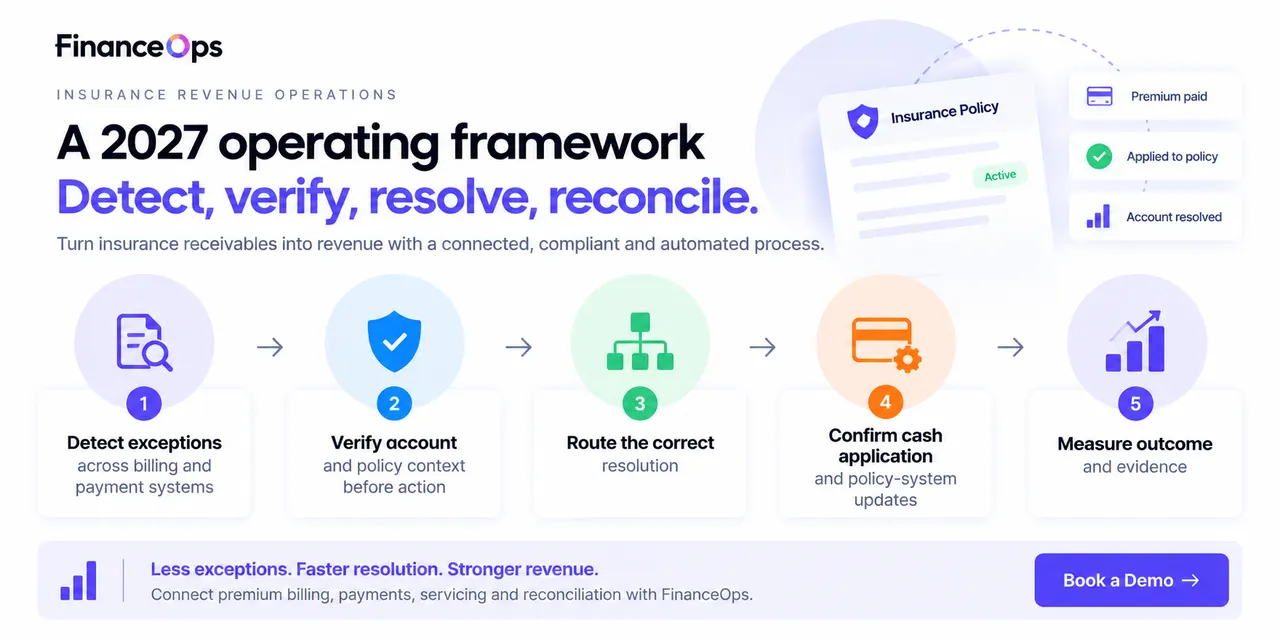
1. Detect exceptions across billing and payment systems
Capture premium due dates, changes from endorsements, payment method failures, ACH return information, reversals, settlement status, and unidentified deposits. Use authoritative records for each event.
2. Verify account and policy context before action
Check the correct policy, current balance, legal and contractual notice requirements, consent, and whether the account is already pending a payment or servicing review. Do not automate a cancellation or reinstatement decision from a transaction status.
3. Route the correct resolution
A card update, disputed premium, hardship request, mismatched payment, and cancellation inquiry are different queues. Offer only carrier-approved options, and escalate coverage, dispute, reinstatement, and nonstandard cases to authorized staff.
4. Confirm cash application and policy-system updates
Do not close an exception merely because a customer accepted a payment link. Verify settlement, application to the correct policy or invoice, downstream status synchronization, and later returns or reversals.
5. Measure outcome and evidence
Create an account-level record of the event, applied business rule, communication, approval, payment result, servicing outcome, and exception closure. Finance should be able to reconstruct a sample account without joining five manual spreadsheets.
Where FinanceOps Agentic AI fits
FinanceOps can support the receivables and resolution orchestration layer while the insurer retains policy administration, regulatory interpretation, and authorization for coverage decisions.
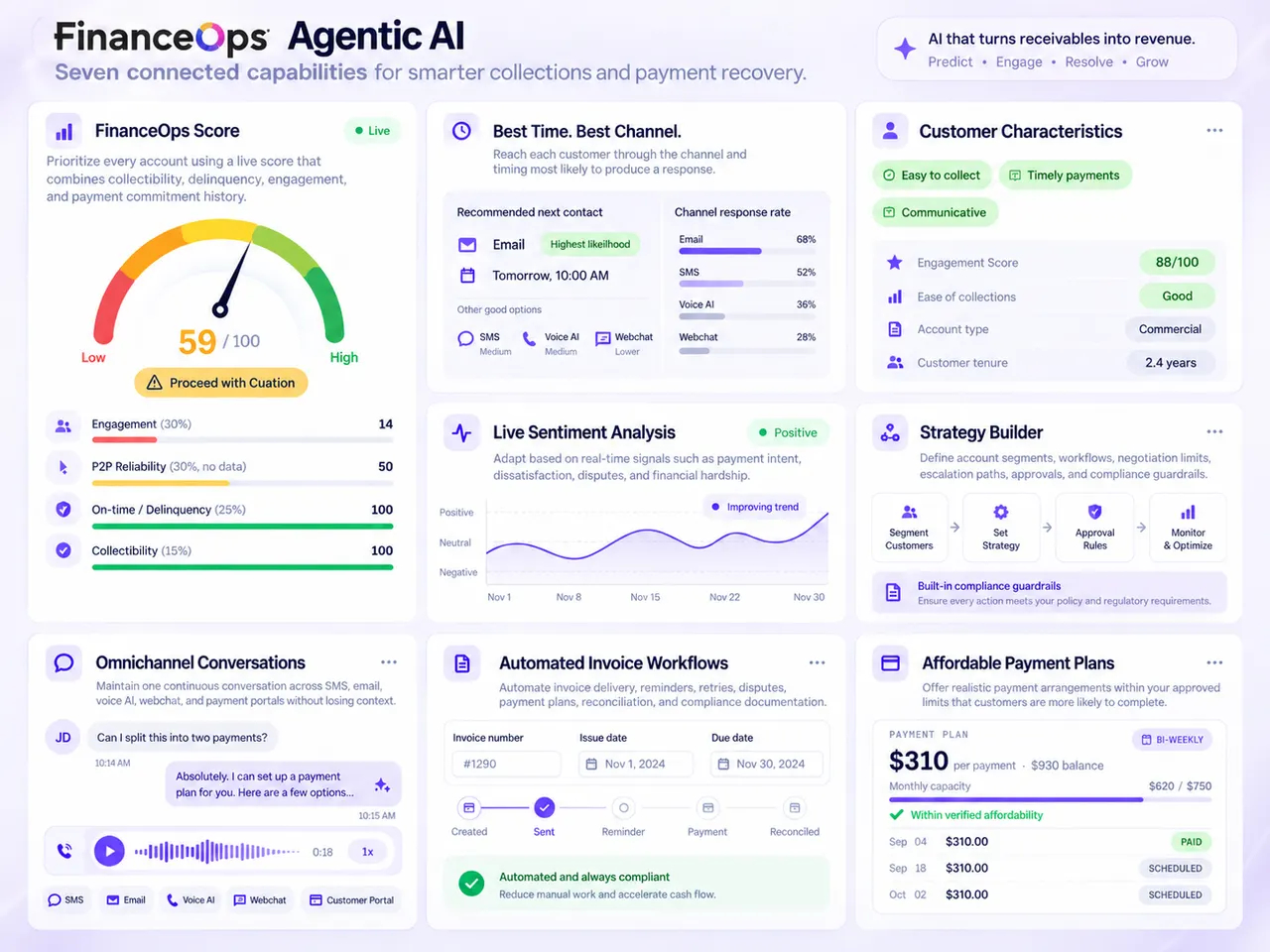
- Agentic Payments helps connect payment events, approved recovery action, and reconciliation visibility.
- Autopilot supports governed, routine follow-up and account prioritization where applicable.
- Strategy Builder allows an insurer to define approved segmentation, contact, escalation, and workflow rules.
- Copilot assists human representatives when billing disputes, sensitive questions, and complex interactions require staff judgment.
- FinanceOps Products provides the broader platform overview.
A realistic insurance integration should begin with data mapping, exception ownership, permitted actions, and human approval points: not a promise that a generic AI agent can independently decide insurance coverage.
To connect payment recovery with broader financial reporting, explore FinanceOps Dashboards. For more detail on cross-industry architecture, read Agentic Payments: How AI Makes Payment Recovery Proactive and Why Failed Payments Are Becoming a CFO-Level Revenue Problem.
A practical 60-day insurance receivables pilot
Days 1 to 15: Baseline: Select a single product line and a bounded cohort of premium billing exceptions. Map payment events, settlement files, policy IDs, open balances, and current handoffs. Agree on exclusions and legally required intervention points.
Days 16 to 30: Controlled workflow: Enable approved payment-method-update and billing-support paths; keep cancellations, reinstatements, disputes, and exceptions requiring discretion with trained staff.
Days 31 to 45: Verification: Compare settled recovery, unapplied cash, exception closure time, repeat contacts, and complaints with a suitable baseline or comparison group. Confirm that recovered amounts remain settled and applied.
Days 46 to 60: Decision: Calculate incremental net cash effects separately from cash acceleration and reduced operating costs. Expand only after financial, servicing, information-security, and legal owners approve.
Avoid judging success by messages sent, chatbot responses, or payment promises. A verified resolved account is the outcome.
Executive checklist for insurers
Before investing in a receivables platform, ask: Can it distinguish payment status from policy status? Can it access authoritative balances and return codes? Can it prevent duplicate outreach after settlement? Can it route regulated decisions to staff? Can finance trace cash to the correct policy? Can compliance review the exact rule and audit trail? Can the pilot show incremental outcomes without counting cash application as recovered cash?
The strongest insurance receivables strategy is not the one that automates the most interactions. It is the one that eliminates avoidable handoffs while preserving accuracy, control, and policyholder trust.