AI for Utilities: How Agentic AI Is Redefining Collections and Revenue Recovery
Utilities are facing a new reality in customer payments. Rising affordability challenges, increasing operational complexity, and changing customer expectations are making traditional collections workflows less effective.
The future of utility collections software will not be defined by sending more reminders. It will be defined by intelligent systems that understand customer behavior, make better decisions, and help utilities recover revenue while maintaining customer trust.
Key Takeaways
- Utility collections are becoming more complex because customer payment behavior is influenced by affordability, billing challenges, seasonal usage, and changing economic conditions.
- Agentic AI enables utilities to move beyond rules-based automation by combining customer intelligence, workflow execution, and human-controlled governance.
- FinanceOps Agentic AI helps utilities improve revenue recovery through intelligent account prioritization, personalized engagement, flexible payment strategies, omnichannel communication, and automated financial workflows.
Why Utility Collections Need a New Operating Model
The utility industry operates differently from many other industries.
Utilities provide essential services while managing millions of customer relationships, complex billing environments, regulatory requirements, and changing financial conditions. Every customer account represents a different situation influenced by usage patterns, payment history, household circumstances, and financial ability.
Historically, utility collections were designed around consistency and scale. Bills were generated, payment reminders were issued, overdue accounts moved through collection stages, and escalation processes were triggered.
This approach helped utilities manage large volumes of accounts. However, it was designed around predefined workflows rather than customer context. That distinction matters today.
A customer who misses a payment because of temporary financial pressure requires a different approach from a customer who disputes a bill or a customer who repeatedly ignores payment commitments.
Treating every account the same creates unnecessary friction for customers and inefficient recovery processes for utilities.
Recent industry research highlights this challenge. McKinsey notes that utilities are exploring Agentic AI to transform customer operations, including billing, payments, and collections, as they face rising operational complexity, customer expectations, and pressure to improve efficiency.
The challenge utilities face is no longer simply collecting overdue balances. The challenge is understanding why customers fall behind and determining the right action for each situation.
The Challenge Is Not Data. It Is Decision Making
After building payment infrastructure and financial operations systems, one pattern has become clear across regulated industries: organizations rarely lack data. They already have years of billing information, payment history, customer interactions, and account activity.
The real challenge is turning that information into timely and intelligent decisions. Utilities already know:
- What customers owe and the current status of their outstanding balances.
- When payments were missed and how accounts have progressed through collection stages.
- Historical communication patterns and previous customer engagement activity.
However, many traditional systems still struggle to answer the questions that matter most:
- Which customers require attention first?
- What communication approach is most likely to create engagement?
- Is the customer experiencing financial difficulty or another issue affecting payment?
- What payment option is realistic based on the customer’s situation?
- When should a human employee become involved for additional support or judgment?
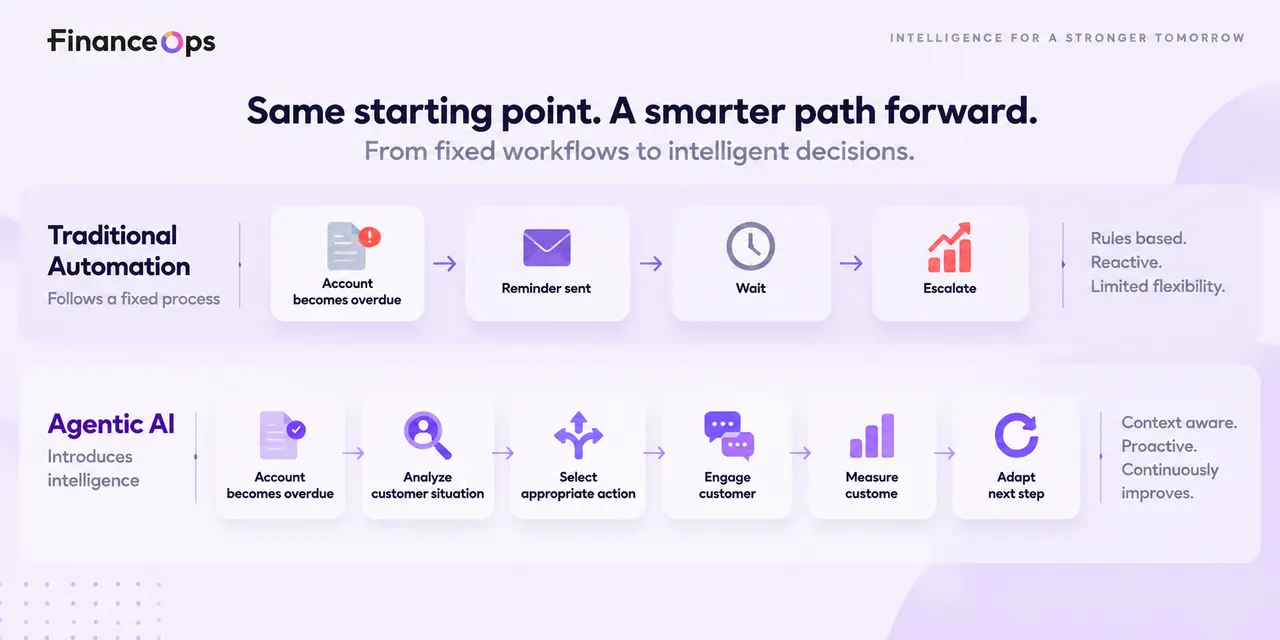
Traditional automation can execute predefined workflows, but it cannot always understand the context behind each customer situation.
The next generation of financial operations requires systems that can interpret context, make intelligent decisions, and take the right action at the right time. This is where Agentic AI changes the operating model.
What Is Agentic AI for Utilities?
Agentic AI for utilities is an AI-powered system that can analyze customer and account information, make decisions within utility-defined policies, execute workflows, communicate with customers, and adapt actions based on outcomes.
Unlike traditional automation, which follows predefined instructions, Agentic AI evaluates context before determining the next best action.

The difference is decision-making. Agentic AI does not replace utility policies or operational teams.
Instead, it works within defined boundaries while reducing repetitive execution and allowing employees to focus on situations where human judgment creates the most value.
From Automation to Intelligent Revenue Recovery
The transition toward Agentic AI is not about replacing existing utility systems. Most utilities already have billing platforms, customer information systems, payment infrastructure, and operational processes in place. The missing layer is intelligence that can transform existing data into better decisions.
Traditional systems are designed to answer a simple question: “What process should happen next?”
Agentic AI approaches the problem differently by asking: “What action is most likely to create the best outcome?”
This difference is critical because collections are not only a process problem. It is a decision problem. The future of revenue recovery requires systems that can understand context, evaluate customer situations, and take intelligent actions while operating within utility-defined policies.
How FinanceOps Agentic AI Helps Utilities Transform Collections

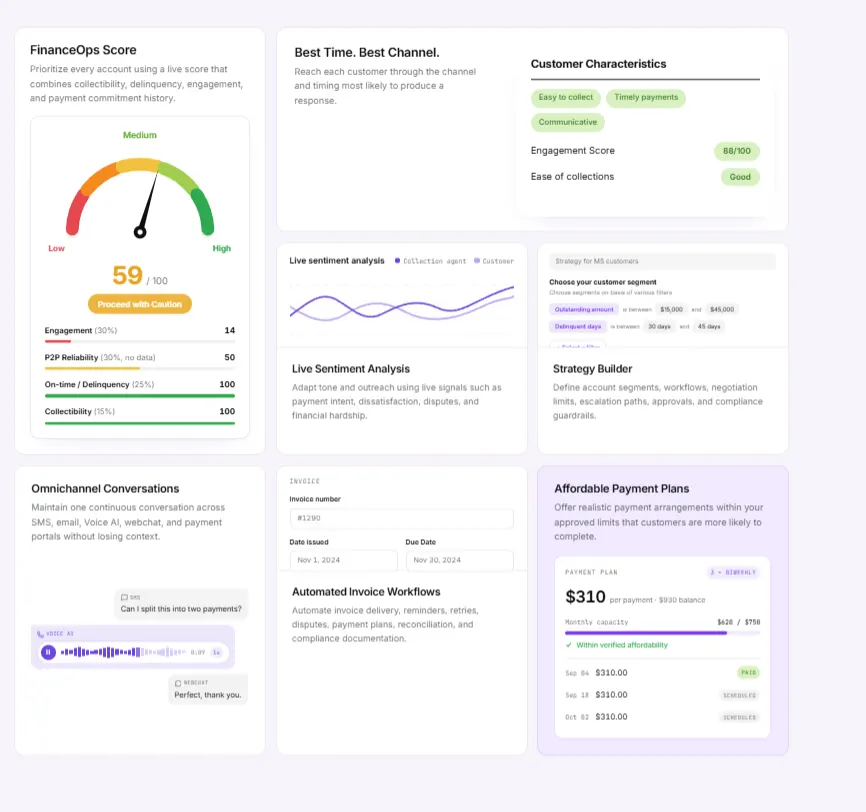
FinanceOps Score
One of the biggest challenges in utility collections is that overdue accounts are often evaluated using limited information such as outstanding balance or days past due.
While these indicators provide visibility, they do not explain the likelihood of resolution or the reason behind a missed payment.
Two customers with the same overdue balance can require completely different approaches. One customer may need a flexible payment arrangement, while another may need help understanding a billing issue.
FinanceOps Score creates a more intelligent understanding of each account by analyzing payment behavior, engagement patterns, account history, and customer interactions.
This allows utilities to move away from treating every overdue account the same way and instead focus attention where intervention is most likely to create a successful resolution.
The future of collections is not simply prioritizing accounts by balance size. It is prioritizing accounts based on the probability of resolution.
Best Time, Channel, and Person to Contact
Customer engagement plays a critical role in successful payment recovery. However, many traditional collection processes still rely on fixed communication schedules. A message may be sent because a system says it is time to send one, rather than because it is the right moment for that specific customer.
FinanceOps Agentic AI analyzes customer engagement patterns to determine the best time to communicate, the most effective channel, and the appropriate person to engage.
This creates a more personalized experience where customers receive communication that is relevant to their situation.
Instead of measuring success by the number of reminders delivered, utilities can focus on whether conversations are leading toward resolution.
Live Sentiment Analysis
Payment conversations are rarely only about payments. Customers may be confused about a bill, experiencing financial hardship, disputing charges, or looking for assistance options.
Live Sentiment Analysis helps FinanceOps Agentic AI understand customer intent, tone, and urgency during interactions. This allows communication to adapt based on the customer’s situation instead of following a one-size-fits-all approach.
A customer experiencing temporary hardship should not receive the same experience as an account that repeatedly ignores payment commitments. Understanding context creates better outcomes for both utilities and customers.
Two-Way Omnichannel Communication
Customers do not think in channels. They think in conversations. A customer may receive an SMS reminder, ask a billing question online, continue through voice, and complete a payment digitally.
Many traditional systems lose context when customers move between communication channels. FinanceOps Agentic AI maintains continuity across SMS, email, voice, and digital communication channels, allowing customers to continue conversations without repeatedly explaining their situation.
This transforms collections from disconnected interactions into a continuous customer engagement process.
Affordability-Based Flexible Payment Plans
A payment arrangement is only successful when customers can realistically complete it. Traditional collections systems often rely on predefined payment options that may not reflect individual customer circumstances.
FinanceOps Agentic AI evaluates affordability signals, customer behavior, and account context to support flexible payment strategies within utility-defined policies. This helps utilities create more realistic payment commitments while supporting customers who need additional flexibility.
The objective is not creating more promises to pay. The objective is increasing successful payment outcomes.
User-Controlled Strategy Builder
Utilities operate in highly regulated environments where governance and control are essential. AI systems cannot operate as uncontrolled decision engines.
FinanceOps User-Controlled Strategy Builder allows utility teams to define communication strategies, payment rules, escalation paths, and exception handling workflows.
The AI executes within those boundaries. The utility remains responsible for policy decisions and accountability. This creates a governed AI operating model where utilities gain automation without losing control.
Automated Invoice Lifecycle Management
Revenue recovery does not begin when an account becomes overdue. It begins throughout the entire invoice lifecycle.
Billing accuracy, invoice delivery, customer communication, payment processing, disputes, and reconciliation all influence financial outcomes.
FinanceOps Automated Invoice Lifecycle Management connects these processes into a continuous workflow. By connecting invoice operations with customer engagement and payment workflows, utilities gain a more complete view of the revenue cycle.
Improve Utility Revenue Recovery With FinanceOps Autopilot
Utilities need more than automated reminders. They need an intelligent platform that understands customer behavior, automates approved workflows, and helps teams make better decisions.
FinanceOps Autopilot enables utilities to automate customer engagement, payment workflows, and collections execution while maintaining control through configurable strategies.
Why Utilities Need Industry-Specific AI
Generic AI can generate responses. But regulated industries require more than responses. Utilities need AI that understands billing workflows, customer assistance programs, payment behavior, regulatory expectations, and revenue recovery processes.
Industry-specific AI creates operational intelligence around real business challenges. The future is not generic automation applied everywhere. The future is AI designed around industry realities.
How Utility Leaders Should Evaluate Agentic AI Platforms
Before implementing Agentic AI, utility leaders should evaluate whether the platform can operate within their environment.
The first question is whether the platform understands utility workflows. A successful solution must support billing complexity, customer engagement requirements, payment operations, and compliance expectations.
The second question is whether utilities maintain control. AI should provide transparency, configurable strategies, escalation capabilities, and auditability.
The third question is whether AI improves customer experience. The strongest AI systems help utilities communicate earlier, understand customers better, and create realistic paths toward resolution. Revenue recovery and customer experience should improve together.
How FinanceOps Helps Utilities Modernize Revenue Recovery
FinanceOps Agentic AI provides utilities with an intelligent operating layer for customer engagement, payments, and collections.
The platform combines customer intelligence, AI-powered communication, payment decisioning, workflow automation, and human oversight.
Utilities can automate repetitive execution while allowing their teams to focus on complex customer situations requiring judgment.
The next generation of utility collections software will not be defined by more aggressive recovery methods. It will be defined by smarter decisions.
Utilities are entering a new era of financial operations. Traditional automation helped utilities organize collection processes. Agentic AI helps utilities understand customers, make intelligent decisions, and execute workflows with greater precision.
The future is not AI replacing utility teams. The future is AI working alongside utility teams to improve cash flow, operational efficiency, and customer relationships. For utility leaders, the question is no longer whether automation matters. The question is whether their automation understands the customer behind every account.